

|
시장보고서
상품코드
2146277
위성 시장 예측(-2032년) : 질량, 용도, 서브시스템, 주파수, 추진, 지역별Satellites Market by Mass (1-1,200, 1,201-2,000, >2,000 kg), Application (Communication, Earth Observation, Navigation), Subsystem (Satellite Buses, Solar Panels, Payloads, Satellite Antennas), Frequency, Propulsion, and Region - Global Forecast To 2032 |
||||||

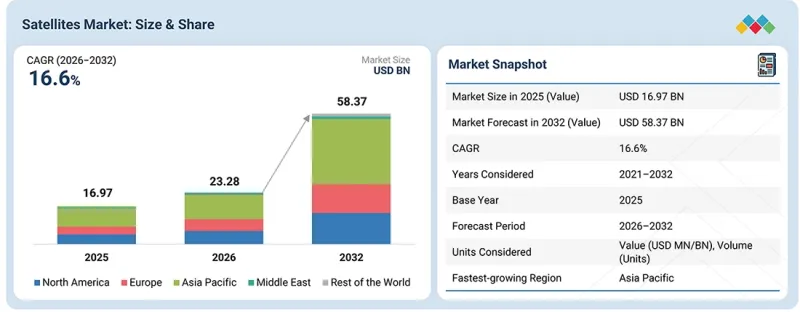
위성 시장은 2026년 232억 8,000만 달러에서 2032년까지 583억 7,000만 달러로, CAGR 16.6%로 확대할 것으로 예측됩니다.
수량 기준으로는 시장이 2026년 4,383기에서 2032년까지 7,748기로 증가할 것으로 예상됩니다. 통신사업자들이 새로운 발사, 위성 군집 확대 및 구형 위성 교체를 통해 용량을 지속적으로 증강함에 따라 위성 시장은 성장하고 있습니다.
| 조사 범위 | |
|---|---|
| 조사 대상 기간 | 2021-2032년 |
| 기준 연도 | 2025 |
| 예측 기간 | 2026-2032년 |
| 산정 단위 | 금액(10억 달러) |
| 부문 | 품질, 용도, 하위 시스템, 지역별 |
| 대상 지역 | 북미, 유럽, 아시아태평양(APAC), 기타 지역(RoW) |
통신, 지구 관측, 항법 분야의 수요가 증가하고 있으며, 이것이 위성 수의 증가를 지원하고 있습니다. 한편, 더 많은 민간 기업과 지역 우주 프로그램이 시장에 진입하고 있으며, 전반적인 성장에 기여하고 있습니다.
"Ka 대역은 예측 기간 중 가장 빠르게 성장할 주파수 대역이 될 것으로 예상됩니다."
주파수별로 보면 Ka 대역 부문은 주로 대용량 위성 광대역, 데이터 서비스 및 모바일 연결에 대한 수요 증가에 힘입어 예측 기간 중 가장 높은 성장률을 보일 것으로 예상됩니다. Ka 대역은 더 빠른 데이터 전송 속도로 작동하고 더 넓은 대역폭을 제공하므로 광대역 인터넷,항공, 해상, 기업, 정부 통신 등의 용도에 최적입니다. 고처리량 위성 및 LEO(저궤도)와 MEO(중궤도) 통신 콘스텔레이션의 도입 확대가 Ka 대역 시스템의 채택을 더욱 촉진하고 있습니다.
"예측 기간 중 전기 추진 기술 부문은 추진 기술 부문 중 두 번째로 큰 규모를 차지할 것으로 예상됩니다."
추진 기술별로 보면 전기 추진 부문은 예측 기간 중 두 번째로 큰 시장 점유율을 차지할 것으로 추정됩니다. 이는 전기 추진이 경량이며 고효율이기 때문에 더 많은 위성이 위치 유지, 궤도 상승 및 콘스텔레이션 임무에 전기 추진을 채택하고 있기 때문입니다. 전기 추진 시스템을 통해 사업자는 1회 발사당 더 많은 페이로드를 탑재할 수 있으며, 전체 발사 비용을 절감할 수 있습니다. 또한 위성의 수명을 연장하고 추진제 소비량도 줄일 수 있으므로 많은 상업 사업자들이 전기 추진으로 전환하고 있습니다.
"예측 기간 중 유럽은 시장 점유율에서 2위를 차지할 것으로 예상됩니다."
유럽은 예측 기간 중 위성 시장에서 두 번째로 큰 점유율을 차지할 것으로 예상됩니다. 이는 주로 해당 지역 전체에서 통신, 지구 관측, 항법, 국방 위성 프로그램에 대한 투자가 지속되고 있기 때문입니다. 또한 유럽 국가들은 안전한 위성통신, 기후 모니터링, 우주 기반 감시에 대한 지출도 늘리고 있습니다. 주요 위성 제조사와 우주 기관의 존재, 그리고 갈릴레오, 코페르니쿠스, IRIS2 등 진행 중인 프로그램들이 시장 성장을 지원할 것으로 예상됩니다.
위성 시장의 주요 참여자 프로필은 다음과 같습니다. :
- 기업 유형별: Tier 1-30%, Tier 2-45%, Tier 3-25%
- 직책별: 이사 - 20%, 관리자 - 10%, 기타 - 70%
- 지역별: 북미-40%, 유럽-20%, 아시아태평양-20%, 중동-10%, 기타 지역-10%
조사 범위:
본 시장 조사는 다양한 부문 및 하위 부문에 걸친 위성 시장을 대상으로 합니다. 본 조사는 각 지역별 시장 규모와 성장 잠재력을 추정하는 것을 목적으로 합니다. 또한 주요 기업에 대한 상세한 경쟁 분석, 각 기업의 프로필, 제품 및 사업 내용에 대한 주요 관찰 사항, 최근 동향, 그리고 각 기업이 채택하고 있는 주요 전략에 대해서도 제공합니다.
이 보고서를 구매해야 하는 이유:
이 보고서는 위성 시장 전체 매출의 추정치를 제공함으로써 시장을 선도하는 기업과 신규 진입 기업을 지원합니다. 또한 이해관계자가 경쟁 구도를 이해하고, 자사의 비즈니스를 더 나은 위치로 이끌며, 효과적인 시장 진입 전략을 수립하기 위한 인사이트를 얻는 데 도움이 됩니다. 더불어 이 보고서는 주요 촉진요인, 제약, 과제, 기회 등 시장 동향에 대한 인사이트를 제공합니다.
이 보고서는 다음 사항에 대한 인사이트를 제공합니다. :
- 시장 촉진요인(LEO 콘스텔레이션의 급속한 전개, 지구 관측 데이터에 대한 수요 증가, 발사 및 위성 제조 비용의 감소), 제약 요인(주파수 대역 할당 및 규제 당국의 승인, 우주용 인증 부품의 공급 부족),기회(데이터-어-서비스(DaaS) 비즈니스 모델, 소프트웨어 정의형 및 재구성 가능한 위성, 궤도상 서비스 및 수명 종료시 솔루션), 과제(궤도 상의 혼잡 및 충돌 위험, 위성군(Constellation)의 장기적 경제성).
- 시장 침투도: 위성 시장의 주요 기업이 제공하는 위성에 관한 포괄적인 정보
- 제품 개발/혁신: 위성 시장의 향후 기술, 연구개발 활동 및 제품 출시에 대한 상세 인사이트
- 시장 개발: 다양한 지역의 수익성 높은 시장에 대한 포괄적인 정보
- 시장 다각화: 위성 시장의 신제품, 미개발 지역, 최근 동향 및 투자에 관한 포괄적인 정보
- 경쟁 분석: 위성 시장 주요 기업의 시장 점유율, 성장 전략, 제품 및 생산 능력에 대한 상세한 평가
자주 묻는 질문
목차
제1장 서론
제2장 요약
제3장 주요 인사이트
- 위성 시장에서 사업자에게 매력적인 비즈니스 기회
- 위성 시장(위성 질량별)
- 용도별 위성 시장
- 추진 기술별 위성 시장
제4장 시장 개요
- 시장 역학
- 촉진요인
- 억제요인
- 기회
- 과제
- 미충족 수요와 미개발 분야
- 통합 우주 교통 관리 및 충돌 회피
- 중저가 위성을 위한 경제적인 수명 주기 관리
- 지상 부문 통합 및 데이터 접근성 관련 과제
- 규제 및 지속가능성 관련 규정 준수 지원
- 상호 연계된 시장 및 부문 간 기회
- 지상 디지털 인프라와의 통합
- 정부 및 공공 부문의 디지털화
- 에너지 및 천연자원 모니터링
- 금융 서비스 및 보험 분야에서의 활용
- 모빌리티 및 교통 생태계
- Tier 1/2/3 주요 기업의 전략적 움직임
- 데이터 양
제5장 업계 동향
- 생태계 분석
- 주요 계약업체 및 통합형 위성 공급업체
- 위성 플랫폼 및 서브시스템 제조사
- 최종사용자
- 밸류체인 분석
- 가격 분석
- 지역별 평균 판매 가격 동향, 2021-2025년
- 위성 질량별 추정 가격 분석, 2025년
- 무역 데이터
- 수입 시나리오(HS 코드 880260)
- 수출 시나리오(HS 코드 880260)
- 사례 연구
- VIASAT(미국)은 광대역 사용이 많은 용도를 위해 설계된 대용량 정지궤도 통신 위성을 운영하고 있습니다
- MAXAR TECHNOLOGIES(미국)는 빈번한 재방문 주기로 상세한 이미지를 촬영할 수 있는 고해상도 지구 관측 위성군을 운영하고 있습니다
- 미국 우주군이 배치한 GPS 항법 위성 군은 전 세계에 지속적인 커버리지를 제공하고 있습니다
- AST 스페이스 모바일은 기기에 직접 연결되는 광대역 통신을 확대하기 위해 차세대 블루버드 위성을 배치했습니다
- 2026-2027년 주요 회의 및 행사
- 투자 및 자금 조달 시나리오
- 고객의 비즈니스에 영향을 미치는 동향과 파괴적 변화
- 거시경제 전망
- GDP 동향 및 전망
- 세계 우주 산업의 동향
- 총 소유 비용
- 부품 리스트
제6장 기술의 진보, AI의 영향, 특허, 혁신 및 향후 응용
- 주요 신규 기술
- 첨단 추진 시스템
- 자율 운용 및 기내 의사결정
- 우주 상황 인식(SSA) 및 위협 감시용 페이로드
- 보완 기술
- 지휘통제시스템
- 지상 부문의 가상화 및 클라우드 기반 운용
- 기술 로드맵
- 신규 기술 동향
- 특허 분석
- 향후 응용
- AI/생성형 AI가 위성 시장에 미치는 영향
- 주요 활용 사례 및 시장 잠재력
- 위성 시장의 베스트 프랙티스
- 위성 시장에서의 AI 도입 사례 연구
- 상호 연계되는 인접 생태계와 시장 참여자에 미치는 영향
- 위성 시장용 생성형 AI 도입에 대한 고객의 준비 현황
- 성공 사례 및 실제 적용 사례
- 스페이스X - AI와 궤도상 컴퓨팅을 활용한 위성 기능 향상
- 스타클라우드 - 궤도상에서 직접 AI 컴퓨팅 실증
- 사테로직 - 실시간 지구 관측을 위한 위성 AI 통합
제7장 고객 동향과 구매 행동
- 의사결정 과정
- 구매와 관련된 이해관계자 및 구매 평가 기준
- 구매 과정에서 주요 이해관계자
- 구매 기준
- 도입 장벽과 사내 과제
제8장 지속가능성과 규제 현황
- 지역별 규제 및 규정 준수
- 규제기관, 정부 기관 및 기타 조직
- 규제 체계
- 북미
- 유럽
- 아시아태평양
- 중동
- 기타 지역
- 업계 표준
- 지속가능성 관련 활동
- 지속가능성에 미치는 영향 및 규제 정책에 대한 노력
- 인증, 표시 및 환경 기준
제9장 위성 시장: 위성 질량별
- 소형 위성(1-1200kg)
- 중형 위성(1,201-2,000kg)
- 대형 위성(2000kg 이상)
제10장 위성 시장: 궤도별
- 저궤도(LEO)(160-2,000km)
- 중궤도(MEO)(2,000-35,786 km)
- 정지 궤도(GEO)(35,786 km)
- 기타
제11장 위성 시장: 서브시스템별
- 복잡도는 낮고 기능은 뛰어난 플랫폼의 위성 버스 구성
- 위성 버스
- 페이로드
- 태양전지판
- 위성 안테나
- 기타 시스템
제12장 위성 시장: 용도별
- 위성의 다양한 용도에 채택된 페이로드 기술
- 통신
- 항법
- 지구 관측
- 기타
제13장 위성 시장: 고객 유형별
- 지역별 정부 및 민간 위성 발사 계획
- 상업
- 정부 및 민간
- 국방
제14장 위성 시장: 주파수별
- 서로 다른 주파수 대역별 위성 처리량 분류
- L대역
- S 대역
- C 대역
- X 대역
- KU 대역
- KA 대역
- Q/V/E 대역
- HF/VHF/UHF 대역
- 레이저/광파 대역
제15장 위성 시장: 추진 기술별
- 고추력 추진 시스템(100-2,000 N): 주요 활용 사례
- 화학식
- 전기
- 기타 기술
제16장 위성 시장: 지역별
- 북미
- 미국
- 캐나다
- 아시아태평양
- 중국
- 인도
- 일본
- 한국
- 호주
- 유럽
- 러시아
- 영국
- 독일
- 프랑스
- 이탈리아
- 중동
- 아랍에미리트
- 사우디아라비아
- 기타 중동
- 세계의 기타 지역(ROW)
- 라틴아메리카
- 아프리카
제17장 경쟁 현황
- 주요 참여 기업의 전략/강점
- 수익 분석(2021-2025년)
- 시장 점유율 분석(2025년)
- 기업 평가 매트릭스: 주요 기업, 2025년
- 스타 기업
- 신흥 리더
- 광범위한 업체
- 진입 기업
- 기업의 사업 전개: 주요 기업, 2025년
- 기업 평가 매트릭스: 스타트업/중소기업, 2025년
- 선도적인 기업
- 대응력이 뛰어난 기업
- 역동적인 기업
- 출발점
- 경쟁사 벤치마킹
- 기업 가치 평가와 재무 지표
- 브랜드·제품 비교
- 경쟁 시나리오
- 제품 출시
- 거래
- 기타 동향
제18장 기업 개요
- 주요 기업
- SPACEX
- LOCKHEED MARTIN CORPORATION
- AIRBUS
- NORTHROP GRUMMAN
- THALES ALENIA SPACE
- L3HARRIS TECHNOLOGIES, INC.
- MDA SPACE
- PLANET LABS PBC
- SNC
- LANTERIS SPACE SYSTEMS
- MITSUBISHI ELECTRIC CORPORATION
- RTX
- OHB SE
- BOEING
- YORK SPACE SYSTEMS
- SURREY SATELLITE TECHNOLOGY LTD.
- 기타 주요 기업
- AEROSPACELAB
- ENDUROSAT
- NANOAVIONICS
- ASTRANIS
- ICEYE
- PIXXEL
- FLEET SPACE TECHNOLOGIES PTY LTD
- AMAZON LEO
- ALEN SPACE
- SKYKRAFT PTY LTD
- ARGOTEC S.R.L.
제19장 조사 방법론
제20장 부록
KSA 26.10.19The satellites market is projected to grow from USD 23.28 billion in 2026 to USD 58.37 billion by 2032, at a CAGR of 16.6%. In terms of volume, the market is expected to rise from 4,383 units in 2026 to 7,748 units by 2032. The satellites market is expanding as operators continue adding capacity through new launches, constellation expansion, and replacing older satellites.
| Scope of the Report | |
|---|---|
| Years Considered for the Study | 2021-2032 |
| Base Year | 2025 |
| Forecast Period | 2026-2032 |
| Units Considered | Value (USD Billion) |
| Segments | By Mass, Application, Subsystem and Region |
| Regions covered | North America, Europe, APAC, RoW |
Demand is increasing in communication, Earth observation, and navigation, which supports higher satellite volumes. Meanwhile, more commercial players and regional space programs are entering the market, contributing to overall growth.
"Ka-band is expected to be the fastest-growing frequency segment during the forecast period."
By frequency, the Ka-band segment is expected to grow at the highest rate during the forecast period, mainly driven by rising demand for high-capacity satellite broadband, data services, and mobility connectivity. Ka-band operates at higher data rates and offers greater bandwidth, making it ideal for applications such as broadband internet, aviation, maritime, enterprise, and government communications. The growing deployment of high-throughput satellites, as well as LEO and MEO communication constellations, is further driving the adoption of Ka-band systems.
"Electric is expected to be the second-largest propulsion technology segment during the forecast period."
By propulsion technology, the electric segment is estimated to account for the second-largest market share during the forecast period, as more satellites use electric propulsion for station keeping, orbit raising, and constellation missions because it is lighter and more efficient. Electric systems enable operators to carry more payloads per launch and reduce overall launch costs. They also support longer satellite lifespans and require less propellant, which is why many commercial operators are shifting toward electric propulsion.
"Europe is expected to hold the second-largest market share during the forecast period."
Europe is expected to hold the second-largest share of the satellites market during the forecast period. This is mainly due to continued investment in communication, Earth observation, navigation, and defense satellite programs across the region. European countries are also increasing spending on secure satellite communications, climate monitoring, and space-based surveillance. The presence of major satellite manufacturers and space agencies, as well as ongoing programs such as Galileo, Copernicus, and IRIS2, is expected to support market growth.
The breakdown of profiles for primary participants in the satellites market is provided below:
- By Company Type: Tier 1 - 30%, Tier 2 - 45%, and Tier 3 - 25%
- By Designation: Directors - 20%, Managers - 10%, and Others - 70%
- By Region: North America - 40%, Europe - 20%, Asia Pacific - 20%, Middle East - 10%, and Rest of the World - 10%
Research Coverage:
This market study covers the satellites market across various segments and subsegments. It aims to estimate the size and growth potential of this market across different regions. The study also provides an in-depth competitive analysis of the key players, their company profiles, important observations about their products and business offerings, recent developments, and the key strategies they have adopted.
Reasons to buy this report:
The report will assist market leaders and new entrants by providing approximations of the revenue figures for the overall satellites market. It will also help stakeholders understand the competitive landscape and gain insights to better position their businesses and develop effective go-to-market strategies. Additionally, the report will provide insights into the market pulse, including key drivers, restraints, challenges, and opportunities.
The report provides insights into the following pointers:
- Market Drivers (Rapid deployment of LEO constellations, Rising demand for Earth observation data, Declining launch and satellite production costs), Restraints (Spectrum allocation and regulatory approvals, Limited availability of space-qualified components), Opportunities (Data-as-a-service business models, Software-defined and reconfigurable satellites, On-orbit servicing and end-of-life solutions), Challenges (Orbital congestion and collision risk, Long-term constellation economics).
- Market Penetration: Comprehensive information on satellites offered by the top players in the satellites market
- Product Development/Innovation: Detailed insights on upcoming technologies, R&D activities, and product launches in the satellites market
- Market Development: Comprehensive information about lucrative markets across varied regions
- Market Diversification: Exhaustive information about new products, untapped geographies, recent developments, and investments in the satellites market
- Competitive Assessment: In-depth assessment of market share, growth strategies, products, and manufacturing capabilities of leading players in the satellites market
TABLE OF CONTENTS
1 INTRODUCTION
- 1.1 STUDY OBJECTIVES
- 1.2 MARKET DEFINITION
- 1.3 STUDY SCOPE
- 1.3.1 MARKET SEGMENTATION & REGIONAL SCOPE
- 1.3.2 INCLUSIONS & EXCLUSIONS
- 1.4 YEARS CONSIDERED
- 1.5 CURRENCY CONSIDERED
- 1.6 STAKEHOLDERS
- 1.7 SUMMARY OF CHANGES
2 EXECUTIVE SUMMARY
- 2.1 KEY INSIGHTS AND MARKET HIGHLIGHTS
- 2.2 KEY MARKET PARTICIPANTS: MAPPING OF STRATEGIC DEVELOPMENTS
- 2.3 HIGH-GROWTH SEGMENTS
- 2.4 REGIONAL SNAPSHOT: MARKET SIZE, GROWTH RATE, AND FORECAST
3 PREMIUM INSIGHTS
- 3.1 ATTRACTIVE OPPORTUNITIES FOR PLAYERS IN SATELLITES MARKET
- 3.2 SATELLITES MARKET, BY SATELLITE MASS
- 3.3 SATELLITES MARKET, BY APPLICATION
- 3.4 SATELLITES MARKET, BY PROPULSION TECHNOLOGY
4 MARKET OVERVIEW
- 4.1 INTRODUCTION
- 4.2 MARKET DYNAMICS
- 4.2.1 DRIVERS
- 4.2.1.1 Rapid deployment of low Earth orbit (LEO) constellations
- 4.2.1.2 Rising demand for Earth observation (EO) data
- 4.2.1.3 Declining launch and satellite production costs
- 4.2.2 RESTRAINTS
- 4.2.2.1 Spectrum allocation and regulatory approvals
- 4.2.2.2 Limited availability of space-qualified components
- 4.2.3 OPPORTUNITIES
- 4.2.3.1 Data-as-a-service business models
- 4.2.3.2 Software-defined and reconfigurable satellites
- 4.2.3.3 On-orbit servicing and end-of-life solutions
- 4.2.4 CHALLENGES
- 4.2.4.1 Orbital congestion and collision risk
- 4.2.4.2 Long-term constellation economics
- 4.2.1 DRIVERS
- 4.3 UNMET NEEDS AND WHITE SPACES
- 4.3.1 INTEGRATED SPACE TRAFFIC MANAGEMENT AND COLLISION AVOIDANCE
- 4.3.2 AFFORDABLE LIFECYCLE MANAGEMENT FOR MID-VALUE SATELLITES
- 4.3.3 GROUND SEGMENT INTEGRATION AND DATA USABILITY GAPS
- 4.3.4 REGULATORY AND SUSTAINABILITY COMPLIANCE SUPPORT
- 4.4 INTERCONNECTED MARKET AND CROSS-SECTOR OPPORTUNITIES
- 4.4.1 INTEGRATION WITH TERRESTRIAL DIGITAL INFRASTRUCTURE
- 4.4.2 GOVERNMENT AND PUBLIC SECTOR DIGITALIZATION
- 4.4.3 ENERGY AND NATURAL RESOURCE MONITORING
- 4.4.4 FINANCIAL SERVICES AND INSURANCE APPLICATIONS
- 4.4.5 MOBILITY AND TRANSPORTATION ECOSYSTEMS
- 4.5 STRATEGIC MOVES BY TIER 1/2/3 PLAYERS
- 4.6 VOLUME DATA
5 INDUSTRY TRENDS
- 5.1 INTRODUCTION
- 5.2 ECOSYSTEM ANALYSIS
- 5.2.1 PRIME CONTRACTORS & INTEGRATED SATELLITE PROVIDERS
- 5.2.2 SATELLITE PLATFORM & SUBSYSTEM MANUFACTURERS
- 5.2.3 END USERS
- 5.3 VALUE CHAIN ANALYSIS
- 5.4 PRICING ANALYSIS
- 5.4.1 AVERAGE SELLING PRICE TREND, BY REGION, 2021-2025 (USD MILLION)
- 5.4.2 INDICATIVE PRICING ANALYSIS, BY SATELLITE MASS, 2025 (USD MILLION)
- 5.5 TRADE DATA
- 5.5.1 IMPORT SCENARIO (HS CODE 880260)
- 5.5.2 EXPORT SCENARIO (HS CODE 880260)
- 5.6 CASE STUDIES
- 5.6.1 VIASAT (US) DEPLOYED HIGH-CAPACITY GEOSTATIONARY COMMUNICATION SATELLITES DESIGNED FOR BROADBAND-INTENSIVE APPLICATIONS
- 5.6.2 MAXAR TECHNOLOGIES (US) OPERATED FLEET OF HIGH-RESOLUTION EARTH OBSERVATION SATELLITES CAPABLE OF CAPTURING DETAILED IMAGERY WITH FREQUENT REVISIT RATES
- 5.6.3 US SPACE FORCE'S GPS-DEPLOYED CONSTELLATION OF NAVIGATION SATELLITES, PROVIDING CONTINUOUS GLOBAL COVERAGE
- 5.6.4 AST SPACEMOBILE DEPLOYED NEXT-GENERATION BLUEBIRD SATELLITES TO EXPAND DIRECT-TO-DEVICE BROADBAND CONNECTIVITY
- 5.7 KEY CONFERENCES & EVENTS, 2026-2027
- 5.8 INVESTMENT AND FUNDING SCENARIO
- 5.9 TRENDS AND DISRUPTIONS IMPACTING CUSTOMER BUSINESS
- 5.10 MACROECONOMIC OUTLOOK
- 5.10.1 INTRODUCTION
- 5.10.2 GDP TRENDS AND FORECAST
- 5.10.3 TRENDS IN GLOBAL SPACE INDUSTRY
- 5.11 TOTAL COST OF OWNERSHIP
- 5.12 BILL OF MATERIALS
6 TECHNOLOGICAL ADVANCEMENTS, AI-DRIVEN IMPACT, PATENTS, INNOVATIONS, AND FUTURE APPLICATIONS
- 6.1 KEY EMERGING TECHNOLOGIES
- 6.1.1 ADVANCED PROPULSION SYSTEMS
- 6.1.2 AUTONOMOUS OPERATIONS AND ONBOARD DECISION-MAKING
- 6.1.3 SPACE SITUATIONAL AWARENESS (SSA) AND THREAT MONITORING PAYLOADS
- 6.2 COMPLEMENTARY TECHNOLOGIES
- 6.2.1 COMMAND-AND-CONTROL SYSTEMS
- 6.2.2 GROUND SEGMENT VIRTUALIZATION AND CLOUD-BASED OPERATIONS
- 6.3 TECHNOLOGY ROADMAP
- 6.4 EMERGING TECHNOLOGY TRENDS
- 6.5 PATENT ANALYSIS
- 6.6 FUTURE APPLICATIONS
- 6.7 IMPACT OF AI/ GENERATIVE AI ON SATELLITES MARKET
- 6.7.1 TOP USE CASES AND MARKET POTENTIAL
- 6.7.2 BEST PRACTICES IN SATELLITES MARKET
- 6.7.3 CASE STUDIES OF AI IMPLEMENTATION IN SATELLITES MARKET
- 6.7.4 INTERCONNECTED ADJACENT ECOSYSTEM AND IMPACT ON MARKET PLAYERS
- 6.7.5 CLIENTS' READINESS TO ADOPT GENERATIVE AI IN SATELLITES MARKET
- 6.8 SUCCESS STORIES AND REAL-WORLD APPLICATIONS
- 6.8.1 SPACEX -USING AI AND ORBITAL COMPUTING TO ADVANCE SATELLITE CAPABILITIES
- 6.8.2 STARCLOUD - DEMONSTRATING AI COMPUTING DIRECTLY IN ORBIT
- 6.8.3 SATELLOGIC - INTEGRATING AI INTO SATELLITES FOR REAL-TIME EARTH OBSERVATION
7 CUSTOMER LANDSCAPE & BUYER BEHAVIOR
- 7.1 DECISION-MAKING PROCESS
- 7.2 BUYER STAKEHOLDERS AND BUYING EVALUATION CRITERIA
- 7.2.1 KEY STAKEHOLDERS IN BUYING PROCESS
- 7.2.2 BUYING CRITERIA
- 7.3 ADOPTION BARRIERS & INTERNAL CHALLENGES
8 SUSTAINABILITY AND REGULATORY LANDSCAPE
- 8.1 REGIONAL REGULATIONS AND COMPLIANCE
- 8.1.1 REGULATORY BODIES, GOVERNMENT AGENCIES, AND OTHER ORGANIZATIONS
- 8.2 REGULATORY FRAMEWORK
- 8.2.1 NORTH AMERICA
- 8.2.2 EUROPE
- 8.2.3 ASIA PACIFIC
- 8.2.4 MIDDLE EAST
- 8.2.5 REST OF THE WORLD
- 8.3 INDUSTRY STANDARDS
- 8.4 SUSTAINABILITY INITIATIVES
- 8.5 SUSTAINABILITY IMPACT AND REGULATORY POLICY INITIATIVES
- 8.6 CERTIFICATIONS, LABELING, AND ECO-STANDARDS
9 SATELLITES MARKET, BY SATELLITE MASS
- 9.1 INTRODUCTION
- 9.2 SMALL SATELLITES (1-1200 KG)
- 9.2.1 ADVANCEMENTS IN MINIATURIZATION OF ELECTRONICS TO DRIVE MARKET
- 9.2.2 NANOSATELLITES (1-10 KG)
- 9.2.3 MICROSATELLITES (11-100 KG)
- 9.2.4 MINISATELLITES (101-1200 KG)
- 9.3 MEDIUM SATELLITES (1201-2000 KG)
- 9.3.1 NEED FOR TECHNOLOGICAL ADVANCEMENTS TO DRIVE MARKET
- 9.4 LARGE SATELLITES (ABOVE 2000 KG)
- 9.4.1 DEMAND FOR HIGH-CAPACITY TELECOMMUNICATION AND BROADBAND SERVICES TO DRIVE MARKET
10 SATELLITES MARKET, BY ORBIT
- 10.1 INTRODUCTION
- 10.2 LOW EARTH ORBIT (LEO) (160-2,000 KM)
- 10.2.1 EXPANDING DEMAND FOR LOW-LATENCY CONNECTIVITY TO DRIVE MARKET
- 10.3 MEDIUM EARTH ORBIT (MEO) (2,000-35,786 KM)
- 10.3.1 RISING DEMAND FOR HIGH-THROUGHPUT AND LOW-LATENCY CONNECTIVITY TO DRIVE MARKET
- 10.4 GEOSTATIONARY ORBIT (GEO) (35,786 KM)
- 10.4.1 RISING DEMAND FOR HIGH-CAPACITY AND WIDE-AREA CONNECTIVITY TO DRIVE SEGMENTAL GROWTH
- 10.5 OTHERS
11 SATELLITES MARKET, BY SUBSYSTEM
- 11.1 INTRODUCTION
- 11.2 SATELLITE BUS CONFIGURATION OF LOW-COMPLEXITY AND HIGH-CAPABILITY PLATFORMS
- 11.2.1 LOW-COMPLEXITY BUS CONFIGURATIONS (NON-PROPULSION, BASIC ADCS, FIXED ANTENNAS): TOP USE CASES
- 11.2.2 HIGH-CAPABILITY BUS CONFIGURATIONS (PROPULSION-EQUIPPED, HIGH-POWER, PRECISE ADCS): TOP USE CASES
- 11.3 SATELLITE BUS
- 11.3.1 FOCUS ON ENHANCING SATELLITE PERFORMANCE TO DRIVE MARKET
- 11.3.2 ATTITUDE AND ORBITAL CONTROL SYSTEMS
- 11.3.2.1 Sensors
- 11.3.2.1.1 Sun sensors
- 11.3.2.1.2 Magnetometers
- 11.3.2.2 Reaction wheels
- 11.3.2.3 Actuators
- 11.3.2.4 Control electronics
- 11.3.2.1 Sensors
- 11.3.3 COMMAND AND DATA HANDLING SYSTEMS
- 11.3.3.1 Onboard computer
- 11.3.3.2 Processor
- 11.3.3.3 Microcontroller
- 11.3.3.4 Memory
- 11.3.3.5 Solid-state recorder
- 11.3.3.6 Router
- 11.3.3.7 Onboard charger (OBC) adaptor
- 11.3.4 ELECTRICAL POWER SYSTEMS
- 11.3.4.1 Power management device
- 11.3.4.2 Power converter
- 11.3.4.3 Battery
- 11.3.4.3.1 Primary battery
- 11.3.4.3.2 Secondary battery
- 11.3.5 PROPULSION SYSTEMS
- 11.3.5.1 Thrusters
- 11.3.5.2 Propellant tank
- 11.3.5.3 Propellant feed plumbing
- 11.3.6 TELEMETRY, TRACKING, AND COMMAND SYSTEMS
- 11.3.6.1 Transmitter
- 11.3.6.2 Receiver
- 11.3.6.3 Modem/Baseband unit
- 11.3.7 STRUCTURES
- 11.3.8 THERMAL SYSTEMS
- 11.3.8.1 Temperature sensors
- 11.3.8.2 Heaters
- 11.3.8.3 Thermostats
- 11.3.8.4 Insulation
- 11.4 PAYLOADS
- 11.4.1 PAYLOADS DRIVE SATELLITES' DESIGN AND SUBSYSTEMS
- 11.4.2 TRADITIONAL PAYLOADS
- 11.4.3 SOFTWARE-DEFINED PAYLOADS
- 11.5 SOLAR PANELS
- 11.5.1 NEED FOR ENHANCED EFFICIENCY WITH PHOTOVOLTAIC CELL MATERIALS TO DRIVE MARKET
- 11.6 SATELLITE ANTENNAS
- 11.6.1 ABILITY OF SATELLITE ANTENNAS TO OPERATE IN DIFFERENT FREQUENCIES TO DRIVE DEMAND
- 11.6.2 WIRE ANTENNAS
- 11.6.2.1 Monopole antennas
- 11.6.2.2 Dipole antenna
- 11.6.3 HORN ANTENNAS
- 11.6.4 ARRAY ANTENNAS
- 11.6.5 REFLECTOR ANTENNAS
- 11.6.5.1 Parabolic reflectors
- 11.6.5.2 Double reflectors
- 11.7 OTHER SYSTEMS
12 SATELLITES MARKET, BY APPLICATION
- 12.1 INTRODUCTION
- 12.2 PAYLOAD TECHNOLOGY USED ACROSS SATELLITE APPLICATIONS
- 12.2.1 SENSING AND IMAGING PAYLOADS (OPTICAL, IR, MULTISPECTRAL, HYPERSPECTRAL, SAR, LIDAR): TOP USE CASES
- 12.2.2 COMMUNICATION PAYLOADS (RF/OPTICAL TRANSPONDERS, IOT/M2M, DATA RELAY, AIS/ADS-B): TOP USE CASES
- 12.2.3 SCIENTIFIC AND MISSION-SUPPORT PAYLOADS (ATMOSPHERIC SENSORS, GNSS-R, PARTICLE DETECTORS, TECH-DEMO PAYLOADS): TOP USE CASES
- 12.3 COMMUNICATION
- 12.3.1 GROWING DEMAND FOR GLOBAL CONNECTIVITY AND RESILIENT COMMUNICATION INFRASTRUCTURE TO DRIVE MARKET
- 12.4 NAVIGATION
- 12.4.1 DEPENDENCE OF CRITICAL INFRASTRUCTURE AND MILITARY OPERATIONS ON PRECISE PNT SERVICES TO DRIVE MARKET
- 12.5 EARTH OBSERVATION
- 12.5.1 RISING NEED FOR REAL-TIME INTELLIGENCE AND DATA-DRIVEN ENVIRONMENTAL MONITORING TO DRIVE MARKET
- 12.6 OTHERS
13 SATELLITES MARKET, BY CUSTOMER TYPE
- 13.1 INTRODUCTION
- 13.2 REGION-WISE GOVERNMENT AND PRIVATE SATELLITE LAUNCH PROGRAMS
- 13.2.1 GOVERNMENT PROGRAMS: TOP USE CASES
- 13.2.2 PRIVATE PROGRAMS: TOP USE CASES
- 13.3 COMMERCIAL
- 13.3.1 SATELLITE OPERATORS/OWNERS
- 13.3.1.1 Rapid deployment of satellite constellations to drive market
- 13.3.2 MEDIA & ENTERTAINMENT COMPANIES
- 13.3.2.1 High demand for fast broadband connectivity from streaming platforms to drive market
- 13.3.3 ENERGY SERVICE PROVIDERS
- 13.3.3.1 Integration of satellite technology to enhance energy-related operations and services to drive market
- 13.3.4 SCIENTIFIC RESEARCH & DEVELOPMENT ORGANIZATIONS
- 13.3.4.1 Untapped potential in space research to drive market
- 13.3.5 OTHERS
- 13.3.1 SATELLITE OPERATORS/OWNERS
- 13.4 GOVERNMENT & CIVIL
- 13.4.1 NATIONAL SPACE AGENCIES
- 13.4.1.1 Need for cost-effective space exploration solutions to drive market
- 13.4.2 SEARCH & RESCUE ENTITIES
- 13.4.2.1 Need for swift and accurate data in emergencies to drive market
- 13.4.3 ACADEMIC & RESEARCH INSTITUTIONS
- 13.4.3.1 Active participation in satellite development to drive market
- 13.4.4 NATIONAL MAPPING & TOPOGRAPHIC AGENCIES
- 13.4.4.1 Emphasis on improving navigation and tracking capabilities to drive market
- 13.4.1 NATIONAL SPACE AGENCIES
- 13.5 DEFENSE
- 13.5.1 RESILIENT AND MISSION-CRITICAL SPACE ARCHITECTURES TO DRIVE MARKET
14 SATELLITES MARKET, BY FREQUENCY
- 14.1 INTRODUCTION
- 14.2 SATELLITE THROUGHPUT CATEGORIES ACROSS DIFFERENT FREQUENCY BANDS
- 14.2.1 LOW THROUGHPUT SATELLITES (1 KBPS-50 MBPS): TOP USE CASES
- 14.2.2 HIGH THROUGHPUT SATELLITES (50 MBPS-100+ GBPS): TOP USE CASES
- 14.3 L-BAND
- 14.3.1 NEED FOR EFFECTIVE SATELLITE COMMUNICATION AND GPS SERVICES TO BOOST GROWTH
- 14.4 S-BAND
- 14.4.1 INCREASING SCIENTIFIC MISSIONS TO DRIVE DEMAND FOR S-BAND SATELLITES
- 14.5 C-BAND
- 14.5.1 ESCALATING DEMAND FOR STEADY COMMUNICATIONS SERVICES FROM DEVELOPING REGIONS TO DRIVE MARKET
- 14.6 X-BAND
- 14.6.1 RISING GEOPOLITICAL TENSIONS TO DRIVE MARKET
- 14.7 KU-BAND
- 14.7.1 GROWING INTERNET PENETRATION IN SATELLITES TO DRIVE MARKET
- 14.8 KA-BAND
- 14.8.1 NEED FOR BACKHAUL SOLUTIONS WITH EXPANSION OF 5G TO DRIVE MARKET
- 14.9 Q/V/E-BAND
- 14.9.1 ELEVATED DEMAND FOR ULTRA-HIGH-SPEED DATA SERVICES TO DRIVE MARKET
- 14.10 HF/VHF/UHF-BAND
- 14.10.1 NEED FOR WIDE-RANGE COVERAGE TO DRIVE MARKET
- 14.11 LASER/OPTICAL BAND
- 14.11.1 DEVELOPMENT OF LASER COMMUNICATION TECHNOLOGY BY PROMINENT COMPANIES TO DRIVE MARKET
15 SATELLITES MARKET, BY PROPULSION TECHNOLOGY
- 15.1 INTRODUCTION
- 15.2 HIGH-THRUST PROPULSION SYSTEMS (100-2,000 N): TOP USE CASES
- 15.2.1 LOW-THRUST PROPULSION SYSTEMS (MICRO-NEWTON TO < 100 N): TOP USE CASES
- 15.3 CHEMICAL
- 15.3.1 FOCUS ON FAST ORBIT INSERTION AND COLLISION AVOIDANCE TO DRIVE MARKET
- 15.3.1.1 Solid
- 15.3.1.2 Liquid
- 15.3.1.3 Hybrid
- 15.3.1 FOCUS ON FAST ORBIT INSERTION AND COLLISION AVOIDANCE TO DRIVE MARKET
- 15.4 ELECTRIC
- 15.4.1 EFFICIENCY OF ELECTRIC PROPULSION TO DRIVE CONSTELLATION-SCALE DEPLOYMENT OF SATELLITES
- 15.4.1.1 Electrostatic
- 15.4.1.2 Electrothermal
- 15.4.1.3 Electromagnetic
- 15.4.1 EFFICIENCY OF ELECTRIC PROPULSION TO DRIVE CONSTELLATION-SCALE DEPLOYMENT OF SATELLITES
- 15.5 OTHER TECHNOLOGIES
- 15.5.1 SOLAR SAIL
- 15.5.2 COLD GAS/WARM GAS
16 SATELLITES MARKET, BY REGION
- 16.1 INTRODUCTION
- 16.2 NORTH AMERICA
- 16.2.1 US
- 16.2.1.1 Integration of national security objectives with commercial space capabilities to drive market
- 16.2.2 CANADA
- 16.2.2.1 Sovereign Earth observation needs and climate-driven policy mandates to drive market
- 16.2.1 US
- 16.3 ASIA PACIFIC
- 16.3.1 CHINA
- 16.3.1.1 State-led expansion of satellite constellations to drive market
- 16.3.2 INDIA
- 16.3.2.1 Demand for digital connectivity, earth observation, navigation augmentation, and defense surveillance to drive market
- 16.3.3 JAPAN
- 16.3.3.1 Emphasis on Earth observation, navigation augmentation, and defense-related satellite systems to drive market
- 16.3.4 SOUTH KOREA
- 16.3.4.1 Government funding for satellite development to drive market
- 16.3.5 AUSTRALIA
- 16.3.5.1 Government measures to develop domestic space industry to drive market
- 16.3.1 CHINA
- 16.4 EUROPE
- 16.4.1 RUSSIA
- 16.4.1.1 National security dependence on sovereign space infrastructure to drive market
- 16.4.2 UK
- 16.4.2.1 Commercial satellite services aligned with national resilience objectives to drive market
- 16.4.3 GERMANY
- 16.4.3.1 Emphasis on technological innovation and advanced engineering to drive market
- 16.4.4 FRANCE
- 16.4.4.1 Defense-led satellite modernization and sustained institutional funding to drive market
- 16.4.5 ITALY
- 16.4.5.1 Targeted investments in application-specific missions to drive market
- 16.4.1 RUSSIA
- 16.5 MIDDLE EAST
- 16.5.1 UAE
- 16.5.1.1 National technology leadership and sovereign space capability to drive market
- 16.5.2 SAUDI ARABIA
- 16.5.2.1 Growing investments in satellite infrastructure to drive market
- 16.5.3 REST OF MIDDLE EAST
- 16.5.1 UAE
- 16.6 REST OF THE WORLD (ROW)
- 16.6.1 LATIN AMERICA
- 16.6.1.1 Use of satellites for monitoring and management to drive market
- 16.6.2 AFRICA
- 16.6.2.1 Development-driven demand for data, connectivity, and capacity building to drive market
- 16.6.1 LATIN AMERICA
17 COMPETITIVE LANDSCAPE
- 17.1 INTRODUCTION
- 17.2 KEY PLAYER STRATEGIES/RIGHT TO WIN
- 17.3 REVENUE ANALYSIS, 2021-2025
- 17.4 MARKET SHARE ANALYSIS, 2025
- 17.5 COMPANY EVALUATION MATRIX: KEY PLAYERS, 2025
- 17.5.1 STARS
- 17.5.2 EMERGING LEADERS
- 17.5.3 PERVASIVE PLAYERS
- 17.5.4 PARTICIPANTS
- 17.5.5 COMPANY FOOTPRINT: KEY PLAYERS, 2025
- 17.6 COMPANY EVALUATION MATRIX: STARTUPS/SMES, 2025
- 17.6.1 PROGRESSIVE COMPANIES
- 17.6.2 RESPONSIVE COMPANIES
- 17.6.3 DYNAMIC COMPANIES
- 17.6.4 STARTING BLOCKS
- 17.6.5 COMPETITIVE BENCHMARKING
- 17.7 COMPANY VALUATION AND FINANCIAL METRICS
- 17.8 BRAND/PRODUCT COMPARISON
- 17.9 COMPETITIVE SCENARIO
- 17.9.1 PRODUCT LAUNCHES
- 17.9.2 DEALS
- 17.9.3 OTHER DEVELOPMENTS
18 COMPANY PROFILES
- 18.1 KEY PLAYERS
- 18.1.1 SPACEX
- 18.1.1.1 Business overview
- 18.1.1.2 Products/Solutions/Services offered
- 18.1.1.3 Recent developments
- 18.1.1.3.1 Deals
- 18.1.1.3.2 Other developments
- 18.1.1.4 MnM view
- 18.1.1.4.1 Right to win
- 18.1.1.4.2 Strategic choices
- 18.1.1.4.3 Weaknesses & competitive threats
- 18.1.2 LOCKHEED MARTIN CORPORATION
- 18.1.2.1 Business overview
- 18.1.2.2 Products/Solutions/Services offered
- 18.1.2.3 Recent developments
- 18.1.2.3.1 Product launches
- 18.1.2.3.2 Deals
- 18.1.2.3.3 Other developments
- 18.1.2.4 MnM view
- 18.1.2.4.1 Right to win
- 18.1.2.4.2 Strategic choices
- 18.1.2.4.3 Weaknesses & competitive threats
- 18.1.3 AIRBUS
- 18.1.3.1 Business overview
- 18.1.3.2 Products/Solutions/Services offered
- 18.1.3.3 Recent developments
- 18.1.3.3.1 Product launches
- 18.1.3.3.2 Deals
- 18.1.3.3.3 Other developments
- 18.1.3.4 MnM view
- 18.1.3.4.1 Right to win
- 18.1.3.4.2 Strategic choices
- 18.1.3.4.3 Weaknesses & competitive threats
- 18.1.4 NORTHROP GRUMMAN
- 18.1.4.1 Business overview
- 18.1.4.2 Products/Solutions/Services offered
- 18.1.4.3 Recent developments
- 18.1.4.3.1 Product launches
- 18.1.4.3.2 Deals
- 18.1.4.3.3 Other developments
- 18.1.4.4 MnM view
- 18.1.4.4.1 Right to win
- 18.1.4.4.2 Strategic choices
- 18.1.4.4.3 Weaknesses & competitive threats
- 18.1.5 THALES ALENIA SPACE
- 18.1.5.1 Business overview
- 18.1.5.2 Products/Solutions/Services offered
- 18.1.5.3 Recent developments
- 18.1.5.3.1 Product launches
- 18.1.5.3.2 Deals
- 18.1.5.3.3 Other developments
- 18.1.5.4 MnM view
- 18.1.5.4.1 Right to win
- 18.1.5.4.2 Strategic choices
- 18.1.5.4.3 Weaknesses & competitive threats
- 18.1.6 L3HARRIS TECHNOLOGIES, INC.
- 18.1.6.1 Business overview
- 18.1.6.2 Products/Solutions/Services offered
- 18.1.6.3 Recent developments
- 18.1.6.3.1 Product launches
- 18.1.6.3.2 Deals
- 18.1.6.3.3 Other developments
- 18.1.7 MDA SPACE
- 18.1.7.1 Business overview
- 18.1.7.2 Products/Solutions/Services offered
- 18.1.7.3 Recent developments
- 18.1.7.3.1 Product launches
- 18.1.7.3.2 Deals
- 18.1.7.3.3 Other developments
- 18.1.8 PLANET LABS PBC
- 18.1.8.1 Business overview
- 18.1.8.2 Products/Solutions/Services offered
- 18.1.8.3 Recent developments
- 18.1.8.3.1 Product launches
- 18.1.8.3.2 Deals
- 18.1.8.3.3 Other developments
- 18.1.9 SNC
- 18.1.9.1 Business overview
- 18.1.9.2 Products/Solutions/Services offered
- 18.1.9.3 Recent developments
- 18.1.9.3.1 Product launches
- 18.1.9.3.2 Other developments
- 18.1.10 LANTERIS SPACE SYSTEMS
- 18.1.10.1 Business overview
- 18.1.10.2 Products/Solutions/Services offered
- 18.1.10.3 Recent developments
- 18.1.10.3.1 Product launches
- 18.1.10.3.2 Deals
- 18.1.10.3.3 Other developments
- 18.1.11 MITSUBISHI ELECTRIC CORPORATION
- 18.1.11.1 Business overview
- 18.1.11.2 Products/Solutions/Services offered
- 18.1.11.3 Recent developments
- 18.1.11.3.1 Product launches
- 18.1.11.3.2 Deals
- 18.1.11.3.3 Other developments
- 18.1.12 RTX
- 18.1.12.1 Business overview
- 18.1.12.2 Products/Solutions/Services offered
- 18.1.12.3 Recent developments
- 18.1.12.3.1 Product launches
- 18.1.12.3.2 Deals
- 18.1.12.3.3 Other developments
- 18.1.13 OHB SE
- 18.1.13.1 Business overview
- 18.1.13.2 Products/Solutions/Services offered
- 18.1.13.3 Recent developments
- 18.1.13.3.1 Product launches
- 18.1.13.3.2 Deals
- 18.1.13.3.3 Other developments
- 18.1.14 BOEING
- 18.1.14.1 Business overview
- 18.1.14.2 Products/Solutions/Services offered
- 18.1.14.3 Recent developments
- 18.1.14.3.1 Product launches
- 18.1.14.3.2 Other developments
- 18.1.15 YORK SPACE SYSTEMS
- 18.1.15.1 Business overview
- 18.1.15.2 Products/Solutions/Services offered
- 18.1.15.3 Recent developments
- 18.1.15.3.1 Product launches
- 18.1.15.3.2 Deals
- 18.1.15.3.3 Other developments
- 18.1.16 SURREY SATELLITE TECHNOLOGY LTD.
- 18.1.16.1 Business overview
- 18.1.16.2 Products/Solutions/Services offered
- 18.1.16.3 Recent developments
- 18.1.16.3.1 Deals
- 18.1.16.3.2 Other developments
- 18.1.1 SPACEX
- 18.2 OTHER PLAYERS
- 18.2.1 AEROSPACELAB
- 18.2.2 ENDUROSAT
- 18.2.3 NANOAVIONICS
- 18.2.4 ASTRANIS
- 18.2.5 ICEYE
- 18.2.6 PIXXEL
- 18.2.7 FLEET SPACE TECHNOLOGIES PTY LTD
- 18.2.8 AMAZON LEO
- 18.2.9 ALEN SPACE
- 18.2.10 SKYKRAFT PTY LTD
- 18.2.11 ARGOTEC S.R.L.
19 RESEARCH METHODOLOGY
- 19.1 RESEARCH DATA
- 19.1.1 SECONDARY DATA
- 19.1.1.1 Key data from secondary sources
- 19.1.2 PRIMARY DATA
- 19.1.2.1 Primary sources
- 19.1.2.2 Key data from primary sources
- 19.1.2.3 Breakdown of primary interviews
- 19.1.1 SECONDARY DATA
- 19.2 FACTOR ANALYSIS
- 19.2.1 INTRODUCTION
- 19.2.2 DEMAND-SIDE INDICATORS
- 19.2.3 SUPPLY-SIDE INDICATORS
- 19.3 MARKET SIZE ESTIMATION
- 19.3.1 BOTTOM-UP APPROACH
- 19.3.2 TOP-DOWN APPROACH
- 19.4 DATA TRIANGULATION
- 19.5 RESEARCH ASSUMPTIONS
- 19.6 RESEARCH LIMITATIONS
- 19.7 RISK ASSESSMENT
20 APPENDIX
- 20.1 DISCUSSION GUIDE
- 20.2 KNOWLEDGESTORE: MARKETSANDMARKETS' SUBSCRIPTION PORTAL
- 20.3 CUSTOMIZATION OPTIONS
- 20.4 RELATED REPORTS
- 20.5 AUTHOR DETAILS


