

|
시장보고서
상품코드
2146279
열매체 시장 예측(-2031년) : 제품 유형별, 온도 범위별, 용도별, 최종 용도 산업별, 지역별Heat Transfer Fluids Market By Product Type (Mineral Oils, Synthetic Fluids), By Temperature Range (Low, Medium, High, Ultra-high), Application (Industrial Process Heating, Thermal Energy Storage), End-use Industry and Region - Global Forecast To 2031 |
||||||

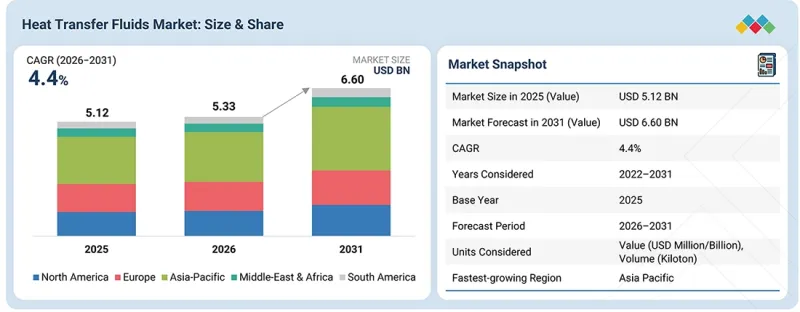
세계의 열매체 시장은 2026년 53억 3,000만 달러에서 2031년까지 66억 달러로 확대하며, 예측 기간 중 CAGR은 4.4%에 달할 것으로 전망되고 있습니다.
| 조사 범위 | |
|---|---|
| 조사 대상 기간 | 2022-2031년 |
| 기준 연도 | 2025년 |
| 예측 기간 | 2026-2031년 |
| 산정 단위 | 금액(백만/십억 달러), 킬로톤 |
| 부문 | 온도 범위, 제품 유형, 용도, 최종 용도 산업 및 지역 |
| 대상 지역 | 아시아태평양, 북미, 유럽, 중동 및 아프리카, 남미 |
열매체 시장은 산업화의 진전, 화학 및 석유화학 공정의 확대, 에너지 효율이 높은 공정 가열에 대한 수요 증가, 그리고 재생 가능 에너지 및 축열 시스템의 도입 확대에 힘입어 성장하고 있습니다. 데이터센터, HVAC 인프라, 제약, 식품 가공, 플라스틱 제조 분야의 급속한 성장으로 인해 신뢰성 높은 온도 제어 솔루션에 대한 수요가 더욱 높아지고 있습니다. 고성능 합성 유체 및 특수 열매체로 전환함으로써 더 넓은 온도 범위에서 운전이 가능해지고 열효율이 향상되어 시장 확대를 지원하고 있습니다. 그러나 원유 및 화학 원료 가격 변동이 시장 성장을 억제하고 있으며, 특히 광물계 및 합성계 유체의 경우 배합 및 생산 비용 상승으로 이어질 가능성이 있습니다. 또한 유체의 열화, 오염, 폐기 요건 및 첨단 열매체의 상대적으로 높은 비용도 비용에 민감한 최종사용자의 도입을 제한하는 요인이 될 수 있습니다.
"온도 범위별로는 중온(0°C-249°C) 부문이 예측 기간 중 가장 큰 시장 점유율을 차지할 것으로 전망됩니다."
중온 범위(0°C-249°C)는 광범위한 산업 및 상업 공정이 이 온도 범위 내에서 가동되고 있으므로 열전달 유체 시장에서 계속해서 가장 큰 온도 부문이 될 전망입니다. 화학·석유화학 공정, 식품 및 음료 제조, 의약품, 플라스틱·폴리머,HVAC 시스템, 그리고 일반 제조업에서는 일반적으로 적당한 온도에서 신뢰성 높은 가열 및 냉각이 요구됩니다. 이 범위를 위해 설계된 열매체는 열 성능, 유체 안정성, 운전 안전성 및 비용의 균형이 뛰어나며, 수많은 열 시스템에 도입되고 있습니다. 또한 중온 용도의 경우 일반적으로 초고온 공정에 비해 장비나 유체에 대한 요구 사항이 엄격하지 않기 때문에 더 광범위한 채택이 촉진되고 있습니다. 따라서 제조 활동의 확대, 공정의 자동화, 그리고 에너지 효율이 높은 가열 시스템의 보급에 힘입어, 이 온도 범위에서 작동하는 열매체에 대한 수요는 계속해서 견고한 추세를 보이고 있습니다.
"최종 용도 산업별로는 예측 기간 중 화학·석유화학 부문이 가장 큰 시장 점유율을 차지할 것으로 예상됩니다."
화학·석유화학 부문은 열전달 유체 시장에서 가장 큰 최종 용도 산업입니다. 이는 해당 산업에서 정확하고 신뢰할 수 있는 온도 제어가 필요한 수많은 연속적이고 에너지 집약적인 공정이 운영되고 있기 때문입니다. 열매체는 반응기, 증류탑, 증발기, 열교환기, 건조기 및 기타 처리 설비에서 간접 가열 및 냉각을 위해 널리 사용되고 있습니다. 또한 화학 및 석유화학 시설은 광범위한 온도 범위에서 가동되므로 광물유, 합성 유체, 글리콜 및 특수 고온 매체에 대한 수요가 발생하고 있습니다. 특히 아시아태평양과 중동에서 화학 제품, 폴리머, 석유화학제품, 특수 화학 제품의 생산이 증가함에 따라 열처리 시스템의 도입 대수가 증가하고 있습니다. 더욱이 에너지 효율 향상, 제품 품질 유지, 공정 가동 중단 시간 최소화 및 운영 비용 최적화라는 요구에 따라 이러한 산업에서는 첨단 열매체 시스템의 도입이 진행되고 있으며, 그 결과 화학 및 석유화학 산업이 최대 최종 소비 부문이 되었습니다.
"예측 기간 중 아시아태평양이 가장 큰 시장 점유율을 차지할 것으로 예상됩니다."
아시아태평양은 광범위한 제조 기반, 급속한 산업화, 그리고 에너지 집약적 산업에 대한 적극적인 투자로 인해 열매체의 최대 지역 시장이 되었습니다. 중국, 인도, 일본, 한국 및 동남아시아 국가에서는 화학, 석유화학,자동차, 플라스틱, 제약, 식품 가공, 전자기기 제조 등의 산업 활동이 활발히 이루어지고 있으며, 산업용 가열 및 온도 제어 시스템에 대한 큰 수요를 창출하고 있습니다. 이 지역의 석유 및 가스 인프라 확대와 재생 가능 에너지(특히 태양광발전 및 열 에너지 저장) 용량 증가는 열매체 소비를 더욱 촉진하고 있습니다. 데이터센터, 상업용 건물, HVAC 인프라의 급속한 건설로 인해 열 관리 솔루션에 대한 수요가 더욱 높아지고 있습니다. 또한 산업 현대화, 에너지 효율화, 공정 자동화에 대한 투자 증가가 첨단 합성 유체 및 특수 열매체의 채택을 촉진하고 있으며, 아시아태평양 시장에서 주도적인 입지를 공고히 하고 있습니다.
- 기업 유형별: Tier 1-50%, Tier 2-30%, Tier 3-20%
- 직책별: 매니저-15%, 이사-20%, 기타-65%
- 지역별: 북미 - 35%, 유럽 - 30%, 아시아태평양 - 25%, 중동 및 아프리카 - 5%, 남미 - 5%
열전달 유체 시장에는 ASTM Chemical Company(미국), Dow(미국), Exxon Mobil Corporation(미국), Shell plc(영국), TotalEnergies(프랑스), Chevron Corporation(미국), Clariant(스위스), Wacker Chemie AG(독일), LANXESS(독일), Lubrizol(미국) 등의 주요 기업이 이름을 올리고 있습니다. 본 조사에서는 열매체 시장의 이러한 주요 기업에 대해 기업 개요, 최근 동향 및 주요 시장 전략을 포함한 상세한 경쟁 분석을 수록하고 있습니다.
조사 범위
이 보고서에서는 열매체 시장을 온도 범위, 제품 유형, 용도, 최종 용도 산업 및 지역별로 세분화하여, 각 지역의 전체 시장 규모에 대한 추정치를 제공합니다. 주요 업계 참여자에 대한 상세한 분석을 통해 열매체 시장과 관련된 사업 개요, 제품 및 서비스, 주요 전략, 그리고 사업 확장에 대한 인사이트를 제공합니다.
이 보고서 구매의 주요 이점
본 조사 보고서는 업계 분석(업계 동향), 주요 기업의 시장 순위 분석, 기업 개요과 같은 다각적인 분석에 초점을 맞추고 있으며, 이를 종합함으로써 경쟁 구도의 전체적인 모습, 열매체 시장의 새로운 성장 분야 및 고성장 부문,고성장 지역, 그리고 시장 촉진요인, 억제요인, 기회, 과제에 대해 파악할 수 있습니다.
이 보고서는 다음 사항에 대한 인사이트를 제공합니다. :
- 촉진요인 분석:(산업계의 에너지 효율 요구 사항이 높아짐에 따라 고성능 열매체의 수요가 증가하고 있습니다), 제약 요인(고성능 합성 열매체는 기존의 광물유계 대체품보다 비용이 높습니다), 기회(환경 규제 강화에 따라 바이오 유래 및 저독성 열매체가 새로운 성장 기회를 창출할 가능성이 있습니다), 과제(광범위한 작동 온도 범위에서 열매체의 성능을 유지하는 것은 여전히 기술적으로 어렵습니다)
- 시장 침투도: 전 세계 열매체 시장의 주요 기업이 제공하는 열매체에 대한 포괄적인 정보
- 제품 개발 및 혁신: 열매체 시장의 향후 기술 동향, 신제품 출시, 사업 확장 및 인수에 대한 상세한 분석
- 시장 개발: 수익성이 높은 신흥 시장에 대한 포괄적인 정보. 이 보고서에서는 지역별 열매체 시장을 분석하고 있습니다.
- 시장 생산 능력: 입수 가능한 범위 내에서 각 기업의 생산 능력을 제시함과 동시에, 열매체 시장의 향후 생산 능력 전망에 대해서도 기술하고 있습니다
- 경쟁 분석: 열매체 시장 주요 기업의 시장 점유율, 전략, 제품 및 생산 능력에 대한 상세한 평가.
자주 묻는 질문
목차
제1장 서론
제2장 요약
제3장 주요 인사이트
- 열전달 유체 시장에서 사업자에게 매력적인 비즈니스 기회
- 열매체 시장: 제품 유형별·지역별
- 열매체 시장: 온도 범위별
- 열매체 시장: 용도별
- 열매체 시장: 최종 용도 산업별
- 열매체 시장: 국가별
제4장 시장 개요
- 시장 역학
- 촉진요인
- 억제요인
- 기회
- 과제
- 미충족 수요 및 미개발 분야
- 열전달 유체 시장의 미충족 수요
- 미개발 시장의 기회
- 상호 연관된 시장 및 부문 간 기회
- 상호 연관된 시장
- 부문 간 기회
- Tier 1/2/3 주요 기업의 전략적 움직임
- 주요 동향 및 전략적 초점
제5장 업계 동향
- Porter's Five Forces 분석
- 신규 진입자의 위협
- 대체품의 위협
- 공급업체의 협상력
- 구매자의 협상력
- 경쟁 기업 간의 적대적 관계
- 거시경제 전망
- GDP 동향 및 전망
- 세계 화학·석유화학 산업의 동향
- 세계 석유 및 가스 산업의 동향
- 공급망 분석
- 가격 분석
- 지역별 열매체 평균 판매 가격 동향(2022-2025년)
- 열매체의 평균 판매 가격 동향(제품 유형별, 2022-2025년)
- 온도 범위별 열전달 유체의 평균 판매 가격 동향(2022-2025년)
- 용도별 열매체의 평균 판매 가격 동향(2022-2025년)
- 열매체의 평균 판매 가격 동향(최종 용도 산업별, 2022-2025년)
- 주요 제조사가 제공하는 열매체의 평균 판매 가격(제품 유형별, 2025년)
- 생태계 분석
- 무역 분석
- 수입 시나리오(HS 코드 382000)
- 수출 시나리오(HS 코드 382000)
- 수입 시나리오(HS 코드 271000)
- 수출 시나리오(HS 코드 271000)
- 수입 시나리오(HS 코드 382390)
- 수출 시나리오(HS 코드 382490)
- 2026-2027년 주요 회의 및 행사
- 고객의 비즈니스에 영향을 미치는 동향/파괴적 변화
- 투자 및 자금 조달 시나리오
- 사례 연구 분석
- 이스트만 케미컬 컴퍼니(EASTMAN CHEMICAL COMPANY)와 CSP 개발 사업자가 열 에너지 저장 유체 시스템 분야에서 제휴
- DOW와 데이터센터 인프라 제공업체, 유전체 액체 침지 냉각액 공급을 위해 제휴
- LUBRIZOL과 제약 장비 제조사가 고순도 바이오 프로세싱용 유체 시스템 분야에서 제휴
- 미국의 관세가 열전달 유체 시장에 미치는 영향
- 주요 관세율
- 가격에 미치는 영향 분석
- 지역별 영향
- 용도에 미치는 영향
제6장 기술 발전, AI의 영향, 특허, 혁신 및 향후 용도
- 주요 기술
- 합성 방향족 및 공융 혼합물 화학
- 억제제가 첨가된 글리콜 유체용 유기산 기술(OAT)
- 단상 및 이상 유전체 침지 냉각 유체
- 초고온 열저장용 공융 용융염 배합
- 바이오 기반 및 폐쇄 루프형 순환 재정제 기술
- 보완 기술
- IoT를 활용한 인라인 유체 상태 모니터링 및 예측 분석
- 불활성 가스(질소) 블랭킷 시스템
- 소형 인쇄 회로 및 마이크로 채널 열교환기(PCHES)
- 관련 기술
- 전기 히트 트레이스 및 직접 임피던스 가열 시스템
- 잠열 저장용 상변화 재료(PCMS)
- 기술 및 제품 로드맵
- 저독성·장수명 억제제 배합으로의 전환
- 실시간 센서 텔레메트리 및 예측형 IoT 유체 진단 도입
- 고밀도 전자기기 및 전기자동차(EV)의 침지 냉각용 유전체 유체의 신속한 상용화
- 열 에너지 저장(TES) 분야에서 첨단 공융염의 유틸리티 규모 도입
- 폐루프형 순환 재정제 및 바이오 기반 합성 유체 네트워크
- 특허 분석
- 조사 방법론
- 2016-2025년 특허 등록 건수
- 인사이트
- 법적 현황
- 관할 구역 분석
- 주요 출원인
- 주요 특허 리스트
- 향후 응용
- AI/범용 AI가 열전달 유체 시장에 미치는 영향
- 주요 사용 사례 및 시장 잠재력
- 열전달 유체 시장에서 OEM 기업이 실천하고 있는 베스트 프랙티스
- 열전달 유체 시장에서 AI/생성형 AI 도입에 관한 사례 연구
- 상호 연계된 생태계와 시장 관계자에 미치는 영향
- AI/생성형 AI를 통합한 열전달 유체 도입에 대한 고객의 준비 현황
- 성공 사례 및 실제 적용 사례
- EASTMAN CHEMICAL COMPANY: 고온 처리 및 집광형 태양광발전용 첨단 합성 방향족 유체(서미노?ル)
- THE DOW CHEMICAL COMPANY: 핵심 공정 분야용 특수 합성 유기·실리콘·유전체 유체(다우솜 및 실솜)
- SHELL PLC: 산업 및 데이터센터용 고효율 가스-액체 전환(GTL) 열매체 및 침지 냉각제
제7장 규제 현황 및 지속가능성 노력
- 지역별 규제 및 규정 준수
- 규제기관, 정부 기관 및 기타 조직
- 업계 기준
- 지속가능성 노력
- 바이오 기반 및 쉽게 생분해되는 열매체의 상용화
- PFAS가 없고 GWP가 낮은 유전성 냉매로의 전환
- 폐쇄 루프 방식을 통한 유체 회수, 재정제 및 순환 경제 실천
- 산업 공정의 탈탄소화를 위한 고온 열 에너지 저장(TES) 구현
- 산업용 폐열 회수(WHR)를 위한 열역학적 효율 최적화
- 지속가능성 구상이 규제 정책에 미치는 영향
- 인증, 표시 및 환경 기준
제8장 고객 동향과 구매 행동
- 의사결정 과정
- 구매 과정에 관여하는 주요 이해관계자와 평가 기준
- 구매 과정의 주요 이해관계자
- 구매 기준
- 도입 장벽 및 사내 과제
- 다양한 용도에서의 미충족 수요
- 시장의 수익성
- 합성 및 실리콘 배합 분야의 프리미엄 가격 책정
- 집광형 태양광발전 및 열 에너지 저장 분야의 가치 창출
- 유체 교환 및 보충을 통한 지속적인 수익
- 부가가치가 있는 기술 서비스 및 유체 모니터링
- 원자재 가격 변동성 및 이익률의 민감도
제9장 열전달 유체 시장: 제품 유형별
- 광물유
- 합성 유체
- 글리콜계 유체
- 기타 유체
제10장 열매체 시장: 온도 범위별
- 저온(0°C 미만)
- 중온(0°C-249°C)
- 고온(250°C-400°C)
- 초고온(400°C 이상)
제11장 열매체 시장: 용도별
- 산업 공정 가열
- 열 에너지 저장
- 냉수·온수 루프
- 극저온 및 저온 처리
- 발전 및 폐열 회수
- 열 관리
- 기타 용도
제12장 열매체 시장: 최종 용도 산업별
- 화학·석유화학
- 석유 및 가스
- 자동차
- 전자 및 데이터센터
- 식품 및 음료
- 의약품
- 재생에너지
- HVAC
- 기타 최종 용도 산업
제13장 열매체 시장: 지역별
- 아시아태평양
- 중국
- 일본
- 인도
- 한국
- 기타 아시아태평양
- 북미
- 미국
- 캐나다
- 멕시코
- 유럽
- 독일
- 이탈리아
- 프랑스
- 영국
- 스페인
- 기타 유럽
- 중동 및 아프리카
- GCC 국가들
- 남아프리카
- 기타 중동 및 아프리카
- 남미
- 브라질
- 아르헨티나
- 기타 남미
제14장 경쟁 현황
- 주요 진입 기업의 전략/강점
- 시장 점유율 분석(2025년)
- 수익 분석
- 기업 평가 매트릭스: 주요 기업, 2025년
- 스타 기업
- 신흥 리더
- 광범위한 사업 전개를 하는 기업
- 진출 기업
- 기업의 사업 전개: 주요 기업, 2026년
- 기업 평가 매트릭스: 스타트업/중소기업, 2026년
- 선도적인 기업
- 대응력이 뛰어난 기업
- 역동적인 기업
- 출발점
- 경쟁사 벤치마킹
- 브랜드 비교
- 기업 가치 평가 및 재무 지표
- 경쟁 시나리오
- 제품 출시
- 거래
- 사업 확장
제15장 기업 개요
- 주요 기업
- EASTMAN CHEMCIAL COMPANY
- DOW
- EXXON MOBIL CORPORATION
- SHELL PLC
- PRODUCTS/SOLUTIONS/SERVICES OFFERED
- TOTALENERGIES
- CHEVRON CORPORATION
- CLARIANT AG
- WACKER CHEMIE AG
- LANXESS AG
- LUBRIZOL
- 기타 주요 기업
- FUCHS SE
- PHILLIPS 66 COMPANY
- BP P.L.C.
- PETRO-CANADA LUBRICANTS INC.
- CHINA PETROLEUM &CHEMICAL CORPORATION
- INDIAN OIL CORPORATION LIMITED
- ENI S.P.A.
- REPSOL, S.A.
- GULF OIL LUBRICANTS INDIA LIMITED
- KUWAIT PETROLEUM CORPORATION
- DYNALENE, INC.
- IDEMITSU KOSAN CO., LTD.
- SAVITA OIL TECHNOLOGIES LIMITED
- DEHON SAS
- FRAGOL AG
제16장 조사 방법론
제17장 부록
KSA 26.10.19The global heat transfer fluids market is projected to grow from USD 5.33 billion in 2026 to USD 6.60 billion by 2031, registering a CAGR of 4.4% during the forecast period.
| Scope of the Report | |
|---|---|
| Years Considered for the Study | 2022-2031 |
| Base Year | 2025 |
| Forecast Period | 2026-2031 |
| Units Considered | Value (USD Million/Billion), Volume (Kiloton) |
| Segments | Temperature Range, Product Type, Application, End-use Industry, and Region |
| Regions covered | Asia Pacific, North America, Europe, Middle East & Africa, South America |
The heat transfer fluids market is driven by rising industrialization, expansion of chemical and petrochemical processing, growing demand for energy-efficient process heating, and increasing deployment of renewable energy and thermal energy storage systems. Rapid growth of data centers, HVAC infrastructure, pharmaceuticals, food processing, and plastics manufacturing is further increasing demand for reliable temperature-control solutions. The shift toward high-performance synthetic fluids and specialized thermal media is also supporting market expansion by enabling operation across wider temperature ranges and improving thermal efficiency. However, market growth is restrained by fluctuations in crude oil and chemical feedstock prices, which can increase formulation and production costs, particularly for mineral- and synthetic-based fluids. Fluid degradation, contamination, disposal requirements, and the relatively high cost of advanced thermal fluids can also limit adoption among cost-sensitive end users.
"By temperature range, the medium-temperature (0°C to 249°C) segment is anticipated to account for the largest market share during the forecast period."
The medium-temperature range (0°C to 249°C) is expected to remain the largest temperature segment in the heat transfer fluids market because a broad range of industrial and commercial processes operate within this temperature window. Chemical and petrochemical processing, food and beverage production, pharmaceuticals, plastics and polymers, HVAC systems, and general manufacturing commonly require reliable heating and cooling at moderate temperatures. Heat transfer fluids designed for this range offer a favorable balance between thermal performance, fluid stability, operating safety, and cost, making them suitable for a large installed base of thermal systems. Additionally, medium-temperature applications generally involve less demanding equipment and fluid requirements than ultra-high-temperature processes, supporting wider adoption. The expansion of manufacturing activities, process automation, and energy-efficient heating systems is therefore sustaining strong demand for fluids operating within this temperature range.
"By end-use industry, the chemicals & petrochemicals segment is anticipated to account for the largest market share during the forecast period."
The chemicals & petrochemicals segment is the largest end-use industry for the heat transfer fluids market because these industries run numerous continuous, energy-intensive processes that require precise, reliable temperature control. Heat transfer fluids are extensively used in reactors, distillation columns, evaporators, heat exchangers, dryers, and other processing equipment for indirect heating and cooling. Chemical and petrochemical facilities also operate across broad temperature ranges, creating demand for mineral oils, synthetic fluids, glycols, and specialized high-temperature media. Growing production of chemicals, polymers, petrochemicals, and specialty chemicals, particularly across Asia Pacific and the Middle East, is increasing the installed base of thermal processing systems. Furthermore, the need to improve energy efficiency, maintain product quality, minimize process downtime, and optimize operating costs encourages these industries to adopt advanced heat transfer fluid systems, making chemicals and petrochemicals the largest consuming end-use segment.
"Asia Pacific is expected to account for the largest market share during the forecast period."
Asia Pacific is the largest regional market for heat transfer fluids due to its extensive manufacturing base, rapid industrialization, and strong investment across energy-intensive industries. China, India, Japan, South Korea, and Southeast Asian economies have significant chemical, petrochemical, automotive, plastics, pharmaceutical, food processing, and electronics manufacturing activities, generating substantial demand for industrial heating and temperature-control systems. The region's expanding oil & gas infrastructure and growing renewable energy capacity, particularly solar power and thermal energy storage, further support heat transfer fluid consumption. Rapid construction of data centers, commercial buildings, and HVAC infrastructure is creating additional demand for thermal management solutions. Moreover, increasing investments in industrial modernization, energy efficiency, and process automation are encouraging adoption of advanced synthetic fluids and specialized thermal media, reinforcing Asia Pacific's leading market position.
In-depth interviews were conducted with Chief Executive Officers (CEOs), marketing directors, other innovation and technology directors, and executives from various key organizations operating in the heat transfer fluids market, and information was gathered from secondary research to determine and verify the market size of several segments.
- By Company Type: Tier 1 - 50%, Tier 2 - 30%, and Tier 3 - 20%
- By Designation: Managers - 15%, Directors - 20%, and Others - 65%
- By Region: North America - 35%, Europe - 30%, Asia Pacific - 25%, Middle East & Africa - 5%, South America - 5%
The heat transfer fluids market comprises major companies, such as Eastman Chemical Company (US), Dow (US), Exxon Mobil Corporation (US), Shell plc (UK), TotalEnergies (France), Chevron Corporation (US), Clariant (Switzerland), Wacker Chemie AG (Germany), LANXESS (Germany), and Lubrizol (US). The study includes an in-depth competitive analysis of these key players in the heat transfer fluids market, with their company profiles, recent developments, and key market strategies.
Research Coverage
This report segments the heat transfer fluids market on the basis of temperature range, product type, application, end-use industry, and region, and provides estimations for the overall value of the market across various regions. A detailed analysis of key industry players has been conducted to provide insights into their business overviews, products & services, key strategies, and expansions associated with the heat transfer fluids market.
Key benefits of buying this report
This research report is focused on various levels of analysis-industry analysis (industry trends), market ranking analysis of top players, and company profiles, which together provide an overall view of the competitive landscape; emerging and high-growth segments of the heat transfer fluids market; high-growth regions; and market drivers, restraints, opportunities, and challenges.
The report provides insights into the following points:
- Analysis of Drivers: (Rising industrial energy-efficiency requirements are supporting demand for high-performance heat transfer fluids), restraints (High-performance synthetic fluids carry higher costs than conventional mineral-oil-based alternatives), opportunities (Bio-based and low-toxicity fluids can create new growth opportunities as environmental requirements tighten), and challenges (Maintaining fluid performance across wide operating-temperature ranges remains technically demanding)
- Market Penetration: Comprehensive information on the heat transfer fluids offered by top players in the global heat transfer fluids market
- Product Development/Innovation: Detailed insights on upcoming technologies, product launches, expansions, and acquisitions in the heat transfer fluids market
- Market Development: Comprehensive information about lucrative emerging markets; the report analyzes the markets for heat transfer fluids across regions.
- Market Capacity: Production capacity of the companies is provided wherever available, with upcoming capacities for the heat transfer fluids market
- Competitive Assessment: In-depth assessment of market shares, strategies, products, and manufacturing capabilities of leading players in the heat transfer fluids market.
TABLE OF CONTENTS
1 INTRODUCTION
- 1.1 STUDY OBJECTIVES
- 1.2 MARKET DEFINITION
- 1.3 STUDY SCOPE
- 1.3.1 MARKETS COVERED AND REGIONAL SCOPE
- 1.3.2 INCLUSIONS AND EXCLUSIONS
- 1.3.3 YEARS CONSIDERED
- 1.3.4 CURRENCY CONSIDERED
- 1.3.5 UNITS CONSIDERED
- 1.4 STAKEHOLDERS
- 1.5 SUMMARY OF CHANGES
2 EXECUTIVE SUMMARY
- 2.1 KEY INSIGHTS AND MARKET HIGHLIGHTS
- 2.2 KEY MARKET PARTICIPANTS: SHARE INSIGHTS AND STRATEGIC DEVELOPMENTS
- 2.3 DISRUPTIVE TRENDS SHAPING MARKET
- 2.4 HIGH-GROWTH SEGMENTS & EMERGING FRONTIERS
- 2.5 SNAPSHOT: MARKET SIZE, GROWTH RATE, AND FORECAST
3 PREMIUM INSIGHTS
- 3.1 ATTRACTIVE OPPORTUNITIES FOR PLAYERS IN HEAT TRANSFER FLUIDS MARKET
- 3.2 HEAT TRANSFER FLUIDS MARKET, BY PRODUCT TYPE AND REGION
- 3.3 HEAT TRANSFER FLUIDS MARKET, BY TEMPERATURE RANGE
- 3.4 HEAT TRANSFER FLUIDS MARKET, BY APPLICATION
- 3.5 HEAT TRANSFER FLUIDS MARKET, BY END-USE INDUSTRY
- 3.6 HEAT TRANSFER FLUIDS MARKET, BY COUNTRY
4 MARKET OVERVIEW
- 4.1 INTRODUCTION
- 4.2 MARKET DYNAMICS
- 4.2.1 DRIVERS
- 4.2.1.1 Accelerating adoption of parabolic trough concentrating solar power systems demands ultra-high-temperature synthetic media
- 4.2.1.2 Replacement of industrial steam boilers with closed-loop thermal fluid systems for precision heat control
- 4.2.1.3 Stringent pharmaceutical and food processing hygiene mandates drive adoption of NSF-certified food-grade formulations
- 4.2.2 RESTRAINTS
- 4.2.2.1 Severe thermal cracking kinetics and fluid degradation under continuous high-temperature heat flux
- 4.2.2.2 Prohibitive upfront capital constraints and complex infrastructure retrofitting bottlenecks
- 4.2.3 OPPORTUNITIES
- 4.2.3.1 Explosive commercialization of single- and two-phase immersion cooling for high-density artificial intelligence data centers
- 4.2.3.2 Integration of high-capacity thermal energy storage solutions for industrial decarbonization grids
- 4.2.4 CHALLENGES
- 4.2.4.1 Imminent regulatory phase-outs of per- and polyfluoroalkyl substances threatening fluorinated dielectric inventories
- 4.2.4.2 Navigating stringent flash-point constraints and fire safety compliance in heavy industrial zoning
- 4.2.1 DRIVERS
- 4.3 UNMET NEEDS AND WHITE SPACES
- 4.3.1 UNMET NEEDS IN HEAT TRANSFER FLUIDS MARKET
- 4.3.2 WHITE SPACE OPPORTUNITIES
- 4.4 INTERCONNECTED MARKETS AND CROSS-SECTOR OPPORTUNITIES
- 4.4.1 INTERCONNECTED MARKETS
- 4.4.2 CROSS-SECTOR OPPORTUNITIES
- 4.5 STRATEGIC MOVES BY TIER-1/2/3 PLAYERS
- 4.5.1 KEY MOVES AND STRATEGIC FOCUS
5 INDUSTRY TRENDS
- 5.1 PORTER'S FIVE FORCES ANALYSIS
- 5.1.1 THREAT OF NEW ENTRANTS
- 5.1.2 THREAT OF SUBSTITUTES
- 5.1.3 BARGAINING POWER OF SUPPLIERS
- 5.1.4 BARGAINING POWER OF BUYERS
- 5.1.5 INTENSITY OF COMPETITIVE RIVALRY
- 5.2 MACROECONOMIC OUTLOOK
- 5.2.1 INTRODUCTION
- 5.2.2 GDP TRENDS AND FORECAST
- 5.2.3 TRENDS IN GLOBAL CHEMICALS & PETROCHEMICALS INDUSTRY
- 5.2.4 TRENDS IN GLOBAL OIL & GAS INDUSTRY
- 5.3 SUPPLY CHAIN ANALYSIS
- 5.4 PRICING ANALYSIS
- 5.4.1 AVERAGE SELLING PRICE TREND OF HEAT TRANSFER FLUIDS, BY REGION, 2022-2025
- 5.4.2 AVERAGE SELLING PRICE TREND OF HEAT TRANSFER FLUIDS, BY PRODUCT TYPE, 2022-2025
- 5.4.3 AVERAGE SELLING PRICE TREND OF HEAT TRANSFER FLUIDS, BY TEMPERATURE RANGE, 2022-2025
- 5.4.4 AVERAGE SELLING PRICE TREND OF HEAT TRANSFER FLUIDS, BY APPLICATION, 2022-2025
- 5.4.5 AVERAGE SELLING PRICE TREND OF HEAT TRANSFER FLUIDS, BY END USE INDUSTRY, 2022-2025
- 5.4.6 AVERAGE SELLING PRICE OF HEAT TRANSFER FLUIDS OFFERED BY KEY PLAYERS, BY PRODUCT TYPE, 2025
- 5.5 ECOSYSTEM ANALYSIS
- 5.6 TRADE ANALYSIS
- 5.6.1 IMPORT SCENARIO (HS CODE 382000)
- 5.6.2 EXPORT SCENARIO (HS CODE 382000)
- 5.6.3 IMPORT SCENARIO (HS CODE 271000)
- 5.6.4 EXPORT SCENARIO (HS CODE 271000)
- 5.6.5 IMPORT SCENARIO (HS CODE 382390)
- 5.6.6 EXPORT SCENARIO (HS CODE 382490)
- 5.7 KEY CONFERENCES AND EVENTS, 2026-2027
- 5.8 TRENDS/DISRUPTIONS IMPACTING CUSTOMER BUSINESS
- 5.9 INVESTMENT AND FUNDING SCENARIO
- 5.10 CASE STUDY ANALYSIS
- 5.10.1 EASTMAN CHEMICAL COMPANY AND CSP DEVELOPERS COLLABORATE FOR THERMAL ENERGY STORAGE FLUID SYSTEMS
- 5.10.2 DOW AND DATA CENTER INFRASTRUCTURE PROVIDERS PARTNER FOR DIELECTRIC IMMERSION COOLING FLUIDS
- 5.10.3 LUBRIZOL AND PHARMACEUTICAL EQUIPMENT MANUFACTURERS COLLABORATE FOR HIGH-PURITY BIOPROCESSING FLUID SYSTEMS
- 5.11 IMPACT OF US TARIFFS - HEAT TRANSFER FLUIDS MARKET
- 5.11.1 INTRODUCTION
- 5.11.2 KEY TARIFF RATES
- 5.11.3 PRICE IMPACT ANALYSIS
- 5.11.4 IMPACT ON REGIONS
- 5.11.4.1 North America
- 5.11.4.2 Europe
- 5.11.4.3 Asia Pacific
- 5.11.5 IMPACT ON APPLICATIONS
6 TECHNOLOGICAL ADVANCEMENTS, AI-DRIVEN IMPACT, PATENTS, INNOVATIONS, AND FUTURE APPLICATIONS
- 6.1 KEY TECHNOLOGIES
- 6.1.1 SYNTHETIC AROMATIC & EUTECTIC BLEND CHEMISTRY
- 6.1.2 ORGANIC ACID TECHNOLOGY (OAT) FOR INHIBITED GLYCOL FLUIDS
- 6.1.3 SINGLE-PHASE & TWO-PHASE DIELECTRIC IMMERSION COOLING FLUIDS
- 6.1.4 EUTECTIC MOLTEN SALT FORMULATIONS FOR ULTRA-HIGH TEMPERATURE THERMAL STORAGE
- 6.1.5 BIO-BASED & CLOSED-LOOP CIRCULAR RE-REFINING TECHNOLOGIES
- 6.2 COMPLEMENTARY TECHNOLOGIES
- 6.2.1 IOT-ENABLED IN-LINE FLUID CONDITION MONITORING & PREDICTIVE ANALYTICS
- 6.2.2 INERT GAS (NITROGEN) BLANKETING SYSTEMS
- 6.2.3 COMPACT PRINTED CIRCUIT & MICROCHANNEL HEAT EXCHANGERS (PCHES)
- 6.3 ADJACENT TECHNOLOGIES
- 6.3.1 ELECTRIC HEAT TRACING & DIRECT IMPEDANCE HEATING SYSTEMS
- 6.3.2 PHASE CHANGE MATERIALS (PCMS) FOR LATENT HEAT STORAGE
- 6.4 TECHNOLOGY/PRODUCT ROADMAP
- 6.4.1 TRANSITION TOWARD LOW-TOXICITY, EXTENDED-LIFE INHIBITED FORMULATIONS
- 6.4.2 DEPLOYMENT OF REAL-TIME SENSOR TELEMETRY AND PREDICTIVE IOT FLUID DIAGNOSTICS
- 6.4.3 RAPID COMMERCIALIZATION OF DIELECTRIC FLUIDS FOR HIGH-DENSITY ELECTRONICS AND EV IMMERSION COOLING
- 6.4.4 UTILITY-SCALE DEPLOYMENT OF ADVANCED EUTECTIC SALTS IN THERMAL ENERGY STORAGE (TES)
- 6.4.5 CLOSED-LOOP CIRCULAR RE-REFINING AND BIO-BASED SYNTHETIC FLUID NETWORKS
- 6.5 PATENT ANALYSIS
- 6.5.1 METHODOLOGY
- 6.5.2 GRANTED PATENTS, 2016-2025
- 6.5.3 INSIGHTS
- 6.5.4 LEGAL STATUS
- 6.5.5 JURISDICTION ANALYSIS
- 6.5.6 TOP APPLICANTS
- 6.5.7 LIST OF MAJOR PATENTS
- 6.6 FUTURE APPLICATIONS
- 6.7 IMPACT OF AI/GEN AI ON HEAT TRANSFER FLUIDS MARKET
- 6.7.1 TOP USE CASES AND MARKET POTENTIAL
- 6.7.2 BEST PRACTICES FOLLOWED BY OEMS IN HEAT TRANSFER FLUIDS MARKET
- 6.7.3 CASE STUDIES RELATED TO AI/GEN AI IMPLEMENTATION IN HEAT TRANSFER FLUIDS MARKET
- 6.7.4 INTERCONNECTED ECOSYSTEM AND IMPACT ON MARKET PLAYERS
- 6.7.5 CLIENTS' READINESS TO ADOPT AI/GEN AI-INTEGRATED HEAT TRANSFER FLUIDS
- 6.8 SUCCESS STORIES AND REAL-WORLD APPLICATIONS
- 6.8.1 EASTMAN CHEMICAL COMPANY: ADVANCED SYNTHETIC AROMATIC F LUIDS (THERMINOL) FOR HIGH-TEMPERATURE PROCESSING & CONCENTRATED SOLAR POWER
- 6.8.2 THE DOW CHEMICAL COMPANY: SPECIALTY SYNTHETIC ORGANIC, SILICONE & DIELECTRIC FLUIDS (DOWTHERM & SYLTHERM) FOR CRITICAL PROCESS SECTORS
- 6.8.3 SHELL PLC: HIGH-EFFICIENCY GAS-TO-LIQUID (GTL) THERMAL OILS & IMMERSION COOLANTS FOR INDUSTRY & DATA CENTERS
7 REGULATORY LANDSCAPE AND SUSTAINABILITY INITIATIVES
- 7.1 REGIONAL REGULATIONS AND COMPLIANCE
- 7.1.1 REGULATORY BODIES, GOVERNMENT AGENCIES, AND OTHER ORGANIZATIONS
- 7.1.2 INDUSTRY STANDARDS
- 7.2 SUSTAINABILITY INITIATIVES
- 7.2.1 COMMERCIALIZATION OF BIO-BASED AND READILY BIODEGRADABLE THERMAL FLUIDS
- 7.2.2 TRANSITION TOWARD PFAS-FREE AND LOW-GWP DIELECTRIC COOLANTS
- 7.2.3 CLOSED-LOOP FLUID RECLAMATION, RE-REFINING, AND CIRCULAR ECONOMY PRACTICES
- 7.2.4 ENABLING HIGH-TEMPERATURE THERMAL ENERGY STORAGE (TES) FOR INDUSTRIAL PROCESS DECARBONIZATION
- 7.2.5 THERMODYNAMIC EFFICIENCY OPTIMIZATION FOR INDUSTRIAL WASTE HEAT RECOVERY (WHR)
- 7.3 IMPACT OF SUSTAINABILITY INITIATIVES ON REGULATORY POLICIES
- 7.4 CERTIFICATIONS, LABELING, AND ECO-STANDARDS
8 CUSTOMER LANDSCAPE AND BUYER BEHAVIOR
- 8.1 DECISION-MAKING PROCESS
- 8.2 KEY STAKEHOLDERS INVOLVED IN BUYING PROCESS AND EVALUATION CRITERIA
- 8.2.1 KEY STAKEHOLDERS IN BUYING PROCESS
- 8.2.2 BUYING CRITERIA
- 8.3 ADOPTION BARRIERS AND INTERNAL CHALLENGES
- 8.4 UNMET NEEDS OF VARIOUS APPLICATIONS
- 8.5 MARKET PROFITABILITY
- 8.5.1 PREMIUM PRICING IN SYNTHETIC AND SILICONE FORMULATIONS
- 8.5.2 VALUE CREATION IN CONCENTRATED SOLAR POWER AND THERMAL ENERGY STORAGE
- 8.5.3 RECURRING REVENUE FROM FLUID REPLACEMENT AND TOP-UPS
- 8.5.4 VALUE-ADDED TECHNICAL SERVICES AND FLUID MONITORING
- 8.5.5 FEEDSTOCK VOLATILITY AND MARGIN SENSITIVITY
9 HEAT TRANSFER FLUIDS MARKET, BY PRODUCT TYPE
- 9.1 INTRODUCTION
- 9.2 MINERAL OIL
- 9.2.1 COST-SENSITIVE MANUFACTURING SUSTAINS DEMAND FOR MINERAL OIL
- 9.3 SYNTHETIC FLUIDS
- 9.3.1 HEAVY PROCESS INDUSTRIES DRIVE DEMAND FOR SYNTHETIC FLUIDS
- 9.4 GLYCOL-BASED FLUIDS
- 9.4.1 SAFETY AND HYGIENE STANDARDS FUEL DEMAND FOR GLYCOL-BASED FLUIDS
- 9.5 OTHER FLUIDS
10 HEAT TRANSFER FLUIDS MARKET, BY TEMPERATURE RANGE
- 10.1 INTRODUCTION
- 10.2 LOW TEMPERATURE (BELOW 0°C)
- 10.2.1 COLD-CHAIN EXPANSION DRIVES DEMAND FOR LOW TEMPERATURE FLUIDS
- 10.3 MEDIUM TEMPERATURE (0°C TO 249°C)
- 10.3.1 WIDESPREAD INDUSTRIAL USE SUSTAINS DEMAND FOR MEDIUM TEMPERATURE FLUIDS
- 10.4 HIGH TEMPERATURE (250°C TO 400°C)
- 10.4.1 RISING PROCESS INTENSITY FUELS DEMAND FOR HIGH TEMPERATURE FLUIDS
- 10.5 ULTRA-HIGH TEMPERATURE (ABOVE 400°C)
- 10.5.1 CLEAN ENERGY AND DATA GROWTH PROPEL ULTRA-HIGH TEMPERATURE FLUIDS
11 HEAT TRANSFER FLUIDS MARKET, BY APPLICATION
- 11.1 INTRODUCTION
- 11.2 INDUSTRIAL PROCESS HEATING
- 11.2.1 CONTINUOUS HEAT DEMAND SUSTAINS INDUSTRIAL PROCESS HEATING APPLICATIONS
- 11.3 THERMAL ENERGY STORAGE
- 11.3.1 RENEWABLE ENERGY GROWTH FUELS THERMAL ENERGY STORAGE APPLICATIONS
- 11.4 CHILLED/HOT WATER LOOPS
- 11.4.1 CLIMATE CONTROL NEEDS SUSTAIN CHILLED/HOT WATER LOOP APPLICATIONS
- 11.5 CRYOGENIC AND LOW-TEMPERATURE PROCESSING
- 11.5.1 RISING LNG & COLD-CHAIN EXPANSION DRIVE CRYOGENIC AND LOW-TEMPERATURE PROCESSING APPLICATIONS
- 11.6 POWER GENERATION & WASTE HEAT RECOVERY
- 11.6.1 ENERGY EFFICIENCY GOALS PROPEL POWER GENERATION & WASTE HEAT RECOVERY
- 11.7 THERMAL MANAGEMENT
- 11.7.1 ELECTRONICS GROWTH ACCELERATES THERMAL MANAGEMENT APPLICATIONS
- 11.8 OTHER APPLICATIONS
12 HEAT TRANSFER FLUIDS MARKET, BY END-USE INDUSTRY
- 12.1 INTRODUCTION
- 12.2 CHEMICAL & PETROCHEMICALS
- 12.2.1 CONTINUOUS PROCESS HEAT DEMAND ANCHORS CHEMICAL & PETROCHEMICALS APPLICATIONS
- 12.3 OIL & GAS
- 12.3.1 EXTRACTION AND REFINING DEMANDS SUSTAIN OIL & GAS APPLICATIONS
- 12.4 AUTOMOTIVE
- 12.4.1 VEHICLE ELECTRIFICATION ACCELERATES AUTOMOTIVE APPLICATIONS
- 12.5 ELECTRONICS & DATA CENTERS
- 12.5.1 DATA INFRASTRUCTURE GROWTH FUELS ELECTRONICS & DATA CENTERS APPLICATIONS
- 12.6 FOOD & BEVERAGE
- 12.6.1 HYGIENE AND SAFETY STANDARDS SUPPORT FOOD & BEVERAGE APPLICATIONS
- 12.7 PHARMACEUTICALS
- 12.7.1 CONTAMINATION-FREE STANDARDS DRIVE PHARMACEUTICAL APPLICATIONS
- 12.8 RENEWABLE ENERGY
- 12.8.1 SOLAR THERMAL EXPANSION POWERS RENEWABLE ENERGY APPLICATIONS
- 12.9 HVAC
- 12.9.1 CLIMATE CONTROL NEEDS SUSTAINED HVAC APPLICATIONS
- 12.10 OTHER END-USE INDUSTRIES
13 HEAT TRANSFER FLUIDS MARKET, BY REGION
- 13.1 INTRODUCTION
- 13.2 ASIA PACIFIC
- 13.2.1 CHINA
- 13.2.1.1 Rapid industrialization driving thermal fluid demand
- 13.2.2 JAPAN
- 13.2.2.1 Precision manufacturing driving demand for high-performance fluids
- 13.2.3 INDIA
- 13.2.3.1 Expanding pharmaceutical and chemical sectors fuelling growth
- 13.2.4 SOUTH KOREA
- 13.2.4.1 Semiconductor and electronics boom boosting fluid demand
- 13.2.5 REST OF ASIA PACIFIC
- 13.2.1 CHINA
- 13.3 NORTH AMERICA
- 13.3.1 US
- 13.3.1.1 Chemical and power generation sectors anchoring steady demand
- 13.3.2 CANADA
- 13.3.2.1 Oil, gas, and mining industries supporting steady fluid demand
- 13.3.3 MEXICO
- 13.3.3.1 Growing manufacturing and automotive sectors driving fluid demand
- 13.3.1 US
- 13.4 EUROPE
- 13.4.1 GERMANY
- 13.4.1.1 Automotive and chemical engineering excellence driving fluid innovation
- 13.4.2 ITALY
- 13.4.2.1 Industrial manufacturing and food processing supporting fluid demand
- 13.4.3 FRANCE
- 13.4.3.1 Nuclear power and chemical industry anchoring fluid demand
- 13.4.4 UK
- 13.4.4.1 Chemical processing and renewable energy transition driving demand
- 13.4.5 SPAIN
- 13.4.5.1 Renewable energy expansion and industrial growth supporting demand
- 13.4.6 REST OF EUROPE
- 13.4.1 GERMANY
- 13.5 MIDDLE EAST & AFRICA
- 13.5.1 GCC COUNTRIES
- 13.5.1.1 Saudi Arabia
- 13.5.1.1.1 Petrochemical leadership and Vision 2030 driving fluid demand
- 13.5.1.2 UAE
- 13.5.1.2.1 Industrial diversification and renewable energy push driving demand
- 13.5.1.3 Rest of GCC Countries
- 13.5.1.1 Saudi Arabia
- 13.5.2 SOUTH AFRICA
- 13.5.2.1 Mining and industrial manufacturing anchoring fluid demand
- 13.5.3 REST OF MIDDLE EAST & AFRICA
- 13.5.1 GCC COUNTRIES
- 13.6 SOUTH AMERICA
- 13.6.1 BRAZIL
- 13.6.1.1 Chemical and agribusiness sectors driving fluid demand
- 13.6.2 ARGENTINA
- 13.6.2.1 Energy sector growth and industrial modernization supporting demand
- 13.6.3 REST OF SOUTH AMERICA
- 13.6.1 BRAZIL
14 COMPETITIVE LANDSCAPE
- 14.1 INTRODUCTION
- 14.2 KEY PLAYERS STRATEGIES/RIGHT TO WIN
- 14.3 MARKET SHARE ANALYSIS, 2025
- 14.4 REVENUE ANALYSIS
- 14.5 COMPANY EVALUATION MATRIX: KEY PLAYERS, 2025
- 14.5.1 STARS
- 14.5.2 EMERGING LEADERS
- 14.5.3 PERVASIVE PLAYERS
- 14.5.4 PARTICIPANTS
- 14.5.5 COMPANY FOOTPRINT: KEY PLAYERS, 2026
- 14.5.5.1 Company footprint
- 14.5.5.2 By product type footprint
- 14.5.5.3 By temperature range footprint
- 14.5.5.4 By end-use industry footprint
- 14.5.5.5 By region footprint
- 14.6 COMPANY EVALUATION MATRIX: STARTUPS/SMES, 2026
- 14.6.1 PROGRESSIVE COMPANIES
- 14.6.2 RESPONSIVE COMPANIES
- 14.6.3 DYNAMIC COMPANIES
- 14.6.4 STARTING BLOCKS
- 14.6.5 COMPETITIVE BENCHMARKING
- 14.6.5.1 Detailed list of key startups/SMEs
- 14.6.5.2 Competitive benchmarking of key startups/SMEs
- 14.7 BRAND COMPARISON
- 14.8 COMPANY VALUATION AND FINANCIAL METRICS
- 14.9 COMPETITIVE SCENARIO
- 14.9.1 PRODUCT LAUNCHES
- 14.9.2 DEALS
- 14.9.3 EXPANSIONS
15 COMPANY PROFILES
- 15.1 KEY PLAYERS
- 15.1.1 EASTMAN CHEMCIAL COMPANY
- 15.1.1.1 Business overview
- 15.1.1.2 Products/Solutions/Services offered
- 15.1.1.3 Recent developments
- 15.1.1.3.1 Deals
- 15.1.1.4 MnM view
- 15.1.1.4.1 Key strengths
- 15.1.1.4.2 Strategic choices
- 15.1.1.4.3 Weaknesses and competitive threats
- 15.1.2 DOW
- 15.1.2.1 Business overview
- 15.1.2.2 Products/Solutions/Services offered
- 15.1.2.3 Recent developments
- 15.1.2.3.1 Product launches
- 15.1.2.3.2 Expansions
- 15.1.2.4 MnM view
- 15.1.2.4.1 Key strengths
- 15.1.2.4.2 Strategic choices
- 15.1.2.4.3 Weaknesses and competitive threats
- 15.1.3 EXXON MOBIL CORPORATION
- 15.1.3.1 Business overview
- 15.1.3.2 Products/Solutions/Services offered
- 15.1.3.3 Recent developments
- 15.1.3.3.1 Deals
- 15.1.3.3.2 Expansions
- 15.1.3.4 MnM view
- 15.1.3.4.1 Key strengths
- 15.1.3.4.2 Strategic choices
- 15.1.3.4.3 Weaknesses and competitive threats
- 15.1.4 SHELL PLC
- 15.1.4.1 Business overview
- 15.1.5 PRODUCTS/SOLUTIONS/SERVICES OFFERED
- 15.1.5.1 Recent developments
- 15.1.5.1.1 Deals
- 15.1.5.2 MnM view
- 15.1.5.2.1 Key strengths
- 15.1.5.2.2 Strategic choices
- 15.1.5.2.3 Weaknesses and competitive threats
- 15.1.5.1 Recent developments
- 15.1.6 TOTALENERGIES
- 15.1.6.1 Business overview
- 15.1.6.2 Products/Solutions/Services offered
- 15.1.6.3 Recent developments
- 15.1.6.3.1 Deals
- 15.1.6.4 MnM view
- 15.1.6.4.1 Key strengths
- 15.1.6.4.2 Strategic choices
- 15.1.6.4.3 Weaknesses and competitive threats
- 15.1.7 CHEVRON CORPORATION
- 15.1.7.1 Business overview
- 15.1.7.2 Products/Solutions/Services offered
- 15.1.7.3 MnM view
- 15.1.7.3.1 Right to win
- 15.1.7.3.2 Strategic choices
- 15.1.7.3.3 Weaknesses and competitive threats
- 15.1.8 CLARIANT AG
- 15.1.8.1 Business overview
- 15.1.8.2 Products/Solutions/Services offered
- 15.1.8.3 MnM view
- 15.1.8.3.1 Right to win
- 15.1.8.3.2 Strategic choices
- 15.1.8.3.3 Weaknesses and competitive threats
- 15.1.9 WACKER CHEMIE AG
- 15.1.9.1 Business overview
- 15.1.9.2 Products/Solutions/Services offered
- 15.1.9.3 MnM view
- 15.1.9.3.1 Right to win
- 15.1.9.3.2 Strategic choices
- 15.1.9.3.3 Weaknesses and competitive threats
- 15.1.10 LANXESS AG
- 15.1.10.1 Business overview
- 15.1.10.2 Products/Solutions/Services offered
- 15.1.10.3 MnM view
- 15.1.10.3.1 Right to win
- 15.1.10.3.2 Strategic choices
- 15.1.10.3.3 Weaknesses and competitive threats
- 15.1.11 LUBRIZOL
- 15.1.11.1 Business overview
- 15.1.11.2 Recent developments
- 15.1.11.2.1 Product Launches
- 15.1.11.2.2 Deals
- 15.1.11.3 MnM view
- 15.1.11.3.1 Right to win
- 15.1.11.3.2 Strategic choices
- 15.1.11.3.3 Weaknesses and competitive threats
- 15.1.1 EASTMAN CHEMCIAL COMPANY
- 15.2 OTHER PLAYERS
- 15.2.1 FUCHS SE
- 15.2.2 PHILLIPS 66 COMPANY
- 15.2.3 BP P.L.C.
- 15.2.4 PETRO-CANADA LUBRICANTS INC.
- 15.2.5 CHINA PETROLEUM & CHEMICAL CORPORATION
- 15.2.6 INDIAN OIL CORPORATION LIMITED
- 15.2.7 ENI S.P.A.
- 15.2.8 REPSOL, S.A.
- 15.2.9 GULF OIL LUBRICANTS INDIA LIMITED
- 15.2.10 KUWAIT PETROLEUM CORPORATION
- 15.2.11 DYNALENE, INC.
- 15.2.12 IDEMITSU KOSAN CO., LTD.
- 15.2.13 SAVITA OIL TECHNOLOGIES LIMITED
- 15.2.14 DEHON SAS
- 15.2.15 FRAGOL AG
16 RESEARCH METHODOLOGY
- 16.1 RESEARCH DATA
- 16.1.1 SECONDARY DATA
- 16.1.1.1 Key data from secondary sources
- 16.1.2 PRIMARY DATA
- 16.1.2.1 Key data from primary sources
- 16.1.2.2 Key primary interview participants
- 16.1.2.3 Breakdown of primary interviews
- 16.1.2.4 Key industry insights
- 16.1.1 SECONDARY DATA
- 16.2 MARKET SIZE ESTIMATION
- 16.2.1 BOTTOM-UP APPROACH
- 16.2.2 TOP-DOWN APPROACH
- 16.3 BASE NUMBER CALCULATION
- 16.3.1 APPROACH 1: SUPPLY-SIDE ANALYSIS
- 16.3.2 APPROACH 2: DEMAND-SIDE ANALYSIS
- 16.4 MARKET FORECAST APPROACH
- 16.4.1 SUPPLY SIDE
- 16.4.2 DEMAND SIDE
- 16.5 DATA TRIANGULATION
- 16.6 FACTOR ANALYSIS
- 16.7 RESEARCH ASSUMPTIONS
- 16.8 RESEARCH LIMITATIONS AND RISK ASSESSMENT
17 APPENDIX
- 17.1 DISCUSSION GUIDE
- 17.2 KNOWLEDGESTORE: MARKETSANDMARKETS' SUBSCRIPTION PORTAL
- 17.3 CUSTOMIZATION OPTIONS
- 17.4 RELATED REPORTS
- 17.5 AUTHOR DETAILS


