

|
시장보고서
상품코드
2149761
인력 관리 시장 : 솔루션 유형별, 비즈니스 기능별 - 예측(-2031년)Workforce Management Market by Solution Type (Core WFM, Workforce Optimization & Analytics, Workforce Intelligence & Strategy), by Business Functions (HR/People Function, Operation/Frontline Leaders, Finance & Payroll, IT/Security) - Forecast 2031 |
||||||

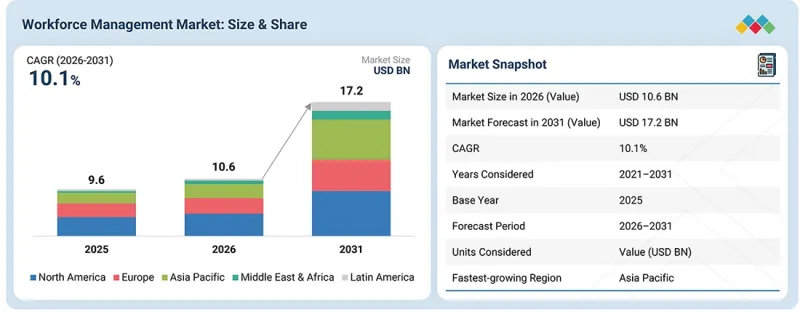
인력 관리 시장은 급속히 확대되고 있으며, 시장 규모는 2026년 약 106억 달러에서 2031년까지 172억 달러로 성장할 것으로 예상되며, 예측 기간 동안 연평균 성장률(CAGR)은 10.1%에 달할 것으로 전망됩니다.
세계 및 각 지역 시장에서 노동 규제가 점점 더 복잡해지고 있는 점이 인력 관리 수요를 견인할 것으로 예상됩니다. 오늘날의 조직은 초과근무 규정, 휴식 요건, 휴가 권리, 노동조합과의 협약, 안전 규정, 산업별 규정 준수 요건 등 노동법이 빈번하게 변경되는 환경에서 사업을 운영하고 있습니다.
| 조사 범위 | |
|---|---|
| 조사 대상 기간 | 2021-2031년 |
| 기준 연도 | 2025년 |
| 예측 기간 | 2026-2031년 |
| 산정 단위 | 10억 달러 |
| 부문 | 제공 방식별, 솔루션 유형별, 배포 방식별, 조직 규모별, 비즈니스 기능별, 산업별 |
| 대상 지역 | 북미, 유럽, 아시아태평양, 중동 및 아프리카, 라틴아메리카 |
대규모 또는 분산된 직원을 관리하는 기업의 경우, 이러한 규정을 수작업으로 준수하는 것이 점점 더 어려워지고 있으며, 규정 위반에 따른 벌금, 급여 계산 오류, 업무 효율 저하 등의 위험이 높아지고 있습니다. 인력 관리 솔루션은 규정 적용을 자동화하고, 국가별 규정 준수 템플릿을 유지하며, 규제 변경 사항을 실시간으로 반영함으로써 이러한 과제를 해결합니다. 이를 통해 정확한 근태 관리, 올바른 급여 계산, 문서 관리 개선 및 사업장 간 일관된 정책 적용이 보장됩니다. 기업이 지리적으로 확장되고 하이브리드형 및 유연한 근무 방식을 도입함에 따라, 통합되고 자동화된 규정 준수 관리의 필요성은 더욱 중요해지고 있습니다. 이러한 규제 압박이 가중됨에 따라, 기업들은 위험을 줄이고 원활하며 법규를 준수하는 업무 운영을 지원하는 첨단 인력 관리 시스템으로의 전환을 계속해서 요구받고 있습니다.
“전개 방식별로는 예측 기간 동안 클라우드가 가장 높은 성장률을 보일 것으로 예상됩니다.”
제조업, 소매업, 의료, 서비스업에 걸친 조직들이 사업을 확장하는 가운데, 클라우드 기반 WFM 플랫폼은 온프레미스 인프라 관리 부담 없이 여러 거점 간의 통합, 실시간 데이터 접근, 원활한 업데이트를 손쉽게 실현합니다. 모바일 근로자 및 데스크리스 근로자의 증가도 클라우드 도입을 더욱 가속화하고 있습니다. 클라우드 시스템을 통해 일정 관리, 근태 관리, 셀프서비스 도구에 대한 원격 접근이 가능하기 때문입니다.
또한, 클라우드 도입은 신속한 구현, 규정 준수 업데이트의 자동화, 그리고 견고한 보안 체계를 지원하므로, 민첩성과 IT 간접비 절감을 추구하는 기업에게 최적의 선택지가 되고 있습니다. 또한, 각 벤더사는 AI, 예측 분석, 자동화 기능을 클라우드 플랫폼에 직접 통합하고 있으며, 이를 통해 조직은 인력 계획 최적화, 수요 예측 및 직원 생산성 향상을 도모할 수 있습니다. 기업들이 비용 효율성, 운영 유연성, 디지털 전환을 우선시하는 가운데, 클라우드 도입 모델은 온프레미스 시스템을 능가하는 속도로 성장을 이어가며 WFM 시장의 주요 촉진요인으로 부상할 것입니다.
“솔루션 분야는 예측 기간 동안 가장 큰 시장 점유율을 차지할 것으로 전망됩니다.”
조직이 근태 관리, 근무표 작성, 결근 관리, 인력 최적화와 같은 핵심 기능의 자동화를 우선시함에 따라, 인력 관리 솔루션은 꾸준히 시장 점유율의 가장 큰 부분을 차지하고 있습니다. 이러한 솔루션은 제조, 소매, 물류, 의료 등 다양한 산업이 직면한 업무상의 과제를 직접 해결해 주며, 해당 산업에서는 비용 관리와 생산성 향상을 위해 실시간 인력 가시화 및 정확한 근로 시간 추적이 필수적입니다. 노동법이 복잡해지고 현장 직원 수가 증가하는 가운데, 기업들은 규정 준수를 확보하고, 인적 오류를 줄이며, 일상적인 인력 운영 업무의 효율성을 높이기 위해 고도화된 WFM 플랫폼 도입을 점점 더 확대하고 있습니다.
WFM 솔루션에 AI 및 분석 기능이 통합되는 추세도 수요를 더욱 가속화하고 있으며, 이를 통해 예측형 스케줄링, 수요 예측, 자동화된 의사결정 지원이 가능해졌습니다. 모바일 우선 기능, 셀프서비스 포털, 그리고 인사, 급여, ERP 시스템과의 원활한 연동 또한 이러한 솔루션을 인력 디지털화 전략의 핵심으로 자리매김하게 하고 있습니다. 클라우드 기반 도입이 증가하고 기업이 통합된 인력 생태계로 전환되는 가운데, 솔루션 제공은 계속해서 최고의 가치와 가장 광범위한 채택을 이끌어내며, 예측 기간 동안 인력 관리 시장의 주요 구성요소로서의 입지를 공고히 하고 있습니다.
“북미는 클라우드 기반 솔루션의 도입이 활발하여 시장을 선도하고 있습니다.”
북미는 선진적인 디지털 인프라, 견고한 규제 체계, 주요 산업에서의 광범위한 자동화 도입으로 인해 인력 관리 시장에서 가장 큰 점유율을 차지할 것으로 예상됩니다. 미국 및 캐나다의 조직들은 초과 근무 규제, 노동조합과의 협약, 주 차원의 노동 정책 등 강화된 노동 규정 준수 요건에 직면해 있으며, 이는 정확성과 투명성을 확보하기 위한 첨단 WFM 도구에 대한 의존도를 높이고 있습니다. 또한 제조업, 소매업, 의료, BFSI(은행·금융·보험), 공공 부문에 걸친 이 지역의 성숙한 기업 환경 역시 최신 근태 관리 시스템, AI를 활용한 스케줄링, 그리고 분석을 기반으로 한 인력 최적화에 대한 투자를 가속화하고 있습니다.
클라우드 기반 인력 관리 플랫폼의 높은 보급률은 ADP, UKG, Workday, Ceridian, Oracle과 같은 견실한 벤더들의 존재에 힘입어 북미의 우위를 더욱 공고히 하고 있습니다. 이러한 기업들은 예측형 인력 계획, 모바일 셀프서비스, AI를 활용한 규정 준수 모니터링 등의 혁신을 지속적으로 도입하며 대기업과 중견 기업 모두를 끌어들이고 있습니다. 또한, 해당 지역에서 하이브리드 및 현장 직원 모델로의 전환에 따라 실시간 가시성, 모바일 액세스, 통합된 인사·급여 워크플로를 제공하는 통합 플랫폼에 대한 수요가 증가하고 있습니다. 높은 기술 도입 준비도, 벤더들의 막대한 투자, 그리고 지속적인 업무 환경 혁신을 배경으로, 북미는 예측 기간 동안 지배적인 위치를 유지할 것으로 전망됩니다.
주요 조사 대상의 세부 내역
당사는 인력 관리 시장의 주요 조직에 소속된 최고경영자(CEO), 혁신 및 기술 담당 이사, 시스템 통합업체, 그리고 임원진을 대상으로 심층 인터뷰를 실시했습니다.
- 기업 규모별 : 티어 I - 35%, 티어 II - 45%, 티어 III - 20%
- 직책별 : C레벨 임원 - 35%, D레벨 임원 - 25%, 기타 - 40%
- 지역별 : 북미 45%, 유럽 20%, 아시아태평양 25%, 중동 및 아프리카 5%, 라틴아메리카 5%.
조사 범위
본 조사 보고서에서는 인력 관리 시장을 제공 내용(솔루션 및 서비스), 솔루션 유형(코어 WFM, 워크포스 최적화·분석, 워크포스 인텔리전스·전략), 서비스(전문 서비스, 관리형 서비스), 제공 형태(온프레미스, 클라우드), 조직 규모(대기업, 중소기업), 업무 기능(인사·인재 관리, 운영·현장 리더, 재무·급여, IT·보안), 산업별(BFSI, 소매·E-Commerce, 헬스케어·생명과학, 통신, IT·ITeS, 미디어·엔터테인먼트, 제조, 정부·국방, 운송·물류, 기타), 및 지역(북미, 유럽, 아시아태평양, 중동 및 아프리카, 라틴아메리카)을 기준으로 분류하고 있습니다. 본 보고서에서는 인력 관리 시장의 성장에 영향을 미치는 주요 요인(촉진요인, 제약요인, 과제, 기회 등)을 포괄적으로 다루고 있습니다. 주요 업계 플레이어에 대한 상세한 분석을 통해 각 기업의 사업 개요, 솔루션, 서비스는 물론 주요 전략, 계약, 파트너십, 합의 사항, 신제품·서비스 출시, 합병·인수, 그리고 인력 관리 시장의 최근 동향에 대한 인사이트를 제공합니다. 또한, 본 보고서에는 인력 관리 시장 생태계에서 두각을 나타내고 있는 스타트업 기업에 대한 경쟁 분석도 포함되어 있습니다.
본 보고서를 구매해야 하는 이유
본 보고서는 시장 선도 기업 및 신규 진입 기업에게 인력 관리 시장 전체 및 그 하위 부문에 대해 입수 가능한 가장 정확한 시장 매출 추정치를 제공합니다. 이를 통해 이해관계자는 경쟁 구도를 이해하고, 자사의 비즈니스를 더 유리한 위치에 놓으며, 적절한 시장 진입 전략을 수립하기 위한 인사이트를 얻을 수 있습니다. 또한 시장 동향을 파악하고, 주요 시장 촉진요인, 제약요인, 과제 및 기회에 대한 정보를 제공합니다.
본 보고서는 다음 사항에 대한 인사이트를 제공합니다:
- 주요 촉진요인(인력 관리와 인력 계획 및 인력 최적화의 융합 발전, 현장 및 데스크리스 직원의 업무에서 디지털화 진전, 기술 기반 인력 계획 및 배치의 도입 확대, 노동 규제의 복잡화 및 다국적 환경에서의 인력 규정 준수 강화) 및 제약요인(생체인식, 위치 정보, 직원 모니터링 기능에 대한 데이터 개인정보 보호 우려, 레거시 급여 계산 시스템, HCM, ERP 및 인력 시스템과의 복잡한 통합), 기회(AI 및 에이전틱 AI를 활용한 인력 관리 기능의 확대, 중소기업에서의 클라우드 기반 WFM 도입 확대, 피로 위험 및 인력 안전 관리 기회의 확대), 과제(인력 예측의 정확도 유지, 최적화와 일정 유연성 간의 균형 유지)
- 제품 개발/혁신 : 인력 관리 시장의 향후 기술, 연구 개발 활동 및 신제품·서비스 출시에 대한 상세한 인사이트
- 시장 개발 : 수익성이 높은 시장에 대한 종합적인 정보 - 본 보고서는 다양한 지역에 걸친 인력 관리 시장을 분석합니다
- 시장 다각화 : 인력 관리 시장의 신제품·서비스, 미개척 지역, 최근 동향 및 투자에 관한 종합적인 정보
- 경쟁 분석 : 주요 시장 촉진요인, 제약요인, 과제 및 기회에 대한 정보를 제공함으로써 이해관계자가 인력 관리 시장을 이해하는 데 도움을 줍니다.
자주 묻는 질문
목차
제1장 서론
제2장 요약
제3장 주요 인사이트
- 인력 관리 시장의 주요 기업들에게 매력적인 기회
- 인력 관리 시장 : 제공 서비스별
- 인력 관리 시장 : 솔루션 서비스별
- 인력 관리 시장 : 산업별
- 인력 관리 시장 : 지역별
제4장 시장 개요
- 시장 역학
- 성장 촉진요인
- 성장 억제요인
- 기회
- 과제
- 미충족 수요와 미개척 분야
- 인재 관리 시장의 미충족 수요
- 미개척 시장의 기회
- 상호 연관된 시장과 부문 간 기회
- 상호 연관된 시장
- 부문 간 기회
- 새로운 비즈니스 모델과 생태계의 변화
- 새로운 비즈니스 모델
- 생태계의 변화
- Tier 1/2/3 기업들의 전략적 움직임
- 주요 동향과 전략적 중점
제5장 업계 동향
- Porter's Five Forces 분석
- 신규 진입자의 위협
- 대체품의 위협
- 구매자의 협상력
- 공급업체의 협상력
- 경쟁 기업 간의 적대 관계의 격렬함
- 거시경제 전망
- GDP 동향 및 전망
- 세계 인적자본 관리 업계의 동향
- 세계 핵심 HR 소프트웨어 업계 동향
- 공급망 분석
- 기술 및 데이터 인프라 제공업체
- 인력 관리 소프트웨어 공급업체
- 시스템 통합업체 및 채널 파트너
- 산업별
- 생태계 분석
- 가격 분석
- 주요 기업별 솔루션 평균 판매 가격(2026년)
- 벤더별 제품 가격 추정 분석(2026년)
- 주요 컨퍼런스 및 행사(2026-2027년)
- 고객의 비즈니스에 영향을 미치는 동향/파괴적 변화
- 투자 및 자금 조달 시나리오
- 사례 연구 분석
- MILEONE AUTOGROUP, Workday의 인력 관리 솔루션을 통해 현장 직원의 효율성 향상
- OMEGA HEALTHCARE, Oracle Fusion Cloud를 활용하여 기업의 디지털 전환 가속화
- SUNOPTA, Dayforce를 활용하여 직원 관리 업무 및 급여 계산의 효율화 실현
- PLAINS COMMERCE BANK, PAYCOR 솔루션을 통해 직원 관리 및 인사 업무 현대화
- PILOT FLYING J, INFOR의 인력 관리 솔루션으로 직원 경험과 업무 일관성 향상
- 2025년 미국 관세가 미치는 영향 - 인력 관리 시장
- 주요 관세율
- 가격에 미치는 영향 분석
- 국가·지역별 영향
- 산업별 영향
제6장 기술 발전, AI의 영향, 특허, 혁신 및 향후 응용
- 기술 분석
- 주요 신흥 기술
- 보완 기술
- 인접 기술
- 기술·제품 로드맵
- 단기(2026-2028년) : 플랫폼 통합 및 설계 단계부터의 규정 준수 대응
- 중기(2028-2031년) : 실시간 인력 오케스트레이션 및 업무 통합
- 장기(2031-2036년 이후) : 자율적인 인력 운영 및 신뢰할 수 있는 생태계
- 특허 분석
- 미래 적용 분야
- 실시간 자율형 인력 오케스트레이션
- 기술 기반의 동적 인력 배분
- 규정 준수를 반영한 공정한 스케줄링 생태계
- 현장 직원을 위한 체험 중심 플랫폼
- 운영 주도형 인재 관리 컨트롤 타워
- AI/생성형 AI가 인재 관리 시장에 미치는 영향
- 주요 활용 사례와 시장의 잠재력
- 인력 관리 분야의 모범 사례
- 인력 관리 시장에서 AI 도입 사례 연구
- 상호 연계되는 인접 생태계와 시장 참여자에 미치는 영향
- 인력 관리 분야에서 생성형 AI 도입에 대한 고객의 준비 현황
- 성공 사례 및 실제 운영 사례
- ATOSS SOFTWARE : AI 인력 관리 플랫폼
- PAYCOR : AI를 활용한 인력 인사이트
제7장 규제 현황
- 규제 및 규정 준수
- 규제 기관, 정부 기관 및 기타 조직
- 지역별 업계 기준
제8장 고객 현황과 구매 행동
- 의사결정 과정
- 구매 과정에 관여하는 이해관계자와 그 평가 기준
- 구매 과정의 주요 이해관계자
- 구매 기준
- 도입 장벽과 사내 과제
- 각 최종사용자 산업 분야의 미충족 수요
- 시장의 수익성
- 수익 창출 가능성
- 비용 동향
- 주요 용도별 이익률 향상 기회
제9장 인력 관리 시장 : 제공 유형별
- 솔루션
- 서비스
제10장 인력 관리 시장 : 솔루션 유형별
- 핵심 WFM
- 인력 최적화(WFO) 및 분석
- 인력 인텔리전스 및 전략
제11장 인력 관리 시장 : 제공 방식별
- 온프레미스
- 클라우드
제12장 인력 관리 시장 : 조직 규모별
- 대기업
- 중소기업(SME)
제13장 인력 관리 시장 : 비즈니스 기능별
- 인사·인재 관리 기능
- 업무/현장 리더
- 재무·급여
- IT/보안
제14장 인력 관리 시장 : 산업별
- BFSI
- 소매·E-Commerce
- 헬스케어·생명과학
- 통신
- IT 및 ITES
- 미디어·엔터테인먼트
- 제조
- 정부·국방
- 운송·물류
- 기타 업종
제15장 인력 관리 시장 : 지역별
- 북미
- 미국
- 캐나다
- 유럽
- 영국
- 독일
- 프랑스
- 이탈리아
- 기타 유럽
- 아시아태평양
- 중국
- 인도
- 일본
- 호주 및 뉴질랜드
- 기타 아시아태평양
- 중동 및 아프리카
- GCC 국가들
- 남아프리카
- 기타 중동 및 아프리카
- 라틴아메리카
- 브라질
- 멕시코
- 기타 라틴아메리카
제16장 경쟁 현황
- 주요 진입 기업의 전략/강점,2023-2025년
- 수익 분석, 2021-2025년
- 시장 점유율 분석(2025년)
- 제품 비교
- WORKDAY
- UKG
- ORACLE
- SAP
- ADP
- 기업 평가 매트릭스 : 주요 기업, 2026년
- 스타
- 신흥 리더
- 광범위한 업체
- 진입 기업
- 기업 사업 전개 : 주요 기업, 2026년
- 기업 평가 매트릭스 : 스타트업/중소기업, 2026년
- 선도적인 기업
- 대응력이 뛰어난 기업
- 역동적인 기업
- 출발점
- 경쟁사 벤치마킹 : 스타트업/중소기업, 2026년
- 기업 평가 및 재무 지표
- 주요 벤더의 기업 가치 평가
- 주요 벤더의 재무 지표
- 경쟁 시나리오
- 제품 출시 및 기능 강화
- 거래
제17장 기업 개요
- 주요 기업
- WORKDAY
- UKG
- ORACLE
- SAP
- ATOSS SOFTWARE
- DAYFORCE
- INFOR
- ADP
- VERINT
- IBM
- 기타 주요 기업
- RAMCO SYSTEMS
- ACTIVEOPS PLC
- SISQUAL WFM
- NICE
- PAYCHEX
- PAYLOCITY
- QUINYX
- ZEBRA
- DELTEK
- LEGION TECHNOLOGIES, INC.
- ASSEMBLED
- SKEDULO
- CONNECTEAM
- PUSH OPERATIONS
- RIPPLING
- PERSONIO
제18장 조사 방법론
제19장 부록
KSM 26.10.23The workforce management market is expanding rapidly, with a projected market size rising from about USD 10.6 billion in 2026 to USD 17.2 billion by 2031, at a CAGR of 10.1% during the forecast period. Growing complexity of labor regulations across global and regional markets is expected to drive workforce management. Organizations today operate in environments where labor laws change frequently, covering overtime policies, break requirements, leave entitlements, union agreements, safety rules, and industry-specific compliance mandates.
| Scope of the Report | |
|---|---|
| Years Considered for the Study | 2021-2031 |
| Base Year | 2025 |
| Forecast Period | 2026-2031 |
| Units Considered | USD Billion |
| Segments | By Offering, By Solution Type, By Deployment Mode, By Organization Size, By Business Function, By Vertical |
| Regions covered | North America, Europe, Asia Pacific, Middle East & Africa, Latin America |
For companies managing large or distributed workforces, manually ensuring adherence to these regulations has become increasingly difficult, increasing the risk of non-compliance penalties, payroll inaccuracies, and operational inefficiencies. Workforce management solutions address this challenge by automating rule enforcement, maintaining country-specific compliance templates, and updating regulatory changes in real time. This ensures accurate time tracking, correct pay calculations, improved documentation, and consistent policy application across sites. As businesses expand geographically and adopt hybrid or flexible working models, the need for centralized, automated compliance management becomes even more critical. This growing regulatory pressure continues to push enterprises toward advanced workforce management systems that reduce risk and support smooth, lawful operations.
"By deployment mode, cloud is expected to account for the fastest growth rate during the forecast period"
As organizations across manufacturing, retail, healthcare, and services expand their operations, cloud-based WFM platforms offer easier multi-site integration, real-time data access, and seamless updates without the burden of managing on-premises infrastructure. The rise of mobile and deskless workers is further accelerating cloud adoption, as cloud systems enable remote access to scheduling, time tracking, and self-service tools.
Additionally, cloud deployment supports faster implementation, automated compliance updates, and stronger security frameworks, making it a preferred choice for companies seeking agility and reduced IT overheads. Vendors are also embedding AI, predictive analytics, and automation capabilities directly into cloud platforms, helping organizations optimize labor planning, forecast demand, and enhance workforce productivity. As enterprises prioritize cost efficiency, operational flexibility, and digital transformation, the cloud deployment model will continue to outpace on-premises systems and emerge as the dominant growth driver in the WFM market.
"By offering, the solutions segment is expected to hold the largest market share during the forecast period"
Workforce management solutions are steadily capturing the largest share of the market as organizations prioritize automation of core functions such as time and attendance, scheduling, absence management, and labor optimization. These solutions directly address the operational pressures faced by sectors like manufacturing, retail, logistics, and healthcare, where real-time workforce visibility and accurate labor tracking are essential for cost control and productivity. As labor laws become more complex and frontline workforces expand, companies are increasingly adopting advanced WFM platforms to ensure compliance, reduce manual errors, and streamline day-to-day workforce operations.
The growing integration of AI and analytics within WFM solutions is further accelerating demand, enabling predictive scheduling, demand forecasting, and automated decision support. Mobile-first capabilities, self-service portals, and seamless integration with HR, payroll, and ERP systems also make these solutions central to workforce digitalization strategies. As cloud-based deployments rise and enterprises shift toward unified workforce ecosystems, solution offerings continue to deliver the highest value and widest adoption, reinforcing their position as the dominant component in the workforce management market throughout the forecast period.
"North America leads the market with its strong adoption of cloud-based solutions"
North America is expected to hold the largest share of the workforce management market due to its advanced digital infrastructure, strong regulatory frameworks, and widespread adoption of automation across major industries. Organizations in the US and Canada face growing labor compliance requirements, including overtime rules, union agreements, and state-level labor policies, which drive reliance on sophisticated WFM tools for accuracy and transparency. The region's mature enterprise landscape across manufacturing, retail, healthcare, BFSI, and the public sector has also accelerated investment in modern time and attendance systems, AI-powered scheduling, and analytics-driven labor optimization.
High adoption of cloud-based workforce management platforms further strengthens North America's lead, supported by robust vendor presence, including ADP, UKG, Workday, Ceridian, and Oracle. These companies continually introduce innovations such as predictive workforce planning, mobile self-service, and AI-enabled compliance monitoring, attracting both large enterprises and mid-sized firms. Additionally, the region's shift toward hybrid and frontline workforce models has increased demand for unified platforms that offer real-time visibility, mobile access, and integrated HR-payroll workflows. With strong technology readiness, significant vendor investments, and ongoing workplace transformation, North America is expected to maintain its dominant position throughout the forecast period.
Breakdown of Primaries
We conducted in-depth interviews with Chief Executive Officers (CEOs), innovation and technology directors, system integrators, and executives from key organizations in the workforce management market.
- By Company: Tier I - 35%, Tier II - 45%, and Tier III - 20%
- By Designation: C-Level Executives - 35%, D-Level Executives - 25%, and Others - 40%
- By Region: North America - 45%, Europe - 20%, Asia Pacific - 25%, Middle East & Africa - 5%, and Latin America - 5%.
The report includes a study of key workforce management players. It profiles major vendors in the workforce management market. The major market players include ADP (US), UKG (US), Oracle (US), Workday (US), SAP (Germany), Dayforce (US), NICE (Israel), Infor (US), ATOSS Software (Germany), Verint (US), IBM (US), Zebra Technologies (US), Paychex (US), Deltek (US), Rippling (US), Legion Technologies (US), Paylocity (US), Ramco (India), Skedulo (US), Personia (US), Quinyx (Sweden), ActiveOps (UK), Sisqual WFM (Portugal), Assembled (US), Push Operation (Canada), and Connecteam (US).
Research Coverage
This research report categorizes the workforce management market based on offering (solutions and services), solution type (core WFM, workforce optimization & analytics, workforce intelligence & strategy), services (professional services, managed services), delivery mode (on-premises, cloud), organization size (large enterprises, SMEs), business function (HR/people function, operations/frontline leaders, finance & payroll, IT/security), vertical (BFSI, retail & E-commerce, healthcare & life sciences, telecommunication, IT & ITeS, media & entertainment, manufacturing, government & defense, transport & logistics, others), and region (North America, Europe, Asia Pacific, Middle East & Africa, and Latin America). The report covers major factors, including drivers, restraints, challenges, and opportunities, that influence the growth of the workforce management market. A detailed analysis of key industry players provides insights into their business overview, solutions, and services, as well as key strategies, contracts, partnerships, agreements, new product & service launches, mergers and acquisitions, and recent developments in the workforce management market. This report also includes a competitive analysis of emerging startups in the workforce management market ecosystem.
Reasons to Buy this Report
The report provides market leaders and new entrants with the closest available revenue estimates for the overall workforce management market and its subsegments. It helps stakeholders understand the competitive landscape and gain insights to better position their businesses and plan suitable go-to-market strategies. It also helps stakeholders understand the market's pulse and provides them with information on key market drivers, restraints, challenges, and opportunities.
The report provides insights into the following points:
- Analysis of key drivers (growing convergence of workforce management with workforce planning and labor optimization, increasing digitalization of frontline and deskless workforce operations, growing adoption of skills-based workforce planning and deployment, increasing complexity of labor regulations and multi-country workforce compliance), restraints (data privacy concerns around biometric, location, and employee monitoring capabilities, complex integration with legacy payroll, HCM, ERP, and workforce systems), opportunities (expansion of AI and Agentic AI-enabled workforce management capabilities, growing adoption of cloud-based WFM among SMEs, growing opportunity for fatigue risk and workforce safety management), and challenges (maintaining workforce forecast accuracy, balancing optimization with schedule flexibility)
- Product Development/Innovation: Detailed insights into upcoming technologies, research & development activities, and new product & service launches in the workforce management market
- Market Development: Comprehensive information about lucrative markets-the report analyses the workforce management market across varied regions
- Market Diversification: Exhaustive information about new products & services, untapped geographies, recent developments, and investments in the workforce management market
- Competitive Assessment: In-depth assessment of market shares, growth strategies and service offerings of leading players such as ADP (US), UKG (US), Oracle (US), Workday (US), SAP (Germany), Dayforce (US), NICE (Israel), Infor (US), ATOSS Software (Germany), Verint (US), IBM (US), Zebra Technologies (US), Paychex (US), Deltek (US), Rippling (US), Legion Technologies (US), Paylocity (US), Ramco (India), Skedulo (US), Personia (US), Quinyx (Sweden), ActiveOps (UK), Sisqual WFM (Portugal), Assembled (US), Push Operation (Canada), and Connecteam (US). The report also helps stakeholders understand the workforce management market, providing information on key market drivers, restraints, challenges, and opportunities.
TABLE OF CONTENTS
1 INTRODUCTION
- 1.1 STUDY OBJECTIVES
- 1.2 MARKET DEFINITION
- 1.3 MARKET SCOPE
- 1.3.1 MARKET SEGMENTATION AND REGIONAL SCOPE
- 1.3.2 INCLUSIONS AND EXCLUSIONS
- 1.3.3 YEARS CONSIDERED
- 1.4 CURRENCY CONSIDERED
- 1.5 LIMITATIONS
- 1.6 STAKEHOLDERS
- 1.7 SUMMARY OF CHANGES
2 EXECUTIVE SUMMARY
- 2.1 MARKET HIGHLIGHTS AND KEY INSIGHTS
- 2.2 KEY MARKET PARTICIPANTS: MAPPING OF STRATEGIC DEVELOPMENTS
- 2.3 DISRUPTIVE TRENDS IN WORKFORCE MANAGEMENT MARKET
- 2.4 HIGH-GROWTH SEGMENTS
- 2.5 REGIONAL SNAPSHOT: MARKET SIZE, GROWTH RATE, AND FORECAST
3 PREMIUM INSIGHTS
- 3.1 ATTRACTIVE OPPORTUNITIES FOR PLAYERS IN WORKFORCE MANAGEMENT MARKET
- 3.2 WORKFORCE MANAGEMENT MARKET, BY OFFERING
- 3.3 WORKFORCE MANAGEMENT MARKET, BY SOLUTION TYPE
- 3.4 WORKFORCE MANAGEMENT MARKET, BY VERTICAL
- 3.5 WORKFORCE MANAGEMENT MARKET, BY REGION
4 MARKET OVERVIEW
- 4.1 INTRODUCTION
- 4.2 MARKET DYNAMICS
- 4.2.1 DRIVERS
- 4.2.1.1 Growing convergence of workforce management with workforce planning and labor optimization
- 4.2.1.2 Increasing digitalization of frontline and deskless workforce operations
- 4.2.1.3 Growing adoption of skills-based workforce planning and deployment
- 4.2.1.4 Increasing complexity of labor regulations and multi-country workforce compliance
- 4.2.2 RESTRAINTS
- 4.2.2.1 Data privacy concerns
- 4.2.2.2 Integration complexity with legacy platforms
- 4.2.3 OPPORTUNITIES
- 4.2.3.1 Expansion of AI- and agentic AI-enabled workforce management capabilities
- 4.2.3.2 Expanding cloud WFM adoption among SMEs
- 4.2.3.3 Growing demand for real-time workforce analytics and reporting
- 4.2.3.4 Growing opportunity for fatigue risk and workforce safety management
- 4.2.4 CHALLENGES
- 4.2.4.1 Maintaining workforce forecast accuracy
- 4.2.4.2 Balancing optimization with schedule flexibility
- 4.2.1 DRIVERS
- 4.3 UNMET NEEDS AND WHITE SPACES
- 4.3.1 UNMET NEEDS IN WORKFORCE MANAGEMENT MARKET
- 4.3.2 WHITE SPACE OPPORTUNITIES
- 4.4 INTERCONNECTED MARKETS AND CROSS-SECTOR OPPORTUNITIES
- 4.4.1 INTERCONNECTED MARKETS
- 4.4.2 CROSS-SECTOR OPPORTUNITIES
- 4.5 EMERGING BUSINESS MODELS AND ECOSYSTEM SHIFTS
- 4.5.1 EMERGING BUSINESS MODELS
- 4.5.1.1 Workforce management business models
- 4.5.2 ECOSYSTEM SHIFTS
- 4.5.1 EMERGING BUSINESS MODELS
- 4.6 STRATEGIC MOVES BY TIER-1/2/3 PLAYERS
- 4.6.1 KEY MOVES AND STRATEGIC FOCUS
5 INDUSTRY TRENDS
- 5.1 PORTER'S FIVE FORCES ANALYSIS
- 5.1.1 THREAT OF NEW ENTRANTS
- 5.1.2 THREAT OF SUBSTITUTES
- 5.1.3 BARGAINING POWER OF BUYERS
- 5.1.4 BARGAINING POWER OF SUPPLIERS
- 5.1.5 INTENSITY OF COMPETITIVE RIVALRY
- 5.2 MACROECONOMIC OUTLOOK
- 5.2.1 INTRODUCTION
- 5.2.2 GDP TRENDS AND FORECASTS
- 5.2.3 TRENDS IN GLOBAL HUMAN CAPITAL MANAGEMENT INDUSTRY
- 5.2.4 TRENDS IN GLOBAL CORE HR SOFTWARE INDUSTRY
- 5.3 SUPPLY CHAIN ANALYSIS
- 5.3.1 TECHNOLOGY & DATA INFRASTRUCTURE PROVIDERS
- 5.3.2 WORKFORCE MANAGEMENT SOFTWARE VENDORS
- 5.3.3 SYSTEM INTEGRATORS & CHANNEL PARTNERS
- 5.3.4 VERTICALS
- 5.4 ECOSYSTEM ANALYSIS
- 5.5 PRICING ANALYSIS
- 5.5.1 AVERAGE SELLING PRICE OF SOLUTIONS, BY KEY PLAYER, 2026
- 5.5.2 INDICATIVE PRICING ANALYSIS OF PRODUCTS, BY VENDOR, 2026
- 5.6 KEY CONFERENCES AND EVENTS, 2026-2027
- 5.7 TRENDS/DISRUPTIONS IMPACTING CUSTOMER BUSINESS
- 5.8 INVESTMENT AND FUNDING SCENARIO
- 5.9 CASE STUDY ANALYSIS
- 5.9.1 MILEONE AUTOGROUP STRENGTHENS FRONTLINE WORKFORCE EFFICIENCY THROUGH WORKDAY WORKFORCE MANAGEMENT
- 5.9.2 OMEGA HEALTHCARE ACCELERATES ENTERPRISE DIGITAL TRANSFORMATION WITH ORACLE FUSION CLOUD
- 5.9.3 SUNOPTA STREAMLINES WORKFORCE OPERATIONS AND PAYROLL EFFICIENCY WITH DAYFORCE
- 5.9.4 PLAINS COMMERCE BANK MODERNIZES WORKFORCE AND HR OPERATIONS WITH PAYCOR
- 5.9.5 PILOT FLYING J ENHANCES WORKFORCE EXPERIENCE AND OPERATIONAL CONSISTENCY WITH INFOR WORKFORCE MANAGEMENT
- 5.10 IMPACT OF 2025 US TARIFF - WORKFORCE MANAGEMENT MARKET
- 5.10.1 INTRODUCTION
- 5.10.2 KEY TARIFF RATES
- 5.10.3 PRICE IMPACT ANALYSIS
- 5.10.4 IMPACT ON COUNTRIES/REGIONS
- 5.10.4.1 US
- 5.10.4.2 Europe
- 5.10.4.3 Asia Pacific
- 5.10.5 IMPACT ON VERTICALS
- 5.10.5.1 IT & ITeS
- 5.10.5.2 BFSI
- 5.10.5.3 Retail & e-commerce
- 5.10.5.4 Healthcare & life sciences
- 5.10.5.5 Media & entertainment
- 5.10.5.6 Manufacturing
- 5.10.5.7 Transportation & logistics
- 5.10.5.8 Government & defense
6 TECHNOLOGICAL ADVANCEMENTS, AI-DRIVEN IMPACT, PATENTS, INNOVATIONS, AND FUTURE APPLICATIONS
- 6.1 TECHNOLOGY ANALYSIS
- 6.1.1 KEY EMERGING TECHNOLOGIES
- 6.1.1.1 AI-driven workforce analytics and predictive labor optimization
- 6.1.1.2 Cloud-native workforce management platforms
- 6.1.1.3 Mobile workforce enablement and real-time employee engagement
- 6.1.2 COMPLEMENTARY TECHNOLOGIES
- 6.1.2.1 Workforce integration middleware and API orchestration
- 6.1.2.2 Labor compliance and rules-based workforce governance engines
- 6.1.2.3 Workforce data management and master data harmonization
- 6.1.3 ADJACENT TECHNOLOGIES
- 6.1.3.1 Workforce learning enablement and skills intelligence platforms
- 6.1.3.2 Workforce experience and employee sentiment intelligence
- 6.1.3.3 Workforce safety, risk, and incident management technologies
- 6.1.1 KEY EMERGING TECHNOLOGIES
- 6.2 TECHNOLOGY/PRODUCT ROADMAP
- 6.2.1 SHORT-TERM (2026-2028): PLATFORM UNIFICATION & COMPLIANCE-BY-DESIGN
- 6.2.2 MID-TERM (2028-2031): REAL-TIME LABOR ORCHESTRATION & OPERATIONAL INTEGRATION
- 6.2.3 LONG-TERM (2031-2036+): AUTONOMOUS WORKFORCE OPERATIONS & TRUSTED ECOSYSTEMS
- 6.3 PATENT ANALYSIS
- 6.4 FUTURE APPLICATIONS
- 6.4.1 REAL-TIME AUTONOMOUS WORKFORCE ORCHESTRATION
- 6.4.2 SKILLS-BASED DYNAMIC WORKFORCE ALLOCATION
- 6.4.3 COMPLIANCE-EMBEDDED FAIR SCHEDULING ECOSYSTEMS
- 6.4.4 EXPERIENCE-CENTRIC FRONTLINE WORKFORCE PLATFORMS
- 6.4.5 OPERATIONS-LED WORKFORCE CONTROL TOWERS
- 6.5 IMPACT OF AI/GENERATIVE AI ON WORKFORCE MANAGEMENT MARKET
- 6.5.1 TOP USE CASES AND MARKET POTENTIAL
- 6.5.2 BEST PRACTICES IN WORKFORCE MANAGEMENT
- 6.5.3 CASE STUDY OF AI IMPLEMENTATION IN WORKFORCE MANAGEMENT MARKET
- 6.5.3.1 Verint TimeFlex Bot enables AI-driven schedule flexibility for leading telecommunications company
- 6.5.4 INTERCONNECTED ADJACENCY ECOSYSTEM AND IMPACT ON MARKET PLAYERS
- 6.5.5 CLIENT READINESS TO ADOPT GENERATIVE AI IN WORKFORCE MANAGEMENT
- 6.6 SUCCESS STORIES AND REAL-WORLD APPLICATIONS
- 6.6.1 ATOSS SOFTWARE: AI WORKFORCE MANAGEMENT PLATFORM
- 6.6.2 PAYCOR: AI WORKFORCE INSIGHTS
7 REGULATORY LANDSCAPE
- 7.1 REGULATIONS AND COMPLIANCE
- 7.1.1 REGULATORY BODIES, GOVERNMENT AGENCIES, AND OTHER ORGANIZATIONS
- 7.1.2 INDUSTRY STANDARDS, BY REGION
- 7.1.2.1 North America
- 7.1.2.2 Europe
- 7.1.2.3 Asia Pacific
- 7.1.2.4 Middle East & Africa
- 7.1.2.5 Latin America
8 CUSTOMER LANDSCAPE AND BUYER BEHAVIOR
- 8.1 DECISION-MAKING PROCESS
- 8.2 BUYER STAKEHOLDERS INVOLVED IN BUYING PROCESS AND THEIR EVALUATION CRITERIA
- 8.2.1 KEY STAKEHOLDERS IN BUYING PROCESS
- 8.2.2 BUYING CRITERIA
- 8.3 ADOPTION BARRIERS AND INTERNAL CHALLENGES
- 8.4 UNMET NEEDS IN VARIOUS END-USER INDUSTRIES
- 8.5 MARKET PROFITABILITY
- 8.5.1 REVENUE POTENTIAL
- 8.5.2 COST DYNAMICS
- 8.5.3 MARGIN OPPORTUNITIES IN KEY APPLICATIONS
9 WORKFORCE MANAGEMENT MARKET, BY OFFERING
- 9.1 INTRODUCTION
- 9.1.1 OFFERING: WORKFORCE MANAGEMENT MARKET DRIVERS
- 9.2 SOLUTIONS
- 9.2.1 STANDALONE WFM
- 9.2.2 INTEGRATED WFM
- 9.3 SERVICES
- 9.3.1 PROFESSIONAL SERVICES
- 9.3.2 MANAGED SERVICES
10 WORKFORCE MANAGEMENT MARKET, BY SOLUTION TYPE
- 10.1 INTRODUCTION
- 10.1.1 SOLUTION TYPE: WORKFORCE MANAGEMENT MARKET DRIVERS
- 10.2 CORE WFM
- 10.2.1 TIME & ATTENDANCE
- 10.2.2 WORKFORCE SCHEDULING & PLANNING
- 10.2.3 LEAVE & ABSENCE MANAGEMENT
- 10.2.4 COMPLIANCE MANAGEMENT
- 10.2.5 OTHER CORE WFM SOLUTIONS
- 10.3 WORKFORCE OPTIMIZATION (WFO) & ANALYTICS
- 10.3.1 WORKFORCE PLANNING & DEMAND FORECASTING
- 10.3.2 PRODUCTIVITY & PERFORMANCE ANALYTICS
- 10.3.3 LABOR COSTING
- 10.3.4 OTHER WORKFORCE OPTIMIZATION & ANALYTICS SOLUTIONS
- 10.4 WORKFORCE INTELLIGENCE & STRATEGY
- 10.4.1 STRATEGIC WORKFORCE PLANNING
- 10.4.2 EMPLOYEE ENGAGEMENT
- 10.4.3 ADVANCED LABOR ANALYTICS
- 10.4.4 OTHER WORKFORCE INTELLIGENCE & STRATEGY SOLUTIONS
11 WORKFORCE MANAGEMENT MARKET, BY DELIVERY MODE
- 11.1 INTRODUCTION
- 11.1.1 DELIVERY MODE: WORKFORCE MANAGEMENT MARKET DRIVERS
- 11.2 ON-PREMISES
- 11.2.1 SECURE WORKFORCE OPERATIONS THROUGH ON-PREMISES DEPLOYMENT
- 11.3 CLOUD
- 11.3.1 TRANSFORM WORKFORCE OPERATIONS THROUGH CLOUD DELIVERY
- 11.3.2 PUBLIC CLOUD
- 11.3.3 PRIVATE CLOUD
12 WORKFORCE MANAGEMENT MARKET, BY ORGANIZATION SIZE
- 12.1 INTRODUCTION
- 12.1.1 ORGANIZATION SIZE: WORKFORCE MANAGEMENT MARKET DRIVERS
- 12.2 LARGE ENTERPRISES
- 12.2.1 STRENGTHENING LABOR PLANNING AND COMPLIANCE WITH WFM IN LARGE ENTERPRISES
- 12.3 SMALL & MEDIUM ENTERPRISES (SMES)
- 12.3.1 IMPROVING WORKFORCE EFFICIENCY IN SMES
13 WORKFORCE MANAGEMENT MARKET, BY BUSINESS FUNCTION
- 13.1 INTRODUCTION
- 13.1.1 BUSINESS FUNCTION: WORKFORCE MANAGEMENT MARKET DRIVERS
- 13.2 HR/PEOPLE FUNCTIONS
- 13.2.1 ENHANCING HR WORKFORCE VISIBILITY, SCHEDULING ACCURACY, AND POLICY ADHERENCE THROUGH WFM
- 13.3 OPERATIONS/FRONTLINE LEADERS
- 13.3.1 ENHANCING WORKFORCE PRODUCTIVITY AND SERVICE LEVELS THROUGH WFM FOR FRONTLINE LEADERS
- 13.4 FINANCE & PAYROLL
- 13.4.1 IMPROVING PAYROLL ACCURACY AND LABOR COST CONTROL THROUGH WFM SOLUTIONS
- 13.5 IT/SECURITY
- 13.5.1 STRENGTHENING WORKFORCE DATA SECURITY AND ACCESS CONTROL THROUGH WFM
14 WORKFORCE MANAGEMENT MARKET, BY VERTICAL
- 14.1 INTRODUCTION
- 14.1.1 VERTICAL: WORKFORCE MANAGEMENT MARKET DRIVERS
- 14.2 BFSI
- 14.3 RETAIL & E-COMMERCE
- 14.4 HEALTHCARE & LIFE SCIENCES
- 14.5 TELECOMMUNICATIONS
- 14.6 IT & ITES
- 14.7 MEDIA & ENTERTAINMENT
- 14.8 MANUFACTURING
- 14.9 GOVERNMENT & DEFENSE
- 14.10 TRANSPORTATION & LOGISTICS
- 14.11 OTHER VERTICALS
15 WORKFORCE MANAGEMENT MARKET, BY REGION
- 15.1 INTRODUCTION
- 15.2 NORTH AMERICA
- 15.2.1 US
- 15.2.1.1 AI-led innovation and platform consolidation to drive market
- 15.2.2 CANADA
- 15.2.2.1 Regulatory alignment, bilingual enablement, and sector-focused digitalization to drive market
- 15.2.1 US
- 15.3 EUROPE
- 15.3.1 UK
- 15.3.1.1 National labor reforms, public sector digitalization, and frontline workforce modernization to drive market
- 15.3.2 GERMANY
- 15.3.2.1 Industrial workforce complexity and need for AI-enabled skill-based scheduling to drive market
- 15.3.3 FRANCE
- 15.3.3.1 Labor regulation intensity, focus on AI-enabled HR platforms, and domestic software leadership to drive market
- 15.3.4 ITALY
- 15.3.4.1 AI-focused startup investment, HR services consolidation, and flexible workforce digitization to drive market
- 15.3.5 REST OF EUROPE
- 15.3.1 UK
- 15.4 ASIA PACIFIC
- 15.4.1 CHINA
- 15.4.1.1 National digitalization mandates, large-scale enterprise operations, and policy-led automation to drive market
- 15.4.2 INDIA
- 15.4.2.1 Public sector digitalization, AI-enabled compliance, and large-scale workforce formalization to drive market
- 15.4.3 JAPAN
- 15.4.3.1 Labor scarcity, regulatory complexity, and enterprise digital productivity platforms to drive market
- 15.4.4 AUSTRALIA AND NEW ZEALAND'S
- 15.4.4.1 Labor shortages, regulatory complexity, and digital workforce platforms to drive market
- 15.4.5 REST OF ASIA PACIFIC
- 15.4.1 CHINA
- 15.5 MIDDLE EAST & AFRICA
- 15.5.1 GCC COUNTRIES
- 15.5.1.1 Saudi Arabia
- 15.5.1.1.1 Digital labor reforms, payroll transparency, and compliance-led automation to drive market
- 15.5.1.2 UAE
- 15.5.1.2.1 Digital labor governance, AI integration and payroll-centric compliance to drive market
- 15.5.1.3 Other GCC countries
- 15.5.1.1 Saudi Arabia
- 15.5.2 SOUTH AFRICA
- 15.5.2.1 Focus on HR digitalization and data-driven workforce analytics to drive market
- 15.5.3 REST OF MIDDLE EAST & AFRICA
- 15.5.1 GCC COUNTRIES
- 15.6 LATIN AMERICA
- 15.6.1 BRAZIL
- 15.6.1.1 Digital transformation, labor compliance modernization, and data-driven HR platforms to drive market
- 15.6.2 MEXICO
- 15.6.2.1 Enterprise scaling, compliance automation, and digital time and attendance adoption to drive market
- 15.6.3 REST OF LATIN AMERICA
- 15.6.1 BRAZIL
16 COMPETITIVE LANDSCAPE
- 16.1 INTRODUCTION
- 16.2 KEY PLAYER STRATEGIES/RIGHT TO WIN, 2023-2025
- 16.3 REVENUE ANALYSIS, 2021-2025
- 16.4 MARKET SHARE ANALYSIS, 2025
- 16.5 PRODUCT COMPARISON
- 16.5.1 WORKDAY
- 16.5.2 UKG
- 16.5.3 ORACLE
- 16.5.4 SAP
- 16.5.5 ADP
- 16.6 COMPANY EVALUATION MATRIX: KEY PLAYERS, 2026
- 16.6.1 STARS
- 16.6.2 EMERGING LEADERS
- 16.6.3 PERVASIVE PLAYERS
- 16.6.4 PARTICIPANTS
- 16.6.5 COMPANY FOOTPRINT: KEY PLAYERS, 2026
- 16.6.5.1 Company footprint
- 16.6.5.2 Regional footprint
- 16.6.5.3 Solution type footprint
- 16.6.5.4 Vertical footprint
- 16.7 COMPANY EVALUATION MATRIX: STARTUPS/SMES, 2026
- 16.7.1 PROGRESSIVE COMPANIES
- 16.7.2 RESPONSIVE COMPANIES
- 16.7.3 DYNAMIC COMPANIES
- 16.7.4 STARTING BLOCKS
- 16.7.5 COMPETITIVE BENCHMARKING: STARTUPS/SMES, 2026
- 16.7.5.1 Detailed list of key startups/SMEs
- 16.7.5.2 Competitive benchmarking of key startups/SMEs
- 16.8 COMPANY VALUATION AND FINANCIAL METRICS
- 16.8.1 COMPANY VALUATION OF KEY VENDORS
- 16.8.2 FINANCIAL METRICS OF KEY VENDORS
- 16.9 COMPETITIVE SCENARIO
- 16.9.1 PRODUCT LAUNCHES AND ENHANCEMENTS
- 16.9.2 DEALS
17 COMPANY PROFILES
- 17.1 INTRODUCTION
- 17.2 KEY PLAYERS
- 17.2.1 WORKDAY
- 17.2.1.1 Business overview
- 17.2.1.2 Products/Solutions/Services offered
- 17.2.1.3 Recent developments
- 17.2.1.3.1 Product launches and enhancements
- 17.2.1.3.2 Deals
- 17.2.2 UKG
- 17.2.2.1 Business overview
- 17.2.2.2 Products/Solutions/Services offered
- 17.2.2.3 Recent developments
- 17.2.2.3.1 Product launches and enhancements
- 17.2.2.3.2 Deals
- 17.2.3 ORACLE
- 17.2.3.1 Business overview
- 17.2.3.2 Products/Solutions/Services offered
- 17.2.3.3 Recent developments
- 17.2.3.3.1 Product launches and enhancements
- 17.2.3.3.2 Deals
- 17.2.4 SAP
- 17.2.4.1 Business overview
- 17.2.4.2 Products/Solutions/Services offered
- 17.2.4.3 Recent developments
- 17.2.4.3.1 Product launches and enhancements
- 17.2.4.3.2 Deals
- 17.2.5 ATOSS SOFTWARE
- 17.2.5.1 Business overview
- 17.2.5.2 Products/Solutions/Services offered
- 17.2.5.3 Recent developments
- 17.2.5.3.1 Product launches and enhancements
- 17.2.5.3.2 Deals
- 17.2.6 DAYFORCE
- 17.2.6.1 Business overview
- 17.2.6.2 Products/Solutions/Services offered
- 17.2.6.3 Recent developments
- 17.2.6.3.1 Product launches
- 17.2.6.3.2 Deals
- 17.2.7 INFOR
- 17.2.7.1 Business overview
- 17.2.7.2 Products/Solutions/Services offered
- 17.2.7.3 Recent developments
- 17.2.7.3.1 Product launches and enhancements
- 17.2.7.3.2 Deals
- 17.2.8 ADP
- 17.2.8.1 Business overview
- 17.2.8.2 Products/Solutions/Services offered
- 17.2.8.3 Recent developments
- 17.2.8.3.1 Product launches and enhancements
- 17.2.8.3.2 Deals
- 17.2.9 VERINT
- 17.2.9.1 Business overview
- 17.2.9.2 Products/Solutions/Services offered
- 17.2.9.3 Recent developments
- 17.2.9.3.1 Product launches and enhancements
- 17.2.9.3.2 Deals
- 17.2.10 IBM
- 17.2.10.1 Business overview
- 17.2.10.2 Products/Solutions/Services offered
- 17.2.10.3 Recent developments
- 17.2.10.3.1 Product launches and enhancements
- 17.2.10.3.2 Deals
- 17.2.1 WORKDAY
- 17.3 OTHER PLAYERS
- 17.3.1 RAMCO SYSTEMS
- 17.3.2 ACTIVEOPS PLC
- 17.3.3 SISQUAL WFM
- 17.3.4 NICE
- 17.3.5 PAYCHEX
- 17.3.6 PAYLOCITY
- 17.3.7 QUINYX
- 17.3.8 ZEBRA
- 17.3.9 DELTEK
- 17.3.10 LEGION TECHNOLOGIES, INC.
- 17.3.11 ASSEMBLED
- 17.3.12 SKEDULO
- 17.3.13 CONNECTEAM
- 17.3.14 PUSH OPERATIONS
- 17.3.15 RIPPLING
- 17.3.16 PERSONIO
18 RESEARCH METHODOLOGY
- 18.1 RESEARCH DATA
- 18.1.1 SECONDARY DATA
- 18.1.1.1 Data & list of key secondary sources
- 18.1.2 PRIMARY DATA
- 18.1.2.1 Breakdown of primary interviews
- 18.1.2.2 Key industry insights
- 18.1.1 SECONDARY DATA
- 18.2 MARKET SIZE ESTIMATION
- 18.3 DATA TRIANGULATION
- 18.4 FACTOR ANALYSIS
- 18.5 RESEARCH ASSUMPTIONS
19 APPENDIX
- 19.1 DISCUSSION GUIDE
- 19.2 KNOWLEDGESTORE: MARKETSANDMARKETS' SUBSCRIPTION PORTAL
- 19.3 CUSTOMIZATION OPTIONS
- 19.4 RELATED REPORTS
- 19.5 AUTHOR DETAILS


