

|
시장보고서
상품코드
2152959
무균 포장 시장 : 소재, 유형, 용도, 지역별 - 세계 예측(-2031년)Aseptic Packaging Market by Material (Plastic, Metal, Glass, Paper & Paperboard), Type (Cartons, Bottles & Cans, Bags & Pouches, Vial, Ampoules and Prefillable Syringes), Application (Beverage, Food, Pharmaceutical), & Region - Global Forecast to 2031 |
||||||

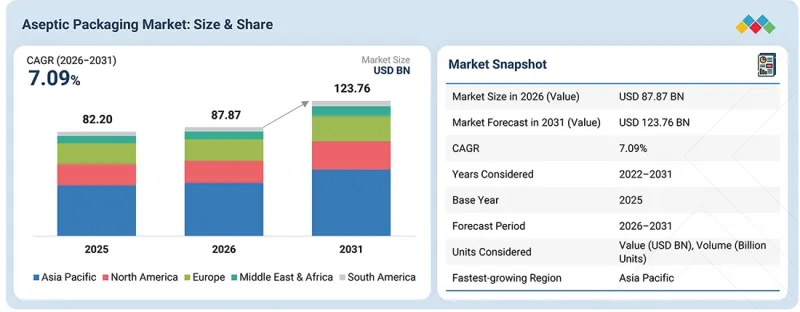
무균 포장 시장은 2026년 878억 7,000만 달러에서 2031년에는 1,237억 6,000만 달러에 달할 것으로 예상되며, 2026년부터 2031년까지의 연평균 성장률(CAGR)은 7.09%가 될 것으로 전망됩니다.
| 조사 범위 | |
|---|---|
| 조사 대상 기간 | 2022-2031년 |
| 기준 연도 | 2025년 |
| 예측 기간 | 2026-2031년 |
| 산정 단위 | 금액(백만 달러)/수량(10억 단위) |
| 부문 | 소재, 종류, 용도 및 지역 |
| 대상 지역 | 북미, 아시아태평양, 유럽, 중동 및 아프리카, 남미 |
무균 포장 시장은 공급망 전반에 걸친 광범위한 식품 손실, 음료 카테고리의 다양화, 분량이 조절된 포장에 대한 수요 증가, 그리고 무균 의약품 분야의 활성화에 힘입어 성장하고 있습니다.
“종이·판지 부문은 예측 기간 동안 2위 규모를 기록할 것으로 전망됩니다.”
종이·판지 부문은 세계 무균 포장 시장의 주요 소재 중 하나로, 2위 규모를 기록할 것으로 예상됩니다. 이러한 높은 비중은 유제품, 식물성 우유 대체품, 주스 및 기타 액체 식품용 액체 카톤의 생산 규모와 특성에서 기인합니다. 판지는 강성과 두께라는 필수 특성에 더해 고품질의 인쇄면을 겸비한, 다층 라미네이트 포장재 시스템의 필수적인 구조 요소로 간주됩니다. 시장에서 판지가 차지하는 막대한 점유율은 부피가 큰 포장에서 운송 효율을 최적화하는 블록 카톤 형태의 공간 절약형 포장으로의 전환을 목표로 하는 식품 및 농업 산업에 의해 뒷받침되고 있습니다. 또한, 판지는 재생 가능한 목재 섬유로 제조되기 때문에 이러한 용도는 탄소발자국 감축을 목표로 하는 기업의 지속가능성 노력과 크게 부합합니다. 마지막으로, 플라스틱을 과도하게 사용하지 않으면서도 식품을 무균 상태로 유지하는 바이오 기반 보호 코팅에 대한 최신 개발 덕분에, 판지 부문은 전 세계 매출액 기준 2위 자리를 확고히 하고 있습니다.
“병·캔 부문은 예측 기간 동안 2위 규모를 차지할 것으로 전망됩니다.”
병·캔 부문은 전 세계 무균 포장 산업에서 2위 규모를 차지할 것으로 예상됩니다. 이러한 높은 시장 점유율의 배경에는 프리미엄 즉석 음료, 임상용 영양액 및 특수 유제품에 대한 시장 수요 증가가 있습니다. PET 병(PET, HDPE 등) 및 알루미늄 캔에 무균 충전 기술을 적용함으로써, 민감한 액체를 완전히 무균 환경에서 보호하고, 보존제를 사용하지 않으면서도 신선도, 풍미, 향을 유지할 수 있게 됩니다. 병과 캔은 장거리 운송 시에도 탁월한 안전성과 보호 성능을 제공하는 견고한 구조라는 고유한 특성 덕분에 소비재(CPG) 업계 브랜드들 사이에서 특히 인기가 높습니다. 또한, 드라이 포밍 기술 및 경량화 기술 분야의 역동적인 혁신으로 인해 이러한 용기 형태의 재료 및 물 소비량이 획기적으로 감소했습니다. 이러한 모든 특징 덕분에 병·캔 부문은 시장에서 두 번째로 중요한 부문임을 보장받고 있습니다.
“예측 기간 동안 식품 부문은 규모 면에서 2위를 차지할 것으로 전망됩니다.”
식품 부문은 전 세계 무균 포장 시장에서 두 번째로 큰 용도 부문이 될 것으로 예측됩니다. 무균 포장에 대한 수요가 막대한 이유는 액상 달걀, 수프, 육수, 이유식, 토마토 페이스트, 레토르트 식품 등 신선 식품의 대량 생산 때문입니다. 무균 처리 공정에서는 식품이 용기에서 분리된 상태에서 순간 살균이 이루어지기 때문에 천연의 풍미, 색상, 식감, 비타민이 손상되지 않을 뿐만 아니라 화학 약품이나 냉장 보관도 필요하지 않습니다. 이를 통해 생산자는 콜드체인의 신뢰성 부족 등 다양한 문제에 시달리지 않고, 복잡한 공급망을 통해 제품을 유통할 수 있게 됩니다. 또한, 이 설계는 일정한 견고성을 갖추고 있어 원재료를 안전하게 운송할 수 있습니다. 동시에 상온 보관이 가능하고, 바로 먹을 수 있으며, 표시가 알기 쉬운 제품에 대한 수요는 계속해서 증가하고 있어, 이에 따라 식품 부문은 확고한 2위 자리를 확보하고 있습니다.
“시장 규모 측면에서는 예측 기간 동안 북미가 2위 부문이 될 것으로 전망됩니다.”
북미는 전 세계 무균 포장 산업에서 2위 지역 부문이 될 것으로 예상됩니다. 시장에서 이러한 중요한 위상은 주로 미국 및 캐나다의 식품 및 음료 산업과 제약 산업의 전반적인 발전에 기인합니다. 북미에서는 편의성을 중시하는 제품에 대한 소비자의 선호도가 높아짐에 따라, 프리미엄 즉석 음용 기능성 음료, 유기농 및 클린 라벨 유제품 대체품, 그리고 분량이 조절된 1인분 식사에 대한 수요가 증가하고 있습니다. 또한, 북미의 바이오의약품 산업 및 생명공학 발전은 치료제, 생물학적 제제, 백신을 미생물 오염으로부터 보호하기 위해 설계된 무균 기술에 의존하고 있습니다. 기업에 무균 제조 기준 준수를 의무화하는 엄격한 지역 규제의 존재, E-Commerce를 위한 첨단 배송 시스템의 구축, 그리고 친환경 포장 형태 개발에 주력하는 기업들의 존재가 이 시장이 다른 지역 중에서 2위 자리를 확고히 하는 요인이 되고 있습니다.
기업 유형별 : Tier 1 : 25%, Tier 2 : 42%, Tier 3 : 33%
직책별 : C레벨 임원 : 20%, 이사 : 30%, 기타 직책 : 50%
지역별 : 북미 : 20%, 유럽 : 10%, 아시아태평양 : 40%, 남미 : 10%, 중동 및 아프리카 : 20%
참고 : 기타 직책에는 영업, 마케팅 및 제품 관리자가 포함됩니다.
Tier 1 : 10억 달러 초과, Tier 2 : 5억 달러-10억 달러, Tier 3 : 5억 달러 미만
본 조사에서는 무균 포장 시장의 주요 기업들에 대해 기업 개요, 최근 동향 및 주요 시장 전략을 포함한 상세한 경쟁 분석을 수행하고 있습니다.
조사 범위
본 조사 보고서에서는 무균 포장 시장을 소재(플라스틱, 금속, 유리, 종이·판지, 기타), 유형(카톤, 병·캔, 봉지·파우치, 바이알, 앰플 및 프리필 주사기, 기타), 용도(음료, 식품, 의약품, 기타), 지역(북미, 유럽, 아시아태평양, 중동 및 아프리카, 남미)에 따라 분류하고 있습니다. 본 보고서의 범위에는 무균 포장 시장의 성장에 영향을 미치는 촉진요인, 제약요인, 과제 및 기회에 대한 상세한 정보가 포함되어 있습니다. 주요 업계 기업에 대한 상세한 분석을 통해 사업 개요, 제공 제품, 그리고 무균 포장 시장과 관련된 파트너십, 제휴, 제품 출시, 사업 확장, 인수합병(M&A) 등의 주요 전략에 대한 인사이트를 제공합니다. 또한, 본 보고서에서는 무균 포장 시장 생태계에서 두각을 나타내고 있는 스타트업 기업의 경쟁 동향에 대한 인사이트도 다루고 있습니다.
본 보고서를 구매해야 하는 이유
본 보고서는 시장 선도 기업 및 신규 진입 기업에게 무균 포장 시장 전체 및 각 하위 부문의 매출에 대한 가장 정확한 추정치를 제공합니다. 본 보고서는 이해관계자가 경쟁 구도를 이해하고, 자사의 비즈니스를 보다 적절하게 포지셔닝하기 위한 인사이트를 심화하며, 적절한 시장 진입 전략을 수립하는 데 도움이 됩니다. 또한 시장 동향을 파악하고, 주요 시장 촉진요인, 제약요인, 과제 및 기회에 대한 정보를 제공합니다.
본 보고서는 다음 사항에 대한 인사이트를 제공합니다:
주요 촉진요인(전체 공급망에 걸친 광범위한 식품 손실, 기존 우유를 넘어선 음료 카테고리의 다양화, 분량 조절된 식품 포맷에 대한 수요 증가, 무균 의약품 분야의 활동 확대) 및 제약요인(무균 생산에 필요한 막대한 자본, 의약품 포장에 대한 엄격한 인증 요건)에 대한 분석, 기회(가공 식품 수출 활동의 확대, 의약품용 프리필드 주사기 및 주사제용 포장, 식물성 유제품 대체품의 성장), 그리고 과제(지역별 환경 규제의 차이, 소규모 제조업체의 비용 효율성 우려)에 대한 분석.
- 제품 개발/혁신 : 무균 포장 시장의 향후 기술, 연구개발 활동 및 제품·서비스 출시에 대한 상세한 인사이트.
- 시장 개발 : 수익성이 높은 시장에 대한 종합적인 정보 - 본 보고서는 다양한 지역에 걸친 무균 포장 시장을 분석하고 있습니다.
시장 다각화 : 무균 포장 시장의 신제품 및 서비스, 미개척 지역, 최근 동향 및 투자에 관한 종합적인 정보.
- 경쟁 평가 : 주요 기업의 시장 점유율, 성장 전략 및 서비스 제공 내용에 대한 상세한 평가
자주 묻는 질문
목차
제1장 서론
제2장 요약
제3장 주요 인사이트
- 무균 포장 시장의 사업자에게 매력적인 비즈니스 기회
- 무균 포장 시장 : 소재 및 유형별
- 무균 포장 시장 : 용도별
- 무균 포장 시장 : 국가별
제4장 시장 개요
- 시장 역학
- 성장 촉진요인
- 성장 억제요인
- 기회
- 과제
- 미충족 수요와 미개척 분야
- 충족되지 않은 수요
- 미개척 분야
- 상호 연관된 시장과 부문 간 기회
- 부문 간 기회
- Tier 1/2/3 주요 기업들의 전략적 움직임
제5장 업계 동향
- Porter's Five Forces 분석
- 신규 진입자의 위협
- 대체품의 위협
- 공급업체의 협상력
- 구매자의 협상력
- 경쟁 기업 간의 적대적 관계
- 거시경제 분석
- GDP 동향 및 전망
- 가치사슬 분석
- 생태계 분석
- 가격 책정 분석
- 주요 기업별 용도별 평균 판매 가격 동향(2025년)
- 지역별 평균 판매 가격 동향(2022-2025년)
- 무역 분석
- HS 코드 392310의 수출 데이터
- HS 코드 392310의 수입 데이터
- HS 코드 4819의 수출 데이터
- HS 코드 4819의 수입 데이터
- 2026-2027년 주요 회의 및 행사
- 고객의 비즈니스에 영향을 미치는 동향 및 변화
- 투자 및 자금 조달 시나리오
- 사례 연구 분석
- LASSONDE의 와인 포장 혁신 : 유리병에서 무균 카톤으로의 전환
- HOCHWALD의 지속가능한 무균 우유 포장 : 무균 카톤에서 알루미늄 제거
- MENGNIU의 맛 우유 포장 혁신 : 무균 포장을 통한 맛 우유의 차별화
- 2025년 미국 관세가 무균 포장 시장에 미치는 영향
- 가격에 미치는 영향 분석
- 각 지역에 미치는 주요 영향
- 최종 용도 부문에 미치는 영향
제6장 기술, 특허, 디지털화, AI 도입에 따른 전략적 변혁
- 주요 신흥 기술
- 무균 충전·밀봉 기술
- 전자빔 멸균 기술
- 고차단 다층 무균 포장 기술
- 보완 기술
- 무균 캡 및 주입구 기술
- 인라인 무균 포장 검사 기술
- 관련 기술
- 레토르트 포장 기술
- 가스 치환 포장(MAP) 기술
- 기술·제품 로드맵
- 단기(2025-2027년)|차단 성능 최적화 및 살균 효율 향상 단계
- 중기(2027-2030년) : 스마트 충전 및 첨단 소재 단계
- 장기(2030-2035년 이후) : 지능형 순환형 무균 포장 단계
- 특허 분석
- 접근 방식
- 주요 출원인
- 관할 구역 분석
- 향후 응용
- 정밀 발효 원료용 무균 포장
- 배양육 배지용 무균 포장
- 효소를 이용한 식품 가공 시스템을 위한 무균 포장
- 실험실에서 배양된 생물학적 시약용 무균 포장
- 무균성 확보를 위한 자가 모니터링형 무균 포장
- AI/생성형 AI가 무균 포장 시장에 미치는 영향
- 주요 사용 사례 및 시장의 잠재력
- 무균 포장 분야에서 제조사/OEM이 실천하는 모범 사례
- 무균 포장 시장에서 AI 도입 사례 연구
- 상호 연계된 생태계와 시장 관계자에 미치는 영향
- AI를 통합한 무균 포장에 대한 고객의 수용도
제7장 지속가능성과 규제 현황
- 지역별 규제 및 규정 준수
- 규제 기관, 정부 기관 및 기타 조직
- 업계 표준
- 지속가능성 추진 활동
- 탄소 배출량 감축 노력
- 무균 포장에서의 친환경 적용
- 규제 정책이 지속가능성 노력에 미치는 영향
- 인증, 표시, 환경 기준
제8장 고객 동향과 구매 행동
- 의사결정 과정
- 구매 과정에 관여하는 주요 이해관계자와 그 평가 기준
- 구매 과정의 주요 이해관계자
- 구매 기준
- 도입 장벽 및 사내 과제
- 다양한 최종 용도에서의 미충족 수요
- 시장의 수익성
- 수익 창출 가능성
- 비용 동향
- 용도별 이익률 기회
- 식품
- 음료
- 의약품
- 기타 용도
제9장 무균 포장 시장 : 소재별
- 플라스틱
- 종이 및 판지
- 금속
- 유리
- 기타 소재
제10장 무균 포장 시장 : 유형별
- 카톤
- 병 및 캔
- 봉지 및 파우치
- 바이알, 앰플 및 프리필 주사기
- 기타 유형
제11장 무균 포장 시장 : 용도별
- 음료
- 식품
- 의약품
- 기타 용도
제12장 무균 포장 시장 : 지역별
- 아시아태평양
- 중국
- 인도
- 일본
- 한국
- 호주
- 기타 아시아태평양
- 북미
- 미국
- 캐나다
- 멕시코
- 유럽
- 독일
- 영국
- 프랑스
- 스페인
- 이탈리아
- 기타 유럽
- 중동 및 아프리카
- GCC 국가들
- 사우디아라비아
- 아랍에미리트
- 기타 GCC 국가
- 남아프리카
- 기타 중동 및 아프리카 국가들
- 남미
- 브라질
- 아르헨티나
- 기타 남미
제13장 경쟁 현황
- 개요
- 주요 진입 기업의 전략/강점
- 수익 분석(2021-2025년)
- 시장 점유율 분석(2025년)
- 브랜드 비교
- 기업 평가 매트릭스 : 주요 기업, 2025년
- 스타 기업
- 신흥 리더
- 광범위한 업체
- 진입 기업
- 기업 사업 전개 : 주요 기업, 2026년
- 기업 평가 매트릭스 : 스타트업/중소기업, 2025년
- 선도적인 기업
- 대응력이 뛰어난 기업
- 역동적인 기업
- 출발점
- 경쟁사 벤치마킹 : 스타트업/중소기업, 2025년
- 기업 평가 및 재무 지표
- 기업 평가
- 재무 지표
- 경쟁 시나리오
- 제품 출시
- 거래
- 사업 확장
- 기타 동향
제14장 기업 개요
- 주요 기업
- AMCOR PLC
- MONDI PLC
- SMURFIT WESTROCK PLC
- TOPPAN HOLDINGS INC.
- GRAPHIC PACKAGING HOLDING COMPANY
- NIPPON PAPER INDUSTRIES CO., LTD.
- DAI NIPPON PRINTING CO., LTD.(DNP)
- HUHTAMAKI OYJ
- STORA ENSO OYJ
- TETRA PAK INTERNATIONAL S.A.
- 기타 주요 기업
- SIG GROUP AG
- UFLEX LIMITED
- ELOPAK ASA
- GREATVIEW ASEPTIC PACKAGING CO., LTD.
- NAMPAK LIMITED
- GOGLIO S.P.A.
- PRINTPACK, INC.
- ECOLEAN AB
- ARAN GROUP
- DIZAYN PACK
- POSETSAN AMBALAJ SANAYI VE TICARET A.S.
- LAMIPAK
- POLYOAK PACKAGING
- AMERICAN PACKAGING CORPORATION
- HANSIN PACKING
제15장 조사 방법론
제16장 부록
KSM 26.10.26The aseptic packaging market is projected to reach USD 123.76 billion in 2031 from USD 87.87 billion in 2026, at a CAGR of 7.09% from 2026 to 2031.
| Scope of the Report | |
|---|---|
| Years Considered for the Study | 2022-2031 |
| Base Year | 2025 |
| Forecast Period | 2026-2031 |
| Units Considered | Value (USD Million) / Volume (Billion Units) |
| Segments | Material, Type, Application, and Region |
| Regions covered | North America, Asia Pacific, Europe, the Middle East & Africa, and South America |
The aseptic packaging market is driven by extensive food loss across supply chains, beverage category diversification, rising demand for portion-controlled formats, and increasing sterile pharmaceutical product activity.
"The paper & paperboard segment is projected to be the second largest during the forecast period."
The paper & paperboard segment is expected to be second largest segment as one of the main materials in the global aseptic packaging market. This high profile can be attributed to the scale and nature of the production of liquid cartons for dairy products, vegetable milk alternatives, juices, and other liquid foods. Paperboard is considered to be the essential structural component of multi-laminate system of packaging material combining the necessary characteristics of rigidity and thickness and the high-quality printing surface. The huge share of paperboard in the market is supported by the food and agriculture industries that strive to shift from bulky packaging to space-saving packaging in the shape of block cartons, which optimize shipping efficiency. Furthermore, since paperboard is manufactured from renewable wood fibers, this usage largely matches the corporate sustainability efforts aimed at decreasing carbon footprint. Finally, the latest developments in bio-based protective coatings that keep food sterile without excessive usage of plastics guarantee the place of the paperboard segment in the second position in global sales.
"The bottles & cans segment is projected to be the second largest during the forecast period."
The bottles & cans segment is anticipated to be the second-largest segment within the global aseptic packaging industry. The reason behind this major share in the market is due to increasing market demand for high-end ready-to-drink beverages, clinical nutritional liquids, and specialty dairy products. Usage of aseptic filling technology for plastic bottles (like PET and HDPE) and aluminum cans protects delicate liquids in completely sterile environments, helping maintain freshness, flavor, and aroma without the need for preservatives. Bottles and cans are especially popular amongst brands in the consumer packaged goods (CPG) industry because of the unique properties of their rigid structures that provide a remarkable level of safety and protection when being transported across long distances. Moreover, dynamic innovations in dry forming technologies and lightweight technologies have caused a dramatic drop in both material and water consumption in these formats. All those features assure Bottles & Cans sector is the second most important segment in the market.
"Food segment projected to be the second largest during the forecast period."
The food segment is projected to be the second largest application segment in the global aseptic packaging market. The substantial volume of aseptic packaging is attributed to the mass production of perishable food products, such as liquid egg, soups, broths, baby food, tomato paste, and ready meals. In the aseptic treatment process, food products undergo flash sterilization away from the container, preventing any loss of natural flavors, colors, textures, and vitamins, and using no chemicals or refrigeration. This effectively equips producers with the ability to distribute their products across complicated supply chains unburdened by various problems, including the unreliability of cold supply chains. The design also has certain robustness, which allows for the shipment of materials safely. At the same time, the demand for shelf-stable, ready-to-eat, and easy-to-read products continues to grow, thereby ensuring a secure second place for the food segment.
"In terms of value, the North America region is projected to be the second-largest segment during the forecast period."
The North America region is anticipated to be the second leading geographic segment in the global aseptic packaging industry. This significant position in the market is mainly attributed to the overall development of the food and beverage and the pharmaceutical industry in the United States and Canada. In North America, the growing preference of consumers for convenience-related products leads to the growing demand for premium ready-to-drink functional beverages, organic clean-label dairy alternatives, and portion-controlled single-serve meals. Moreover, the biopharmaceutical industry in North America, as well as biotechnological advancements, depends on aseptic technologies designed to secure therapeutic agents, biologics, and vaccines against microbial contamination. The presence of strict regional regulations requiring companies to follow aseptic manufacturing norms, the availability of developed delivery systems for e-commerce, and companies striving to develop environmentally-friendly packaging formats have contributed to achieving the second position among other regions in the market.
By Company Type: Tier 1: 25%, Tier 2: 42%, and Tier 3: 33%
By Designation: C-level Executives: 20%, Directors: 30%, and Other Designations: 50%
By Region: North America: 20%, Europe: 10%, Asia Pacific: 40%, South America: 10%, and Middle East & Africa 20%
Notes: Other designations include sales, marketing, and product managers.
Tier 1: >USD 1 Billion; Tier 2: USD 500 million-1 Billion; and Tier 3: <USD 500 million
Companies Covered: Amcor plc (Switzerland), Mondi plc (UK), Smurfit Westrock plc (Ireland), TOPPAN Holdings Inc. (Japan), Graphic Packaging Holding Company (US), Nippon Paper Industries Co., Ltd. (Japan), Dai Nippon Printing Co., Ltd. (DNP) (Japan), Huhtamaki Oyj (Finland), Stora Enso Oyj (Finland), Tetra Pak International S.A. (Switzerland), among others, are covered in the report.
The study includes an in-depth competitive analysis of these key players in the aseptic packaging market, with their company profiles, recent developments, and key market strategies.
Research Coverage
This research report categorizes the aseptic packaging market based on material (plastic, metal, glass, paper & paperboard, others), type (cartons, bottles & cans, bags & pouches, vials, ampoules and prefillable syringes, others), application (beverage, food, pharmaceutical, others), and region (North America, Europe, Asia Pacific, Middle East & Africa, and South America). The report's scope covers detailed information regarding the drivers, restraints, challenges, and opportunities influencing the growth of the aseptic packaging market. A detailed analysis of the key industry players has been done to provide insights into their business overview, products offered, and key strategies, such as partnerships, collaborations, product launches, expansions, and acquisitions, associated with the aseptic packaging market. This report covers a competitive analysis of upcoming startups in the aseptic packaging market ecosystem.
Reasons to Buy the Report
The report will offer market leaders/new entrants with information on the closest approximations of the revenue numbers for the overall aseptic packaging market and the subsegments. This report will help stakeholders understand the competitive landscape, gain more insights into positioning their businesses better, and plan suitable go-to-market strategies. The report will help stakeholders understand the pulse of the market and provide them with information on key market drivers, restraints, challenges, and opportunities.
The report provides insights into the following points:
Analysis of key drivers (extensive food loss across supply chains, beverage category diversification beyond traditional milk, increasing demand for portion-controlled food formats, increasing sterile pharmaceutical product activity), restraints (high capital requirements for aseptic production, high pharmaceutical packaging qualification requirements), opportunities (expansion of processed food export activity, pharmaceutical prefilled syringe and injectable packaging, growth of plant-based dairy alternatives), and challenges (variations in environmental mandates across regions, cost-to-benefit ratio a concern to small manufacturers).
- Product Development/Innovation: Detailed insights into upcoming technologies, research & development activities, and product & service launches in the aseptic packaging market.
- Market Development: Comprehensive information about profitable markets - the report analyzes the aseptic packaging market across varied regions.
Market Diversification: Exhaustive information about new products & services, untapped geographies, recent developments, and investments in the aseptic packaging market.
- Competitive Assessment: In-depth assessment of market shares, growth strategies, and service offerings of leading players: Amcor plc (Switzerland), Mondi plc (UK), Smurfit Westrock plc (Ireland), TOPPAN Holdings Inc. (Japan), Graphic Packaging Holding Company (US), Nippon Paper Industries Co., Ltd. (Japan), Dai Nippon Printing Co., Ltd. (DNP) (Japan), Huhtamaki Oyj (Finland), Stora Enso Oyj (Finland), Tetra Pak International S.A. (Switzerland).
TABLE OF CONTENTS
1 INTRODUCTION
- 1.1 STUDY OBJECTIVES
- 1.2 MARKET DEFINITION
- 1.3 STUDY SCOPE
- 1.3.1 MARKETS COVERED & REGIONAL SCOPE
- 1.3.2 INCLUSIONS & EXCLUSIONS
- 1.3.3 YEARS CONSIDERED
- 1.3.4 CURRENCY CONSIDERED
- 1.3.5 UNIT CONSIDERED
- 1.3.6 STAKEHOLDERS
2 EXECUTIVE SUMMARY
- 2.1 KEY INSIGHTS AND MARKET HIGHLIGHTS
- 2.2 KEY MARKET PARTICIPANTS: SHARE INSIGHTS AND STRATEGIC DEVELOPMENTS
- 2.3 DISRUPTIVE TRENDS SHAPING THE MARKET
- 2.4 HIGH-GROWTH SEGMENTS & EMERGING FRONTIERS
- 2.5 SNAPSHOT: GLOBAL MARKET SIZE, GROWTH RATE, AND FORECAST
3 PREMIUM INSIGHTS
- 3.1 ATTRACTIVE OPPORTUNITIES FOR PLAYERS IN ASEPTIC PACKAGING MARKET
- 3.2 ASEPTIC PACKAGING MARKET, BY MATERIAL AND TYPE
- 3.3 ASEPTIC PACKAGING MARKET, BY APPLICATION
- 3.4 ASEPTIC PACKAGING MARKET, BY COUNTRY
4 MARKET OVERVIEW
- 4.1 INTRODUCTION
- 4.2 MARKET DYNAMICS
- 4.2.1 DRIVERS
- 4.2.1.1 Extensive food loss across supply chains
- 4.2.1.2 Beverage category diversification beyond traditional milk
- 4.2.1.3 Increasing demand for portion-controlled food formats
- 4.2.1.4 Increasing sterile pharmaceutical product activity
- 4.2.2 RESTRAINTS
- 4.2.2.1 High capital requirements for aseptic production
- 4.2.2.2 High pharmaceutical packaging qualification requirements
- 4.2.3 OPPORTUNITIES
- 4.2.3.1 Expansion of processed food export activity
- 4.2.3.2 Pharmaceutical prefilled syringe and injectable packaging
- 4.2.3.3 Growth of plant-based dairy alternatives
- 4.2.4 CHALLENGES
- 4.2.4.1 Variations in environmental mandates across regions
- 4.2.4.2 Cost-to-benefit ratio concern of small manufacturers
- 4.2.1 DRIVERS
- 4.3 UNMET NEEDS AND WHITE SPACES
- 4.3.1 UNMET NEEDS
- 4.3.1.1 High-barrier aseptic packaging with lower material complexity and improved recyclability
- 4.3.1.2 Flexible aseptic formats support complex food formulations and portion sizes
- 4.3.2 WHITE SPACES
- 4.3.2.1 Low-carbon aseptic packaging with verified product-level environmental performance
- 4.3.2.2 Intelligent aseptic packaging for real-time product and supply-chain monitoring
- 4.3.1 UNMET NEEDS
- 4.4 INTERCONNECTED MARKETS AND CROSS-SECTOR OPPORTUNITIES
- 4.4.1 CROSS-SECTOR OPPORTUNITIES
- 4.5 STRATEGIC MOVES BY TIER 1/2/3 PLAYERS
5 INDUSTRY TRENDS
- 5.1 PORTER'S FIVE FORCES ANALYSIS
- 5.1.1 THREAT OF NEW ENTRANTS
- 5.1.2 THREAT OF SUBSTITUTES
- 5.1.3 BARGAINING POWER OF SUPPLIERS
- 5.1.4 BARGAINING POWER OF BUYERS
- 5.1.5 INTENSITY OF COMPETITIVE RIVALRY
- 5.2 MACROECONOMIC ANALYSIS
- 5.2.1 INTRODUCTION
- 5.2.2 GDP TRENDS AND FORECASTS
- 5.3 VALUE CHAIN ANALYSIS
- 5.4 ECOSYSTEM ANALYSIS
- 5.5 PRICING ANALYSIS
- 5.5.1 AVERAGE SELLING PRICE TREND AMONG KEY PLAYERS, BY APPLICATION, 2025
- 5.5.2 AVERAGE SELLING PRICE TREND, BY REGION, 2022-2025
- 5.6 TRADE ANALYSIS
- 5.6.1 EXPORT DATA FOR HS CODE 392310
- 5.6.2 IMPORT DATA FOR HS CODE 392310
- 5.6.3 EXPORT DATA FOR HS CODE 4819
- 5.6.4 IMPORT DATA FOR HS CODE 4819
- 5.7 KEY CONFERENCES AND EVENTS, 2026-2027
- 5.8 TRENDS AND DISRUPTIONS IMPACTING CUSTOMER BUSINESS
- 5.9 INVESTMENT AND FUNDING SCENARIO
- 5.10 CASE STUDY ANALYSIS
- 5.10.1 LASSONDE WINE PACKAGING TRANSFORMATION: REPLACING GLASS WITH ASEPTIC CARTONS
- 5.10.2 HOCHWALD SUSTAINABLE ASEPTIC MILK PACKAGING: ELIMINATING ALUMINUM FROM ASEPTIC CARTONS
- 5.10.3 MENGNIU FLAVORED MILK PACKAGING INNOVATION: DIFFERENTIATING FLAVORED MILK THROUGH ASEPTIC PACKAGING
- 5.11 IMPACT OF 2025 US TARIFF ON ASEPTIC PACKAGING MARKET
- 5.11.1 INTRODUCTION
- 5.11.2 PRICE IMPACT ANALYSIS
- 5.11.3 KEY IMPACT ON VARIOUS REGIONS
- 5.11.3.1 US
- 5.11.3.2 Europe
- 5.11.3.3 Asia Pacific
- 5.11.4 END-USE SECTOR IMPACT
6 STRATEGIC DISRUPTION THROUGH TECHNOLOGY, PATENTS, DIGITAL, AND AI ADOPTIONS
- 6.1 KEY EMERGING TECHNOLOGIES
- 6.1.1 ASEPTIC FILLING AND SEALING TECHNOLOGY
- 6.1.2 ELECTRON BEAM STERILIZATION TECHNOLOGY
- 6.1.3 HIGH BARRIER MULTILAYER ASEPTIC PACKAGING TECHNOLOGY
- 6.2 COMPLEMENTARY TECHNOLOGIES
- 6.2.1 ASEPTIC CLOSURE AND SPOUT TECHNOLOGY
- 6.2.2 IN-LINE ASEPTIC PACKAGING INSPECTION TECHNOLOGY
- 6.3 ADJACENT TECHNOLOGIES
- 6.3.1 RETORT PACKAGING TECHNOLOGY
- 6.3.2 MODIFIED ATMOSPHERE PACKAGING (MAP) TECHNOLOGY
- 6.4 TECHNOLOGY/PRODUCT ROADMAP
- 6.4.1 SHORT-TERM (2025-2027) | BARRIER OPTIMIZATION & STERILIZATION EFFICIENCY PHASE
- 6.4.2 MID-TERM (2027-2030): SMART FILLING & ADVANCED MATERIALS PHASE
- 6.4.3 LONG-TERM (2030-2035+): INTELLIGENT CIRCULAR ASEPTIC PACKAGING PHASE
- 6.5 PATENT ANALYSIS
- 6.5.1 INTRODUCTION
- 6.5.2 APPROACH
- 6.5.3 TOP APPLICANTS
- 6.5.4 JURISDICTION ANALYSIS
- 6.6 FUTURE APPLICATIONS
- 6.6.1 ASEPTIC PACKAGING FOR PRECISION FERMENTATION INGREDIENTS
- 6.6.2 ASEPTIC PACKAGING FOR CULTIVATED MEAT CULTURE MEDIA
- 6.6.3 ASEPTIC PACKAGING FOR ENZYME-BASED FOOD PROCESSING SYSTEMS
- 6.6.4 ASEPTIC PACKAGING FOR LAB-GROWN BIOLOGICAL REAGENTS
- 6.6.5 SELF-MONITORING ASEPTIC PACKAGES FOR STERILITY ASSURANCE
- 6.7 IMPACT OF AI/GEN AI ON ASEPTIC PACKAGING MARKET
- 6.7.1 TOP USE CASES AND MARKET POTENTIAL
- 6.7.2 BEST PRACTICES FOLLOWED BY MANUFACTURERS/OEMS IN ASEPTIC PACKAGING
- 6.7.3 CASE STUDIES OF AI IMPLEMENTATION IN ASEPTIC PACKAGING MARKET
- 6.7.4 INTERCONNECTED ECOSYSTEM AND IMPACT ON MARKET PLAYERS
- 6.7.5 CLIENTS' READINESS TO ADAPT AI-INTEGRATED ASEPTIC PACKAGING
7 SUSTAINABILITY AND REGULATORY LANDSCAPE
- 7.1 REGIONAL REGULATIONS AND COMPLIANCE
- 7.1.1 REGULATORY BODIES, GOVERNMENT AGENCIES, AND OTHER ORGANIZATIONS
- 7.1.2 INDUSTRY STANDARDS
- 7.2 SUSTAINABILITY INITIATIVES
- 7.2.1 CARBON IMPACT REDUCTION INITIATIVES
- 7.2.1.1 Replacing Aluminum With Lower Carbon Barrier Structures
- 7.2.1.2 Increasing Renewable and Responsibly Sourced Materials
- 7.2.1.3 Lightweighting and Material-Efficient Package Design
- 7.2.2 ECO APPLICATIONS IN ASEPTIC PACKAGING
- 7.2.2.1 Renewable Material Aseptic Cartons
- 7.2.2.2 Aseptic Packaging Designed for Recycling
- 7.2.2.3 Circular Polymer Aseptic Packaging
- 7.2.1 CARBON IMPACT REDUCTION INITIATIVES
- 7.3 IMPACT OF REGULATORY POLICIES ON SUSTAINABILITY INITIATIVES
- 7.4 CERTIFICATIONS, LABELING, ECO-STANDARDS
8 CUSTOMER LANDSCAPE AND BUYER BEHAVIOR
- 8.1 DECISION-MAKING PROCESS
- 8.2 KEY STAKEHOLDERS INVOLVED IN BUYING PROCESS AND THEIR EVALUATION CRITERIA
- 8.2.1 KEY STAKEHOLDERS IN BUYING PROCESS
- 8.2.2 BUYING CRITERIA
- 8.3 ADOPTION BARRIERS & INTERNAL CHALLENGES
- 8.4 UNMET NEEDS FROM VARIOUS END-USES
- 8.5 MARKET PROFITABILITY
- 8.5.1 REVENUE POTENTIAL
- 8.5.2 COST DYNAMICS
- 8.6 MARGIN OPPORTUNITIES, BY APPLICATIONS
- 8.6.1 FOOD
- 8.6.2 BEVERAGES
- 8.6.3 PHARMACEUTICALS
- 8.6.4 OTHER APPLICATIONS
9 ASEPTIC PACKAGING MARKET, BY MATERIAL
- 9.1 INTRODUCTION
- 9.2 PLASTIC
- 9.2.1 PLASTIC PACKAGING ENABLES FLEXIBLE ASEPTIC FORMATS ACROSS DIVERSE APPLICATIONS
- 9.3 PAPER AND PAPERBOARD
- 9.3.1 PAPER AND PAPERBOARD REMAIN CENTRAL TO LIGHTWEIGHT ASEPTIC CARTON CONSTRUCTION
- 9.4 METAL
- 9.4.1 METAL PACKAGING PROVIDES HIGH BARRIER PROTECTION FOR SPECIALIZED ASEPTIC APPLICATIONS
- 9.5 GLASS
- 9.5.1 GLASS SUPPORTS STERILE PHARMACEUTICAL PACKAGING THROUGH CHEMICAL STABILITY AND BARRIER PERFORMANCE
- 9.6 OTHER MATERIALS
10 ASEPTIC PACKAGING MARKET, BY TYPE
- 10.1 INTRODUCTION
- 10.2 CARTONS
- 10.2.1 CARTONS COMBINE LIGHTWEIGHT STRUCTURES WITH HIGH BARRIER PROTECTION
- 10.3 BOTTLES & CANS
- 10.3.1 BOTTLES AND CANS EXTEND ASEPTIC PACKAGING INTO RIGID CONTAINER APPLICATIONS
- 10.4 BAGS & POUCHES
- 10.4.1 BAGS AND POUCHES IMPROVE MATERIAL EFFICIENCY THROUGH FLEXIBLE ASEPTIC DESIGNS
- 10.5 VIALS, AMPOULES AND PREFILLABLE SYRINGES
- 10.5.1 VIALS, AMPOULES, AND PREFILLABLE SYRINGES SUPPORT HIGH INTEGRITY STERILE DRUG DELIVERY
- 10.6 OTHER TYPES
11 ASEPTIC PACKAGING MARKET, BY APPLICATION
- 11.1 INTRODUCTION
- 11.2 BEVERAGE
- 11.2.1 BEVERAGE APPLICATIONS DRIVE ASEPTIC PACKAGING THROUGH AMBIENT DISTRIBUTION AND PRODUCT DIVERSIFICATION
- 11.3 FOOD
- 11.3.1 FOOD APPLICATIONS EXPAND ASEPTIC PACKAGING BEYOND LIQUID DAIRY AND JUICES
- 11.4 PHARMACEUTICAL
- 11.4.1 PHARMACEUTICAL APPLICATIONS REQUIRE VALIDATED STERILE CONTAINMENT AND DELIVERY COMPATIBILITY
- 11.5 OTHER APPLICATIONS
12 ASEPTIC PACKAGING MARKET, BY REGION
- 12.1 INTRODUCTION
- 12.2 ASIA PACIFIC
- 12.2.1 CHINA
- 12.2.1.1 Expanding food and pharmaceutical industries support aseptic packaging demand
- 12.2.2 INDIA
- 12.2.2.1 Food processing expansion and pharmaceutical scale support aseptic packaging demand
- 12.2.3 JAPAN
- 12.2.3.1 Export growth and pharmaceutical base sustain aseptic packaging demand
- 12.2.4 SOUTH KOREA
- 12.2.4.1 Food export expansion and pharmaceutical output support aseptic packaging demand
- 12.2.5 AUSTRALIA
- 12.2.5.1 Food export strength and pharmaceutical manufacturing support aseptic packaging demand
- 12.2.6 REST OF ASIA PACIFIC
- 12.2.1 CHINA
- 12.3 NORTH AMERICA
- 12.3.1 US
- 12.3.1.1 Consumer activity and manufacturing scale strengthen aseptic packaging demand
- 12.3.2 CANADA
- 12.3.2.1 Food, beverage, and pharmaceutical sectors support aseptic packaging demand
- 12.3.3 MEXICO
- 12.3.3.1 Food manufacturing and pharmaceutical base supports aseptic packaging demand
- 12.3.1 US
- 12.4 EUROPE
- 12.4.1 GERMANY
- 12.4.1.1 Food production scale and technology growth sustain aseptic packaging demand
- 12.4.2 UK
- 12.4.2.1 UK food consumption and pharmaceutical production support aseptic packaging demand
- 12.4.3 FRANCE
- 12.4.3.1 Food manufacturing scale and pharmaceutical stability sustain aseptic packaging demand
- 12.4.4 SPAIN
- 12.4.4.1 Food manufacturing scale and pharmaceutical investment sustain aseptic packaging demand
- 12.4.5 ITALY
- 12.4.5.1 Italy's food manufacturing base and pharmaceutical output sustain aseptic packaging demand
- 12.4.6 REST OF EUROPE
- 12.4.1 GERMANY
- 12.5 MIDDLE EAST & AFRICA
- 12.5.1 GCC COUNTRIES
- 12.5.2 SAUDI ARABIA
- 12.5.2.1 Food and pharmaceutical infrastructure supports aseptic packaging demand
- 12.5.3 UAE
- 12.5.3.1 Food manufacturing expansion and economic diversification support aseptic packaging demand
- 12.5.4 REST OF GCC COUNTRIES
- 12.5.5 SOUTH AFRICA
- 12.5.5.1 Food processing and pharmaceutical base supports aseptic packaging demand
- 12.5.6 REST OF MIDDLE EAST & AFRICA
- 12.6 SOUTH AMERICA
- 12.6.1 BRAZIL
- 12.6.1.1 Brazil's agribusiness and manufacturing expansion supports aseptic packaging demand
- 12.6.2 ARGENTINA
- 12.6.2.1 Food and pharmaceutical sectors support aseptic packaging demand
- 12.6.3 REST OF SOUTH AMERICA
- 12.6.1 BRAZIL
13 COMPETITIVE LANDSCAPE
- 13.1 OVERVIEW
- 13.2 KEY PLAYER STRATEGIES/RIGHT TO WIN
- 13.3 REVENUE ANALYSIS, 2021-2025
- 13.4 MARKET SHARE ANALYSIS, 2025
- 13.5 BRAND COMPARISON
- 13.6 COMPANY EVALUATION MATRIX: KEY PLAYERS, 2025
- 13.6.1 STARS
- 13.6.2 EMERGING LEADERS
- 13.6.3 PERVASIVE PLAYERS
- 13.6.4 PARTICIPANTS
- 13.6.5 COMPANY FOOTPRINT: KEY PLAYERS, 2026
- 13.6.5.1 Company footprint
- 13.6.5.2 Region footprint
- 13.6.5.3 Material footprint
- 13.6.5.4 Type footprint
- 13.6.5.5 Application footprint
- 13.7 COMPANY EVALUATION MATRIX: STARTUPS/SMES, 2025
- 13.7.1 PROGRESSIVE COMPANIES
- 13.7.2 RESPONSIVE COMPANIES
- 13.7.3 DYNAMIC COMPANIES
- 13.7.4 STARTING BLOCKS
- 13.7.5 COMPETITIVE BENCHMARKING: STARTUPS/SMES, 2025
- 13.7.5.1 List of key startups/SMEs
- 13.7.5.2 Competitive benchmarking of key startups/SMEs
- 13.8 COMPANY VALUATION AND FINANCIAL METRICS
- 13.8.1 COMPANY VALUATION
- 13.8.2 FINANCIAL METRICS
- 13.9 COMPETITIVE SCENARIO
- 13.9.1 PRODUCT LAUNCHES
- 13.9.2 DEALS
- 13.9.3 EXPANSIONS
- 13.9.4 OTHER DEVELOPMENTS
14 COMPANY PROFILES
- 14.1 KEY PLAYERS
- 14.1.1 AMCOR PLC
- 14.1.1.1 Business overview
- 14.1.1.2 Products offered
- 14.1.1.3 Recent developments
- 14.1.1.3.1 Deals
- 14.1.1.3.2 Expansions
- 14.1.1.3.3 Other Developments
- 14.1.1.4 MnM view
- 14.1.1.4.1 Right to win
- 14.1.1.4.2 Strategic choices
- 14.1.1.4.3 Weakness and competitive threats
- 14.1.2 MONDI PLC
- 14.1.2.1 Business overview
- 14.1.2.2 Products offered
- 14.1.2.3 Recent developments
- 14.1.2.3.1 Product launches
- 14.1.2.4 MnM view
- 14.1.2.4.1 Right to win
- 14.1.2.4.2 Strategic choices
- 14.1.2.4.3 Weakness and competitive threats
- 14.1.3 SMURFIT WESTROCK PLC
- 14.1.3.1 Business overview
- 14.1.3.2 Products offered
- 14.1.3.3 Recent developments
- 14.1.3.3.1 Deals
- 14.1.3.3.2 Expansions
- 14.1.3.3.3 Other Developments
- 14.1.3.4 MnM view
- 14.1.3.4.1 Right to win
- 14.1.3.4.2 Strategic choices
- 14.1.3.4.3 Weakness and competitive threats
- 14.1.4 TOPPAN HOLDINGS INC.
- 14.1.4.1 Business overview
- 14.1.4.2 Products offered
- 14.1.4.3 Recent developments
- 14.1.4.3.1 Product launches
- 14.1.4.3.2 Deals
- 14.1.4.3.3 Expansions
- 14.1.4.4 MnM view
- 14.1.4.4.1 Right to win
- 14.1.4.4.2 Strategic choices
- 14.1.4.4.3 Weakness and competitive threats
- 14.1.5 GRAPHIC PACKAGING HOLDING COMPANY
- 14.1.5.1 Business overview
- 14.1.5.2 Products offered
- 14.1.5.3 Recent developments
- 14.1.5.3.1 Product launches
- 14.1.5.3.2 Deals
- 14.1.5.3.3 Expansions
- 14.1.5.4 MnM view
- 14.1.5.4.1 Right to win
- 14.1.5.4.2 Strategic choices
- 14.1.5.4.3 Weakness and competitive threats
- 14.1.6 NIPPON PAPER INDUSTRIES CO., LTD.
- 14.1.6.1 Business overview
- 14.1.6.2 Products offered
- 14.1.6.3 Recent developments
- 14.1.6.3.1 Product launches
- 14.1.6.4 MnM view
- 14.1.7 DAI NIPPON PRINTING CO., LTD. (DNP)
- 14.1.7.1 Business overview
- 14.1.7.2 Products offered
- 14.1.7.3 Recent developments
- 14.1.7.3.1 Product launches
- 14.1.7.3.2 Deals
- 14.1.7.3.3 Expansions
- 14.1.7.4 MnM view
- 14.1.8 HUHTAMAKI OYJ
- 14.1.8.1 Business overview
- 14.1.8.2 Products offered
- 14.1.8.3 Recent developments
- 14.1.8.3.1 Product launches
- 14.1.8.3.2 Deals
- 14.1.8.3.3 Expansions
- 14.1.8.4 MnM view
- 14.1.9 STORA ENSO OYJ
- 14.1.9.1 Business overview
- 14.1.9.2 Products offered
- 14.1.9.3 Recent developments
- 14.1.9.3.1 Product launches
- 14.1.9.3.2 Deals
- 14.1.9.3.3 Expansions
- 14.1.9.4 MnM view
- 14.1.10 TETRA PAK INTERNATIONAL S.A.
- 14.1.10.1 Business overview
- 14.1.10.2 Products offered
- 14.1.10.3 Recent developments
- 14.1.10.3.1 Product launches
- 14.1.10.3.2 Deals
- 14.1.10.3.3 Expansions
- 14.1.10.4 MnM view
- 14.1.1 AMCOR PLC
- 14.2 OTHER PLAYERS
- 14.2.1 SIG GROUP AG
- 14.2.2 UFLEX LIMITED
- 14.2.3 ELOPAK ASA
- 14.2.4 GREATVIEW ASEPTIC PACKAGING CO., LTD.
- 14.2.5 NAMPAK LIMITED
- 14.2.6 GOGLIO S.P.A.
- 14.2.7 PRINTPACK, INC.
- 14.2.8 ECOLEAN AB
- 14.2.9 ARAN GROUP
- 14.2.10 DIZAYN PACK
- 14.2.11 POSETSAN AMBALAJ SANAYI VE TICARET A.S.
- 14.2.12 LAMIPAK
- 14.2.13 POLYOAK PACKAGING
- 14.2.14 AMERICAN PACKAGING CORPORATION
- 14.2.15 HANSIN PACKING
15 RESEARCH METHODOLOGY
- 15.1 RESEARCH DATA
- 15.2 SECONDARY DATA
- 15.2.1 KEY DATA FROM SECONDARY SOURCES
- 15.3 PRIMARY DATA
- 15.3.1 KEY DATA FROM PRIMARY SOURCES
- 15.3.2 KEY INDUSTRY INSIGHTS
- 15.3.3 BREAKDOWN OF INTERVIEWS WITH EXPERTS
- 15.4 MARKET SIZE ESTIMATION
- 15.5 GROWTH FORECAST
- 15.6 DATA TRIANGULATION
- 15.7 RESEARCH ASSUMPTIONS
- 15.8 RISK ASSESSMENT
- 15.9 FACTOR ANALYSIS
- 15.10 RESEARCH LIMITATIONS
16 APPENDIX
- 16.1 DISCUSSION GUIDE
- 16.2 KNOWLEDGESTORE: MARKETSANDMARKETS' SUBSCRIPTION PORTAL
- 16.3 CUSTOMIZATION OPTIONS
- 16.4 RELATED REPORTS
- 16.5 AUTHOR DETAILS


