|
시장보고서
상품코드
2035059
데이터센터 블레이드 서버 시장 : 점유율 분석, 업계 동향 및 통계, 성장 예측(2026-2031년)Data Center Blade Server - Market Share Analysis, Industry Trends & Statistics, Growth Forecasts (2026 - 2031) |
||||||
 Mordor Intelligence
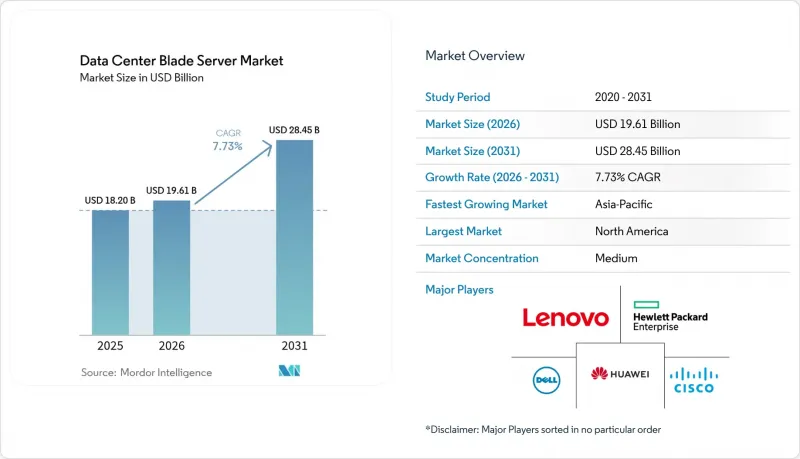
2026년 데이터센터 블레이드 서버 시장 규모는 196억 1,000만 달러 라고 추계되고 있어 2025년 182억 달러에서 성장하여 2031년에는 284억 5,000만 달러에 이를 것으로 예측됩니다.
2026년부터 2031년까지 연평균 복합 성장률(CAGR) 7.73%를 나타낼 것으로 예측됩니다.
AI 및 머신러닝 워크로드 도입이 확대되면서 컴퓨팅 밀도에 대한 요구사항이 재정의되고 있으며, 벤더들은 컴퓨팅, 스토리지, 네트워크 리소스가 분리된 컴포저블(composable) 및 디애그리게이티드(disaggregated) 블레이드 설계로 전환하고 있습니다. 이러한 아키텍처 전환을 통해 활용도를 높이고 워크로드를 빠르게 재할당할 수 있습니다. 또한, 직접 액체 냉각, 실리콘 포토닉스 백플레인, 고급 섀시 관리 소프트웨어를 통해 운영자는 현재 30kW가 넘는 랙의 전력 소비를 관리할 수 있습니다. 북미가 규모 면에서 여전히 주도권을 쥐고 있지만, 인도, 중국, 싱가포르의 대규모 신규 건설을 배경으로 아시아태평양의 성장률은 더 높습니다. 코로케이션 시설이 여전히 가장 큰 고객층이지만, 하이퍼스케일러들은 랙 레벨의 효율성을 높이기 위해 전용 설계된 AI 블레이드 시스템으로의 전환을 추진하면서 기술적 방향성을 결정하고 있습니다.
세계 데이터센터 블레이드 서버 시장 동향 및 인사이트
급증하는 AI/ML 워크로드를 위한 랙 수준의 전력 밀도 증가에 대응
AI 추론 및 트레이닝 클러스터를 통해 랙의 전력 밀도를 기존 10-15kW에서 30-50kW로 끌어올렸습니다. Open Compute Project의 OSAI 사양은 250kW에서 1MW의 랙 아키텍처를 목표로 하고 있으며, 블레이드 벤더들에게 고효율 전압 조정기와 직접 액체 냉각의 통합을 장려하고 있습니다. Dell의 PowerEdge XE9680L은 섀시 수준의 기류, 콜드 플레이트 루프 및 AI 전용 가속기가 열 스로틀링 없이 공존할 수 있음을 입증했습니다. 국제에너지기구(IEA)는 2030년까지 AI 전용 데이터센터의 전력 소비량이 945TWh에 달할 것으로 예측하고 있으며, 이에 따라 전력 효율이 높은 블레이드 설계가 사업자 전략의 핵심으로 떠오르고 있습니다.
엣지-클라우드 융합으로 마이크로모듈형 데이터센터 도입 가속화
5G의 확산과 초저지연 서비스로 인해 컴퓨팅이 네트워크 엣지로 이동함에 따라, 배선 및 냉각이 미리 준비된 상태로 배송이 가능한 마이크로 모듈형 데이터센터에 대한 수요가 증가하고 있습니다. 구글의 모듈형 엣지 시설에 대한 특허는 전원 공급과 열교환 기능을 통합한 안전한 멀티테넌트 랙 어셈블리의 중요성을 뒷받침합니다. 통신 사업자들은 6,000억 달러 규모의 설비 투자 계획 중 상당 부분을 이러한 엣지 사이트에 할당하고 있으며, 이는 블레이드 벤더들에게 제한된 설치 공간에 최적화된 쿼터 높이 노드를 공급할 수 있는 기회를 제공합니다.
실리콘 포토닉스와 800GbE 백플레인 전환으로 인한 설비 투자 급증
광집적 회로와 800GbE 패브릭으로의 전환은 지연시간과 대역폭을 향상시키지만, 새로운 섀시, 미드플레인 커넥터, 리타이머 카드가 필요합니다. 각국 규제 당국은 효율성 향상을 인정하고 있지만, 특히 중견기업에서는 초기 도입에 많은 자본비용이 소요되는 만큼 주의를 당부하고 있습니다. CXL을 통한 메모리 디어그리게이션에 대한 조사 결과, 투자 회수까지 수년이 소요될 것으로 예상되며, 사업자들은 단계적으로 업그레이드를 진행해야 하는 것으로 나타났습니다.
부문 분석
2025년 기준, Tier 3 시설은 데이터센터 블레이드 서버 시장의 42.05%를 차지했으며, N+1 이중화 프로파일은 주류 엔터프라이즈 SLA에 부합하는 것으로 나타났습니다. Tier 4 사이트는 수는 적지만, AI 트레이닝 클러스터의 내결함성 수요로 인해 CAGR 11.63%를 나타낼 것으로 예측됩니다. 이러한 모멘텀을 바탕으로 Tier 4는 100% 수냉식 섀시 및 실리콘 포토닉스 인터커넥션의 시험장으로 자리매김하고 있습니다.
일반적으로 엣지 집적 및 지사 워크로드를 처리하는 Tier 1 및 Tier 2 시설 운영자는 비용 관리를 유지하면서 더 나은 자동화를 달성하기 위해 표준화된 블레이드를 사용합니다. 인프라 메이슨스 보고서에 따르면, 현재 전력 수요 증가의 90%가 AI 모델 훈련에 기인하고 있으며, 이 부하는 현재 더 높은 전력 소비와 랙 밀도를 처리해야 하는 소규모 사이트로 파급되고 있습니다. 그 결과, 각 벤더들은 컨테이너 아일이나 리어 도어형 열교환기를 사용하여 저계층 룸을 개조할 수 있는 키트를 패키지화하여 데이터센터 블레이드 서버 시장 전체에 대한 모멘텀을 유지하고 있습니다.
하프하이트 블레이드는 2025년 매출의 48.02%를 차지했으며, 듀얼 소켓 CPU, 충분한 DIMM 슬롯, 대부분의 가상화 및 데이터베이스 작업을 위한 PCIe 확장 기능을 갖추고 있습니다. 이들은 엔터프라이즈 코로케이션 랙의 주력 제품입니다. 풀하이트 모델은 인메모리 분석과 같은 메모리 의존적인 워크로드를 쿼드 소켓으로 계속 지원하고 있습니다.
쿼터 높이 및 마이크로 블레이드 노드는 10U 선반당 16-32개의 컴퓨팅 스레드를 수용할 수 있어 제한된 엣지 설치 공간에 적합하며, CAGR 13.39%로 가장 빠르게 성장하고 있는 부문입니다. 현재 각 벤더들은 이러한 소형 스레드에 GPU 가속기를 통합하여 휴대폰 기지국에서 실시간 추론을 가능하게 하는 GPU 가속기를 통합하고 있습니다. Open Rack v3 규격과의 호환성을 통해 동일 캐비닛 내 혼재 배치가 가능하여 데이터센터 블레이드 서버 시장의 엣지 배치 트렌드를 주도하고 있습니다.
데이터센터 블레이드 서버 시장 보고서는 업계를 유형(Tier 1, Tier 2 등), 폼팩터(하프하이트 블레이드, 풀하이트 블레이드 등), 최종 사용자 산업(은행, 금융서비스 및 보험(BFSI), 제조업 등), 데이터센터 유형(하이퍼스케일러/클라우드 서비스 제공업체 등), 지역(아시아태평양, 유럽 등)으로 분류하고 있습니다. 시장 예측은 금액(USD) 기준으로 제시됩니다.
지역별 분석
2025년 북미는 데이터센터 블레이드 서버 시장의 41.88%를 차지했습니다. 이는 버지니아 북부, 텍사스, 실리콘밸리의 하이퍼스케일 캠퍼스가 주도한 것입니다. 로렌스 버클리 국립연구소(Lawrence Berkeley National Laboratory)의 추정에 따르면, 2023년 미국의 데이터센터 전력 소비량은 176TWh에 달했으며, 시설의 PUE를 낮추는 수냉식 블레이드 서버에 대한 수요가 급증할 것으로 예측됩니다. 캐나다와 멕시코에서는 지역적 소버린 클라우드와 재해복구 구역을 통해 수요가 확대되고 있습니다.
아시아태평양은 2026년부터 2031년까지 연평균 복합 성장률(CAGR) 11.92%로 가장 빠르게 성장하는 시장입니다. 중국은 거대한 AI 클라우드 클러스터를 구축하고 있으며, 인도는 디지털 경제 목표를 따라잡기 위해 2030년까지 설치 용량을 1.35GW에서 5GW로 확대해야 합니다. 싱가포르의 정책 프레임워크는 고밀도 블레이드와 열회수 냉각기를 통합한 설계에 대해 우선적으로 용량 라이선스를 부여하고 있습니다. 일본과 호주에서는 해저 케이블 양륙국을 따라 엣지 인프라를 확장하고, 컨텐츠 캐싱을 위해 쿼터하이트 블레이드를 도입하고 있습니다. 유럽에서는 엄격한 효율성 및 데이터 주권 관련 규제에 따라 꾸준한 확장을 보이고 있습니다. 에코 디자인 지침 2019/424의 개정으로 35℃ 이상의 온수 냉각에 대응하는 블레이드 섀시가 권장되며, 지역 열 공급 루프와의 통합이 용이해졌습니다. 중동 및 아프리카에서는 핀테크 및 게임 산업 고객을 위한 클라우드 온램프에 대한 투자가 활발히 이루어지고 있습니다. 남미에서는 브라질의 인터넷 교환 허브 주변에 도입이 집중되어 있으며, 사업자들은 계절적 트래픽 피크에 대응하기 위해 컴포저블 블레이드를 도입하고 있습니다. 이러한 지역별 동향은 데이터센터 블레이드 서버 시장의 세계 중요성을 뒷받침하고 있습니다.
기타 특전:
- 엑셀 형식 시장 예측(ME) 시트
- 3개월간 애널리스트 지원
자주 묻는 질문
목차
제1장 서론
제2장 조사 방법
제3장 주요 요약
제4장 시장 구도
제5장 시장 규모와 성장 예측
제6장 경쟁 구도
제7장 시장 기회와 향후 전망
JHS 26.05.20Data Center Blade Server market size in 2026 is estimated at USD 19.61 billion, growing from 2025 value of USD 18.2 billion with 2031 projections showing USD 28.45 billion, growing at 7.73% CAGR over 2026-2031.
Rising deployment of AI and machine-learning workloads is reshaping compute density requirements, pushing vendors toward composable, disaggregated blade designs that separate compute, storage and networking resources. This architectural shift enables higher utilization and rapid workload re-allocation, while direct liquid cooling, silicon-photonics backplanes and advanced chassis management software help operators manage rack power envelopes that now exceed 30 kW. North America retains scale leadership, yet Asia-Pacific is growing faster on the back of large greenfield builds in India, China and Singapore. Colocation facilities remain the largest customer group, but hyperscalers are setting the technical agenda as they move to purpose-built AI blade systems that deliver higher rack-level efficiency.
Global Data Center Blade Server Market Trends and Insights
Surging Rack-Level Power Density Accommodates AI/ML Workloads
AI inference and training clusters now push rack envelopes from 10-15 kW toward 30-50 kW. The Open Compute Project's OSAI specification targets 250 kW to 1 MW rack architectures, encouraging blade vendors to integrate high-efficiency voltage regulators and direct liquid cooling. Dell's PowerEdge XE9680L demonstrates how chassis-level airflow, cold-plate loops, and AI-specific accelerators can coexist without thermal throttling. The International Energy Agency projects that AI-focused data centers could consume 945 TWh by 2030, which keeps power-efficient blade design at the center of operator strategies
Edge-Cloud Convergence Accelerating Deployment in Micro-Modular DCs
5G rollouts and ultra-low-latency services push compute to the network edge, spawning demand for micro-modular data centers that can ship pre-wired and pre-cooled. Google's patent for modular edge facilities confirms the importance of secure, multitenant rack assemblies with integrated power and heat exchange. Telecom operators are allocating a sizeable share of their USD 600 billion CAPEX plan to such edge sites, giving blade vendors an opening to supply quarter-height nodes tailored for constrained footprints
CapEx Spike from Silicon-Photonics and 800 GbE Backplane Migration
Switching to photonic integrated circuits and 800 GbE fabrics unlocks latency and bandwidth gains but demands new chassis, mid-plane connectors and retimer cards. National agencies acknowledge the efficiency upside yet caution that early deployments bear heavy capital costs, particularly for mid-sized enterprises. Research into memory disaggregation over CXL suggests a multi-year payback, forcing operators to stagger upgrades
Other drivers and restraints analyzed in the detailed report include:
- High Server Consolidation Ratios Lower OPEX and Real-Estate Cost
- Liquid-Cooling Ready Chassis Gaining Regulatory Incentives
- Supplier Concentration in Proprietary Chassis Ecosystems
For complete list of drivers and restraints, kindly check the Table Of Contents.
Segment Analysis
Tier 3 facilities owned 42.05% of the Data Center Blade Server market in 2025, as their N+1 redundancy profile aligns with mainstream enterprise SLAs. Tier 4 sites, though smaller in count, are forecast to grow at 11.63% CAGR thanks to fault-tolerance demands from AI training clusters. This momentum positions Tier 4 as the proving ground for 100% liquid-cooled chassis and silicon-photonics interconnects.
Operators of Tier 1 and Tier 2 facilities, typically serving edge aggregation or branch workloads, adopt standardized blades to maintain cost discipline while gaining better automation. The Infrastructure Masons report links 90% of current power growth to AI model training, a load now propagating into even modest sites that must accommodate higher power draw and rack density. As a result, vendors are packaging kits that retrofit lower-tier rooms with containment aisles and rear-door heat exchangers, preserving momentum for the wider Data Center Blade Server market.
Half-height blades delivered 48.02% revenue in 2025, supporting dual-socket CPUs, ample DIMM slots and PCIe expansion for most virtualization and database tasks. They remain the workhorse of enterprise colocation racks. Full-height models continue to serve quad-socket, memory-bound workloads such as in-memory analytics.
Quarter-height and micro-blade nodes are the fastest-growing slice at 13.39% CAGR because they fit 16-32 compute sleds per 10U shelf, ideal for limited edge footprints. Vendors now integrate GPU accelerators into these compact sleds, enabling real-time inference at cell-tower sites. Compatibility with Open Rack v3 specifications allows mixed deployment inside the same cabinet, sustaining the Data Center Blade Server market's edge expansion narrative.
Data Center Blade Server Market Report Segments the Industry Into Type (Tier 1, Tier 2, and More), Form Factor(Half-Height Blades, Full-Height Blades, and More), End-User Verticals (BFSI, Manufacturing, and More), Data Center Type(Hyperscalers/Cloud Service Provider, and More) and Geography (Asia-Pacific, Europe, and More). The Market Forecasts are Provided in Terms of Value (USD).
Geography Analysis
North America controlled 41.88% of the Data Center Blade Server market in 2025, fueled by hyperscale campuses in Northern Virginia, Texas and Silicon Valley. The Lawrence Berkeley National Laboratory calculated 176 TWh of US data-center electricity use in 2023, raising urgency for liquid-cooled blades that cut facility PUEs. Canada and Mexico add incremental demand through regional sovereign-cloud and disaster-recovery zones.
Asia-Pacific is the fastest-growing theater at 11.92% CAGR from 2026-2031. China deploys massive AI cloud clusters, while India needs to expand installed capacity from 1.35 GW to 5 GW by 2030 to keep pace with digital-economy targets. Policy frameworks in Singapore award capacity licenses preferentially to designs that include high-density blades and heat-recovery chillers. Japan and Australia extend the edge footprint along subsea cable landing stations, embedding quarter-height blades for content caching. Europe shows steady expansion under strict efficiency and data-sovereignty rules. Ecodesign 2019/424 revisions encourage blade chassis that support warm-water cooling above 35 °C, easing integration with district-heat loops. The Middle East and Africa attract investment for cloud on-ramps serving fintech and gaming customers. South America's installations cluster around Brazil's internet exchange hubs, where operators deploy composable blades to meet seasonal traffic peaks. These regional dynamics reinforce the global relevance of the Data Center Blade Server market.
- Cisco Systems Inc.
- Dell Technologies
- Hewlett Packard Enterprise
- Huawei Technologies Co. Ltd.
- IBM Corporation
- Fujitsu Ltd.
- Lenovo Group Ltd.
- NEC Corporation
- Oracle Corporation
- Super Micro Computer Inc.
- Inspur Group
- Quanta Cloud Technology
- Gigabyte Technology
- Hitachi Ltd.
- AMD (Pensando)
- Nvidia Corp. (Grace Superchip platforms)
- Marvell Technology (DPU-centric blades)
- Broadcom Inc. (Switch-on-Blade)
- Advantech Co. Ltd.
- Silicom Ltd.
- ZTE Corporation
Additional Benefits:
- The market estimate (ME) sheet in Excel format
- 3 months of analyst support
TABLE OF CONTENTS
1 INTRODUCTION
- 1.1 Study Assumptions and Market Definition
- 1.2 Scope of the Study
2 RESEARCH METHODOLOGY
3 EXECUTIVE SUMMARY
4 MARKET LANDSCAPE
- 4.1 Market Overview
- 4.2 Market Drivers
- 4.2.1 Surging rack-level power density accommodates AI/ML workloads
- 4.2.2 Edge-cloud convergence accelerating deployment in micro-modular DCs
- 4.2.3 High server consolidation ratios lower OPEX and real-estate cost
- 4.2.4 Liquid-cooling ready chassis gaining regulatory incentives (EU, Singapore)
- 4.2.5 Growing hyperscaler preference for composable disaggregated blades
- 4.3 Market Restraints
- 4.3.1 CapEx spike from silicon photonics and 800 Gb E backplane migration
- 4.3.2 Supplier concentration in proprietary chassis ecosystems
- 4.3.3 Skill-gap in managing multi-fabric, disaggregated architectures
- 4.3.4 Delayed ORAN/5G monetisation lengthening ROI for telco DCs
- 4.4 Supply-Chain Analysis
- 4.5 Regulatory and Sustainability Landscape
- 4.6 Technological Outlook (PCIe 6.0, CXL 3.0, silicon photonics)
- 4.7 Porter's Five Forces
- 4.7.1 Threat of New Entrants
- 4.7.2 Bargaining Power of Buyers
- 4.7.3 Bargaining Power of Suppliers
- 4.7.4 Threat of Substitutes
- 4.7.5 Intensity of Rivalry
- 4.8 Assessment of the Impact on Macro Economic Trends on the Market
5 MARKET SIZE AND GROWTH FORECASTS (VALUES)
- 5.1 By Data-Center Tier
- 5.1.1 Tier 1 and 2
- 5.1.2 Tier 3
- 5.1.3 Tier 4
- 5.2 By Form Factor
- 5.2.1 Half-height Blades
- 5.2.2 Full-height Blades
- 5.2.3 Quarter-height / Micro-blades
- 5.3 By Application / Workload
- 5.3.1 Virtualisation and Private Cloud
- 5.3.2 High-Performance Computing (HPC)
- 5.3.3 Artificial Intelligence/Machine Learning and Data Analytics
- 5.3.4 Storage-centric
- 5.3.5 Edge / IoT Gateways
- 5.4 By Data Center Type
- 5.4.1 Hyperscalers/Cloud Service Provider
- 5.4.2 Colocation Facilities
- 5.4.3 Enterprise and Edge
- 5.5 By End-use Industry
- 5.5.1 BFSI
- 5.5.2 IT and Telecom / CSPs
- 5.5.3 Healthcare and Life-Sciences
- 5.5.4 Manufacturing and Industry 4.0
- 5.5.5 Energy and Utilities
- 5.5.6 Government and Defence
- 5.6 By Geography
- 5.6.1 North America
- 5.6.1.1 United States
- 5.6.1.2 Canada
- 5.6.1.3 Mexico
- 5.6.2 Europe
- 5.6.2.1 United Kingdom
- 5.6.2.2 Germany
- 5.6.2.3 France
- 5.6.2.4 Italy
- 5.6.2.5 Spain
- 5.6.2.6 Rest of Europe
- 5.6.3 Asia-Pacific
- 5.6.3.1 China
- 5.6.3.2 Japan
- 5.6.3.3 India
- 5.6.3.4 Singapore
- 5.6.3.5 Australia
- 5.6.3.6 Malaysia
- 5.6.3.7 Rest of Asia-Pacific
- 5.6.4 South America
- 5.6.4.1 Brazil
- 5.6.4.2 Chile
- 5.6.4.3 Argentina
- 5.6.4.4 Rest of South America
- 5.6.5 Middle East
- 5.6.5.1 United Arab Emirate
- 5.6.5.2 Saudi Arabia
- 5.6.5.3 Turkey
- 5.6.5.4 Rest of Middle East
- 5.6.6 Africa
- 5.6.6.1 South Africa
- 5.6.6.2 Nigeria
- 5.6.6.3 Rest of Africa
- 5.6.1 North America
6 COMPETITIVE LANDSCAPE
- 6.1 Market Concentration
- 6.2 Strategic Initiatives
- 6.3 Market Share Analysis
- 6.4 Company Profiles (includes Global level Overview, Market level overview, Core Segments, Financials as available, Strategic Information, Market Rank/Share, Products and Services, Recent Developments)
- 6.4.1 Cisco Systems Inc.
- 6.4.2 Dell Technologies
- 6.4.3 Hewlett Packard Enterprise
- 6.4.4 Huawei Technologies Co. Ltd.
- 6.4.5 IBM Corporation
- 6.4.6 Fujitsu Ltd.
- 6.4.7 Lenovo Group Ltd.
- 6.4.8 NEC Corporation
- 6.4.9 Oracle Corporation
- 6.4.10 Super Micro Computer Inc.
- 6.4.11 Inspur Group
- 6.4.12 Quanta Cloud Technology
- 6.4.13 Gigabyte Technology
- 6.4.14 Hitachi Ltd.
- 6.4.15 AMD (Pensando)
- 6.4.16 Nvidia Corp. (Grace Superchip platforms)
- 6.4.17 Marvell Technology (DPU-centric blades)
- 6.4.18 Broadcom Inc. (Switch-on-Blade)
- 6.4.19 Advantech Co. Ltd.
- 6.4.20 Silicom Ltd.
- 6.4.21 ZTE Corporation
7 MARKET OPPORTUNITIES AND FUTURE OUTLOOK
- 7.1 White-space and Unmet-Need Assessment