

|
시장보고서
상품코드
2157039
유럽의 메트로 고밀도 파장 분할 다중(DWDM) : 시장 점유율 분석, 업계 동향과 통계, 성장 예측(2026-2031년)Europe Metro Dense Wave Division Multiplexing (DWDM) - Market Share Analysis, Industry Trends & Statistics, Growth Forecasts (2026 - 2031) |
||||||
 Mordor Intelligence
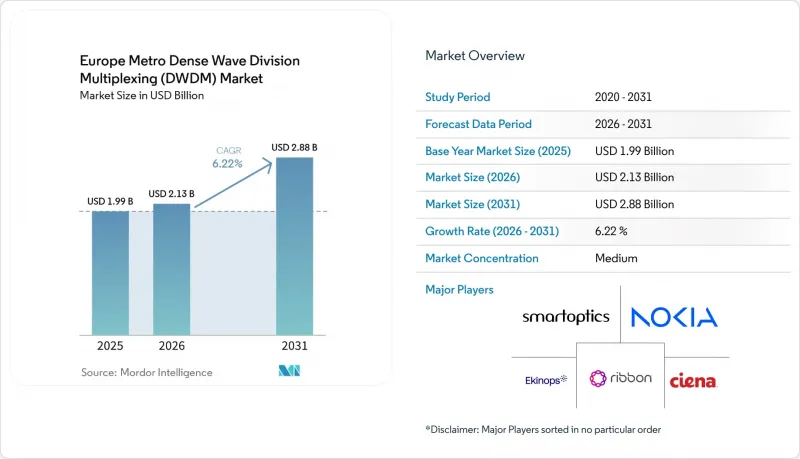
에 따르면 유럽의 메트로 고밀도 파장 분할 다중(DWDM) 시장 규모는 2025년에 19억 9,000만 달러로 평가되며, 2026년 21억 3,000만 달러에서 2031년까지 28억 8,000만 달러에 달할 것으로 예측되고 있으며, 예측 기간에 CAGR은 6.22%입니다(2026-2031년).
유럽 메트로 고밀도 파장 분할 다중화(DWDM) 시장의 동향 및 인사이트
클라우드, AI 및 비디오 워크로드로 인한 메트로 트래픽의 가속화
클라우드 서비스, AI 추론 및 비디오 트래픽으로 인해 유럽의 메트로 네트워크 전반, 특히 데이터센터와 인터넷 교환 지점(IXP)을 연결하는 경로에서 대역폭 수요가 증가하고 있습니다. Connect Europe에 따르면 유럽 인터넷 트래픽 총량의 87.5%를 고정 광대역이 차지하고 있으며, 통신 투자의 46%가 고정 광대역에 투자되고 있습니다. AI 트래픽은 주로 소비자의 엔드포인트로 향하는 것이 아니라, 메트로 회랑 내의 분산형 GPU 클러스터 사이를 이동하는 등 다른 네트워크 패턴을 보이고 있습니다. 이러한 연결에는 저지연, 대용량, 고밀도 및 단거리 파장이 필요하며, 이는 메트로 DWDM의 설계 이념과 직접적으로 부합합니다. 유럽연합(EU) 기업의 AI 도입률은 2024-2025년에 48% 증가할 것으로 예상되며, 이에 따라 통신사업자가 전송 용량을 증설할 수 있는 시간이 단축되고 있습니다. 따라서 기존의 네트워크 구축 주기만으로는 이러한 새로운 집중형 데이터 흐름에 충분히 대응하지 못할 경우, 유럽의 메트로 DWDM 시장이 그 혜택을 누리게 될 것입니다.
5G-Advanced xHaul 및 광섬유 용량 한계에 대한 대응
5G 독립형 네트워크 및 향후 5G-Advanced의 전개에서는 더 많은 무선 용량이 사용자 근처에 배치되므로, 통신사업자는 미드홀 및 프론트홀 전송망을 업그레이드해야 합니다. 건물이 밀집된 대도시권에서는 덕트 공간이 제한적이고 신규 건설에 시간이 걸리기 때문에 DWDM은 기존 광섬유의 용량을 확대합니다. 2025년 말 기준, 유럽의 5G 인구 커버리지는 94.9%에 달했으나, 독립형 방식의 구축 및 중대역 밀도 면에서는 여전히 중국과 미국에 뒤처져 있습니다. GSMA의 추산에 따르면 유럽이 2035년까지 5G 구축을 완료하려면 4,750억 유로(5,538억 4,000만 달러)가 필요하지만, 그 중 57%만 실현될 전망입니다. DWDM은 한 쌍의 광섬유에서 80개 이상의 파장을 지원할 수 있으므로 광섬유가 고갈된 지역에서 새로운 토목 공사를 대체할 수 있는 대안이 됩니다. 이처럼 광섬유 효율 향상이 요구되는 상황은 모바일 전송 경로 및 상류 집약 네트워크에서 유럽의 메트로 DWDM 도입을 촉진하고 있습니다.
부품 리드타임의 장기화와 포토닉스 부품에 대한 의존도
인듐 인화물 레이저 및 고속 광 트랜시버의 공급 상황은, 특히 통신사업자가 새로운 코히어런트 모듈을 필요로 하는 경우, 메트로폴리탄 시스템의 구축 일정에 제약을 줄 가능성이 있습니다. 본 초안에서는 첨단 모듈의 수급 격차가 지적되고 있으며, 2026년에는 400G 및 800G 장비의 리드타임이 길어질 것으로 전망됩니다. 이로 인해 가장 빠르게 확대되고 있는 용량 계층에 대응하는 800G ZR 및 ZR+ 시스템의 경우, 조기 조달이 더욱 중요해집니다. 통신사업자는 기존의 적시 조달이나 신속한 납품에 의존하기보다는 계획된 설치 9-12개월 전에 부품을 발주해야 할 수도 있습니다. 소규모 지역 통신사업자의 경우, 비록 동일한 도입 요건에 직면해 있더라도 대형 통신사업자나 하이퍼스케일러에 비해 재고를 보유할 여력이 부족한 것이 현실입니다. 그 결과 발생하는 조달 유연성의 차이로 인해 광섬유, 수요, 도입 계획이 이미 갖춰져 있더라도 유럽의 메트로 DWDM 시장내 프로젝트가 지연될 가능성이 있습니다.
부문 분석
2025년 유럽 메트로 DWDM 시장에서 하드웨어가 시장 점유율의 81.37%를 차지했습니다. 이는 도시 지역의 광 네트워크 구축이 자본 집약적이라는 점을 반영한 것입니다. 이 비율은 파장을 생성, 유도 및 증폭하는 트랜스폰더 섀시, 재구성 가능한 광 애드-드롭 멀티플렉서(ROADM), 증폭기 노드 및 코히어런트 플러그인 모듈에 대한 지출을 반영한 것입니다. 사업자가 선택하는 소프트웨어 계층에 관계없이, 새로운 상호 연결 경로가 하나 늘어날 때마다 네트워크 서비스 제공을 시작하려면 물리적 광통신 장비가 필요합니다. 따라서 트래픽이 많은 도시 회랑에서의 캠퍼스 확장이나 광섬유 업그레이드는 특히 기존 용량이 이미 할당된 지역에서 이러한 시스템에 대한 수요를 지원하고 있습니다. 유럽의 메트로 DWDM 하드웨어 시장 규모는 각 엔드포인트에서의 파장 종단, 증폭, 보호 및 관리의 필요성에 의해 견인되고 있습니다.
네트워크 제어가 복잡해짐에 따라 소프트웨어 시장은 2031년까지 연평균 성장률(CAGR) 9.27%로 성장하여 전체 시장을 상회하는 속도로 확대될 것으로 예측됩니다. 통신사업자가 여러 벤더의 장비를 관리하고 더 명확한 네트워크 가시성을 필요로 하는 가운데, 개방형 제어 플레인 및 파장 자동화의 중요성이 높아지고 있습니다. 디스어그리게이트 설계를 통해 소프트웨어가 서로 다른 제조사의 ROADM 및 증폭기를 연동할 수 있게 되어, 단일 장비 스택에 대한 의존도를 낮출 수 있습니다. 네트워크 환경이 복잡해지고 운영상의 책임이 커짐에 따라 서비스 분야에서는 통합, 네트워크 설계, 테스트 및 관리형 파장 지원이 제공되고 있습니다. 2025년, eww ITandTEL사는 OcNOS-SP-PLUS와 화이트박스 하드웨어를 활용한 디스어그리게이트형 400G IP-over-DWDM 설계로 전환하며, 이러한 실용적인 전환을 입증했습니다.
2025년, 400Gbps 대역은 유럽 메트로 DWDM 시장 점유율의 31.24%를 차지하며, 보고된 전송 용량 중 1위를 기록했습니다. 이는 대용량과 성숙한 공급업체 기반을 모두 갖추고 있으며, 데이터센터 집계 및 교환 지점 연결에서 확립된 핵심 속도가 되었습니다. 경쟁력 있는 가격 책정과 검증된 상호 운용성 덕분에 이 대역은 통신사업자 및 지역 사업자가 사용하는 많은 오픈 라인 시스템에 적합합니다. 200Gbps 대역은 트래픽 밀도나 전력 요구 사항이 다른 최대 규모의 허브를 제외한 메트로 에지 및 모바일 집약 용도에서 여전히 중요한 역할을 하고 있습니다. 최대 100Gbps의 레거시 시스템은 여전히 롱테일 도시권 회선 및 공공 부문의 다크 파이버 사용자에게 서비스를 제공하고 있지만, 신규 도입의 경우 400Gbps로 직접 전환하는 경향이 강해지고 있습니다.
400Gbps를 초과하는 대역폭은 2031년까지 연평균 성장률(CAGR) 11.58%로 확대될 것으로 예측되며, 보고된 용량 대역 중 가장 빠른 성장률을 보이고 있습니다. 유럽 메트로 DWDM 시장에서 이 대역의 규모는 데이터센터 트래픽이 집중되는 경로에서 800G의 시험 운영을 거쳐 상용화로 전환됨에 따라 형성되고 있습니다. Core-Backbone사가 2026년 4월 프랑크푸르트-암스테르담 구간에서 실시한 도입 사례는 800G가 유럽의 트래픽이 많은 회선에서 실제 운용 단계에 접어들었음을 보여줍니다. 2024년 하반기에 최종 합의에 도달한 OIF의 800ZR 협정에 따라 하드웨어에 의존하지 않는 플러그인 가능한 풋프린트가 확립되어 전환 비용 절감과 조달 유연성 향상이 가능해졌습니다. 이는 대용량으로의 업그레이드를 결정하기 전에 여러 벤더로부터의 공급이 확보되어 있는지 확인하고 싶어 하는 중견 통신사업자들의 도입을 촉진할 가능성이 있습니다.
기타 혜택:
- 엑셀 형식의 시장 예측(ME) 시트
- 3개월간의 애널리스트 지원
자주 묻는 질문
목차
제1장 서론
- 조사 전제조건과 시장 정의
- 조사 범위
제2장 조사 방법
제3장 개요
제4장 시장 구도
- 시장 개요
- 시장 성장 촉진요인
- 시장 성장 억제요인
- 업계 밸류체인 분석
- 규제 상황
- 기술 전망
- Porter's Five Forces 분석
- 거시경제 요인이 시장에 미치는 영향
제5장 시장 규모와 성장 예측
- 컴포넌트별
- 송전 용량별
- 용도별
- 최종사용자별
- 국가별
- 독일
- 영국
- 프랑스
- 이탈리아
- 스페인
- 기타 유럽 국가
제6장 경쟁 구도
- 시장 집중도
- 전략적 동향
- 시장 점유율 분석
- 기업 개요
- Nokia Corporation
- Cisco Systems, Inc.
- Ciena Corporation
- Huawei Technologies Co., Ltd.
- ADTRAN, Inc.
- ZTE Corporation
- PacketLight Networks Ltd.
- NEC Corporation
- Corning Incorporated
- Smartoptics AS
- Ribbon Communications Inc.
- Ekinops S.A.
- Lumentum Holdings Inc.
- Coherent Corp.
- HUBER+SUHNER AG
- Source Photonics, Inc.
- FLXOPTIX GmbH
- IP Infusion Inc.
- Juniper Networks, Inc.
제7장 시장 기회와 향후 전망
KSA 26.10.30According to Mordor Intelligence, the Europe metro dense wave division multiplexing (DWDM) market size was valued at USD 1.99 billion in 2025 and is estimated to grow from USD 2.13 billion in 2026 to reach USD 2.88 billion by 2031, at a CAGR of 6.22% during the forecast period (2026-2031).
Europe Metro Dense Wave Division Multiplexing (DWDM) Market Trends and Insights
Accelerating Metro Traffic From Cloud, AI, and Video Workloads
Cloud services, AI inference, and video traffic are raising bandwidth requirements across European metropolitan networks, particularly on routes linking data centers and internet exchange points. Fixed broadband carried 87.5% of total internet traffic in Europe, and fixed broadband investment represented 46% of telecommunications investment, according to Connect Europe. AI traffic exhibits a different network pattern, moving between distributed GPU clusters within metro corridors rather than traveling primarily to consumer endpoints. These connections require dense, short-reach wavelengths with low latency and high capacity, which aligns directly with metropolitan DWDM design. AI adoption among European Union enterprises increased 48% from 2024 to 2025, shortening the time available for operators to add transport capacity. The Europe metro DWDM market, therefore, benefits when traditional network provisioning cycles cannot keep pace with these new, concentrated data flows.
5G-Advanced xHaul and Fiber-Exhaustion Upgrades
5G standalone networks and future 5G-Advanced deployments require operators to upgrade midhaul and fronthaul transport as more radio capacity is placed closer to users. In densely built metropolitan areas, DWDM increases capacity on existing fiber when duct space is constrained, and new construction would take longer. European 5G population coverage reached 94.9% by the end of 2025, although standalone deployment and mid-band density remained behind China and the United States. GSMA estimated that Europe needs EUR 475 billion (USD 553.84 billion) to complete its 5G journey through 2035, with only 57% of that amount expected to materialize. DWDM can support 80 or more wavelengths on a fiber pair, offering an alternative to new civil works at fiber-exhausted sites. This need for greater fiber efficiency supports deployment of European metro DWDM across mobile transport routes and upstream aggregation networks.
High Component Lead Times and Photonic Supply Dependence
Supply availability for indium phosphide lasers and high-speed optical transceivers can constrain deployment schedules for metropolitan systems, especially where operators need newer coherent modules. The draft identifies a shortfall between demand and supply for advanced modules, with longer lead times for 400G and 800G equipment during 2026. This places greater importance on early procurement for 800G ZR and ZR+ systems that serve the fastest-expanding capacity tier. Operators may need to order components 9-12 months before a planned installation rather than rely on conventional just-in-time purchasing and rapid delivery. Smaller regional carriers have less capacity to hold inventory than larger carriers and hyperscalers, even when they face the same installation requirements. The resulting difference in purchasing flexibility may delay projects in the European metro DWDM market, even where fiber, demand, and deployment plans are already in place.
Other drivers and restraints analyzed in the detailed report include:
- Higher Spectral Efficiency From 400G, 800G, and Coherent Optics
- Hyperscale and Colocation Expansion Across FLAP-D Hubs
- Fragmented Cross-Border Equipment Approval and Deployment Rules
For complete list of drivers and restraints, kindly check the Table Of Contents.
Segment Analysis
Hardware accounted for 81.37% of the Europe metro DWDM market share in 2025, reflecting the capital intensity of metropolitan optical construction. This position reflected spending on transponder chassis, reconfigurable optical add-drop multiplexers, amplifier nodes, and coherent pluggable modules that create, direct, and strengthen wavelengths. Every new interconnection route requires physical optical equipment before network services can begin, regardless of the software layer selected by the operator. Campus additions and fiber upgrades across high-traffic metropolitan corridors, therefore, sustain demand for these systems, especially where existing capacity is already committed. The European metro DWDM hardware market size is driven by the need to terminate, amplify, protect, and manage wavelengths at each endpoint.
Software is projected to grow at a 9.27% CAGR through 2031, outpacing the overall market as network control becomes more complex. Open control planes and wavelength automation are becoming more relevant as operators manage equipment from several vendors and need clearer network visibility. Disaggregated designs enable software to coordinate ROADMs and amplifiers from different manufacturers, reducing dependence on a single equipment stack. Services provide integration, network design, testing, and managed-wavelength support as network environments become more complex and operational accountability increases. In 2025, eww ITandTEL moved to a disaggregated 400G IP-over-DWDM design using OcNOS-SP-PLUS and white-box hardware, demonstrating this practical shift.
The 400 Gbps tier accounted for 31.24% of the Europe metro DWDM market share in 2025, making it the leading reported transmission capacity. It is the established core speed for data center aggregation and exchange-point connectivity because it combines high capacity with a mature supplier base. Competitive pricing and proven interoperability have made this tier suitable for many open line systems used by carriers and regional operators. The 200 Gbps tier remains relevant for metro-edge and mobile aggregation uses outside the largest hubs, where traffic density and power requirements differ. Legacy systems at up to 100 Gbps still serve long-tail metropolitan circuits and public-sector dark-fiber users, while new installations increasingly move directly to 400 Gbps.
The above 400 Gbps tier is projected to expand at an 11.58% CAGR through 2031, the fastest rate among the reported capacity bands. The Europe metro DWDM market size for this tier is shaped by the movement from 800G trials to commercial deployments on routes with concentrated data center traffic. Core-Backbone's April 2026 deployment on the Frankfurt-Amsterdam route showed that 800G is entering production use on busy European corridors. OIF's 800ZR agreement, finalized in late 2024, created a hardware-neutral pluggable footprint that can reduce switching costs and improve procurement flexibility. It may support adoption by mid-tier operators seeking confidence in multi-source availability before committing to higher-capacity upgrades.
Complete Report Scope:
- By Component
- Hardware
- Software
- Services
- By Transmission Capacity
- Up to 100 Gbps
- 200 Gbps
- 400 Gbps
- Above 400 Gbps
- By Application
- Data Center Interconnect
- Mobile Backhaul and Fronthaul
- Broadband and Access Network Aggregation
- Other Applications
- By End-User
- Communication Service Providers
- Cloud and Data Center Providers
- Enterprises
- Government and Public Sector
- By Country
- Germany
- United Kingdom
- France
- Italy
- Spain
- Rest of Europe
List of Companies Covered in this Report:
- Nokia Corporation
- Cisco Systems, Inc.
- Ciena Corporation
- Huawei Technologies Co., Ltd.
- ADTRAN, Inc.
- ZTE Corporation
- PacketLight Networks Ltd.
- NEC Corporation
- Corning Incorporated
- Smartoptics AS
- Ribbon Communications Inc.
- Ekinops S.A.
- Lumentum Holdings Inc.
- Coherent Corp.
- HUBER+SUHNER AG
- Source Photonics, Inc.
- FLXOPTIX GmbH
- IP Infusion Inc.
- Juniper Networks, Inc.
Additional Benefits:
- The market estimate (ME) sheet in Excel format
- 3 months of analyst support
TABLE OF CONTENTS
1 INTRODUCTION
- 1.1 Study Assumptions and Market Definition
- 1.2 Scope of the Study
2 RESEARCH METHODOLOGY
3 EXECUTIVE SUMMARY
4 MARKET LANDSCAPE
- 4.1 Market Overview
- 4.2 Market Drivers
- 4.2.1 Accelerating Metro Traffic From Cloud, AI, and Video Workloads
- 4.2.2 5G-Advanced Xhaul and Fiber-Exhaustion Upgrades
- 4.2.3 Higher Spectral Efficiency From 400G, 800G, and Coherent Optics
- 4.2.4 Hyperscale and Colocation Expansion Across FLAP-D Hubs
- 4.2.5 Open, Disaggregated, and IP-over-DWDM Architectures
- 4.2.6 Sovereign Cloud and Intra-European Data-Center Interconnection
- 4.3 Market Restraints
- 4.3.1 High Component Lead Times and Photonic Supply Dependence
- 4.3.2 Fragmented Cross-Border Equipment Approval and Deployment Rules
- 4.3.3 Hyperscaler Purchasing Power and System Price Erosion
- 4.3.4 Multi-Vendor Operational Complexity and Skills Shortage
- 4.4 Industry Value Chain Analysis
- 4.5 Regulatory Landscape
- 4.6 Technological Outlook
- 4.7 Porter's Five Forces Analysis
- 4.7.1 Bargaining Power of Suppliers
- 4.7.2 Bargaining Power of Buyers
- 4.7.3 Threat of New Entrants
- 4.7.4 Threat of Substitutes
- 4.7.5 Competitive Rivalry
- 4.8 Impact of Macroeconomic Factors on the Market
5 MARKET SIZE AND GROWTH FORECASTS (VALUE)
- 5.1 By Component
- 5.1.1 Hardware
- 5.1.2 Software
- 5.1.3 Services
- 5.2 By Transmission Capacity
- 5.2.1 Up to 100 Gbps
- 5.2.2 200 Gbps
- 5.2.3 400 Gbps
- 5.2.4 Above 400 Gbps
- 5.3 By Application
- 5.3.1 Data Center Interconnect
- 5.3.2 Mobile Backhaul and Fronthaul
- 5.3.3 Broadband and Access Network Aggregation
- 5.3.4 Other Applications
- 5.4 By End-User
- 5.4.1 Communication Service Providers
- 5.4.2 Cloud and Data Center Providers
- 5.4.3 Enterprises
- 5.4.4 Government and Public Sector
- 5.5 By Country
- 5.5.1 Germany
- 5.5.2 United Kingdom
- 5.5.3 France
- 5.5.4 Italy
- 5.5.5 Spain
- 5.5.6 Rest of Europe
6 COMPETITIVE LANDSCAPE
- 6.1 Market Concentration
- 6.2 Strategic Moves
- 6.3 Market Share Analysis
- 6.4 Company Profiles (includes Global Level Overview, Market Level Overview, Core Segments, Financials as available, Strategic Information, Market Rank/Share, Products and Services, Recent Developments)
- 6.4.1 Nokia Corporation
- 6.4.2 Cisco Systems, Inc.
- 6.4.3 Ciena Corporation
- 6.4.4 Huawei Technologies Co., Ltd.
- 6.4.5 ADTRAN, Inc.
- 6.4.6 ZTE Corporation
- 6.4.7 PacketLight Networks Ltd.
- 6.4.8 NEC Corporation
- 6.4.9 Corning Incorporated
- 6.4.10 Smartoptics AS
- 6.4.11 Ribbon Communications Inc.
- 6.4.12 Ekinops S.A.
- 6.4.13 Lumentum Holdings Inc.
- 6.4.14 Coherent Corp.
- 6.4.15 HUBER+SUHNER AG
- 6.4.16 Source Photonics, Inc.
- 6.4.17 FLXOPTIX GmbH
- 6.4.18 IP Infusion Inc.
- 6.4.19 Juniper Networks, Inc.
7 MARKET OPPORTUNITIES AND FUTURE OUTLOOK
- 7.1 White-Space and Unmet-Need Assessment


