

|
시장보고서
상품코드
2157042
클라우드 탐지 및 대응 : 시장 점유율 분석, 업계 동향과 통계, 성장 예측(2026-2031년)Cloud Detection and Response - Market Share Analysis, Industry Trends & Statistics, Growth Forecasts (2026 - 2031) |
||||||
 Mordor Intelligence
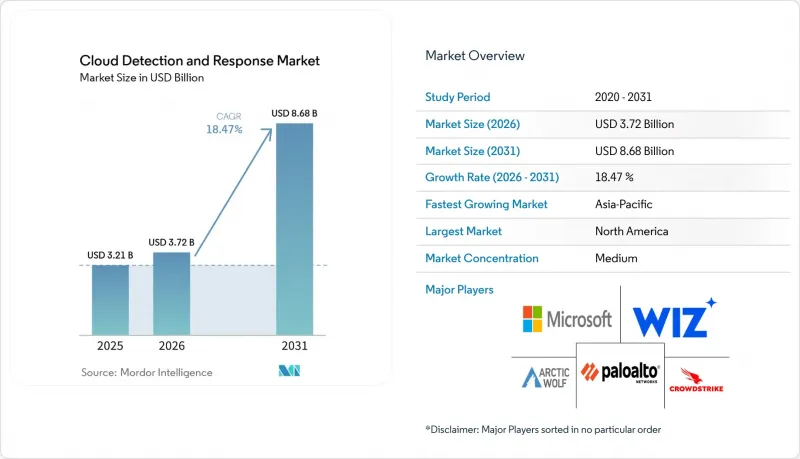
에 따르면 클라우드 탐지·대응 시장 규모는 2025년 32억 1,000만 달러, 2026년 37억 2,000만 달러에서 2031년까지 86억 8,000만 달러로 확대될 것으로 예측되고 있으며, 2026-2031년까지 연평균 성장률(CAGR)은 18.47%에 달할 전망입니다.
전 세계 클라우드 탐지 및 대응 시장의 동향과 인사이트
클라우드 및 멀티클라우드 워크로드의 확대
조직들은 하이브리드 및 멀티클라우드 환경 전반에서 더 많은 워크로드를 운영하고 있으며, 보안 프로세스도 이러한 변화에 맞춰 진화하고 있습니다. 포티넷의 보고서에 따르면 2026년에는 조직의 88%가 하이브리드 또는 멀티클라우드 환경을 운영할 것으로 예상되며, 이는 전년의 82%에서 증가한 수치입니다. 동 보고서에 따르면 81%의 조직이 중요한 워크로드에 2개 이상의 클라우드 공급자를 이용하고 있는 것으로도 밝혀졌습니다. 각 공급자는 고유한 제어 플레인 및 데이터 소스를 도입하고 있으며, 보안 팀은 이를 모니터링해야 합니다. 구매자가 AWS, Azure, Google Cloud에 걸친 활동에 대한 통합 뷰를 요구할 경우, 클라우드 탐지 및 대응 시장은 그 혜택을 누리게 될 것입니다. 클라우드 텔레메트리 데이터를 직접 수집하여 이러한 환경에 걸친 관련 활동을 연계할 수 있는 제공업체는 이러한 요구 사항을 충족하는 데 유리한 입장에 있습니다.
‘신원 중심(Identity-First)’형 클라우드 공격의 증가
인증 정보, 서비스 계정, 토큰이 영구적인 접근 권한을 제공할 수 있으므로 ID는 클라우드 공격의 핵심 표적이 되고 있습니다. 소포스(Sophos)의 조사에 따르면 71%의 조직이 전년도에 적어도 1건의 ID 관련 침해 사고를 경험했으며, 영향을 받은 조직은 평균 3건의 사고를 보고했습니다. 이 조직들이 보고한 평균 복구 비용은 164만 달러였으며, 73%의 조직이 최소 25만 달러의 비용을 부담했습니다. CrowdStrike의 보고서에 따르면 이 회사의 탐지 사례 중 82%는 악성코드가 수반되지 않은 것이었으며, 클라우드 사고의 35%에서 유효한 계정의 악용이 확인되었습니다. Permiso의 보고서에 따르면 조직의 77%가 보안 사고의 최대 75%를 ID 유출이 차지한다고 응답한 반면, 46%는 ID에 대한 포괄적인 가시성을 확보하고 있다고 보고했습니다. 따라서 클라우드 탐지 및 대응 시장에서는 API 키, 연합 인증 정보, 서비스 계정 및 워크로드 신호를 통합하는 플랫폼이 주목받고 있습니다.
보안 툴의 난립과 통합의 복잡성
보안 팀은 보안 태세 관리, 액세스 제어, 엔드포인트 보안, 이벤트 관리를 위해 기존 시스템에 클라우드 툴을 추가하는 경우가 많습니다. Fortinet의 조사에 따르면 응답자의 70% 가까이가 2026년에 효과적인 클라우드 보안을 저해하는 주요 요인으로 툴의 난립과 가시성 격차를 꼽았습니다. 개별 툴에서는 공통된 맥락이 결여된 경보가 발생하여 분석가의 업무 부담을 가중시킬 수 있습니다. 또한 통합 지연으로 인해 새로운 런타임 탐지 툴이 실질적인 결과를 제공할 수 있게 되기까지의 기간도 길어집니다. 구매자가 새로운 제품을 파편화된 보안 스택로 연결해야 하는 경우, 클라우드 탐지 및 대응 시장은 제약을 받을 수 있습니다. 통합 플랫폼은 툴 수를 줄이고 조사 워크플로를 간소화함으로써 이러한 장벽을 낮출 수 있습니다.
부문 분석
2025년, 솔루션은 클라우드 탐지 및 대응(CDR) 시장의 58.46% 점유율을 차지하고 있으며, 이는 전용으로 설계된 CDR 플랫폼에 대한 기업의 수요를 반영합니다. 이러한 플랫폼은 클라우드 텔레메트리 수집, 공격 상관 관계 분석, 경보 분류를 보안 팀을 위한 단일 운영 환경으로 통합합니다. 이를 통해 분석가는 서로 연동되지 않는 개별 제품에서 발생하는 고립된 경보를 일일이 조사하는 대신, 관련 이벤트를 포괄적으로 평가할 수 있게 됩니다. 파로알토 네트웍스의 보고서에 따르면 99%의 조직이 전년도에 AI 시스템에 대해 적어도 한 번의 공격을 받은 것으로 나타났습니다. 이러한 압박으로 인해 기존 클라우드 워크로드에 더해 생성형 AI 워크로드까지 모니터링하는 플랫폼에 대한 수요가 증가하고 있습니다.
서비스 시장은 2031년까지 연평균 성장률(CAGR) 24.16%로 확대될 것으로 예상되며, 이는 구성 요소별 성장률 중에서도 가장 높은 수치입니다. 중견 기업은 사내 클라우드 보안 담당 인력만으로는 지속적인 클라우드 모니터링을 유지할 수 없는 경우, 매니지드 서비스를 선택하는 경우가 많습니다. 서비스 제공업체는 여러 클라우드 환경에 걸친 온보딩, 텔레메트리 매핑 및 탐지 엔지니어링을 지원함으로써 서비스 개시까지의 시간을 단축할 수 있습니다. 벤더들은 구독 계약에서 라이선스 소프트웨어와 매니지드 서비스를 결합하는 사례가 늘어나고 있으며, 이 두 범주의 경계가 모호해지고 있습니다. 이는 클라우드 탐지 및 대응 업계에서 독립형 매니지드 보안 서비스 제공업체의 포지셔닝과 이익률에 영향을 미칠 가능성이 있습니다.
2025년, 퍼블릭 클라우드는 클라우드 탐지 및 대응 시장의 57.29%를 차지하고 있으며, 이는 워크로드와 보안 예산이 단일 공급자 환경에 집중되어 있음을 반영합니다. 퍼블릭 클라우드 환경을 보유한 구매자들은 클라우드 사용이 확대됨에 따라 데이터, ID, 워크로드 및 제공업체의 제어 계층에 대한 모니터링이 필요합니다. 이러한 도입 기반은 클라우드 네이티브 탐지 툴에 대한 수요의 중요한 원천으로 계속 작용하고 있습니다. 또한 제품의 지속적인 채택을 위해서는 주요 퍼블릭 클라우드 서비스와의 상호 운용성이 중요합니다. 단일 공급자 설계를 유지하고 있는 조직이라 하더라도, 보안 이벤트와 클라우드 운영 활동을 연계하는 툴은 여전히 필요합니다.
하이브리드 및 멀티클라우드 배포는 2031년까지 연평균 성장률(CAGR) 23.46%로 확대될 것으로 예측됩니다. 기업은 다양한 비즈니스 요구에 따라 온프레미스 시스템, 프라이빗 클라우드, 퍼블릭 클라우드 서비스를 조합한 운영 모델을 채택하고 있습니다. 유럽 및 아시아태평양의 데이터 주권 요건으로 인해 이러한 구조는 규정 준수를 위한 대응일 뿐만 아니라 아키텍처상의 선택이 될 수도 있습니다. 공급자별 API를 공통 데이터 모델로 변환하는 공급자는 팀이 환경에 관계없이 일관된 탐지 규칙을 적용할 수 있도록 지원할 수 있습니다. 또한 엄격한 데이터 분류 요건을 가진 금융 기관이나 국방 기관의 경우, 프라이빗 클라우드는 여전히 중요한 역할을 수행하고 있습니다.
지역별 분석
2025년, 북미는 클라우드 탐지 및 대응 시장의 44.87%를 차지했습니다. 이 지역은 광범위한 클라우드 인프라, 기업 대상의 고밀도 집중, 그리고 확립된 보안 예산을 모두 갖추고 있습니다. HIPAA, SOC 2, GLBA 및 SEC의 사이버 보안 공개에 관한 미국의 요건은 공식적인 보안 관리를 지원하고 있습니다. 연방 정부의 클라우드 구상과 제로 트러스트(Zero Trust) 요건 또한 공공 부문의 수요를 창출하고 있습니다. 하이브리드 근무의 확산으로 경계 중심의 보안 접근 방식의 한계가 드러나는 가운데, 북미 지역의 클라우드 보안 지출은 연평균 성장률(CAGR) 16.76%로 확대되었습니다.
유럽은 클라우드 탐지 및 대응 시장의 중요한 부분을 차지하고 있으며, 지출은 규정 준수 요건에 의해 점점 더 좌우되고 있습니다. DORA는 2025년 1월부터 유럽연합(EU)내 은행, 보험사, 결제 기업, 자산 운용사에 적용되고 있습니다. 이 규정의 사고 및 위험 관리 요건으로 인해 지속적인 탐지·대응 기능에 대한 수요가 발생하고 있습니다. NIS2 의무화로 인해 에너지, 의료, 운송, 디지털 인프라 분야에 걸쳐 구매자층이 확대되고 있습니다. 영국, 프랑스, 독일, 이탈리아, 스페인이 주요 지출 거점으로 자리 잡고 있으며, 남미에서는 인프라 및 인력 제약이 있음에도 불구하고 브라질과 칠레에서 새로운 수요가 나타나고 있습니다.
아시아태평양은 2031년까지 연평균 성장률(CAGR) 23.59%로 확대될 것으로 예측되며, 이는 지역별로는 가장 높은 성장률입니다. 인도, 한국, 일본의 ‘클라우드 퍼스트’ 인프라 구축 계획, 아세안(ASEAN) 국가들의 핀테크 확대, 그리고 현지화 요건이 수요를 지원하고 있습니다. 중국의 사이버 보안 및 데이터 보안 관련 규제는 현지화된 접근 방식을 요구하며, 국가별 도입 모델을 촉진하고 있습니다. 중동에서는 주권 클라우드 보안 계획을 통해 수요가 확대되고 있지만, 아프리카는 남아프리카공화국과 나이지리아가 주도하는 가운데 여전히 초기 단계에 머물러 있습니다.
기타 혜택:
- 엑셀 형식의 시장 예측(ME) 시트
- 3개월간의 애널리스트 지원
자주 묻는 질문
목차
제1장 서론
- 조사 전제조건과 시장 정의
- 조사 범위
제2장 조사 방법
제3장 개요
제4장 시장 구도
- 시장 개요
- 거시경제 요인의 영향
- 시장 성장 촉진요인
- 시장 성장 억제요인
- 가치 및 공급망 분석
- 규제 상황
- 기술 전망
- Porter's Five Forces 분석
제5장 시장 규모와 성장 예측
- 컴포넌트별
- 배포 모드별
- 조직 규모별
- 산업 분야별
- 지역별
- 북미
- 미국
- 캐나다
- 멕시코
- 남미
- 브라질
- 아르헨티나
- 칠레
- 기타 남미 국가
- 유럽
- 독일
- 영국
- 프랑스
- 이탈리아
- 스페인
- 기타 유럽 국가
- 아시아태평양
- 중국
- 일본
- 인도
- 한국
- 호주
- 기타 아시아태평양 국가
- 중동
- 사우디아라비아
- 아랍에미리트
- 기타 중동 국가
- 아프리카
- 남아프리카공화국
- 나이지리아
- 이집트
- 기타 아프리카 국가
- 북미
제6장 경쟁 구도
- 시장 집중도
- 전략적 동향
- 시장 점유율 분석
- 기업 개요
- Palo Alto Networks, Inc.
- CrowdStrike Holdings, Inc.
- Microsoft Corporation
- Wiz, Inc.
- Arctic Wolf
- Cisco Systems, Inc.
- Fortinet, Inc.
- Check Point Software Technologies Ltd.
- Trend Micro Incorporated
- SentinelOne, Inc.
- Orca Security Ltd.
- Sysdig, Inc.
- Rapid7, Inc.
- Sophos Limited
- Tenable Holdings, Inc.
- Qualys, Inc.
- Darktrace plc
- Arctic Wolf Networks, Inc.
- ReliaQuest Holdings, LLC
- Expel, Inc.
제7장 시장 기회와 향후 전망
KSA 26.10.30According to Mordor Intelligence, the cloud detection and response market size is projected to expand from USD 3.21 billion in 2025 and USD 3.72 billion in 2026 to USD 8.68 billion by 2031, registering a CAGR of 18.47% between 2026 and 2031.
Global Cloud Detection and Response Market Trends and Insights
Cloud and Multi-Cloud Workload Expansion
Organizations are running more workloads across hybrid and multi-cloud environments, and their security processes are adapting to this change. Fortinet reported that 88% of organizations operated hybrid or multi-cloud environments in 2026, compared with 82% in the prior year. The same report found that 81% used 2 or more cloud providers for critical workloads. Each provider introduces its own control planes and data sources that security teams need to monitor. The cloud detection and response market benefits when buyers require a unified view of activity across AWS, Azure, and Google Cloud. Providers that ingest cloud telemetry directly and connect related activity across those environments are better positioned for this requirement.
Identity-First Cloud Attack Growth
Identity has become a central attack surface for cloud attacks because credentials, service accounts, and tokens can provide persistent access. Sophos found that 71% of organizations experienced at least 1 identity-related breach in the prior year, and affected organizations reported an average of 3 incidents. Those organizations reported average recovery costs of USD 1.64 million, while 73% incurred costs of at least USD 250,000. CrowdStrike reported that 82% of its detections were malware-free and that valid account abuse appeared in 35% of cloud incidents. Permiso reported that 77% of organizations said identity compromise accounted for up to 75% of security incidents, while 46% reported comprehensive visibility over identities. The cloud detection and response market, therefore, favors platforms that integrate API keys, federated credentials, service accounts, and workload signals.
Security Tool Sprawl and Integration Complexity
Security teams often add cloud tools to existing systems for posture management, access control, endpoint security, and event management. Fortinet found that nearly 70% of respondents cited tool sprawl and visibility gaps as a primary hindrance to effective cloud security in 2026. Separate tools can generate alerts that lack common context, creating more work for analysts. Integration also delays the point at which a new runtime detection tool delivers usable results. The cloud detection and response market can be constrained when buyers must connect a new product to a fragmented security stack. Consolidated platforms can reduce this barrier by lowering tool counts and simplifying investigation workflows.
Other drivers and restraints analyzed in the detailed report include:
- Regulatory and Cyber-Insurance Control Requirements
- Cloud-Native Application and DevSecOps Adoption
- Cloud-Security Skills Shortage
For complete list of drivers and restraints, kindly check the Table Of Contents.
Segment Analysis
Solutions held 58.46% of the cloud detection and response market share in 2025, reflecting enterprise demand for purpose-built CDR platforms. These platforms bring cloud telemetry ingestion, attack correlation, and alert triage into one operating environment for security teams. They help analysts assess related events rather than investigate isolated alerts from disconnected point products. Palo Alto Networks reported that 99% of organizations had experienced at least 1 attack on their AI systems during the prior year. This pressure supports demand for platforms that observe generative AI workloads alongside established cloud workloads.
Services are projected to expand at a 24.16% CAGR through 2031, the highest rate within the component split. Mid-market enterprises often select managed services when they cannot maintain continuous cloud monitoring with internal cloud security staff. Service providers support onboarding, telemetry mapping, and detection engineering across several cloud environments, which can shorten the time to use. Vendors are increasingly combining licensed software with managed services in subscription contracts, narrowing the distinction between the two categories. This can affect the positioning and margins of standalone managed security service providers within the cloud detection and response industry.
Public cloud accounted for 57.29% of the cloud detection and response market in 2025, reflecting the concentration of workloads and security budgets in single-provider environments. Buyers with public cloud estates require monitoring of data, identities, workloads, and provider control planes as cloud usage expands. This installed base remains a substantial source of demand for cloud-native detection tools. It also makes interoperability with major public cloud services important for continued product adoption. Organizations that retain a single-provider design still need tools that connect security events with operational cloud activity.
Hybrid and multi-cloud deployment is projected to expand at a 23.46% CAGR through 2031. Enterprises are using operating models that combine on-premises systems, private cloud, and public cloud services across different business needs. Data sovereignty requirements in Europe and the Asia-Pacific can make this structure both a compliance response and an architectural choice. Providers that convert provider-specific APIs into a common data model can help teams apply consistent detection rules across environments. Private cloud also remains relevant for financial institutions and defense organizations with strict data classification requirements.
Complete Report Scope:
- By Component
- Solutions
- Services
- By Deployment Mode
- Public Cloud
- Private Cloud
- Hybrid and Multi-Cloud
- By Organization Size
- Large Enterprises
- Small and Medium-Sized Enterprises
- By Industry Vertical
- Government and Public Administration
- Industrial Manufacturing
- Retail and E-Commerce
- Transportation and Logistics
- Energy and Utilities
- Oil and Gas
- IT and Telecommunication
- Media and Entertainment
- Education and Research Institutions
- Healthcare and Life Sciences
- Banking, Financial Services, and Insurance (BFSI)
- Other Industry Verticals
- By Geography
- North America
- United States
- Canada
- Mexico
- South America
- Brazil
- Argentina
- Chile
- Rest of South America
- Europe
- Germany
- United Kingdom
- France
- Italy
- Spain
- Rest of Europe
- Asia-Pacific
- China
- Japan
- India
- South Korea
- Australia
- Rest of Asia-Pacific
- Middle East
- Saudi Arabia
- United Arab Emirates
- Rest of Middle East
- Africa
- South Africa
- Nigeria
- Egypt
- Rest of Africa
- North America
Geography Analysis
North America held 44.87% of the cloud detection and response market in 2025. The region combines extensive cloud infrastructure, a high concentration of enterprise targets, and established security budgets. U.S. requirements related to HIPAA, SOC 2, GLBA, and SEC cybersecurity disclosures support formal security controls. Federal cloud initiatives and zero-trust requirements also create public-sector demand. Cloud security spending in North America advanced at a 16.76% CAGR as hybrid work revealed the limits of perimeter-focused security approaches.
Europe is a significant part of the cloud detection and response market, with spending increasingly guided by compliance requirements. DORA has been applied since January 2025 to banks, insurers, payment firms, and asset managers in the European Union. Its incident and risk-management requirements create demand for continuous detection and response capability. NIS2 obligations broaden the buyer base across energy, healthcare, transportation, and digital infrastructure. The United Kingdom, France, Germany, Italy, and Spain are the main spending bases, while South America shows emerging demand in Brazil and Chile despite infrastructure and skill constraints.
Asia-Pacific is projected to expand at a 23.59% CAGR through 2031, the fastest regional rate. Cloud-first infrastructure programs in India, South Korea, and Japan, ASEAN fintech expansion, and localization requirements support demand. China's cybersecurity and data security rules require localized approaches and encourage country-specific deployment models. The Middle East is developing demand through sovereign-cloud security plans, while Africa remains at an earlier stage, led by South Africa and Nigeria.
- Palo Alto Networks, Inc.
- CrowdStrike Holdings, Inc.
- Microsoft Corporation
- Wiz, Inc.
- Arctic Wolf
- Cisco Systems, Inc.
- Fortinet, Inc.
- Check Point Software Technologies Ltd.
- Trend Micro Incorporated
- SentinelOne, Inc.
- Orca Security Ltd.
- Sysdig, Inc.
- Rapid7, Inc.
- Sophos Limited
- Tenable Holdings, Inc.
- Qualys, Inc.
- Darktrace plc
- Arctic Wolf Networks, Inc.
- ReliaQuest Holdings, LLC
- Expel, Inc.
Additional Benefits:
- The market estimate (ME) sheet in Excel format
- 3 months of analyst support
TABLE OF CONTENTS
1 INTRODUCTION
- 1.1 Study Assumptions and Market Definition
- 1.2 Scope of the Study
2 RESEARCH METHODOLOGY
3 EXECUTIVE SUMMARY
4 MARKET LANDSCAPE
- 4.1 Market Overview
- 4.2 Impact of Macroeconomic Factors
- 4.3 Market Drivers
- 4.3.1 Cloud and Multi-Cloud Workload Expansion
- 4.3.2 Identity-First Cloud Attack Growth
- 4.3.3 Regulatory and Cyber-Insurance Control Requirements
- 4.3.4 Cloud-Native Application and DevSecOps Adoption
- 4.3.5 Ephemeral Workload Telemetry Gaps Creating Demand for Agentless Detection
- 4.3.6 Runtime Security for AI Workloads and Autonomous Agents
- 4.4 Market Restraints
- 4.4.1 Security Tool Sprawl and Integration Complexity
- 4.4.2 Cloud-Security Skills Shortage
- 4.4.3 Data Sovereignty and Cross-Border Telemetry Restrictions
- 4.4.4 Short-Lived Workloads and Sparse Evidence Increasing False Negatives
- 4.5 Value and Supply-Chain Analysis
- 4.6 Regulatory Landscape
- 4.6.1 Shared-Responsibility Requirements
- 4.6.2 Data Protection and Breach Notification
- 4.6.3 Critical Infrastructure and Operational Resilience
- 4.6.4 Software Supply-Chain and Secure Development Requirements
- 4.6.5 Cloud and AI Governance Requirements
- 4.7 Technological Outlook
- 4.7.1 Cloud-Native Telemetry and eBPF Instrumentation
- 4.7.2 Graph-Based Attack-Path Correlation
- 4.7.3 Artificial Intelligence for Detection Triage and Investigation
- 4.7.4 Autonomous Response and Security Orchestration
- 4.7.5 Deception for Identity and Cloud-Control-Plane Threats
- 4.7.6 Container, Kubernetes, and Serverless Runtime Protection
- 4.7.7 AI-SPM and Generative-AI Workload Protection
- 4.8 Porter's Five Forces Analysis
- 4.8.1 Bargaining Power of Cloud Service Providers
- 4.8.2 Bargaining Power of Buyers
- 4.8.3 Threat of New Entrants
- 4.8.4 Threat of Substitutes
- 4.8.5 Competitive Rivalry
5 MARKET SIZE AND GROWTH FORECASTS (VALUE)
- 5.1 By Component
- 5.1.1 Solutions
- 5.1.2 Services
- 5.2 By Deployment Mode
- 5.2.1 Public Cloud
- 5.2.2 Private Cloud
- 5.2.3 Hybrid and Multi-Cloud
- 5.3 By Organization Size
- 5.3.1 Large Enterprises
- 5.3.2 Small and Medium-Sized Enterprises
- 5.4 By Industry Vertical
- 5.4.1 Government and Public Administration
- 5.4.2 Industrial Manufacturing
- 5.4.3 Retail and E-Commerce
- 5.4.4 Transportation and Logistics
- 5.4.5 Energy and Utilities
- 5.4.6 Oil and Gas
- 5.4.7 IT and Telecommunication
- 5.4.8 Media and Entertainment
- 5.4.9 Education and Research Institutions
- 5.4.10 Healthcare and Life Sciences
- 5.4.11 Banking, Financial Services, and Insurance (BFSI)
- 5.4.12 Other Industry Verticals
- 5.5 By Geography
- 5.5.1 North America
- 5.5.1.1 United States
- 5.5.1.2 Canada
- 5.5.1.3 Mexico
- 5.5.2 South America
- 5.5.2.1 Brazil
- 5.5.2.2 Argentina
- 5.5.2.3 Chile
- 5.5.2.4 Rest of South America
- 5.5.3 Europe
- 5.5.3.1 Germany
- 5.5.3.2 United Kingdom
- 5.5.3.3 France
- 5.5.3.4 Italy
- 5.5.3.5 Spain
- 5.5.3.6 Rest of Europe
- 5.5.4 Asia-Pacific
- 5.5.4.1 China
- 5.5.4.2 Japan
- 5.5.4.3 India
- 5.5.4.4 South Korea
- 5.5.4.5 Australia
- 5.5.4.6 Rest of Asia-Pacific
- 5.5.5 Middle East
- 5.5.5.1 Saudi Arabia
- 5.5.5.2 United Arab Emirates
- 5.5.5.3 Rest of Middle East
- 5.5.6 Africa
- 5.5.6.1 South Africa
- 5.5.6.2 Nigeria
- 5.5.6.3 Egypt
- 5.5.6.4 Rest of Africa
- 5.5.1 North America
6 COMPETITIVE LANDSCAPE
- 6.1 Market Concentration
- 6.2 Strategic Moves
- 6.3 Market Share Analysis
- 6.4 Company Profiles (includes Global Level Overview, Market Level Overview, Core Segments, Financials as available, Strategic Information, Market Rank/Share, Products and Services, Recent Developments)
- 6.4.1 Palo Alto Networks, Inc.
- 6.4.2 CrowdStrike Holdings, Inc.
- 6.4.3 Microsoft Corporation
- 6.4.4 Wiz, Inc.
- 6.4.5 Arctic Wolf
- 6.4.6 Cisco Systems, Inc.
- 6.4.7 Fortinet, Inc.
- 6.4.8 Check Point Software Technologies Ltd.
- 6.4.9 Trend Micro Incorporated
- 6.4.10 SentinelOne, Inc.
- 6.4.11 Orca Security Ltd.
- 6.4.12 Sysdig, Inc.
- 6.4.13 Rapid7, Inc.
- 6.4.14 Sophos Limited
- 6.4.15 Tenable Holdings, Inc.
- 6.4.16 Qualys, Inc.
- 6.4.17 Darktrace plc
- 6.4.18 Arctic Wolf Networks, Inc.
- 6.4.19 ReliaQuest Holdings, LLC
- 6.4.20 Expel, Inc.
7 MARKET OPPORTUNITIES AND FUTURE OUTLOOK
- 7.1 White-Space and Unmet-Need Assessment
- 7.1.1 Identity-Centric Detection in Low-Telemetry Environments
- 7.1.2 Unified Cloud-to-SOC Investigation
- 7.1.3 Security for Ephemeral and Serverless Workloads
- 7.1.4 Cloud Detection and Response for Generative-AI Workloads
- 7.1.5 Sovereign Cloud Detection and Response
- 7.1.6 Managed Detection and Response for Small and Medium-Sized Enterprises


