

|
시장보고서
상품코드
2157043
통신 네트워크용 AIOps : 시장 점유율 분석, 업계 동향과 통계, 성장 예측(2026-2031년)AIOps For Telecom Networks - Market Share Analysis, Industry Trends & Statistics, Growth Forecasts (2026 - 2031) |
||||||
 Mordor Intelligence
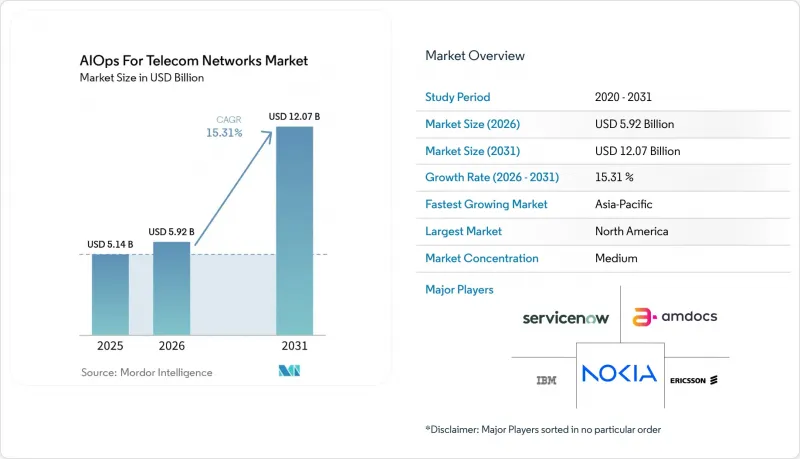
에 따르면 통신 네트워크용 AIOps 시장 규모는 2025년에 51억 4,000만 달러로 평가되며, 2026년 59억 2,000만 달러에서 2031년까지 120억 7,000만 달러에 달할 것으로 예측되고 있으며, 예측 기간(2026-2031년)에 CAGR은 15.31%에 달할 전망입니다.
전 세계 통신 네트워크용 AIOps 시장의 동향 및 인사이트
5G, 네트워크 슬라이싱 및 멀티 도메인의 복잡화로 인해 NOC 아키텍처가 재구축되고 있습니다.
독립형 5G 네트워크에서 통신사업자는 무선, 전송, 코어 각 도메인에 걸친 서비스 계약을 관리해야 하지만, 이러한 도메인에서는 대개 서로 다른 벤더의 시스템이 사용되고 있습니다. 네트워크 슬라이싱에서는 각 슬라이스마다 특정 서비스 수준 계약(SLA)에 맞춘 성능 제어가 필요하므로 또 다른 계층이 추가됩니다. 3GPP의 네트워크 데이터 분석 기능(NDAF)은 5G 코어 내에 네이티브 데이터 수집 및 추론 인터페이스를 제공하는 반면, O-RAN 얼라이언스의 RAN 지능형 컨트롤러는 AI 기반의 의사결정 지원을 무선 도메인까지 확장합니다. 이러한 표준들이 결합되어 통신 네트워크용 AIOps 시장에서 도입 및 벤더 평가를 위한 보다 명확한 기술적 로드맵이 제시되고 있습니다. 통신사업자의 실증 프로그램에서는 AI 에이전트가 다수의 기업 고객에 걸친 슬라이싱 정책을 관리하며, 트래픽이 급증할 때도 50밀리초 이내에 리소스를 조정할 수 있음이 입증되었습니다. 단일 크로스 도메인 뷰를 통해 전문 네트워크 운영 팀 간의 수동 인계가 감소하는 한편, 통신 업계에 특화된 기반 모델을 통해 무선, 전송, 코어 및 서비스 데이터에 대한 통합적인 해석이 향상됩니다.
IoT 및 엣지 텔레메트리 데이터 양의 증가가 AI 네이티브 데이터 처리를 요구
IoT 엔드포인트, 엣지 노드 및 클라우드 네이티브 네트워크 기능은 기존 네트워크 팀이 수동으로 확인할 수 있는 양을 초과하는 운영 데이터를 생성하고 있습니다. 에릭슨(Ericsson)의 보고서에 따르면 2025년 말 기준으로 26억 건의 광대역 및 중요 IoT 연결이 존재하며, 이로 인해 지속적인 네트워크 텔레메트리 양이 더욱 증가했습니다. 따라서 통신 네트워크용 AIOps 시장은 다수의 네트워크 계층에서 발생하는 신호를 실시간으로 상관 분석할 수 있는 시스템에 의존하고 있습니다. 엣지에서 생성된 정보는 중앙 추론 계층에 도달하기 전에, 대부분의 경우 로컬에서 필터링이나 의미적 압축이 필요합니다. AWS는 엣지에 배포된 소형 언어 모델이 대규모의 원시 텔레메트리 스트림을 클라우드 AI 에이전트를 위한 더 작은 진단 신호로 응축하는 통신 분야의 도입 사례를 소개하고 있습니다. 이 접근 방식을 통해 특히 중앙 집중식 처리가 현실적으로 어려운 지역적으로 분산된 네트워크에서 백홀 요구 사항을 줄이고 응답 시간을 단축할 수 있습니다.
레거시 OSS 및 BSS 통합 비용이 AI 도입 속도를 제약
레거시 OSS 및 BSS 시스템은 개별 통신사업자에 맞춰 맞춤화된 경우가 많아, 새로운 AI 툴와의 연동이 어려울 수 있습니다. 이 과제는 멀티 벤더 네트워크에서 더욱 심각하며, 텔레메트리 데이터를 일관되게 해석하기 위해서는 데이터 어댑터나 정규화 레이어가 필요합니다. Amdocs는 2026년 2월, 기존 BSS 및 OSS 스택을 대체하는 것이 아니라 그 위에서 작동하도록 설계된 운영 체제인 ‘aOS’를 발표했습니다. 이러한 설계는 시스템 통합 과정에서 발생할 수 있는 서비스 중단에 대한 통신사업자의 우려를 반영한 것입니다. 통신 네트워크용 AIOps 시장에서는 대규모 사내 통합 팀을 보유하지 않은 중견 통신사업자의 도입 속도가 둔화될 가능성이 있습니다. TM Forum의 Open Digital 아키텍처를 준수하는 클라우드 네이티브 OSS 설계는 향후 통합 부담을 줄일 수 있습니다. 그러나 예측 기간 중는 구형 시스템의 도입 기반이 계속해서 도입 속도와 벤더 선정에 영향을 미칠 것입니다.
부문 분석
2025년, 통신 네트워크용 AIOps 시장에서 플랫폼은 65.72%의 점유율을 차지했습니다. 통신사업자들은 텔레메트리 수집, 모델 관리, 상관 분석 및 폐쇄 루프 오케스트레이션을 결합한 통합 플랫폼을 계속해서 선호하고 있습니다. 이러한 추세는 캐리어급 신뢰성과 통신 업계 특유의 운영 지식에 대한 요구도 반영하고 있습니다. 플랫폼에는 일반적인 기업용 AIOps 제품에는 없는 네트워크 온톨로지나 기존 OSS 커넥터가 포함될 수 있습니다. 이러한 기능을 통해 통신사업자는 여러 네트워크 도메인에 걸쳐 발생하는 방대한 양의 경보 및 성능 데이터를 관리할 수 있게 됩니다. IBM 조사에 따르면 통신에 특화된 기반 모델이 기존 방식에 비해 네트워크 데이터의 예측 정확도를 향상시킬 수 있음이 입증되었습니다. 이는 통신 네트워크용 AIOps 업계에서 전문 플랫폼의 입지를 지원하는 것입니다. 또한 통신사업자들이 플랫폼을 일회성 소프트웨어 구매가 아닌 장기적인 아키텍처 선택지로 평가하는 경우가 많은 이유도 설명하고 있습니다.
서비스 시장은 2026-2031년까지 연평균 성장률(CAGR) 17.24%로 확대될 것으로 예측됩니다. 이 범주에는 도입, 플랫폼 맞춤화, 관리형 운영 및 데이터 준비 지원이 포함됩니다. 서비스에 대한 수요는 기존(브라운필드) 네트워크 환경의 복잡성과 밀접한 관련이 있습니다. AI 플랫폼이 안정적으로 가동되기 위해서는 공급자가 레거시 OSS 및 BSS의 데이터 구조를 매핑해야 하는 경우가 적지 않습니다. 관리형 AIOps 모델은 전담 AI 운영 팀을 보유하지 않은 통신사업자에게 유용합니다. 이러한 모델은 보다 예측 가능한 성과 기반 계약을 제공하며, 사내 인프라에 대한 투자 필요성을 줄일 수 있습니다. 도입 품질이 플랫폼 배포의 신뢰성에 영향을 미치기 때문에 통신 네트워크용 AIOps 시장에서는 앞으로도 서비스에 대한 수요가 지속될 것입니다. 또한 서비스는 벤더가 플랫폼의 초기 판매 이후에도 통신사업자와의 장기적인 관계를 구축하는 데 도움이 됩니다.
2025년, 통신 네트워크용 AIOps 시장에서 온프레미스 배포는 54.63%를 차지했습니다. 이러한 상황은 데이터 주권 요건, 지연에 대한 우려, 그리고 통신사업자들이 오랫동안 중시해 온 현지 제어에 대한 성향을 반영한 것입니다. 국가 규제로 인해 네트워크 텔레메트리 클라우드 처리가 제한되는 지역에서는 온프레미스 시스템이 여전히 중요하게 여겨지고 있습니다. 이는 아시아태평양 및 중동 일부 지역의 국영 통신사업자에게 특히 중요합니다. 또한 온프레미스 구축은 네트워크 인프라에 대한 직접적인 접근이 필요한 기밀성이 높은 워크로드에도 대응할 수 있습니다. 이러한 고려 사항들로 인해 클라우드 기능이 지속적으로 향상되더라도 온프레미스 도입 기반은 여전히 중요한 위치를 차지하고 있습니다. 따라서 통신 네트워크용 AIOps 업계는 온프레미스 및 하이브리드 운영 모델을 모두 지속적으로 지원하고 있습니다. 하이브리드 설계를 통해 통신사업자는 유연성을 확보하는 동시에, 위험이 높은 데이터나 규제 대상 데이터에 대한 관리 권한을 유지할 수 있습니다.
클라우드 기반 도입은 2026-2031년까지 연평균 성장률(CAGR) 19.18%로 확대될 것으로 예측됩니다. 탄력적인 클라우드 인프라는 단기간에 트래픽 패턴이 급격히 변화하는 경우에도 대규모 AI 추론을 지원할 수 있습니다. 노키아는 2026년 6월, 자사의 ‘Autonomous Networks Fabric’이 오케스트레이션, 보증, 인벤토리 관리를 위한 애플리케이션과 함께 AWS 인프라에서 이용 가능해질 것이라고 발표했습니다. 클라우드를 통한 제공은 초기 인프라 요구 사항을 줄이고 소프트웨어 업데이트를 가속화할 수도 있습니다. 감사 가능성 및 데이터 거주지에 관한 유럽의 요구 사항으로 인해 공급업체들은 퍼블릭 클라우드 서비스와 병행하여 소버린 클라우드 옵션을 제공하도록 권장받고 있습니다. 이로 인해 많은 통신사업자에서 하이브리드 아키텍처가 유지될 전망입니다. 통신 네트워크용 AIOps 시장은 온프레미스 제어의 필요성을 배제하지 않으면서도 클라우드 이용으로 전환되고 있습니다.
지역별 분석
북미는 2025년 매출 점유율 31.13%를 차지하며 통신 네트워크용 AIOps 시장에서 선두 자리를 유지했습니다. 미국의 주요 통신사업자들은 광범위한 5G 상용화 프로그램과 병행하여 AI 주도형 네트워크 운영에 투자해 왔습니다. 또한 이 지역에는 통신 벤더와 협력하여 통합 솔루션을 제공하는 클라우드 AI 제공업체의 강력한 기반이 마련되어 있습니다. 이러한 상황이 실제 운영 수준의 자동화 플랫폼 개발을 지원하고 있습니다. 캐나다에서는 지방 및 외딴 지역의 네트워크 관리에 AIOps가 활용되고 있습니다. 멕시코에서는 주로 LTE에서 5G로의 전환에 따른 자동화를 지원하기 위해 이 기술이 활용되고 있습니다. 남미에서는 브라질이 주도적인 역할을 하고 있으며, 해당 국가의 통신사업자들은 멀티밴드 5G 네트워크를 위한 장애 상관 분석 및 예측 유지보수에 투자하고 있습니다. 남미 전역에서의 도입은 광섬유 및 해저 인프라를 보다 효율적으로 관리해야 할 필요성을 반영한 것이기도 합니다.
유럽은 통신 네트워크 분야의 AIOps 시장에 있으며, 여전히 중요한 운영 환경입니다. 영국, 독일, 프랑스에서는 TM Forum의 프레임워크를 활용한 자율형 네트워크 프로그램이 진행되고 있습니다. 도이치 통신은 2025년 11월 독일 국내에 ‘RAN Guardian Agent’를 도입하고, 관련 프로그램을 체코와 크로아티아로 확대하고 있습니다. 유럽연합(EU)의 AI 법에 따라 거버넌스, 감사 가능성 및 문서화된 관리 조치의 필요성이 높아지고 있습니다. 이러한 요건은 ETSI 및 3GPP 표준 준수를 입증할 수 있는 유서 깊은 벤더에게 유리하게 작용할 가능성이 있습니다. 사우디아라비아와 아랍에미리트(UAE)는 스마트 시티와 핵심 연결성에 중점을 둔 디지털 전환 프로그램을 통해 중동 지역에서의 도입을 추진하고 있습니다. 아프리카는 여전히 초기 단계에 있으며, 남아프리카공화국과 나이지리아는 장애 관리 및 성능 최적화에 주력하고 있습니다.
아시아태평양은 2026-2031년까지 연평균 성장률(CAGR) 17.78%로 확대될 것으로 예측됩니다. 중국, 인도, 한국, 일본, 호주, 뉴질랜드에서는 5G 네트워크 확장에 따라 통신 네트워크 시장에서 AIOps의 활용이 증가하고 있습니다. 화웨이는 MWC 2026에서 20개 이상의 AI 에이전트를 탑재한 ‘AUTINOps’를 발표하며, 위험 식별 정확도 80% 이상, 진단 정확도 90% 이상을 달성했다고 보고했습니다. 노키아는 NTT 도코모와 협력하여 ‘MantaRay SON’ 및 ‘AutoPilot’의 시범 운영을 통해 SMO 주도형 자율화에 주력하고 있습니다. 인도에서는 대규모 모바일 가입자 기반 전반에 걸쳐 독립형 5G의 커버리지 범위가 확대되고 있으며, 대량의 텔레메트리 데이터를 수집할 수 있는 환경이 조성되어 있습니다. 호주와 뉴질랜드는 규모는 작지만 기술적으로 첨단인 시장이며, 3GPP 및 TM Forum 표준을 준수하는 클라우드 네이티브 도입을 선호하고 있습니다.
기타 혜택:
- 엑셀 형식의 시장 예측(ME) 시트
- 3개월간의 애널리스트 지원
자주 묻는 질문
목차
제1장 서론
- 조사 전제조건과 시장 정의
- 조사 범위
제2장 조사 방법
제3장 개요
제4장 시장 구도
- 시장 개요
- 시장 성장 촉진요인
- 시장 성장 억제요인
- 업계 밸류체인 분석
- 규제 상황
- 기술 전망
- Porter's Five Forces 분석
- 거시경제 요인이 시장에 미치는 영향
제5장 시장 규모와 성장 예측
- 제공별
- 배포 모델별
- 조직 규모별
- 용도별
- 최종사용자별
- 지역별
- 북미
- 미국
- 캐나다
- 멕시코
- 남미
- 브라질
- 아르헨티나
- 기타 남미 국가
- 유럽
- 영국
- 독일
- 프랑스
- 스페인
- 이탈리아
- 기타 유럽 국가
- 아시아태평양
- 중국
- 일본
- 인도
- 한국
- 호주·뉴질랜드
- 기타 아시아태평양 국가
- 중동
- 사우디아라비아
- 아랍에미리트
- 기타 중동 국가
- 아프리카
- 남아프리카공화국
- 나이지리아
- 기타 아프리카 국가
- 북미
제6장 경쟁 구도
- 시장 집중도
- 전략적 동향
- 시장 점유율 분석
- 기업 개요
- International Business Machines Corporation
- Cisco Systems, Inc.
- Nokia Corporation
- Telefonaktiebolaget LM Ericsson
- Amdocs Limited
- ServiceNow, Inc.
- Huawei Technologies Co., Ltd.
- Ciena Corporation
- Netcracker Technology Corporation
- Oracle Corporation
- Microsoft Corporation
- Google LLC
- ZTE Corporation
- NEC Corporation
- Samsung Electronics Co., Ltd.
- Tech Mahindra Limited
- Tata Consultancy Services Limited
- Infosys Limited
- Wipro Limited
- Radcom Ltd.
- Grokstream, Inc.
제7장 시장 기회와 향후 전망
KSA 26.10.30According to Mordor Intelligence, the AIOps for Telecom Networks Market size was valued at USD 5.14 billion in 2025 and is estimated to grow from USD 5.92 billion in 2026 to reach USD 12.07 billion by 2031, at a CAGR of 15.31% during the forecast period (2026-2031).
Global AIOps For Telecom Networks Market Trends and Insights
5G, Network Slicing, and Multi-Domain Complexity Reshape NOC Architecture
Standalone 5G networks require operators to manage service commitments across the radio, transport, and core domains, which often use separate vendor systems. Network slicing adds another layer because each slice requires performance controls tailored to its specific service-level agreement. The 3GPP Network Data Analytics Function provides a native data collection and inference interface within the 5G core, while the O-RAN Alliance RAN Intelligent Controller extends AI-based decision support into the radio domain. Together, these standards give the AIOps for telecom networks market a clearer technical route for deployment and vendor assessment. Operator programs have shown that AI agents can manage slicing policies across many enterprise customers and adjust resources in less than 50 milliseconds during traffic surges. A single cross-domain view reduces manual transfers between specialist network operations teams, while telecom-specific foundation models can improve the interpretation of combined radio, transport, core, and service data.
IoT and Edge Telemetry Volumes Force AI-Native Data Processing
IoT endpoints, edge nodes, and cloud-native network functions are generating more operational data than traditional network teams can manually review. Ericsson reported 2.6 billion broadband and critical IoT connections at the end of 2025, which increased the volume of continuous network telemetry. The AIOps for telecom networks market, therefore, depends on systems that can correlate signals from many network layers in real time. Edge-generated information often requires local filtering and semantic compression before it reaches a central inference layer. AWS has described telecom deployments in which edge-deployed small language models condense large raw telemetry streams into smaller diagnostic signals for cloud AI agents. This approach can lower backhaul requirements and shorten response times, particularly in geographically dispersed networks where centralized processing is less practical.
Legacy OSS and BSS Integration Costs Constrain AI Deployment Velocity
Legacy OSS and BSS systems are often customized for individual operators and can be difficult to connect with new AI tools. This challenge is more severe in multivendor networks, which require data adapters and normalization layers before telemetry can be interpreted consistently. Amdocs introduced aOS in February 2026 as an operating system designed to run on top of existing BSS and OSS stacks rather than replace them. That design reflects operator concerns about disruption during system integration. The AIOps for telecom networks market may see slower adoption among mid-tier operators without large internal integration teams. Cloud-native OSS designs aligned with TM Forum Open Digital Architecture can reduce future integration burdens. However, the installed base of older systems will continue to affect deployment speed and vendor selection over the forecast period.
Other drivers and restraints analyzed in the detailed report include:
- NOC Cost Reduction and MTTR Improvement Define AIOps ROI
- Predictive Service Assurance Becomes a Commercial Necessity for Operators
- Automated Remediation Introduces New Cybersecurity and Operational Risk Vectors
For complete list of drivers and restraints, kindly check the Table Of Contents.
Segment Analysis
Platforms held 65.72% of the AIOps for telecom networks market share in 2025. Operators continue to favor integrated platforms that combine telemetry ingestion, model management, correlation, and closed-loop orchestration. This preference also reflects the need for carrier-grade reliability and telecom-specific operational knowledge. Platforms can include network ontologies and existing OSS connectors that general enterprise AIOps products lack. These capabilities help operators manage large volumes of alarms and performance data across several network domains. IBM Research demonstrated that telecom-focused foundation models can improve prediction accuracy for network data compared with conventional methods. This supports the position of specialized platforms within the AIOps industry for telecom networks. It also explains why operators often evaluate platforms as long-term architectural choices rather than isolated software purchases.
Services are projected to expand at a 17.24% CAGR from 2026 to 2031. This category includes implementation, platform customization, managed operations, and support for data preparation. Service demand remains closely tied to the complexity of brownfield network environments. Providers must often map legacy OSS and BSS data structures before an AI platform can operate reliably. Managed AIOps models are useful for operators that do not have dedicated AI operations teams. These models can offer more predictable outcome-based arrangements and reduce the need for internal infrastructure investment. The AIOps for telecom networks market will continue to require services, as implementation quality affects the reliability of any platform deployment. Services also help vendors build longer operator relationships after the initial platform sale.
On-premises deployment accounted for 54.63% of the AIOps market for telecom networks in 2025. This position reflected data sovereignty requirements, latency concerns, and long-standing operator preferences for local control. On-premises systems remain important where national rules limit cloud processing of network telemetry. They are especially relevant for state-affiliated operators in parts of the Asia-Pacific and the Middle East. Local deployment can also support highly sensitive workloads that require direct access to network infrastructure. These considerations sustain a meaningful installed base even as cloud options become more capable. The AIOps for telecom networks industry, therefore, continues to support both local and hybrid operating models. Hybrid designs can give operators flexibility while retaining control over high-risk or regulated data.
Cloud-based deployment is projected to expand at a 19.18% CAGR from 2026 to 2031. Elastic cloud infrastructure can support large-scale AI inference when traffic patterns change sharply within short periods. Nokia announced in June 2026 that its Autonomous Networks Fabric would be available on AWS infrastructure with applications for orchestration, assurance, and inventory management. Cloud delivery can also reduce upfront infrastructure requirements and speed software updates. European requirements around auditability and data residency are encouraging suppliers to provide sovereign cloud options alongside public cloud services. This is likely to preserve hybrid architectures for many operators. The AIOps for telecom networks market is moving toward cloud use without eliminating the need for on-premises control.
Complete Report Scope:
- By Offering
- Platforms
- Services
- By Deployment Model
- On-Premises
- Cloud-Based
- By Organization Size
- Large Enterprises
- Small and Medium-Sized Enterprises
- By Application
- Network Performance Management
- Fault and Incident Management
- Network Security Management
- Customer Experience Management
- Infrastructure Management
- Application Performance Analysis
- Other Applications
- By End-User
- Mobile Network Operators
- Fixed and Broadband Operators
- Integrated Communication Service Providers
- Other End-Users
- By Geography
- North America
- United States
- Canada
- Mexico
- South America
- Brazil
- Argentina
- Rest of South America
- Europe
- United Kingdom
- Germany
- France
- Spain
- Italy
- Rest of Europe
- Asia-Pacific
- China
- Japan
- India
- South Korea
- Australia and New Zealand
- Rest of Asia-Pacific
- Middle East
- Saudi Arabia
- United Arab Emirates
- Rest of Middle East
- Africa
- South Africa
- Nigeria
- Rest of Africa
- North America
Geography Analysis
North America held 31.13% revenue share in 2025, giving it the leading position in the AIOps for telecom networks market. Major United States operators have invested in AI-led network operations alongside wider 5G commercialization programs. The region also has a strong base of cloud AI providers that work with telecom vendors on integrated offerings. These conditions support the development of production-grade automation platforms. Canada is applying AIOps to rural and remote network management. Mexico is using the technology mainly to support automation during LTE-to-5G transitions. South America is led by Brazil, where operators are investing in fault correlation and predictive maintenance for multiband 5G networks. Adoption across South America also reflects the need to manage fiber and subsea infrastructure more efficiently.
Europe remains an important operating environment for the AIOps market in telecom networks. The United Kingdom, Germany, and France are advancing autonomous network programs using TM Forum frameworks. Deutsche Telekom deployed its RAN Guardian Agent in Germany during November 2025 and is expanding related programs to the Czech Republic and Croatia. The European Union AI Act has increased the need for governance, auditability, and documented controls. These requirements may favor established vendors that can show compliance with ETSI and 3GPP standards. Saudi Arabia and the United Arab Emirates are driving adoption in the Middle East through digital transformation programs focused on smart cities and critical connectivity. Africa remains at an earlier stage, with South Africa and Nigeria concentrating on fault management and performance optimization.
Asia-Pacific is projected to expand at a 17.78% CAGR from 2026 to 2031. China, India, South Korea, Japan, Australia, and New Zealand are increasing the use of AIOps for the telecom networks market as 5G networks scale. Huawei launched AUTINOps at MWC 2026 with more than 20 AI agents and reported over 80% risk-identification accuracy and above 90% diagnosis accuracy. Nokia is working with NTT DOCOMO on SMO-driven autonomy through MantaRay SON and AutoPilot trials. India offers high-volume telemetry conditions as standalone 5G coverage expands across a large mobile subscriber base. Australia and New Zealand are smaller but technically advanced markets that favor cloud-native deployments aligned with 3GPP and TM Forum standards.
- International Business Machines Corporation
- Cisco Systems, Inc.
- Nokia Corporation
- Telefonaktiebolaget LM Ericsson
- Amdocs Limited
- ServiceNow, Inc.
- Huawei Technologies Co., Ltd.
- Ciena Corporation
- Netcracker Technology Corporation
- Oracle Corporation
- Microsoft Corporation
- Google LLC
- ZTE Corporation
- NEC Corporation
- Samsung Electronics Co., Ltd.
- Tech Mahindra Limited
- Tata Consultancy Services Limited
- Infosys Limited
- Wipro Limited
- Radcom Ltd.
- Grokstream, Inc.
Additional Benefits:
- The market estimate (ME) sheet in Excel format
- 3 months of analyst support
TABLE OF CONTENTS
1 INTRODUCTION
- 1.1 Study Assumptions and Market Definition
- 1.2 Scope of the Study
2 RESEARCH METHODOLOGY
3 EXECUTIVE SUMMARY
4 MARKET LANDSCAPE
- 4.1 Market Overview
- 4.2 Market Drivers
- 4.2.1 5G, Network Slicing, and Multi-Domain Complexity
- 4.2.2 Growth in Network Telemetry From IoT, Edge, and Cloud-Native Infrastructure
- 4.2.3 Pressure to Reduce NOC Costs and Mean Time to Repair
- 4.2.4 Rising Demand for Predictive Service Assurance and Customer Experience Protection
- 4.2.5 Telecom-Specific Foundation Models Trained on Network Telemetry
- 4.2.6 Energy-Aware Closed-Loop Optimization for Radio and Edge Infrastructure
- 4.3 Market Restraints
- 4.3.1 High Integration Costs Across Legacy OSS, BSS, and Multivendor Networks
- 4.3.2 Data Privacy, Cybersecurity, and Operational Risk From Automated Remediation
- 4.3.3 Poorly Labeled Alarm, Incident, and Configuration Data
- 4.3.4 Operator Reluctance to Delegate Control to Agentic Systems
- 4.4 Industry Value-Chain Analysis
- 4.5 Regulatory Landscape
- 4.6 Technological Outlook
- 4.7 Porter's Five Forces Analysis
- 4.7.1 Bargaining Power of Suppliers
- 4.7.2 Bargaining Power of Buyers
- 4.7.3 Threat of New Entrants
- 4.7.4 Threat of Substitutes
- 4.7.5 Competitive Rivalry
- 4.8 Impact of Macroeconomic Factors on the Market
5 MARKET SIZE AND GROWTH FORECASTS (VALUE)
- 5.1 By Offering
- 5.1.1 Platforms
- 5.1.2 Services
- 5.2 By Deployment Model
- 5.2.1 On-Premises
- 5.2.2 Cloud-Based
- 5.3 By Organization Size
- 5.3.1 Large Enterprises
- 5.3.2 Small and Medium-Sized Enterprises
- 5.4 By Application
- 5.4.1 Network Performance Management
- 5.4.2 Fault and Incident Management
- 5.4.3 Network Security Management
- 5.4.4 Customer Experience Management
- 5.4.5 Infrastructure Management
- 5.4.6 Application Performance Analysis
- 5.4.7 Other Applications
- 5.5 By End-User
- 5.5.1 Mobile Network Operators
- 5.5.2 Fixed and Broadband Operators
- 5.5.3 Integrated Communication Service Providers
- 5.5.4 Other End-Users
- 5.6 By Geography
- 5.6.1 North America
- 5.6.1.1 United States
- 5.6.1.2 Canada
- 5.6.1.3 Mexico
- 5.6.2 South America
- 5.6.2.1 Brazil
- 5.6.2.2 Argentina
- 5.6.2.3 Rest of South America
- 5.6.3 Europe
- 5.6.3.1 United Kingdom
- 5.6.3.2 Germany
- 5.6.3.3 France
- 5.6.3.4 Spain
- 5.6.3.5 Italy
- 5.6.3.6 Rest of Europe
- 5.6.4 Asia-Pacific
- 5.6.4.1 China
- 5.6.4.2 Japan
- 5.6.4.3 India
- 5.6.4.4 South Korea
- 5.6.4.5 Australia and New Zealand
- 5.6.4.6 Rest of Asia-Pacific
- 5.6.5 Middle East
- 5.6.5.1 Saudi Arabia
- 5.6.5.2 United Arab Emirates
- 5.6.5.3 Rest of Middle East
- 5.6.6 Africa
- 5.6.6.1 South Africa
- 5.6.6.2 Nigeria
- 5.6.6.3 Rest of Africa
- 5.6.1 North America
6 COMPETITIVE LANDSCAPE
- 6.1 Market Concentration
- 6.2 Strategic Moves
- 6.3 Market Share Analysis
- 6.4 Company Profiles (includes Global Level Overview, Market Level Overview, Core Segments, Financials as available, Strategic Information, Market Rank/Share, Products and Services, Recent Developments)
- 6.4.1 International Business Machines Corporation
- 6.4.2 Cisco Systems, Inc.
- 6.4.3 Nokia Corporation
- 6.4.4 Telefonaktiebolaget LM Ericsson
- 6.4.5 Amdocs Limited
- 6.4.6 ServiceNow, Inc.
- 6.4.7 Huawei Technologies Co., Ltd.
- 6.4.8 Ciena Corporation
- 6.4.9 Netcracker Technology Corporation
- 6.4.10 Oracle Corporation
- 6.4.11 Microsoft Corporation
- 6.4.12 Google LLC
- 6.4.13 ZTE Corporation
- 6.4.14 NEC Corporation
- 6.4.15 Samsung Electronics Co., Ltd.
- 6.4.16 Tech Mahindra Limited
- 6.4.17 Tata Consultancy Services Limited
- 6.4.18 Infosys Limited
- 6.4.19 Wipro Limited
- 6.4.20 Radcom Ltd.
- 6.4.21 Grokstream, Inc.
7 MARKET OPPORTUNITIES AND FUTURE OUTLOOK
- 7.1 White-Space and Unmet-Need Assessment


