

|
시장보고서
상품코드
2157044
클라우드 인시던트 대응 서비스 : 시장 점유율 분석, 업계 동향과 통계, 성장 예측(2026-2031년)Cloud Incident Response Services - Market Share Analysis, Industry Trends & Statistics, Growth Forecasts (2026 - 2031) |
||||||
 Mordor Intelligence
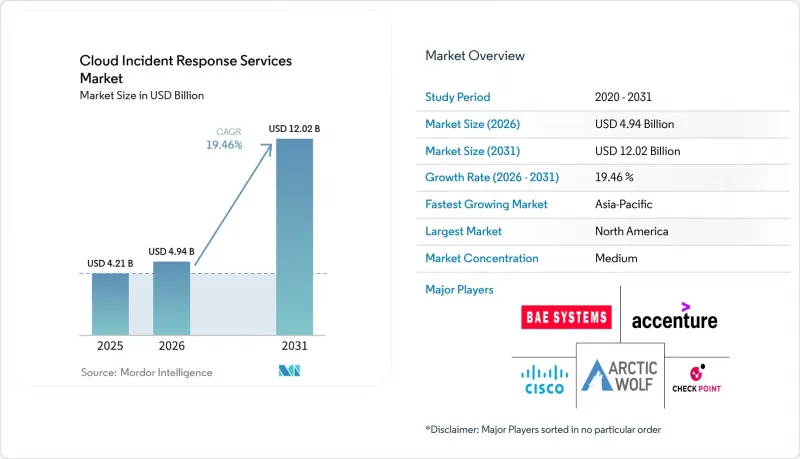
에 따르면 클라우드 인시던트 대응 서비스 시장 규모는 2025년 42억 1,000만 달러, 2026년 49억 4,000만 달러에서 2031년까지 120억 2,000만 달러로 확대될 것으로 예측되고 있으며, 2026-2031년까지 연평균 성장률(CAGR)은 19.46%에 달할 전망입니다.
글로벌 클라우드 인시던트 대응 서비스 시장의 동향 및 인사이트
증가하는 클라우드 ID 및 API 악용
클라우드 침해는 대개 인증 정보나 권한 침해에서 시작되므로 ID 관련 조사가 사고 대응 정액제 예산에서 더 큰 비중을 차지하게 되었습니다. ID 제어는 공격 경로 전반에 걸친 접근에 영향을 미치므로, 대응 팀은 최초 침입 지점을 넘어 이를 면밀히 조사해야 합니다. 침해된 계정을 활용함으로써 공격자는 의심스러운 동작을 감지하는 제어 장치의 감시를 피하면서 정상적인 클라우드 서비스를 이용할 수 있게 됩니다. 사고 대응 팀은 동의 체인, 토큰 이력, 서비스 계정의 권한 경로 및 액세스 정책 변경 사항을 재구성해야 합니다. 이 작업에는 클라우드 플랫폼 및 연결된 애플리케이션 전반에 걸쳐 ID가 어떻게 구현되어 있는지 이해하고 있는 전문가가 필요합니다. 클라우드 사고 대응 서비스 시장에서는 온프레미스 환경에서 차용된 일반적인 대응 플레이북이 아닌, 클라우드 ID 포렌식에 특화된 기술을 보유한 제공업체가 우위를 점하고 있습니다.
AI로 가속화된 공격자의 방법
2025년, AI가 실제 공격 활동의 일부가 되면서 조사 및 봉쇄에 소요되는 시간이 달라졌습니다. Google Mandiant는 2025년 6월, Gemini API에 쿼리를 전송하여 VBScript 소스 코드를 주기적으로 재작성하고 다형적 행동을 유발하는 툴인 ‘PROMPTFLUX’를 식별했습니다. 공격의 자동화로 인해 접근, 횡방향 이동, 데이터 탈취까지 걸리는 시간이 단축될 가능성이 있습니다. 또한 정적 규칙만으로는 반복적으로 변화하는 악의적인 활동을 탐지하기 어려워집니다. 이러한 상황으로 인해 분석가가 각 경보를 확인하기 전에 조치를 취할 수 있는 자동 분류의 필요성이 높아지고 있습니다. 더불어 탐지와 봉쇄를 단일 운영 모델로 통합하는 사고 대응 서비스 제공업체에 대한 수요도 증가하고 있습니다.
로그 설정 미비로 인한 증거 누락
클라우드 대응은 완벽한 텔레메트리에 의존하지만, 로그 설정 미비로 인해 조사시 중요한 증거를 활용할 수 없는 경우가 종종 있습니다. 팔로알토 네트웍스는 자사의 ‘2025년 글로벌 인시던트 대응 보고서’에서 다룬 클라우드 침해 사례의 거의 절반에서 공격자가 설정 오류가 있는 액세스 제어 및 ID 제어를 악용했다고 보고했습니다. 조직은 스토리지 비용을 절감하기 위해 상세한 API 로깅을 제한하는 경우가 있는데, 이로 인해 공격자의 경로나 침해 범위를 파악하는 데 필요한 기록이 손실될 가능성이 있습니다. 특히 이벤트 양이 방대하고 보존 기간이 짧은 경향이 있는 컨테이너나 서버리스 워크로드의 경우, 기본 설정만으로는 불충분할 수 있습니다. 리테이너나 자동화된 플레이북은 애초에 수집되지 않은 소스 정보를 보완할 수 없습니다. 이러한 제약으로 인해 로깅 환경을 갖추지 않은 조직의 경우, 클라우드 사고 대응 서비스 시장의 효과가 떨어질 가능성이 있습니다.
부문 분석
매니지드 탐지 및 대응(MDR)은 2026-2031년까지 연평균 성장률(CAGR) 23.17%로 확대될 것으로 예측되며, 가장 빠르게 성장하는 서비스 유형이 될 전망입니다. 이 정액제 계약 모델은 지속적인 모니터링, 위협 헌팅 및 대응 실행을 단일 계약 하에 통합하고 있습니다. 이러한 구조를 통해 침해 발생 후 구매자가 긴급 지원을 요청할 때 발생할 수 있는 조달 지연을 피할 수 있습니다. CrowdStrike는 2026년 3월, 자율형 AI 에이전트와 Falcon Complete의 분석가를 결합하여 부담이 큰 보안 업무를 자동화하는 ‘Agentic MDR’을 도입했습니다. 이 서비스는 탐지와 격리 간의 연계 강화에 대한 가치 상승을 반영하고 있습니다. MDR(Managed Detection and Response) 클라우드 사고 대응 서비스 시장 규모는 자체적으로 24시간 체제의 위협 인텔리전스 및 대응 팀을 유지할 수 없는 조직들에 의해 지탱되고 있습니다.
2025년 서비스 유형별 지출 중 봉쇄 및 피해 경감이 32.86%를 차지하며, 이 부문에서 클라우드 인시던트 대응 서비스 중 최대 점유율을 기록했습니다. 인시던트의 확산을 막는 것은 침해가 확인된 후 당면한 운영상의 최우선 과제로 남아 있습니다. 인시던트 대응 담당자는 발생한 상황을 파악하고 증거를 보존해야 하므로, 봉쇄 단계 이후에는 일반적으로 조사 및 디지털 포렌식이 수행됩니다. 그 후, 시정 조치 및 복구 단계에서는 서비스 복구, 통제 조치 시정, 재발 가능성 저감에 중점을 둡니다. 그 밖의 서비스 구성으로는 클라우드 ID 관리 계약 및 성과 기반 계약 등이 있습니다. 따라서 이러한 서비스 조합은 많은 조직이 클라우드 보안 사고를 관리하는 순서를 반영하고 있습니다.
2025년에는 퍼블릭 클라우드가 도입 맥락에서 지출의 54.29%를 차지할 것으로 예상되며, 2026-2031년까지 연평균 성장률(CAGR) 22.86%로 확대될 것으로 전망됩니다. 이러한 상황은 기업의 워크로드와 보안 사고가 퍼블릭 클라우드 플랫폼에 집중되어 있음을 반영합니다. AWS, Microsoft Azure, Google Cloud는 전문 사고 대응 플랫폼이 데이터를 수집·분석하도록 설계되는 사례가 늘고 있는 텔레메트리 데이터를 제공하고 있습니다. CrowdStrike는 2026년 4월, 실시간 클라우드 탐지 및 대응 기능을 Google Cloud로 확장했습니다. 이 확장을 통해 분산 환경 전반에 걸친 통합적인 대응이 가능해집니다. 따라서 퍼블릭 클라우드는 이 도입 환경내 클라우드 사고 대응 서비스 시장에서 가장 큰 점유율을 차지하고 있습니다.
프라이빗, 하이브리드 및 멀티클라우드 환경에서는 각각 서로 다른 증거 수집 기법과 대응 담당자의 전문 지식이 요구됩니다. 하이브리드 환경에서는 서로 다른 스키마나 보존 기간이 적용될 가능성이 있는 온프레미스 및 클라우드 기록을 팀이 상호 연관시켜야 합니다. 멀티클라우드 환경에서는 계정이나 토큰이 클라우드 경계를 넘어 존재할 수 있으므로, ID 및 권한과 관련된 문제가 발생합니다. IBM의 조사에 따르면 하이브리드 및 멀티클라우드 환경에서 침해 사고를 식별하고 차단하는 데는 단일 환경에서의 침해 사고보다 더 많은 시간이 소요되는 것으로 나타났습니다. 조직들은 확장 정책에 따라 영향을 받은 인스턴스가 삭제되기 전에 불안정한 상태를 포착하기 위해 자동화된 증거 보존에 투자하고 있습니다. 이러한 상황으로 인해 클라우드 사고 대응 서비스 시장 전반에서 배포에 관한 전문 지식의 중요성이 여전히 유지되고 있습니다.
지역별 분석
2025년, 북미는 전 세계 클라우드 사고 대응 서비스 시장에서 36.74%의 점유율을 차지하며 지역별 최대 점유율을 기록했습니다. 기업의 클라우드 배포, 확립된 공급자 네트워크, 그리고 사고 대응 준비에 대한 투자가 이러한 위상을 지원하고 있습니다. SEC(미국 증권거래위원회)의 사이버 보안 공시 요건으로 인해 이사회에서는 중요성 평가와 준비된 대응 프로그램에 대한 관심이 높아지고 있습니다. 캐나다의 개인정보 보호 체계와 멕시코의 디지털 인프라 보안에 대한 집중으로 인해 수요는 미국 이외의 지역으로도 확대되고 있습니다. 구매자들은 사고 발생 후의 긴급 조달보다는 사전에 준비된 대응 지원을 점점 더 요구하고 있습니다.
아시아태평양은 2026-2031년까지 연평균 성장률(CAGR) 24.63%로 확대될 것으로 예상되며, 이는 지역별로는 가장 높은 성장률입니다. 클라우드 배포과 정부의 사이버 보안 요건으로 인해 해당 지역 전체에서 사전 대응 서비스에 대한 수요가 증가하고 있습니다. 인도의 데이터 보호 체계와 글로벌 딜리버리 센터의 존재로 인해 다국적 기업의 기밀 정보를 다루는 것의 중요성이 커지고 있습니다. 싱가포르와 호주 역시 클라우드 구성 및 정보 유출 대응 요건을 통해 조달 동향에 영향을 미치고 있습니다. 현지 증거 보존 요건 및 규제 준수를 지원할 수 있는 공급업체는 이 지역의 수요에 대응하는 데 유리한 입장에 있습니다.
유럽에서는 DORA, NIS2 및 GDPR 요건이 시장을 형성하고 있으며, 특히 독일, 영국, 프랑스, 베네룩스 국가의 금융 센터에서 이러한 경향이 두드러집니다. 남미는 소규모 기반에서 발전하고 있으며, 브라질과 아르헨티나의 수요는 금융 기관 및 정부 기관에 집중되어 있습니다. 사우디아라비아와 아랍에미리트에서는 중요 인프라 사업자에 대한 사고 대응 계획 요건이 강화되고 있습니다. 아프리카에서는 남아프리카공화국과 나이지리아가 금융 서비스 및 통신 기업의 도입을 주도하고 있지만, 공급업체 확보 및 전문 기술 부족으로 인해 단기적인 진전에는 한계가 있습니다.
기타 혜택:
- 엑셀 형식의 시장 예측(ME) 시트
- 3개월간의 애널리스트 지원
자주 묻는 질문
목차
제1장 서론
- 조사 전제조건과 시장 정의
- 조사 범위
제2장 조사 방법
제3장 개요
제4장 시장 구도
- 시장 개요
- 시장 성장 촉진요인
- 시장 성장 억제요인
- 거시경제 요인의 영향
- 밸류·공급망 분석
- 규제 상황
- 기술 전망
- Porter's Five Forces 분석
제5장 시장 규모와 성장 예측
- 서비스 유형별
- 클라우드 환경별
- 조직 규모별
- 산업 분야별
- 지역별
- 북미
- 미국
- 캐나다
- 멕시코
- 남미
- 브라질
- 아르헨티나
- 기타 남미 국가
- 유럽
- 독일
- 영국
- 프랑스
- 이탈리아
- 스페인
- 기타 유럽 국가
- 아시아태평양
- 중국
- 일본
- 인도
- 한국
- 호주
- 기타 아시아태평양 국가
- 중동
- 사우디아라비아
- 아랍에미리트
- 기타 중동 국가
- 아프리카
- 남아프리카공화국
- 나이지리아
- 기타 아프리카 국가
- 북미
제6장 경쟁 구도
- 시장 집중도
- 전략적 동향
- 시장 점유율 분석
- 기업 개요
- Accenture plc
- Arctic Wolf Networks, Inc.
- BAE Systems plc
- Check Point Software Technologies Ltd.
- Cisco Systems, Inc.
- CrowdStrike Holdings, Inc.
- Deloitte Touche Tohmatsu Limited
- Ernst & Young Global Limited
- Google LLC, Mandiant
- International Business Machines Corporation
- Kaspersky Lab
- KPMG International Limited
- Microsoft Corporation
- NCC Group plc
- NTT DATA Corporation
- Optiv Security Inc.
- Palo Alto Networks, Inc.
- PricewaterhouseCoopers International Limited
- Rapid7, Inc.
- Secureworks Corp.
- SentinelOne, Inc.
- Sophos Limited
제7장 시장 기회와 향후 전망
KSA 26.10.30According to Mordor Intelligence, the cloud incident response services market size is projected to expand from USD 4.21 billion in 2025 and USD 4.94 billion in 2026 to USD 12.02 billion by 2031, registering a CAGR of 19.46% between 2026 to 2031.
Global Cloud Incident Response Services Market Trends and Insights
Rising Cloud Identity and API Abuse
Identity-related investigations are taking a larger share of response retainer budgets because cloud breaches often begin with compromised credentials or permissions. Identity controls influence access throughout the attack path, so response teams must examine them beyond the first point of entry. Compromised accounts can allow an attacker to use ordinary cloud services while avoiding attention from controls that rely on unfamiliar behavior. Response teams must reconstruct consent chains, token histories, service-account privilege paths, and changes to access policies. That work requires specialists who understand how identity is implemented across cloud platforms and connected applications. The cloud incident response services market favors providers with dedicated cloud identity forensic skills instead of general response playbooks adapted from on-premises environments.
AI-Accelerated Attacker Tradecraft
AI became part of operational attack activity during 2025, which changed the time available for investigation and containment. Google Mandiant identified PROMPTFLUX in June 2025, a tool that queried the Gemini API to rewrite its VBScript source code regularly and create polymorphic behavior. Attack automation can reduce the time between access, lateral movement, and data theft. It also makes repeated variations of malicious activity harder to detect with static rules alone. These conditions increase the need for automated triage that can act before analysts review each alert. They increase demand for response providers that connect detection and containment in a single operating model.
Evidence Gaps From Logging Misconfiguration
Cloud response depends on complete telemetry, yet logging configurations often leave important evidence unavailable at the time of an investigation. Palo Alto Networks reported that attackers exploited misconfigured access and identity controls in nearly half of the cloud breaches covered by its 2025 global incident response report. Organizations may limit detailed API logging to control storage costs, but this can remove the records needed to establish an attacker's path and the scope of a breach. Default settings can be particularly inadequate for container and serverless workloads, where event volumes are high and retention periods may be short. Retainers and automated playbooks cannot replace source information that was never captured. This constraint can reduce the effectiveness of the cloud incident response services market for organizations that have not prepared their logging environment.
Other drivers and restraints analyzed in the detailed report include:
- Regulatory and Cyber-Insurance Response Obligations
- Multi-Cloud and Ephemeral Workload Complexity
- Data Sovereignty and Cross-Border Evidence Restrictions
For complete list of drivers and restraints, kindly check the Table Of Contents.
Segment Analysis
Managed detection and response is projected to expand at a 23.17% CAGR during 2026-2031, making it the fastest-growing service type. Its retainer model combines continuous monitoring, threat hunting, and response execution under one agreement. This structure avoids procurement delays that can occur when a buyer seeks emergency assistance after a breach. CrowdStrike introduced Agentic MDR in March 2026, combining autonomous AI agents with Falcon Complete analysts to automate high-friction security work. The offering reflects the growing value placed on a closer connection between detection and containment. The cloud incident response services market size for managed detection and response is supported by organizations that cannot maintain their own round-the-clock threat intelligence and response teams.
Containment and mitigation accounted for 32.86% of service-type spending in 2025, the largest share of Cloud incident response services within this segmentation. Stopping the spread of an incident remains the immediate operating priority after a breach is confirmed. Investigation and digital forensics commonly follow containment because responders need to establish what occurred and preserve evidence. Remediation and recovery then focus on restoring services, correcting controls, and reducing the chance of recurrence. Other service configurations include cloud identity retainers and outcome-based arrangements. The service mix, therefore, reflects the order in which many organizations manage a cloud security incident.
Public cloud held 54.29% of deployment-context spending in 2025 and is projected to expand at a 22.86% CAGR during 2026-2031. This position reflects the concentration of enterprise workloads and security events in public cloud platforms. AWS, Microsoft Azure, and Google Cloud provide telemetry that specialized response platforms are increasingly designed to collect and analyze. CrowdStrike extended its real-time cloud detection and response capabilities to Google Cloud in April 2026. The expansion supports a unified response across distributed environments. Public cloud, therefore, holds the leading market share in cloud incident response services for the deployment context.
Private, hybrid, and multi-cloud environments require different evidence collection methods and responder expertise. Hybrid deployments require teams to correlate on-premises and cloud records that may use different schemas and retention periods. Multi-cloud estates add identity and permission challenges because accounts and tokens can span cloud boundaries. IBM found that hybrid and multi-cloud breaches took longer to identify and contain than breaches in a single environment. Organizations are investing in automated evidence preservation to capture the volatile state before scaling policies remove affected instances. These conditions keep specialized deployment knowledge important across the cloud incident response services market.
Complete Report Scope:
- By Service Type
- Investigation and Digital Forensics
- Containment and Mitigation
- Remediation and Recovery
- Managed Detection and Response
- Other Service Types
- By Cloud Environment
- Public Cloud
- Private Cloud
- Hybrid Cloud
- Multi-Cloud
- By Organization Size
- Large Enterprises
- Small and Medium Enterprises
- By Industry Vertical
- Government and Public Administration
- Industrial Manufacturing
- Retail and E-Commerce
- Transportation and Logistics
- Energy and Utilities
- Oil and Gas
- IT and Telecommunication
- Media and Entertainment
- Education and Research Institutions
- Healthcare and Life Sciences
- Banking, Financial Services, and Insurance (BFSI)
- Other Industry Verticals
- By Geography
- North America
- United States
- Canada
- Mexico
- South America
- Brazil
- Argentina
- Rest of South America
- Europe
- Germany
- United Kingdom
- France
- Italy
- Spain
- Rest of Europe
- Asia-Pacific
- China
- Japan
- India
- South Korea
- Australia
- Rest of Asia-Pacific
- Middle East
- Saudi Arabia
- United Arab Emirates
- Rest of Middle East
- Africa
- South Africa
- Nigeria
- Rest of Africa
- North America
Geography Analysis
North America held 36.74% of the global cloud incident response services market in 2025, the largest regional share. Enterprise cloud adoption, established provider networks, and response-readiness spending underpin its position. SEC cybersecurity disclosure requirements have increased board attention to materiality assessments and prepared response programs. Canada's privacy framework and Mexico's focus on digital infrastructure security extend demand beyond the United States. Buyers increasingly seek pre-arranged response support instead of emergency sourcing after an event.
Asia-Pacific is forecast to expand at a 24.63% CAGR during 2026-2031, the fastest regional rate. Cloud adoption and government cybersecurity requirements are expanding the need for prepared response services across the region. India's data protection framework and global delivery centers increase the importance of handling sensitive multinational information. Singapore and Australia are also influencing procurement through cloud configuration and breach-response requirements. Providers that can support local evidence residency and regulatory response are well placed to serve this regional demand.
Europe is shaped by DORA, NIS2, and GDPR requirements, especially in financial centers across Germany, the United Kingdom, France, and Benelux. South America is developing from a smaller base, with demand in Brazil and Argentina centered on financial institutions and government entities. Saudi Arabia and the United Arab Emirates have increased incident-planning requirements for critical infrastructure operators. South Africa and Nigeria lead African adoption among financial services and telecommunications firms, although provider availability and specialized skills limit near-term progress.
- Accenture plc
- Arctic Wolf Networks, Inc.
- BAE Systems plc
- Check Point Software Technologies Ltd.
- Cisco Systems, Inc.
- CrowdStrike Holdings, Inc.
- Deloitte Touche Tohmatsu Limited
- Ernst & Young Global Limited
- Google LLC, Mandiant
- International Business Machines Corporation
- Kaspersky Lab
- KPMG International Limited
- Microsoft Corporation
- NCC Group plc
- NTT DATA Corporation
- Optiv Security Inc.
- Palo Alto Networks, Inc.
- PricewaterhouseCoopers International Limited
- Rapid7, Inc.
- Secureworks Corp.
- SentinelOne, Inc.
- Sophos Limited
Additional Benefits:
- The market estimate (ME) sheet in Excel format
- 3 months of analyst support
TABLE OF CONTENTS
1 INTRODUCTION
- 1.1 Study Assumptions and Market Definition
- 1.2 Scope of the Study
2 RESEARCH METHODOLOGY
3 EXECUTIVE SUMMARY
4 MARKET LANDSCAPE
- 4.1 Market Overview
- 4.2 Market Drivers
- 4.2.1 Rising Cloud Identity and API Abuse
- 4.2.2 Multi-Cloud and Ephemeral Workload Complexity
- 4.2.3 Regulatory and Cyber-Insurance Response Obligations
- 4.2.4 Shortage of Specialized Cloud Forensics Talent
- 4.2.5 AI-Accelerated Attacker Tradecraft
- 4.2.6 Machine-Readable Evidence and Automated Containment
- 4.3 Market Restraints
- 4.3.1 Evidence Gaps From Logging Misconfiguration
- 4.3.2 Data Sovereignty and Cross-Border Evidence Restrictions
- 4.3.3 Fragmented Tooling and Shared-Responsibility Ambiguity
- 4.3.4 Ephemeral Workload Volatility During Investigation
- 4.4 Impact of Macroeconomic Factors
- 4.4.1 Enterprise Security-Budget Prioritization
- 4.4.2 Cyber-Insurance Pricing and Retention Changes
- 4.4.3 IT Modernization and Cloud Spending Cycles
- 4.5 Value / Supply-Chain Analysis
- 4.6 Regulatory Landscape
- 4.6.1 NIST SP 800-61 and NIST Cybersecurity Framework
- 4.6.2 ISO/IEC 27001, SOC 2 and CIS Controls
- 4.6.3 GDPR, CCPA/CPRA and Regional Privacy Requirements
- 4.6.4 NIS2, DORA and Sectoral ICT-Resilience Rules
- 4.6.5 HIPAA, PCI DSS, SEC Disclosure and Breach-Notification Clocks
- 4.6.6 Evidence Residency, Legal Holds and Cross-Border Transfer
- 4.7 Technological Outlook
- 4.7.1 Cloud-Native Forensics and API-Based Evidence Collection
- 4.7.2 Identity, Entitlement and Token Forensics
- 4.7.3 Container, Kubernetes and Serverless Investigation
- 4.7.4 AI-Assisted Triage and Timeline Reconstruction
- 4.7.5 Automated Isolation, Credential Revocation and Key Rotation
- 4.7.6 Immutable Evidence Lockers and Cryptographic Integrity
- 4.7.7 Cloud Sandboxes, Digital Twins and Deception
- 4.8 Porter's Five Forces Analysis
- 4.8.1 Threat of New Entrants
- 4.8.2 Bargaining Power of Suppliers
- 4.8.3 Bargaining Power of Buyers
- 4.8.4 Threat of Substitutes
- 4.8.5 Competitive Rivalry
5 MARKET SIZE AND GROWTH FORECASTS (VALUE)
- 5.1 By Service Type
- 5.1.1 Investigation and Digital Forensics
- 5.1.2 Containment and Mitigation
- 5.1.3 Remediation and Recovery
- 5.1.4 Managed Detection and Response
- 5.1.5 Other Service Types
- 5.2 By Cloud Environment
- 5.2.1 Public Cloud
- 5.2.2 Private Cloud
- 5.2.3 Hybrid Cloud
- 5.2.4 Multi-Cloud
- 5.3 By Organization Size
- 5.3.1 Large Enterprises
- 5.3.2 Small and Medium Enterprises
- 5.4 By Industry Vertical
- 5.4.1 Government and Public Administration
- 5.4.2 Industrial Manufacturing
- 5.4.3 Retail and E-Commerce
- 5.4.4 Transportation and Logistics
- 5.4.5 Energy and Utilities
- 5.4.6 Oil and Gas
- 5.4.7 IT and Telecommunication
- 5.4.8 Media and Entertainment
- 5.4.9 Education and Research Institutions
- 5.4.10 Healthcare and Life Sciences
- 5.4.11 Banking, Financial Services, and Insurance (BFSI)
- 5.4.12 Other Industry Verticals
- 5.5 By Geography
- 5.5.1 North America
- 5.5.1.1 United States
- 5.5.1.2 Canada
- 5.5.1.3 Mexico
- 5.5.2 South America
- 5.5.2.1 Brazil
- 5.5.2.2 Argentina
- 5.5.2.3 Rest of South America
- 5.5.3 Europe
- 5.5.3.1 Germany
- 5.5.3.2 United Kingdom
- 5.5.3.3 France
- 5.5.3.4 Italy
- 5.5.3.5 Spain
- 5.5.3.6 Rest of Europe
- 5.5.4 Asia-Pacific
- 5.5.4.1 China
- 5.5.4.2 Japan
- 5.5.4.3 India
- 5.5.4.4 South Korea
- 5.5.4.5 Australia
- 5.5.4.6 Rest of Asia-Pacific
- 5.5.5 Middle East
- 5.5.5.1 Saudi Arabia
- 5.5.5.2 United Arab Emirates
- 5.5.5.3 Rest of Middle East
- 5.5.6 Africa
- 5.5.6.1 South Africa
- 5.5.6.2 Nigeria
- 5.5.6.3 Rest of Africa
- 5.5.1 North America
6 COMPETITIVE LANDSCAPE
- 6.1 Market Concentration
- 6.2 Strategic Moves
- 6.3 Market Share Analysis
- 6.4 Company Profiles (includes Global Level Overview, Market Level Overview, Core Segments, Financials as available, Strategic Information, Market Rank/Share, Products and Services, Recent Developments)
- 6.4.1 Accenture plc
- 6.4.2 Arctic Wolf Networks, Inc.
- 6.4.3 BAE Systems plc
- 6.4.4 Check Point Software Technologies Ltd.
- 6.4.5 Cisco Systems, Inc.
- 6.4.6 CrowdStrike Holdings, Inc.
- 6.4.7 Deloitte Touche Tohmatsu Limited
- 6.4.8 Ernst & Young Global Limited
- 6.4.9 Google LLC, Mandiant
- 6.4.10 International Business Machines Corporation
- 6.4.11 Kaspersky Lab
- 6.4.12 KPMG International Limited
- 6.4.13 Microsoft Corporation
- 6.4.14 NCC Group plc
- 6.4.15 NTT DATA Corporation
- 6.4.16 Optiv Security Inc.
- 6.4.17 Palo Alto Networks, Inc.
- 6.4.18 PricewaterhouseCoopers International Limited
- 6.4.19 Rapid7, Inc.
- 6.4.20 Secureworks Corp.
- 6.4.21 SentinelOne, Inc.
- 6.4.22 Sophos Limited
7 MARKET OPPORTUNITIES AND FUTURE OUTLOOK
- 7.1 White-Space and Unmet-Need Assessment
- 7.1.1 Cloud Evidence Residency as a Managed Service
- 7.1.2 Identity-Centric Retainers for Multi-Cloud Estates
- 7.1.3 Incident Response for Containers and Serverless Workloads
- 7.1.4 Outcome-Based Pricing Linked to Containment and Recovery
- 7.1.5 Regional-Language and In-Country Response Coverage
- 7.1.6 Cloud Incident Readiness for Small and Medium Enterprises


