

|
시장보고서
상품코드
2157045
북미의 통신 네트워크용 AIOps : 시장 점유율 분석, 업계 동향과 통계, 성장 예측(2026-2031년)North America AIOps For Telecom Networks - Market Share Analysis, Industry Trends & Statistics, Growth Forecasts (2026 - 2031) |
||||||
 Mordor Intelligence
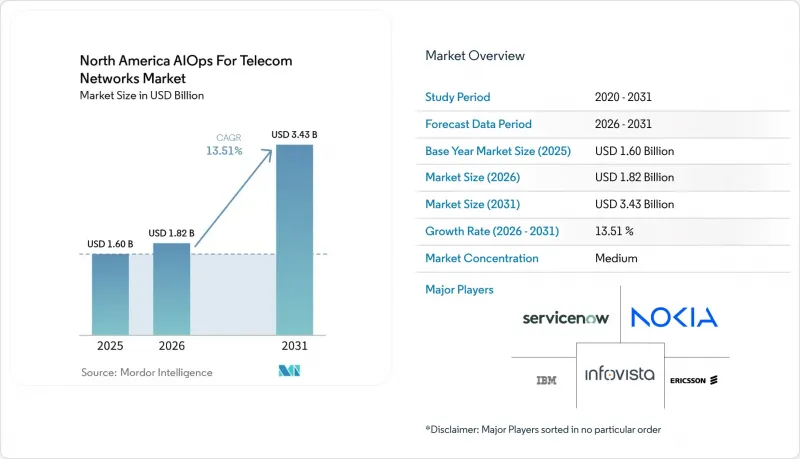
에 따르면 북미의 통신 네트워크용 AIOps 시장 규모는 2025년 16억 달러에서 2026년에는 18억 2,000만 달러로 확대하며, 2026-2031년에 CAGR 13.51%로 추이하며, 2031년까지 34억 3,000만 달러에 달할 것으로 예측됩니다.
북미 통신 네트워크용 AIOps 시장의 동향 및 인사이트
5G, 엣지, 네트워크 슬라이싱의 복잡화
5G 독립형 네트워크는 이전 세대 네트워크에는 없었던 운영상의 복잡성을 수반합니다. 활성화된 각 슬라이스는 개별적인 서비스 수준 임계값, 성능 지표 및 장애 격리 경계를 가질 수 있습니다. 또한 슬라이스를 인식하는 토폴로지는 무선, 전송 및 코어 간의 이벤트 관계도 변화시킵니다. 이로 인해 주로 플랫 네트워크 데이터로 학습된 플랫폼의 경우, 이벤트 간의 상관관계를 파악하기가 더욱 어려워집니다. NGMN 얼라이언스는 자율형 모바일 네트워크를 위한 에이전트형 AI 관련 노력의 일환으로, 이러한 환경에 특화되어 설계된 추론 에이전트를 권장하고 있습니다. 노키아는 MWC 2026에서 AWS와 공동으로 에이전트형 AI를 활용한 5G-Advanced 네트워크 슬라이싱 솔루션을 발표하고, MantaRay SMO를 클라우드 기반 AI 기능과 연동하여 실제 가동중인 네트워크 운영을 실현했습니다.
실시간 네트워크 가시성 및 예측적 보증에 대한 수요
북미의 통신사업자들은 개별 성능 지표 모니터링에 그치지 않는 노력을 기울이고 있습니다. 제어 플레인 및 사용자 플레인의 텔레메트리 데이터와 더불어, 고객 경험의 결과를 평가할 필요성이 점점 더 커지고 있습니다. TM Forum의 프레임워크에서는 사용자 경험 저하를 폐쇄 루프형 복구의 핵심으로 삼고 있습니다. 이러한 접근 방식에는 수많은 네트워크 요소로부터의 정보를 지연을 최소화하며 수집할 수 있는 데이터 수집 시스템이 필요합니다. 도이치 통신은 Google Cloud 기술을 활용하여 구축된 자사의 MINDR 플랫폼이 2025년 11월 출시 후, 실제 운영 개시 첫 달 동안 100건 이상의 자율적인 복구 조치를 촉발했다고 보고했습니다. 또한 이 플랫폼을 통해 중대한 사고에 대한 대응 시간이 몇 시간에서 1분으로 단축되었다고 보고되었습니다.
레거시 OSS, BSS 및 네트워크 도메인 간의 높은 통합 비용
레거시 운영 시스템 및 비즈니스 지원 시스템은 AIOps의 광범위한 도입에 있으며, 큰 장애물로 작용하고 있습니다. 많은 통신사업자는 여전히 포인트-투-포인트 통합에 의존하고 있으며, 제품, 시스템 또는 인수한 자산이 추가될 때마다 관리가 점점 더 어려워집니다. 또한 중요한 고객 데이터나 네트워크 데이터의 마이그레이션에는 서비스 연속성에 대한 우려도 제기됩니다. TM Forum의 ‘Open Digital Architecture’는 공통된 방향성을 제시하고 있지만, 독자적인 사양의 데이터 모델에서 전환하기 위해서는 시간과 치밀한 계획이 필요합니다. 따라서 AIOps 프로젝트에서는 모델 학습에 활용할 수 있는 통합된 텔레메트리 스트림이 확보되기까지 긴 준비 기간이 소요될 수 있습니다. 그로 인해 발생하는 지연은 광범위한 시스템 통합 역량을 갖추지 못한 벤더에게 특히 큰 과제가 됩니다.
부문 분석
2025년, 플랫폼은 지역 매출의 67.21%를 차지했습니다. 이러한 우위는 통합된 데이터 수집, 이벤트 상관관계 분석, 토폴로지 인식 및 폐쇄 루프 자동화를 필요로 하는 주요 통신사업자의 요구를 반영합니다. 통신사업자 고유의 텔레메트리 데이터를 활용하여 수년간 학습된 상관 엔진을 대체하는 것은 어려울 수 있습니다. 이러한 축적된 학습 데이터는 기존 공급업체의 전환 비용을 높이는 요인이 됩니다. 또한 플랫폼에는 일반적인 IT 운영 툴에는 본래 갖추어져 있지 않은 네트워크 고유의 운영 로직도 내장되어 있습니다. 노키아는 2026년 6월 DTW26에서 ‘Autonomous Networks Suite’를 업데이트하고 ‘Autonomous Networks Agent Library’를 출시했습니다.
서비스 시장은 2026-2031년에 연평균 성장률(CAGR) 16.19%로 확대될 것으로 예측됩니다. 이는 북미 통신 네트워크용 AIOps 시장에서 가장 빠르게 성장하고 있는 서비스 유형입니다. 통신사업자들은 5G 독립형 코어 네트워크의 장애 해결이나 예측적 무선 주파수 최적화 등 정의된 활동에 대한 관리형 지원을 점점 더 많이 도입하고 있습니다. 이 모델을 통해 통신사업자는 모델 개발 및 유지보수에 관한 전문가의 지원을 활용하면서도 플랫폼에 대한 광범위한 통제권을 유지할 수 있습니다. 또한 조직이 기밀성이 높은 운영 데이터에 대한 관리 권한을 유지하는 데에도 도움이 됩니다. IBM과 ServiceNow는 2026년 6월, 기업 운영을 위한 AI, 데이터, 자동화 기능을 통합하기 위해 제휴를 확대했습니다. 이번 제휴는 각 통신사업자가 사내에서 완전한 기능을 구축할 필요 없이 운영 툴을 통합하는 서비스에 대한 수요를 반영한 것입니다.
2025년에는 클라우드 기반 도입이 지역 매출의 51.59%를 차지할 것으로 예상되며, 2026-2031년까지 연평균 성장률(CAGR) 16.70%로 확대될 것으로 전망됩니다. 이를 통해 통신사업자는 5G 네트워크의 고밀도화에 따라 텔레메트리 양이 증가하더라도 모델 훈련 및 추론을 확장할 수 있게 됩니다. 그 결과, 워크로드별로 전용 온프레미스 컴퓨팅 리소스를 구축·유지할 필요성이 줄어듭니다. 또한 클라우드 환경은 분산형 데이터 수집 및 보다 신속한 소프트웨어 업데이트에도 대응할 수 있습니다. 이러한 기능을 통해 모니터링 대상 네트워크 이벤트에 대해 거의 실시간으로 의사결정을 내릴 수 있게 됩니다. 북미 통신 네트워크용 AIOps 시장은 확립된 운영 관리 체제와 병행하여 클라우드 툴을 활용할 수 있는 경우 혜택을 받게 됩니다.
온프레미스 배포는 데이터 상주 요건이나 네트워크 분리 요건이 있는 연방 정부 네트워크 및 규제 대상 통신사업자에게 여전히 중요한 역할을 수행하고 있습니다. 하이브리드 설계를 채택하면 기밀성이 높은 처리 및 추론을 로컬에서 유지하면서 적절한 관리 기능을 호스팅 환경로 연결할 수 있습니다. 이러한 접근 방식을 통해 통신사업자는 기존 시스템에서 급격한 전환을 피할 수 있습니다. Infovista는 2026년 1월, 자동화된 보증 및 테스트 제품을 위해 클라우드 호스팅형 및 온프레미스형 배포 옵션을 갖춘 ‘VistAI’를 발표했습니다. 이러한 유연성 덕분에 북미 통신 네트워크용 AIOps 시장은 클라우드 중심 요구 사항과 규정 준수 주도 요구 사항 모두를 충족할 수 있게 되었습니다.
기타 혜택:
- 엑셀 형식의 시장 예측(ME) 시트
- 3개월간의 애널리스트 지원
자주 묻는 질문
목차
제1장 서론
- 조사 전제조건과 시장 정의
- 조사 범위
제2장 조사 방법
제3장 개요
제4장 시장 구도
- 시장 개요
- 시장 성장 촉진요인
- 시장 성장 억제요인
- 업계 밸류체인 분석
- 규제 상황
- 기술 전망
- Porter's Five Forces 분석
- 거시경제 요인이 시장에 미치는 영향
제5장 시장 규모와 성장 예측
- 제공별
- 배포 모델별
- 조직 규모별
- 용도별
- 최종사용자별
- 국가별
- 미국
- 캐나다
- 멕시코
제6장 경쟁 구도
- 시장 집중도
- 전략적 동향
- 시장 점유율 분석
- 기업 개요
- Nokia Corporation
- Telefonaktiebolaget LM Ericsson
- Cisco Systems, Inc.
- Broadcom Inc.
- Juniper Networks, Inc.
- Hewlett Packard Enterprise Company
- IBM Corporation
- VIAVI Solutions Inc.
- NETSCOUT SYSTEMS, INC.
- Infovista SAS
- RADCOM Ltd.
- Infosys Limited
- ServiceNow, Inc.
- NVIDIA Corporation
- Amdocs Limited
- Netcracker Technology Corporation
- Mavenir Systems, Inc.
- Selector Software, Inc.(Selector AI)
- NetAI Inc.
- Spirent Communications plc
제7장 시장 기회와 향후 전망
KSA 26.10.30According to Mordor Intelligence, the North America AIOps for Telecom Networks Market size is expected to grow from USD 1.60 billion in 2025 to USD 1.82 billion in 2026, and is forecast to reach USD 3.43 billion by 2031, at a 13.51% CAGR over 2026-2031.
North America AIOps For Telecom Networks Market Trends and Insights
Rising 5G, Edge, and Network-Slicing Complexity
5G standalone networks add operational complexity that was not present in earlier network generations. Each active slice can carry separate service-level thresholds, performance indicators, and fault-isolation boundaries. A slice-aware topology also changes the relationship between radio, transport, and core events. This makes event correlation more difficult for platforms trained mainly on flat-network data. The NGMN Alliance has recommended purpose-built reasoning agents for these environments in its work on agentic AI for autonomous mobile networks. Nokia presented an agentic AI-powered 5G-Advanced network slicing solution with AWS at MWC 2026, linking MantaRay SMO to cloud-based AI capabilities for live network operations.
Demand for Real-Time Network Visibility and Predictive Assurance
North American operators are moving beyond monitoring isolated performance indicators. They increasingly need to assess customer experience outcomes alongside control-plane and user-plane telemetry. The TM Forum framework places user experience degradation at the center of closed-loop remediation. That approach requires data collection systems that can ingest information from many network elements with limited delay. Deutsche Telekom reported that its MINDR platform, built with Google Cloud technologies, triggered more than 100 autonomous remediation actions in its first month of live operations after its November 2025 launch. The company also reported that the platform reduced management time for major events from hours to 1 minute.
High Integration Costs Across Legacy OSS, BSS, and Network Domains
Legacy operations and business support systems remain a major obstacle to wider AIOps adoption. Many operators still rely on point-to-point integrations that become harder to manage when products, systems, or acquired assets are added. Migrating critical customer and network data also raises service continuity concerns. The TM Forum Open Digital Architecture provides a common direction, but moving from proprietary data models takes time and careful planning. AIOps projects can therefore face lengthy preparation before a unified telemetry stream is available for model training. The resulting delay is especially difficult for vendors that lack broad systems integration capabilities.
Other drivers and restraints analyzed in the detailed report include:
- Pressure to Reduce NOC OPEX and Mean Time to Resolution
- Growth of Cloud-Native, Multi-Vendor, and Hybrid Telecom Infrastructure
- Data Quality, Interoperability, and Telemetry Standardization Gaps
For complete list of drivers and restraints, kindly check the Table Of Contents.
Segment Analysis
Platforms held 67.21% of regional revenue in 2025. Their lead reflects the needs of large carriers that require integrated ingestion, event correlation, topology awareness, and closed-loop automation. Replacing a correlation engine can be difficult when it has been trained on years of carrier-specific telemetry. That accumulated training data can reinforce switching costs for established providers. Platforms also include network-specific operating logic that general IT operations tools do not inherently provide. Nokia updated its Autonomous Networks Suite at DTW26 in June 2026 and released an Autonomous Networks Agent Library.
Services are projected to expand at a 16.19% CAGR from 2026 to 2031. It is the fastest-expanding offering type in the North America AIOps for Telecom Networks market. Operators increasingly procure managed support for defined activities such as fault resolution in 5G standalone core networks or predictive radio-frequency optimization. This model allows carriers to retain broader platform control while drawing on specialist support for model development and maintenance. It can also help organizations keep control of sensitive operational data. IBM and ServiceNow expanded their collaboration in June 2026 to combine AI, data, and automation capabilities for enterprise operations. The arrangement reflects demand for services that bring operational tools together without requiring every operator to build the full capability internally.
Cloud-based deployment accounted for 51.59% of regional revenue in 2025 and is projected to expand at a 16.70% CAGR from 2026 to 2031. It allows operators to scale model training and inference as telemetry volumes rise with denser 5G networks. This reduces the need to build and maintain dedicated on-premises computing capacity for every workload. Cloud environments can also support distributed data collection and faster software updates. These capabilities support near-real-time decisions for monitored network events. The North America AIOps for Telecom Networks market benefits when cloud tools can be used alongside established operational controls.
On-premises deployment remains relevant for federal networks and regulated carriers with data residency or network isolation requirements. Hybrid designs can keep sensitive processing and inference local while connecting suitable management functions to hosted environments. This approach helps operators avoid a hard transition from existing systems. Infovista introduced VistAI in January 2026 with cloud-hosted and on-premises deployment options for automated assurance and testing products. This flexibility allows the North America AIOps for Telecom Networks market to serve both cloud-focused and compliance-led deployment needs.
Complete Report Scope:
- By Offering
- Platforms
- Services
- By Deployment Model
- On-Premises
- Cloud-Based
- By Organization Size
- Large Enterprises
- Small and Medium-Sized Enterprises
- By Application
- Network Performance Management
- Fault and Incident Management
- Network Security Management
- Customer Experience Management
- Infrastructure Management
- Application Performance Analysis
- Other Applications
- By End-User
- Mobile Network Operators
- Fixed and Broadband Operators
- Integrated Communication Service Providers
- Other End-Users
- By Country
- United States
- Canada
- Mexico
List of Companies Covered in this Report:
- Nokia Corporation
- Telefonaktiebolaget LM Ericsson
- Cisco Systems, Inc.
- Broadcom Inc.
- Juniper Networks, Inc.
- Hewlett Packard Enterprise Company
- IBM Corporation
- VIAVI Solutions Inc.
- NETSCOUT SYSTEMS, INC.
- Infovista SAS
- RADCOM Ltd.
- Infosys Limited
- ServiceNow, Inc.
- NVIDIA Corporation
- Amdocs Limited
- Netcracker Technology Corporation
- Mavenir Systems, Inc.
- Selector Software, Inc. (Selector AI)
- NetAI Inc.
- Spirent Communications plc
Additional Benefits:
- The market estimate (ME) sheet in Excel format
- 3 months of analyst support
TABLE OF CONTENTS
1 INTRODUCTION
- 1.1 Study Assumptions and Market Definition
- 1.2 Scope of the Study
2 RESEARCH METHODOLOGY
3 EXECUTIVE SUMMARY
4 MARKET LANDSCAPE
- 4.1 Market Overview
- 4.2 Market Drivers
- 4.2.1 Rising 5G, Edge, and Network-Slicing Complexity
- 4.2.2 Demand for Real-Time Network Visibility and Predictive Assurance
- 4.2.3 Pressure to Reduce NOC OPEX and Mean Time to Resolution
- 4.2.4 Growth of Cloud-Native, Multi-Vendor, and Hybrid Telecom Infrastructure
- 4.2.5 Telecom-Specific Digital Twins for Capacity and Incident Decisions
- 4.2.6 Deterministic Graph-Based Root-Cause Analysis for Alarm Storms
- 4.3 Market Restraints
- 4.3.1 High Integration Costs Across Legacy OSS, BSS, and Network Domains
- 4.3.2 Data Quality, Interoperability, and Telemetry Standardization Gaps
- 4.3.3 Shortage of Telecom AIOps, Data Engineering, and Automation Skills
- 4.3.4 Risk of Automated Change Propagation Across Interdependent Network Layers
- 4.4 Industry Value-Chain Analysis
- 4.5 Regulatory Landscape
- 4.6 Technological Outlook
- 4.7 Porter's Five Forces Analysis
- 4.7.1 Bargaining Power of Suppliers
- 4.7.2 Bargaining Power of Buyers
- 4.7.3 Threat of New Entrants
- 4.7.4 Threat of Substitutes
- 4.7.5 Competitive Rivalry
- 4.8 Impact of Macroeconomic Factors on the Market
5 MARKET SIZE AND GROWTH FORECASTS (VALUE)
- 5.1 By Offering
- 5.1.1 Platforms
- 5.1.2 Services
- 5.2 By Deployment Model
- 5.2.1 On-Premises
- 5.2.2 Cloud-Based
- 5.3 By Organization Size
- 5.3.1 Large Enterprises
- 5.3.2 Small and Medium-Sized Enterprises
- 5.4 By Application
- 5.4.1 Network Performance Management
- 5.4.2 Fault and Incident Management
- 5.4.3 Network Security Management
- 5.4.4 Customer Experience Management
- 5.4.5 Infrastructure Management
- 5.4.6 Application Performance Analysis
- 5.4.7 Other Applications
- 5.5 By End-User
- 5.5.1 Mobile Network Operators
- 5.5.2 Fixed and Broadband Operators
- 5.5.3 Integrated Communication Service Providers
- 5.5.4 Other End-Users
- 5.6 By Country
- 5.6.1 United States
- 5.6.2 Canada
- 5.6.3 Mexico
6 COMPETITIVE LANDSCAPE
- 6.1 Market Concentration
- 6.2 Strategic Moves
- 6.3 Market Share Analysis
- 6.4 Company Profiles (includes Global Level Overview, Market Level Overview, Core Segments, Financials as available, Strategic Information, Market Rank/Share, Products and Services, Recent Developments)
- 6.4.1 Nokia Corporation
- 6.4.2 Telefonaktiebolaget LM Ericsson
- 6.4.3 Cisco Systems, Inc.
- 6.4.4 Broadcom Inc.
- 6.4.5 Juniper Networks, Inc.
- 6.4.6 Hewlett Packard Enterprise Company
- 6.4.7 IBM Corporation
- 6.4.8 VIAVI Solutions Inc.
- 6.4.9 NETSCOUT SYSTEMS, INC.
- 6.4.10 Infovista SAS
- 6.4.11 RADCOM Ltd.
- 6.4.12 Infosys Limited
- 6.4.13 ServiceNow, Inc.
- 6.4.14 NVIDIA Corporation
- 6.4.15 Amdocs Limited
- 6.4.16 Netcracker Technology Corporation
- 6.4.17 Mavenir Systems, Inc.
- 6.4.18 Selector Software, Inc. (Selector AI)
- 6.4.19 NetAI Inc.
- 6.4.20 Spirent Communications plc
7 MARKET OPPORTUNITIES AND FUTURE OUTLOOK
- 7.1 White-Space and Unmet-Need Assessment


