

|
시장보고서
상품코드
2157047
유럽의 통신 네트워크용 AIOps : 시장 점유율 분석, 업계 동향과 통계, 성장 예측(2026-2031년)Europe AIOps For Telecom Networks - Market Share Analysis, Industry Trends & Statistics, Growth Forecasts (2026 - 2031) |
||||||
 Mordor Intelligence
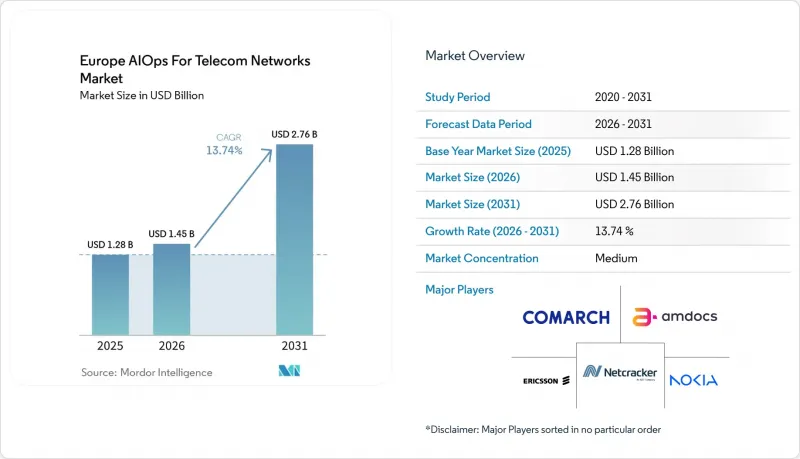
에 따르면 유럽의 통신 네트워크용 AIOps 시장 규모는 2025년에 12억 8,000만 달러로 평가되며, 2026년 14억 5,000만 달러에서 2031년까지 27억 6,000만 달러에 달할 것으로 예측되고 있으며, 예측 기간(2026-2031년)에 CAGR은 13.74%에 달할 전망입니다.
유럽 통신 네트워크용 AIOps 시장의 동향 및 인사이트
5G 및 멀티벤더 네트워크의 복잡성 증가가 플랫폼 도입을 가속화
유럽 통신 네트워크용 AIOps 시장은 관리해야 할 시스템 운영자 수를 증가시키는 5G 독립형(SA) 방식 도입의 혜택을 받고 있습니다. 대도시권의 5G 무선 액세스 네트워크에서는 무선, 분산형, 집중형 및 코어 네트워크 기능별로 서로 다른 벤더가 채택되는 경우가 있습니다. 각 시스템은 서로 다른 스키마, 업데이트 주기, 운영 우선순위를 가진 텔레메트리 데이터를 생성합니다. 기존의 운영 지원 시스템은 보다 중앙 집중화된 단일 벤더 환경을 위해 설계되었습니다. AIOps 플랫폼은 네트워크 도메인을 가로질러 이러한 데이터 스트림을 상호 연관시켜, 사업자가 관련 이벤트를 더 조기에 식별할 수 있도록 지원합니다. E2 인터페이스 및 xApp 프레임워크를 포함한 O-RAN 얼라이언스의 사양은 타사 애플리케이션과의 통합 지점을 제공하지만, 상용 Open RAN 도입에 있어서는 폐쇄 루프 제어를 위해 여전히 대규모 시스템 통합이 필요합니다.
네트워크 운영 비용 및 평균 복구 시간(MTTR) 절감을 위한 압박
사용자 1인당 수익이 정체되는 반면 5G 관련 비용은 증가하고 있으며, 유럽의 통신사업자들은 네트워크 운영 비용 절감을 최우선 과제로 삼고 있습니다. 도이치 통신은 중대한 이벤트 관리를 지원하기 위해 2025년 11월 독일에서 ‘RAN Guardian Agent’를 출시했습니다. 이 회사에 따르면 이 시스템을 통해 중대한 이벤트의 관리 시간이 수 시간에서 1분으로 단축되었다고 합니다. 또한 운영 개시 첫 달인 크리스마스 마켓 개최 기간 중 100건 이상의 시정 조치가 실행되었습니다. 이러한 운영 성과를 통해 유럽 통신 네트워크용 AIOps 시장이 수동 개입 감소를 목표로 하는 통신사업자들로부터 주목받고 있음을 알 수 있습니다. 아울러 NIS2의 보고 요건 역시 신속한 장애 탐지의 중요성을 부각시키고 있습니다. 영향을 받은 통신사업자는 24시간 이내에 조기 경보를 발령하고, 72시간 이내에 최종 보고서를 제출해야 하기 때문입니다.
레거시 OSS의 데이터 사일로와 통합의 복잡성이 도메인 간 AI의 효과를 제한
데이터 가용성은 유럽 통신 네트워크용 AIOps 시장에 있으며, 여전히 근본적인 과제로 남아 있습니다. 많은 유럽 통신사업자들은 10년 20년에 개발된, 벤더 고유의 도메인별로 격리된 관리 시스템을 사용하고 있습니다. 이러한 시스템은 무선, 전송, 코어, 서비스 각 계층 간에 텔레메트리 데이터를 공유하도록 설계되지 않았습니다. AI를 위해 데이터를 준비하려면, 모델이 신뢰할 수 있는 결과를 제공할 수 있게 되기 전에 데이터 수집, 정규화 및 통합을 수행해야 합니다. 불완전하거나 파편화된 텔레메트리는 오경보를 유발하고 가시성 비용을 증가시켜, 도입의 운영적 정당성을 약화시킬 수 있습니다. 이러한 부담은 Tier 1 경쟁사만큼 통합 예산을 확보하지 못하는 중규모 통신사업자에게 더 크게 작용하며, 도입 능력에 뚜렷한 차이를 초래하고 있습니다.
부문 분석
2025년, 플랫폼은 유럽 통신 네트워크용 AIOps 시장의 64.88%를 차지했습니다. 주요 Tier 1 통신사업자들은 수년 전부터 운영 지원 시스템에 플랫폼 라이선스를 통합해 왔습니다. 이러한 계약을 통해 플랫폼은 보증 및 자동화 워크로드의 핵심 인프라로 자리 잡았습니다. 서비스 시장은 2031년까지 연평균 성장률(CAGR) 16.08%로 확대될 것으로 예측됩니다. 이 성장률은 매니지드 서비스, 전문 서비스 및 시스템 통합에 대한 수요 증가를 나타냅니다. 지역 통신사업자들은 구현 책임을 경험이 풍부한 공급자에게 맡기는 계약을 선호하는 경향이 있습니다.
유럽 통신 네트워크용 AIOps 시장에서 이러한 경향이 가장 두드러지게 나타나는 곳은 남유럽 및 동유럽입니다. 이 시장의 많은 통신사업자는 사내 AI 엔지니어링 자원이 제한적인 동시에 레거시 운영 시스템도 관리해야 하는 상황에 처해 있습니다. 성과 기반 제공 모델은 대규모 플랫폼 도입에 수반되는 위험을 완화하고, 통신사업자에게 전문적인 통합 지원에 대한 접근성을 제공합니다. 또한 통신사업자가 개별 툴나 서비스를 직접 조합할 필요가 없으며, 도입 작업을 명확하게 정의된 운영 성과와 연계할 수도 있습니다. 노키아는 2025년에 ‘Autonomous Network Fabric’을 도입하고, Google Cloud와의 연동을 통해 클라우드 제공 옵션을 확충했습니다. 이는 벤더가 소프트웨어 플랫폼과 운영 서비스를 별개의 선택지로 제시하는 것이 아니라, 이를 결합하고 있음을 보여줍니다. 유럽의 통신 네트워크용 AIOps 시장에서 이러한 제공 방식은 통신사업자가 자동화 소프트웨어 외에도 기술 지원이 필요한 상황에서 도입을 현실화할 가능성이 있습니다.
2025년, 유럽 통신 네트워크용 AIOps 시장 규모 중 온프레미스 구축이 58.25%를 차지했습니다. 데이터 주권에 관한 요건이 유럽의 Tier 1 통신사업자들 사이에서 이러한 추세를 지원하고 있습니다. 또한 특정 폐쇄 루프 무선 기능에는 극히 낮은 지연 시간이 요구되지만, 퍼블릭 클라우드 엔드포인트에서는 이를 일관되게 제공하지 못할 수도 있습니다. 클라우드 기반 도입은 2031년까지 연평균 성장률(CAGR) 17.21%로 확대될 것으로 예측됩니다. 가장 빠른 진전이 예상되는 분야는 비실시간 네트워크 분석, 계획, 고객 경험 및 에너지 관리 기능 분야입니다.
퍼블릭 클라우드 환경은 이러한 시간적 제약이 비교적 완화된 사용 사례에 대해 확장 가능한 컴퓨팅 리소스와 기성 AI 툴을 제공합니다. 노키아는 2026년 9월 Google Cloud 마켓플레이스에서 자사의 ‘Assurance Center’를 SaaS(Software-as-a-Service)로 제공하기 시작할 예정입니다. 에릭슨은 2026년 2월 AWS 마켓플레이스에서 ‘Agentic rApp as a Service’를 출시했습니다. 이러한 제공 사례는 대형 통신 장비 벤더들이 클라우드를 통한 제공을 새로운 도입을 위한 중요한 경로로 인식하고 있음을 보여줍니다. 동시에, EU AI법의 의무 사항과 NIS2의 데이터 거주 요건은 하이브리드 클라우드 및 소버린 클라우드 설계를 지원하고 있습니다. 이러한 설계를 통해 클라우드 배포의 이점을 어느 정도 유지하면서, 워크로드를 네트워크 데이터에 더 가까운 곳에서 가동할 수 있게 됩니다. 네트워크 기능이나 통신사업자의 환경에 따라 실시간 제어 요건이 크게 다르기 때문에 이러한 균형은 유럽 통신 네트워크용 AIOps 시장에서 중요한 의미를 지닙니다.
기타 혜택:
- 엑셀 형식의 시장 예측(ME) 시트
- 3개월간의 애널리스트 지원
자주 묻는 질문
목차
제1장 서론
- 조사 전제조건과 시장 정의
- 조사 범위
제2장 조사 방법
제3장 개요
제4장 시장 구도
- 시장 개요
- 시장 성장 촉진요인
- 시장 성장 억제요인
- 업계 밸류체인 분석
- 규제 상황
- 기술 전망
- Porter's Five Forces 분석
- 거시경제 요인이 시장에 미치는 영향
제5장 시장 규모와 성장 예측
- 제공별
- 배포 모델별
- 조직 규모별
- 용도별
- 최종사용자별
- 국가별
- 영국
- 독일
- 프랑스
- 스페인
- 이탈리아
- 기타 유럽 국가
제6장 경쟁 구도
- 시장 집중도
- 전략적 동향
- 시장 점유율 분석
- 기업 개요
- Amdocs Limited
- Telefonaktiebolaget LM Ericsson
- Nokia Corporation
- Netcracker Technology Corporation
- International Business Machines Corporation
- ServiceNow, Inc.
- Infovista SAS
- OpenText Corporation
- Elisa Corporation(Polystar)
- Cisco Systems, Inc.
- Juniper Networking(Hewlett Packard Enterprise Company)
- RADCOM Ltd.
- MyCom OSI
- Google LLC(Google Cloud)
- Microsoft Corporation
- Oracle Corporation
- VIAVI Solutions Inc.
- Comarch S.A.
제7장 시장 기회와 향후 전망
KSA 26.10.30According to Mordor Intelligence, the Europe AIOps for Telecom Networks Market size was valued at USD 1.28 billion in 2025 and is estimated to grow from USD 1.45 billion in 2026 to reach USD 2.76 billion by 2031, at a CAGR of 13.74% during the forecast period (2026-2031).
Europe AIOps For Telecom Networks Market Trends and Insights
5G and Multi-Vendor Network Complexity Accelerates Platform Adoption
The Europe AIOps for telecom networks market is benefiting from 5G standalone deployments, which increase the number of system operators to be managed. A metropolitan 5G radio access network can use separate vendors for radio, distributed, centralized, and core network functions. Each system produces telemetry with different schemas, update cycles, and operational priorities. Older operations support systems were designed for more centralized and single-vendor environments. AIOps platforms can correlate these data streams across network domains and help operators identify related events sooner. O-RAN Alliance specifications, including the E2 interface and xApp framework, provide integration points for third-party applications, although commercial Open RAN deployments still require substantial systems integration for closed-loop control.
Pressure to Reduce Network Operations Costs and Mean Time to Resolution
European telecom operators are prioritizing lower network operating costs as revenue per user remains constrained and 5G expenses rise. Deutsche Telekom launched its RAN Guardian Agent in Germany in November 2025 to support major event management. The company reported that the system reduced major event management time from hours to 1 minute. It also triggered more than 100 remediation actions during Christmas market events in its first production month. These operating outcomes explain that the European AIOps for telecom networks market is attracting attention from operators seeking to reduce manual intervention. NIS2 reporting requirements also underscore the value of prompt fault detection, as affected operators must provide an early warning within 24 hours and a final report within 72 hours.
Legacy OSS Data Silos and Integration Complexity Constrain Cross-Domain AI Effectiveness
Data availability remains a fundamental challenge for the European AIOps market for telecom networks. Many European operators use vendor-specific and domain-isolated management systems developed over 10 to 20 years. These systems were not designed to share telemetry across radio, transport, core, and service layers. Preparing data for AI requires ingestion, normalization, and federation before models can provide dependable results. Incomplete or fragmented telemetry can increase false alarms and observability costs, weakening the operational case for deployment. This burden is greater for mid-sized operators that do not have the integration budgets available to Tier-1 peers, creating a clear difference in adoption capacity.
Other drivers and restraints analyzed in the detailed report include:
- Demand for Predictive Network Assurance and Customer Experience Management Reshapes Buying Criteria
- Expansion of Autonomous Network and Closed-Loop Standards Establishes Demand
- Cybersecurity, Privacy, and AI Governance Requirements Create Compliance Overhead
For complete list of drivers and restraints, kindly check the Table Of Contents.
Segment Analysis
Platforms held 64.88% of the European AIOps for telecom networks market in 2025. Large Tier-1 operators had embedded platform licenses in their operations support systems for several years. These agreements established platforms as core infrastructure for assurance and automation workloads. Services are projected to expand at a 16.08% CAGR through 2031. This rate indicates a stronger demand for managed services, professional services, and systems integration. Regional operators often prefer contracts that transfer implementation responsibility to an experienced provider.
The Europe AIOps for telecom networks market is seeing this preference most clearly in Southern and Eastern Europe. Many operators in these markets have limited in-house AI engineering resources and must manage legacy operations systems at the same time. Outcome-based delivery can reduce the risks associated with a major platform implementation and provide operators with access to specialized integration support. It can also connect implementation work with defined operational outcomes, rather than leaving the operator to assemble separate tools and services. Nokia introduced Autonomous Network Fabric in 2025 and expanded cloud delivery options with Google Cloud. It shows that vendors are combining software platforms with operational services rather than presenting them as separate choices. For the European AIOps for telecom networks market, this delivery approach can make adoption practical where operators need technical support alongside automation software.
On-Premises deployments accounted for 58.25% of the Europe AIOps for telecom networks market size in 2025. Data sovereignty requirements have supported this position among European Tier-1 operators. Certain closed-loop radio functions also require very low latency, which public cloud endpoints may not consistently provide. Cloud-Based deployments are projected to expand at a 17.21% CAGR through 2031. The fastest progress is occurring in non-real-time network analytics, planning, customer experience, and energy management functions.
Public cloud environments provide scalable computing resources and prebuilt AI tools for these less time-sensitive use cases. Nokia scheduled its Assurance Center as a software-as-a-service offering on Google Cloud Marketplace for September 2026. Ericsson launched Agentic rApp as a Service on AWS Marketplace in February 2026. Both offerings show that established telecom suppliers view cloud delivery as an important route for new deployments. At the same time, EU AI Act obligations and NIS2 data-residency expectations are supporting hybrid and sovereign cloud designs. These designs allow workloads to operate closer to network data while retaining some benefits of cloud deployment. This balance matters in the European AIOps for telecom networks market because real-time control requirements vary significantly across network functions and operator environments.
Complete Report Scope:
- By Offering
- Platforms
- Services
- By Deployment Model
- On-Premises
- Cloud-Based
- By Organization Size
- Large Enterprises
- Small and Medium-Sized Enterprises
- By Application
- Network Performance Management
- Fault and Incident Management
- Network Security Management
- Customer Experience Management
- Infrastructure Management
- Application Performance Analysis
- Other Applications
- By End-User
- Mobile Network Operators
- Fixed and Broadband Operators
- Integrated Communication Service Providers
- Other End-Users
- By Country
- United Kingdom
- Germany
- France
- Spain
- Italy
- Rest of Europe
List of Companies Covered in this Report:
- Amdocs Limited
- Telefonaktiebolaget LM Ericsson
- Nokia Corporation
- Netcracker Technology Corporation
- International Business Machines Corporation
- ServiceNow, Inc.
- Infovista SAS
- OpenText Corporation
- Elisa Corporation (Polystar)
- Cisco Systems, Inc.
- Juniper Networking (Hewlett Packard Enterprise Company)
- RADCOM Ltd.
- MyCom OSI
- Google LLC (Google Cloud)
- Microsoft Corporation
- Oracle Corporation
- VIAVI Solutions Inc.
- Comarch S.A.
Additional Benefits:
- The market estimate (ME) sheet in Excel format
- 3 months of analyst support
TABLE OF CONTENTS
1 INTRODUCTION
- 1.1 Study Assumptions and Market Definition
- 1.2 Scope of the Study
2 RESEARCH METHODOLOGY
3 EXECUTIVE SUMMARY
4 MARKET LANDSCAPE
- 4.1 Market Overview
- 4.2 Market Drivers
- 4.2.1 5G and Multi-Vendor Network Complexity
- 4.2.2 Pressure to Reduce Network Operations Costs and Mean Time to Resolution
- 4.2.3 Demand for Predictive Network Assurance and Customer Experience Management
- 4.2.4 Expansion of Autonomous Network and Closed-Loop Standards
- 4.2.5 Telemetry-to-Action Gaps in Disaggregated Open RAN
- 4.2.6 Energy-Aware Closed-Loop Network Optimization
- 4.3 Market Restraints
- 4.3.1 Legacy OSS Data Silos and Integration Complexity
- 4.3.2 Cybersecurity, Privacy and AI Governance Requirements
- 4.3.3 Model Drift Across Vendor-Specific Network States
- 4.3.4 Human Accountability for Autonomous Remediation
- 4.4 Industry Value-Chain Analysis
- 4.5 Regulatory Landscape
- 4.6 Technological Outlook
- 4.7 Porter's Five Forces Analysis
- 4.7.1 Bargaining Power of Suppliers
- 4.7.2 Bargaining Power of Buyers
- 4.7.3 Threat of New Entrants
- 4.7.4 Threat of Substitutes
- 4.7.5 Competitive Rivalry
- 4.8 Impact of Macroeconomic Factors on the Market
5 MARKET SIZE AND GROWTH FORECASTS (VALUE)
- 5.1 By Offering
- 5.1.1 Platforms
- 5.1.2 Services
- 5.2 By Deployment Model
- 5.2.1 On-Premises
- 5.2.2 Cloud-Based
- 5.3 By Organization Size
- 5.3.1 Large Enterprises
- 5.3.2 Small and Medium-Sized Enterprises
- 5.4 By Application
- 5.4.1 Network Performance Management
- 5.4.2 Fault and Incident Management
- 5.4.3 Network Security Management
- 5.4.4 Customer Experience Management
- 5.4.5 Infrastructure Management
- 5.4.6 Application Performance Analysis
- 5.4.7 Other Applications
- 5.5 By End-User
- 5.5.1 Mobile Network Operators
- 5.5.2 Fixed and Broadband Operators
- 5.5.3 Integrated Communication Service Providers
- 5.5.4 Other End-Users
- 5.6 By Country
- 5.6.1 United Kingdom
- 5.6.2 Germany
- 5.6.3 France
- 5.6.4 Spain
- 5.6.5 Italy
- 5.6.6 Rest of Europe
6 COMPETITIVE LANDSCAPE
- 6.1 Market Concentration
- 6.2 Strategic Moves
- 6.3 Market Share Analysis
- 6.4 Company Profiles (includes Global Level Overview, Market Level Overview, Core Segments, Financials as available, Strategic Information, Market Rank/Share, Products and Services, Recent Developments)
- 6.4.1 Amdocs Limited
- 6.4.2 Telefonaktiebolaget LM Ericsson
- 6.4.3 Nokia Corporation
- 6.4.4 Netcracker Technology Corporation
- 6.4.5 International Business Machines Corporation
- 6.4.6 ServiceNow, Inc.
- 6.4.7 Infovista SAS
- 6.4.8 OpenText Corporation
- 6.4.9 Elisa Corporation (Polystar)
- 6.4.10 Cisco Systems, Inc.
- 6.4.11 Juniper Networking (Hewlett Packard Enterprise Company)
- 6.4.12 RADCOM Ltd.
- 6.4.13 MyCom OSI
- 6.4.14 Google LLC (Google Cloud)
- 6.4.15 Microsoft Corporation
- 6.4.16 Oracle Corporation
- 6.4.17 VIAVI Solutions Inc.
- 6.4.18 Comarch S.A.
7 MARKET OPPORTUNITIES AND FUTURE OUTLOOK
- 7.1 White-Space and Unmet-Need Assessment


