

|
시장보고서
상품코드
2157048
사이버 리커버리 볼트 : 시장 점유율 분석, 업계 동향과 통계, 성장 예측(2026-2031년)Cyber Recovery Vault - Market Share Analysis, Industry Trends & Statistics, Growth Forecasts (2026 - 2031) |
||||||
 Mordor Intelligence
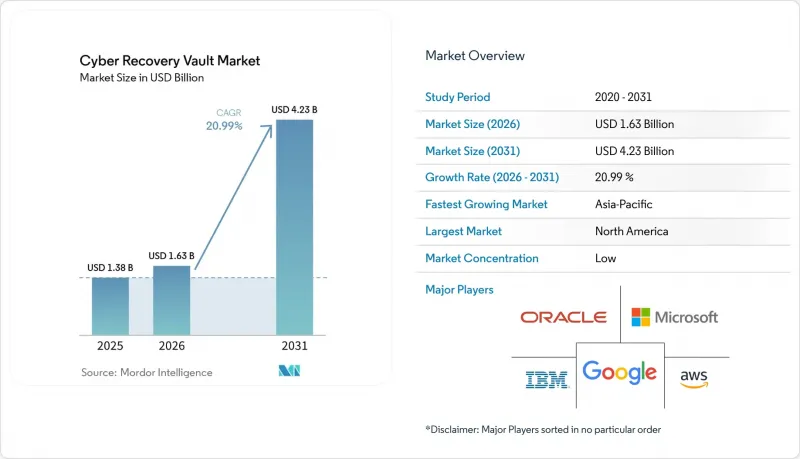
에 따르면 사이버 리커버리 볼트 시장 규모는 2025년에 13억 8,000만 달러, 2026년에 16억 3,000만 달러에 달하며, 2031년까지 42억 3,000만 달러에 달할 것으로 예측되고 있으며, 2026-2031년에 CAGR 20.99%로 성장할 것으로 전망되고 있습니다.
글로벌 사이버 복구 볼트 시장의 동향 및 인사이트
백업 저장소를 표적으로 한 랜섬웨어 및 와이퍼 공격
백업 저장소는 정교한 방법을 사용하는 랜섬웨어 그룹의 직접적인 표적이 되고 있습니다. 조직들이 프로덕션 환경의 보안만으로는 복구 데이터를 보호할 수 없다는 사실을 인식함에 따라 사이버 복구 볼트 시장은 그 혜택을 누리고 있습니다. 소포스(Sophos)의 조사에 따르면 지난 12개월 동안 발생한 공격의 56%에서 데이터 암호화에 성공했습니다. Veeam의 보고서에 따르면 랜섬웨어 공격의 96%가 백업 저장소를 표적으로 삼았으며, 그중 76%에서 백업이 침해된 것으로 나타났습니다. IBM은 2025년 랜섬웨어 사고의 평균 비용을 440만 달러로 추산하고 있습니다. 와이퍼 공격은 몸값을 요구하는 것이 아니라 데이터 파괴를 목적으로 하므로 또 다른 우려 사항이 되고 있습니다. 따라서 몸값을 지불하더라도 영향을 받은 시스템을 복구할 수 없는 경우라도, 격리된 저장소가 있다면 복구 옵션을 확보할 수 있습니다. 또한 소포스(Sophos)의 조사에 따르면 데이터가 암호화된 사례의 66%에서 복구에 백업이 사용되었습니다. 이 결과는 백업에 접근할 수 있고 침해되지 않은 상태라면 그 실용적 가치가 높음을 보여줍니다. 사이버 복구 볼트 시장에서는 복구용 사본과 일반 운영용 인증 정보를 분리하는 설계가 선호되고 있습니다. 이러한 설계를 통해 공격자가 가동중인 데이터와 복구 환경 모두에 접근하는 능력을 제한할 수 있습니다. 또한 조직은 복구를 수행하기 전에 볼트에 저장된 데이터에 문제가 없는지 확인해야 합니다. 이를 위해 각 벤더는 사고가 심각해지기 전에 팀이 복구 지점을 테스트할 수 있도록 지원하는 기능을 개발하고 있습니다.
검증되고 문서화된 복구에 대한 규제 요구 사항
많은 규제 대상 부문에서 복구 요건은 일반적인 지침에서 문서화된 운영 요건으로 전환되고 있습니다. 조직은 사이버 공격 상황에서도 복구 계획이 제대로 작동함을 입증해야 하므로, 사이버 복구 볼트 시장은 성장세를 보이고 있습니다. EU의 ‘디지털 운영 복원력 법(Digital Operational Resilience Act)’은 2025년 1월 17일에 시행되며, 대상 금융 기관에 대해 사이버 공격 시나리오 하에서의 복구 테스트를 의무화하고 있습니다. 또한 복구시 데이터 무결성을 입증하고 감독 당국에 증거를 제출해야 합니다. NIS2(네트워크 및 정보 보안 지침 제2판)는 에너지, 운송, 의료 등의 분야에도 관련된 보안 및 사업 연속성 요건을 확대하고 있습니다. 상장 기업은 사고 공개 의무도 지고 있으며, 신뢰성 높은 복구 프로세스의 중요성이 더욱 커지고 있습니다. 크로스 마켓 오퍼레이셔널 레질리언스 그룹(Cross-Market Operational Resilience Group)은 2026년 4월 기업의 사이버 복구 역량에 관한 지침을 발표했습니다. 이 지침에서는 기업이 보다 신속한 복구 역량을 입증할 필요성이 강조되고 있습니다. 사이버 복구 저장소 시장은 제품이 복구 테스트 및 데이터 무결성에 대한 명확한 증거를 보유할 수 있을 때 지원됩니다. 이러한 증거는 여러 규정 준수 프로그램에서 유용합니다. 또한 각 검토마다 개별적으로 기록을 수집해야 하는 부담을 줄일 수도 있습니다. 복구 워크플로우를 규정 준수 증거와 연계하고 있는 공급업체는 규제 대상 조달 과정에서 유리한 입지를 확보할 수 있습니다.
이종 레거시 환경 통합의 복잡성
많은 기업의 기술 환경에는 지원이 종료된 운영 체제, 자체 개발된 데이터베이스, 그리고 긴밀하게 연동된 애플리케이션이 포함되어 있습니다. 이러한 환경은 클라우드 네이티브 볼트 툴로는 보호하기 어려울 수 있습니다. 조직이 복구를 자동화하기 전에 맞춤형 커넥터나 보안 계층이 필요한 경우, 사이버 복구 볼트 시장의 확산이 지연될 수 있습니다. 수동 오케스트레이션은 기대되는 복구 워크플로우를 약화시킬 우려가 있습니다. 부분적인 도입의 경우, 일부 워크로드는 볼트에 저장되어 있더라도 중요한 종속 관계가 제외되어 있으며, 잘못된 안도감을 줄 수 있습니다. 그 결과, 시스템이 올바른 순서로 재연결되어야 할 때 복구가 실패할 우려가 있습니다. 이 문제는 레거시 시스템이 다수 존재하는 산업에서 급속한 디지털화가 진행될 때 더욱 두드러집니다. 아시아태평양, 중동 및 아프리카에서는 조직이 구형 기반 시스템을 교체하는 데 필요한 예산 주기가 부족할 경우 이러한 제약에 직면할 수 있습니다. 과제는 통합 속도에만 국한되지 않습니다. 복구를 성공적으로 수행하기 위해 필요한 종속 관계를 팀이 완전히 파악하고 있는지도 우려 사항입니다. 공급업체는 최신 클라우드 워크로드뿐만 아니라 혼합 환경도 지원해야 합니다. 또한 조직은 사고 발생시 Vault에 의존하기 전에 전체 복구 순서를 테스트해야 합니다.
부문 분석
2025년에는 솔루션이 매출의 70.24%를 차지하며 사이버 복구 볼트 시장에서 가장 큰 시장 점유율을 기록했습니다. 기업은 불변 스토리지, 강제 격리, 클린룸 환경에서의 복구 오케스트레이션이 필요한 경우 통합된 소프트웨어와 하드웨어를 선호합니다. 사전 통합된 스택을 활용하면 개별 백업 툴에서 이러한 제어 기능을 구축하는 데 필요한 작업을 줄일 수 있습니다. 전용 격리 제어 기능이 없는 모듈형 백업 제품을 사용하는 조직은 리포지토리가 침해될 위험에 노출될 가능성이 있습니다. 백업 저장소는 랜섬웨어 공격의 표적이 되는 경우가 많기 때문에 이러한 우려는 매우 중요합니다. 솔루션 부문의 사이버 복구 볼트 시장 규모는 일반적인 프로덕션 환경의 접근 범위 밖에서 배치할 수 있는 복구 환경에 대한 수요에 의해 지원되고 있습니다. 또한 구매자들은 복구 절차의 테스트 및 문서화를 용이하게 하는 제어 기능도 요구하고 있습니다. 이러한 요구 사항으로 인해 정의된 복구 플랫폼이 필요한 조직에게 있으며, 이 솔루션의 중요성은 여전히 높게 유지되고 있습니다.
서비스 시장은 2031년까지 연평균 성장률(CAGR) 23.08%로 성장할 것으로 예측되며, 이는 구성 요소별 성장률 중 가장 높은 수치입니다. 이러한 성장은 기술 도입과 실제 사고 발생시 이를 효과적으로 운영하는 것 사이의 격차를 반영합니다. 조직에는 복구 준비 상태 평가, 시뮬레이션 훈련, 그리고 규정 준수 증거 마련에 대한 지원이 필요합니다. 전문 서비스는 팀이 복구를 방해할 수 있는 상호 의존성을 파악하도록 지원합니다. 또한 조직이 복구 지점이 정상적이고 사용 가능한지 검증하는 데에도 도움이 됩니다. Commvault는 2025년 11월 ‘Cloud Unity’를 출시하며, 해당 플랫폼의 일환으로 AI를 활용한 ‘Synthetic Recovery’를 도입했습니다. 이 서비스는 복구 소프트웨어와 운영 지원이 점점 더 긴밀하게 연계되어 작동할 수 있음을 보여줍니다. 조직에 전담 복구 엔지니어가 없는 경우, 매니지드 서비스는 여전히 중요한 역할을 수행합니다. 이러한 관계는 플랫폼 도입과 병행하여 서비스가 수행하는 역할을 지원하고 있습니다.
2025년 사이버 리커버리 볼트의 매출 중 클라우드 배포가 68.55%를 차지했습니다. 조직은 관리되고 확장 가능한 볼트 인스턴스를 활용함으로써 자체적인 물리적 격리 인프라를 유지해야 할 필요성을 줄이고 있습니다. 클라우드 옵션을 활용하면 데이터 양의 변화에 따라 보호 대상 용량을 손쉽게 확장할 수 있습니다. 또한 공격을 받고 있는 프로덕션 시스템과는 별개의 복구 환경을 제공할 수도 있습니다. 이 모델은 물리적 볼트 인프라와 관련된 운영 업무를 줄이고자 하는 기업에 적합합니다. 다만, ID에 대한 접근 제어나 복구 데이터의 검증이 필요 없어지는 것은 아닙니다. 따라서 클라우드 배포는 새로운 데이터 보관에 대한 우려를 야기하지 않으면서 격리된 호스트 환경을 활용할 수 있게 해주므로 여전히 중요합니다.
하이브리드 배포는 2031년까지 연평균 성장률(CAGR) 22.34%로 성장할 것으로 예측됩니다. 이 성장률은 온프레미스 시스템과 퍼블릭 클라우드 워크로드를 모두 운영하는 조직의 수요를 반영합니다. 이러한 조직은 환경 간에 워크로드를 이동할 수 있는 능력을 유지하면서 일관된 격리 정책을 필요로 합니다. 온프레미스 배포는 산업 분야, 고보안 환경 및 에어갭 환경에서 여전히 중요하게 여겨집니다. 이러한 환경에서는 클라우드 연결이 추가적인 위험 요인으로 간주될 수 있습니다. 하이브리드 접근 방식을 통해 로컬 복구 능력을 유지하면서 보호 범위를 클라우드 워크로드까지 확대할 수 있습니다. 또한 관할권별로 상이한 데이터 보관 요건에도 대응할 수 있습니다. 하이브리드 배포에서의 ‘사이버 복구 볼트(Cyber Recovery Vault)’ 시장 규모는 여러 기술을 혼합한 환경의 지속적인 활용과 밀접한 관련이 있습니다. 이러한 환경 전반에 걸쳐 동일한 정책과 테스트 프로세스를 적용할 수 있는 벤더는 더욱 복잡한 일련의 복구 요구 사항에 대응할 수 있습니다.
지역별 분석
2025년, 북미는 사이버 복구 볼트 매출 점유율의 36.88%를 차지했습니다. 이 지역에는 복구 관리 조치의 증빙 자료를 요구하는 사이버 보험사가 밀집해 있습니다. 또한 사이버 보안에 관한 공시 의무로 인해 복구 인프라는 이사회 차원의 관심사가 되고 있습니다. IBM 보고서에 따르면 2025년 랜섬웨어 사고의 평균 비용은 440만 달러였습니다. 이러한 비용이 중견 기업 및 대기업의 격리된 복구 환경에 대한 투자를 촉진하고 있습니다. 미국은 여전히 이 지역의 수요를 주도하는 핵심 원천입니다. 캐나다 역시 금융 부문에서의 도입 양상이 미국과 유사합니다.
2025년에는 유럽이 큰 점유율을 차지했으며, 독일, 영국, 프랑스, 베네룩스 국가들이 해당 지역내 도입을 주도했습니다. 금융 기관 및 중요 부문에서는 문서화된 복구 절차에 대한 관심이 높아지고 있습니다. 이 지역의 사이버 복구 저장소 부문 시장 규모는 규제 당국 및 이해관계자에게 복구 준비 태세를 입증해야 할 필요성에 힘입어 성장하고 있습니다. 크로스마켓 운영 복원력 그룹(Cross-Market Operational Resilience Group)은 2026년 4월 영국 기업을 대상으로 사이버 복구 지침을 발표했습니다. 이러한 요건으로 인해 검증된 복구 체계는 기술 및 거버넌스 분야에서 더욱 주목받는 과제가 되고 있습니다. 남미는 급속히 발전하고 있으며, 브라질에서는 금융 규제 요건이 이를 지원하고 있습니다. 해당 지역의 제조업 및 농업 관련 기업도 랜섬웨어 위협에 노출될 위험이 높아지고 있습니다.
아시아태평양은 2031년까지 연평균 성장률(CAGR) 21.72%로 성장할 것으로 예측됩니다. 중국의 데이터 현지화 요건과 인도의 ‘디지털 개인 데이터 보호법’으로 인해 온프레미스 및 하이브리드형 저장소 구성에 대한 관심이 높아지고 있습니다. 일본에서는 금융 기관을 대상으로 한 사이버 복원력에 관한 지침이 갱신되었습니다. 호주에서는 ‘중요 인프라 안전 확보에 관한 법률’ 개정에 따라 복구 의무의 범위가 확대되었습니다. 중동 및 아프리카, 특히 UAE와 사우디아라비아는 가장 활발한 지역으로 꼽힙니다. 이 하위 지역에서는 정부 기관과 BFSI(은행·금융·보험) 조직이 조기 도입을 주도하고 있습니다. 아프리카는 여전히 도입 초기 단계에 있으며, 남아프리카공화국이 주요 시장으로 부상하고 있습니다. 클라우드 제공업체의 지역 데이터센터 투자는 예측 기간 후반에 걸쳐 더 광범위한 도입에 필요한 인프라를 지원하고 있습니다.
기타 혜택:
- 엑셀 형식의 시장 예측(ME) 시트
- 3개월간의 애널리스트 지원
자주 묻는 질문
목차
제1장 서론
- 조사 전제조건과 시장 정의
- 조사 범위
제2장 조사 방법
제3장 개요
제4장 시장 구도
- 시장 개요
- 시장 성장 촉진요인
- 시장 성장 억제요인
- 업계 밸류체인 분석
- 규제 상황
- 기술 전망
- Porter's Five Forces 분석
- 거시경제 요인의 영향
제5장 시장 규모와 성장 예측
- 컴포넌트별
- 배포 모드별
- 조직 규모별
- 보호 대상 워크로드별
- 산업 분야별
- 지역별
- 북미
- 미국
- 캐나다
- 남미
- 브라질
- 멕시코
- 기타 남미 국가
- 유럽
- 독일
- 영국
- 프랑스
- 이탈리아
- 기타 유럽 국가
- 아시아태평양
- 중국
- 일본
- 인도
- 한국
- 기타 아시아태평양 국가
- 중동 및 아프리카
- 중동
- 아랍에미리트
- 사우디아라비아
- 기타 중동 국가
- 아프리카
- 남아프리카공화국
- 기타 아프리카 국가
- 중동
- 북미
제6장 경쟁 구도
- 시장 집중도
- 전략적 동향
- 시장 점유율 분석
- 기업 개요
- Dell Technologies Inc.
- Veritas Technologies LLC
- Veeam Software Group GmbH
- Commvault Systems, Inc.
- Rubrik, Inc.
- Cohesity, Inc.
- International Business Machines Corporation
- Hewlett Packard Enterprise Company
- Druva Inc.
- NetApp, Inc.
- ExaGrid Systems, Inc.
- Arcserve(USA), LLC
- FalconStor Software, Inc.
- Scality, Inc.
- Cristie Software Limited
- Huawei Technologies Co., Ltd.
- Amazon Web Services, Inc.
- Microsoft Corporation
- Google LLC
- Oracle Corporation
제7장 시장 기회와 향후 전망
KSA 26.10.30According to Mordor Intelligence, the cyber recovery vault market size is projected to be USD 1.38 billion in 2025, USD 1.63 billion in 2026, and reach USD 4.23 billion by 2031, growing at a CAGR of 20.99% from 2026 to 2031.
Global Cyber Recovery Vault Market Trends and Insights
Ransomware and Wiper Attacks Targeting Backup Repositories
Backup repositories have become a direct target for sophisticated ransomware groups. The Cyber Recovery Vault Market benefits when organizations recognize that production security alone cannot protect recovery data. Sophos found that 56% of attacks succeeded in encrypting data during the prior 12 months. Veeam reported that 96% of ransomware attacks targeted backup repositories, and 76% of these efforts compromised the backups. IBM placed the average cost of a ransomware incident at USD 4.4 million in 2025. Wiper attacks create a separate concern because they aim to destroy data rather than demand a ransom. An isolated vault can therefore preserve a recovery option when payment cannot restore the affected systems. Sophos also found that 66% of cases involving encrypted data used backups for recovery. This result shows the practical value of backups when they remain accessible and uncompromised. The Cyber Recovery Vault Market supports designs that separate recovery copies from normal production credentials. These designs can limit an attacker's ability to reach both live data and the recovery environment. Organizations also need to validate that the data stored in the vault is clean before it is restored. Vendors are therefore building features that help teams test recovery points before an incident becomes more severe.
Regulatory Demand for Tested and Documented Recovery
Recovery requirements have shifted from general guidance to documented operational expectations across many regulated sectors. The Cyber Recovery Vault Market gains traction as organizations must demonstrate that restoration plans work under cyberattack conditions. The EU Digital Operational Resilience Act became applicable on January 17, 2025, and it requires covered financial entities to test recovery under cyberattack scenarios. It also requires them to demonstrate data integrity during restoration and provide evidence to supervisors. NIS2 extends related security and continuity expectations to sectors such as energy, transportation, and healthcare. Public companies also face incident disclosure obligations that increase the importance of a credible recovery process. The Cross Market Operational Resilience Group issued guidance on firm cyber recovery capabilities in April 2026. This guidance emphasizes the need for firms to demonstrate faster recovery capabilities. The Cyber Recovery Vault Market is supported when a product can retain clear evidence of recovery testing and data integrity. This evidence can be useful across multiple compliance programs. It can also reduce the burden of collecting records separately for each review. Suppliers that align recovery workflows with compliance evidence are better placed in regulated procurement processes.
Heterogeneous Legacy Integration Complexity
Many enterprise technology environments contain end-of-life operating systems, proprietary databases, and tightly connected applications. These environments can be difficult to protect with cloud-native vault tools. The Cyber Recovery Vault Market may see slower adoption when organizations require custom connectors and security layers before recovery can be automated. Manual orchestration can weaken the expected recovery workflow. A partial deployment can create false assurance because some workloads may be vaulted while critical dependencies are excluded. Recovery can then fail when systems need to reconnect in the correct order. This issue is more pronounced where legacy-heavy sectors are digitizing quickly. Asia-Pacific and Middle East, and Africa can face this constraint when organizations lack the budget cycles needed to replace older foundational systems. The challenge is not limited to the speed of integration. It also concerns whether teams have a complete view of the dependencies required for a successful restoration. Suppliers need to support mixed environments rather than only modern cloud workloads. Organizations also need to test the full recovery sequence before relying on the vault during an incident.
Other drivers and restraints analyzed in the detailed report include:
- Hybrid and Multicloud Workload Expansion
- Cyber Insurance Underwriting Requirements
- Recovery Skills and Specialist Staffing Shortages
For complete list of drivers and restraints, kindly check the Table Of Contents.
Segment Analysis
Solutions accounted for 70.24% of revenue in 2025, giving them the largest market share within the Cyber Recovery Vault Market. Enterprises prefer integrated software and hardware when they need immutable storage, enforced isolation, and clean-room recovery orchestration. A pre-integrated stack can reduce the work needed to assemble these controls from separate backup tools. Organizations that use modular backup products without purpose-built isolation controls can remain exposed to repository compromise. This concern is central because backup repositories are frequently targeted in ransomware attacks. The Cyber Recovery Vault Market size for solutions is supported by demand for recovery environments that can be placed outside normal production access. Buyers also look for controls that make recovery procedures easier to test and document. These requirements keep solutions important for organizations that need a defined recovery platform.
Services are projected to grow at a 23.08% CAGR through 2031, the highest rate in the component split. This growth reflects the gap between deploying technology and operating it effectively during a real incident. Organizations need recovery readiness assessments, tabletop exercises, and support for compliance evidence. Professional services can help teams identify dependencies that may interrupt restoration. They can also help organizations test whether the recovery point is clean and usable. Commvault released Cloud Unity in November 2025 and introduced AI-enabled Synthetic Recovery as part of the platform. The offering shows how recovery software and operational support can increasingly work together. Managed services remain relevant where organizations lack dedicated recovery engineers. This relationship supports the role of services alongside platform deployments.
Cloud deployment accounted for 68.55% of the cyber recovery vault revenue in 2025. Organizations use managed and scalable vault instances to reduce the need to maintain their own physical isolation infrastructure. Cloud options can make it easier to scale protected capacity as data volumes change. They can also provide a separate recovery environment from the production systems under attack. This model fits enterprises that want to reduce operational work around physical vault infrastructure. It does not eliminate the need to control access to identities and validate recovery data. Cloud deployment, therefore, remains important, as it allows organizations to use an isolated hosted environment without creating new residency concerns.
Hybrid deployment is projected to grow at a 22.34% CAGR through 2031. This rate reflects demand from organizations that operate both on-premises systems and public cloud workloads. They need consistent isolation policies while preserving the ability to move workloads across environments. On-premises deployment remains relevant in industrial, high-security, and air-gapped settings. These settings may view cloud connectivity as an additional risk surface. A hybrid approach can retain local recovery capability while extending protection to cloud workloads. It can also support different residency needs across jurisdictions. The Cyber Recovery Vault Market size for hybrid deployments is tied to the continued use of mixed-technology estates. Suppliers that apply the same policy and testing process across these estates can serve a more complex set of recovery requirements.
Complete Report Scope:
- By Component
- Solutions
- Services
- By Deployment Mode
- Cloud
- On-Premises
- Hybrid
- By Organization Size
- Large Enterprises
- Small and Medium-Sized Enterprises
- By Protected Workload
- Virtual Machines
- Physical Servers
- Databases
- Other Protected Workloads
- By Industry Vertical
- Government and Public Administration
- IT and Telecommunication
- Education and Research Institutions
- Healthcare and Life Sciences
- Banking, Financial Services, and Insurance (BFSI)
- Other Industry Verticals
- By Geography
- North America
- United States
- Canada
- South America
- Brazil
- Mexico
- Rest of South America
- Europe
- Germany
- United Kingdom
- France
- Italy
- Rest of Europe
- Asia-Pacific
- China
- Japan
- India
- South Korea
- Rest of Asia-Pacific
- Middle East and Africa
- Middle East
- United Arab Emirates
- Saudi Arabia
- Rest of Middle East
- Africa
- South Africa
- Rest of Africa
- Middle East
- North America
Geography Analysis
North America held 36.88% of the cyber recovery vault revenue position in 2025. The region has a high density of cyber insurance carriers that require evidence of recovery controls. Cybersecurity disclosure obligations also elevate recovery infrastructure to a board-level concern. IBM reported an average ransomware incident cost of USD 4.4 million in 2025. This cost supports investment in isolated recovery environments among mid-market and large enterprises. The United States remains the central source of regional demand. Canada follows similar financial-sector adoption patterns.
Europe accounted for a significant share in 2025, with Germany, the United Kingdom, France, and the Benelux countries leading regional adoption. Financial entities and critical sectors are increasing their focus on documented recovery procedures. The cyber recovery vault segment value in the region is supported by the need to show recovery readiness to regulators and stakeholders. The Cross Market Operational Resilience Group issued cyber recovery guidance in April 2026 for firms in the United Kingdom. These requirements make tested recovery a more visible issue in technology and governance. South America is developing rapidly, with Brazil supported by financial regulation requirements. Manufacturing and agribusiness organizations in the region also face rising ransomware exposure.
Asia-Pacific is projected to grow at a 21.72% CAGR through 2031. Data localization requirements in China and India's Digital Personal Data Protection Act encourage interest in on-premises and hybrid vault configurations. Japan has updated cyber resilience guidance for financial institutions. Australia has broadened recovery obligations through amendments to the Security of Critical Infrastructure Act. The Middle East, especially the UAE and Saudi Arabia, is the most active region in the Middle East and Africa. Government and BFSI organizations are leading early deployments in that subregion. Africa remains in an earlier stage of adoption, with South Africa as the anchor market. Regional data center investment by cloud providers supports the infrastructure needed for wider adoption later in the forecast period.
- Dell Technologies Inc.
- Veritas Technologies LLC
- Veeam Software Group GmbH
- Commvault Systems, Inc.
- Rubrik, Inc.
- Cohesity, Inc.
- International Business Machines Corporation
- Hewlett Packard Enterprise Company
- Druva Inc.
- NetApp, Inc.
- ExaGrid Systems, Inc.
- Arcserve (USA), LLC
- FalconStor Software, Inc.
- Scality, Inc.
- Cristie Software Limited
- Huawei Technologies Co., Ltd.
- Amazon Web Services, Inc.
- Microsoft Corporation
- Google LLC
- Oracle Corporation
Additional Benefits:
- The market estimate (ME) sheet in Excel format
- 3 months of analyst support
TABLE OF CONTENTS
1 INTRODUCTION
- 1.1 Study Assumptions and Market Definition
- 1.2 Scope of the Study
2 RESEARCH METHODOLOGY
3 EXECUTIVE SUMMARY
4 MARKET LANDSCAPE
- 4.1 Market Overview
- 4.2 Market Drivers
- 4.2.1 Ransomware and Wiper Attacks Targeting Backup Repositories
- 4.2.2 Regulatory Demand for Tested and Documented Recovery
- 4.2.3 Hybrid and Multicloud Workload Expansion
- 4.2.4 Cyber-Insurance Underwriting Requirements
- 4.2.5 Recovery Readiness for AI-Generated and High-Change-Rate Data
- 4.2.6 Edge and Operational-Technology Recovery Exposure
- 4.3 Market Restraints
- 4.3.1 Heterogeneous Legacy Integration Complexity
- 4.3.2 Recovery Skills and Specialist Staffing Shortages
- 4.3.3 Cloud Egress and Data-Transfer Cost Uncertainty
- 4.3.4 Unproven Recovery-Test Discipline
- 4.4 Industry Value Chain Analysis
- 4.5 Regulatory Landscape
- 4.6 Technological Outlook
- 4.7 Porter's Five Forces Analysis
- 4.7.1 Threat of Substitutes
- 4.7.2 Bargaining Power of Buyers
- 4.7.3 Bargaining Power of Suppliers
- 4.7.4 Threat of New Entrants
- 4.7.5 Competitive Rivalry
- 4.8 Impact of Macroeconomic Factors
5 MARKET SIZE AND GROWTH FORECASTS (VALUE)
- 5.1 By Component
- 5.1.1 Solutions
- 5.1.2 Services
- 5.2 By Deployment Mode
- 5.2.1 Cloud
- 5.2.2 On-Premises
- 5.2.3 Hybrid
- 5.3 By Organization Size
- 5.3.1 Large Enterprises
- 5.3.2 Small and Medium-Sized Enterprises
- 5.4 By Protected Workload
- 5.4.1 Virtual Machines
- 5.4.2 Physical Servers
- 5.4.3 Databases
- 5.4.4 Other Protected Workloads
- 5.5 By Industry Vertical
- 5.5.1 Government and Public Administration
- 5.5.2 IT and Telecommunication
- 5.5.3 Education and Research Institutions
- 5.5.4 Healthcare and Life Sciences
- 5.5.5 Banking, Financial Services, and Insurance (BFSI)
- 5.5.6 Other Industry Verticals
- 5.6 By Geography
- 5.6.1 North America
- 5.6.1.1 United States
- 5.6.1.2 Canada
- 5.6.2 South America
- 5.6.2.1 Brazil
- 5.6.2.2 Mexico
- 5.6.2.3 Rest of South America
- 5.6.3 Europe
- 5.6.3.1 Germany
- 5.6.3.2 United Kingdom
- 5.6.3.3 France
- 5.6.3.4 Italy
- 5.6.3.5 Rest of Europe
- 5.6.4 Asia-Pacific
- 5.6.4.1 China
- 5.6.4.2 Japan
- 5.6.4.3 India
- 5.6.4.4 South Korea
- 5.6.4.5 Rest of Asia-Pacific
- 5.6.5 Middle East and Africa
- 5.6.5.1 Middle East
- 5.6.5.1.1 United Arab Emirates
- 5.6.5.1.2 Saudi Arabia
- 5.6.5.1.3 Rest of Middle East
- 5.6.5.2 Africa
- 5.6.5.2.1 South Africa
- 5.6.5.2.2 Rest of Africa
- 5.6.5.1 Middle East
- 5.6.1 North America
6 COMPETITIVE LANDSCAPE
- 6.1 Market Concentration
- 6.2 Strategic Moves
- 6.3 Market Share Analysis
- 6.4 Company Profiles (includes Global Level Overview, Market Level Overview, Core Segments, Financials as available, Strategic Information, Market Rank/Share, Products and Services, Recent Developments)
- 6.4.1 Dell Technologies Inc.
- 6.4.2 Veritas Technologies LLC
- 6.4.3 Veeam Software Group GmbH
- 6.4.4 Commvault Systems, Inc.
- 6.4.5 Rubrik, Inc.
- 6.4.6 Cohesity, Inc.
- 6.4.7 International Business Machines Corporation
- 6.4.8 Hewlett Packard Enterprise Company
- 6.4.9 Druva Inc.
- 6.4.10 NetApp, Inc.
- 6.4.11 ExaGrid Systems, Inc.
- 6.4.12 Arcserve (USA), LLC
- 6.4.13 FalconStor Software, Inc.
- 6.4.14 Scality, Inc.
- 6.4.15 Cristie Software Limited
- 6.4.16 Huawei Technologies Co., Ltd.
- 6.4.17 Amazon Web Services, Inc.
- 6.4.18 Microsoft Corporation
- 6.4.19 Google LLC
- 6.4.20 Oracle Corporation
7 MARKET OPPORTUNITIES AND FUTURE OUTLOOK
- 7.1 White-Space and Unmet-Need Assessment


