

|
시장보고서
상품코드
2157080
결함 탐지 소프트웨어 : 시장 점유율 분석, 업계 동향과 통계, 성장 예측(2026-2031년)Defect Detection Software - Market Share Analysis, Industry Trends & Statistics, Growth Forecasts (2026 - 2031) |
||||||
 Mordor Intelligence
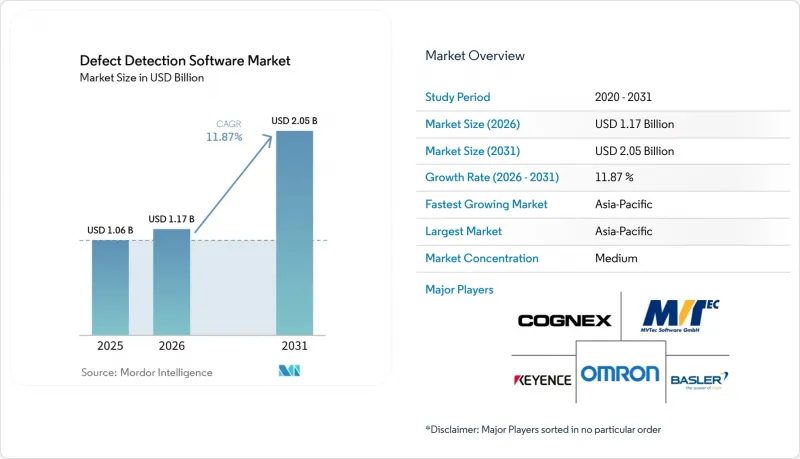
에 따르면 결함 탐지 소프트웨어 시장 규모는 2025년에 10억 6,000만 달러, 2026년에 11억 7,000만 달러에 달하며, 2031년까지 20억 5,000만 달러에 달할 것으로 예측되고 있으며, 2026-2031년에 CAGR 11.87%로 성장할 것으로 전망되고 있습니다.
글로벌 결함 탐지 소프트웨어 시장의 동향 및 인사이트
‘무결함’ 제조 요구 사항의 증가
자동차 및 항공우주 공급망에서 ‘무결함’에 대한 기대가 계약상의 요건으로 자리 잡고 있습니다. 이러한 변화로 인해 고객의 검토 및 시정 조치를 입증할 수 있는 검사 기록의 중요성이 커지고 있습니다. 또한 제조사들은 대형 공급업체뿐만 아니라 소규모 부품 제조업체에 대해서도 품질 요건을 확대하고 있습니다. 이러한 변화로 인해 결함 탐지 소프트웨어 시장은 혜택을 보고 있습니다. 자동 검사는 수작업 점검보다 일관성 있는 기록을 생성할 수 있으며, 공급업체 전반에 걸쳐 심사 업무를 용이하게 수행할 수 있기 때문입니다. 생산 현장에서 결함을 식별하는 시스템은 불량 부품이 후공정으로 유입되는 것을 방지할 수 있습니다. 이러한 수요로 인해 그동안 수작업 심사에 의존해 왔던 공급업체들 사이에서도 육안 검사 소프트웨어의 활용이 확대되고 있습니다. 특히 고객과의 계약에서 각 품질 점검이 완료되었다는 증거가 요구되는 경우, 이러한 경향은 더욱 두드러집니다.
전자, 반도체, 배터리 공장의 AI 검사
첨단 반도체 및 배터리 생산에는 미세하고 발생 빈도가 낮은 결함을 감지할 수 있는 검사 시스템이 필요합니다. 2026년에 실시된 VCSEL 반도체 생산에 관한 연구에서는 하이브리드 딥러닝 접근 방식을 통해 검사 시간을 17.7초에서 1.5초로 단축하면서 전체 정확도 98.7%를 달성했습니다. 이러한 성과는 결함 누락이 수율이나 하류 조립 작업에 영향을 미칠 수 있는 복잡한 생산 환경에서 더 빠른 자동 검사를 도입해야 할 근거를 지원합니다. Roboflow와 NVIDIA는 2026년 6월, 8장의 실제 결함 이미지와 물리 법칙에 따른 합성 사례를 활용하여 평균 정확도 0.95를 달성한 합성 데이터 워크플로를 입증했습니다. 이 접근 방식을 통해 모델이 실용화되기까지 필요한 실제 결함 데이터의 양을 줄일 수 있습니다. 대형 제조업체는 이러한 시스템을 대규모로 운영하기 위해 필요한 컴퓨팅 리소스, 생산 데이터 및 검증 프로세스를 제공하기 쉬운 입장에 있지만, 공급업체는 고객 주도 프로그램을 통해 나중에 이러한 툴을 도입할 가능성이 있습니다.
기존 MES, ERP, SCADA 및 PLC와의 통합에 따른 복잡성
검사 소프트웨어를 구형 생산 시스템로 연결하는 것은 여전히 도입에 있으며, 큰 과제로 남아 있습니다. 많은 공장에서는 오랫동안 사용되어 온 SCADA 히스토리안, 독자적인 사양의 PLC 프로토콜, 그리고 실시간 이미지 데이터를 처리하도록 설계되지 않은 기업 시스템이 여전히 운영되고 있습니다. 각 연결에는 별도의 엔지니어링 작업이나 테스트가 필요할 수 있습니다. 결함 탐지 소프트웨어 시장은 이러한 영향으로 인해 어려움을 겪고 있습니다. 왜냐하면 양측 모두 자동화된 품질 검사의 필요성을 인식하고 있더라도, 일반적으로 대형 제조업체는 중규모 공장보다 이 작업에 자금을 투입하기가 더 수월하기 때문입니다. OPC UA 및 REST API 지원은 SCADA와 MES, 그리고 MES와 ERP 간의 경계에서 도움이 될 수 있지만, 호환성 문제를 모두 해결해 주지는 않습니다. 따라서 기존 시설(브라운필드)에 도입할 때 통합 작업이 예산의 상당 부분을 차지하게 되어, 검사 사용 사례가 명확하더라도 구매가 지연되는 경우가 있습니다.
부문 분석
2025년, 규칙 기반 비전 소프트웨어는 결함 검출 소프트웨어 시장 점유율의 43.56%를 차지했습니다. 이 소프트웨어는 결함의 유형이 안정적이고 제품 변경이 제한적인 고속·저품목 생산에 여전히 적합합니다. 프레스 가공, 주조 및 연속 인쇄 라인에서는 빈번한 재교육이 필요 없는 일관된 ‘합격·불합격’ 판정이 효과적입니다. 이러한 용도는 폭넓은 적응성보다는 예측 가능한 생산 성과와 확립된 절차가 더 중요시되는 생산 라인에 적합합니다.
하이브리드 결함 감지 소프트웨어는 순수한 규칙 기반 검사를 넘어 진화를 도모하려는 제조업체에게 실용적인 가교 역할을 합니다. 이 소프트웨어는 미리 정의된 점검 항목을 유지하면서, 고정된 규칙으로는 포착할 수 없는 표면 상태에 대한 이상 감지 기능을 추가할 수 있습니다. 이러한 구조를 통해 품질관리 담당자는 기술 전환 기간 중도 감사 문서를 쉽게 유지할 수 있습니다. AI/기계학습 기반 결함 감지 소프트웨어는 2031년까지 연평균 성장률(CAGR) 12.58%로 성장할 것으로 예측됩니다. 체계적 문헌 인사이트에 따르면 트랜스포머 모델은 보다 광범위한 문맥 분석을 통해 복잡한 형상의 평가를 개선할 수 있는 반면, 실시간 YOLO 모델은 고속 생산을 지원할 수 있는 것으로 밝혀졌습니다. 오므론은 2025년 10월, 과다 검출을 줄이기 위해 적절한 훈련 이미지를 자동으로 선택하는 AI 기능을 탑재하여 FH 비전 시스템을 업데이트했습니다.
2025년 시점에 표면 결함은 결함 검출 소프트웨어 시장의 34.78%를 차지했습니다. 이러한 결함은 자동차 패널, 금속 프레스 부품, 유리판, 의약품 포장 및 소비재 등 광범위한 분야에서 발생하고 있습니다. 광학 시스템은 생산 속도를 유지한 채로 이러한 결함의 상당 부분을 평가할 수 있습니다. 치수 및 형상 결함은 공차가 엄격하고 모든 부품에 대해 접촉 측정이 현실적으로 어려운 정밀 공학 분야에서 중요합니다. 로봇 통합형 검사는 항공우주 및 의료기기의 기계 가공 분야에서 이러한 용도를 지원합니다. 재료 및 내부 결함은 오염이나 이물질 결함과 함께 X선 및 CT 검사 시스템과 연동되는 소프트웨어에 대한 수요를 창출하고 있습니다.
조립 및 부품 결함 시장은 2031년까지 연평균 성장률(CAGR) 12.43%로 확대될 것으로 예측됩니다. 전기자동차(EV)용 배터리 모듈 제조 및 인쇄회로기판(PCB) 조립에서는 정렬, 부품 유무 및 조립 순서 검증이 필요합니다. 이러한 검사는 제품이 다음 공정으로 진행되기 전에 필수적이며, 결함 감지 소프트웨어 시장은 조립 오류의 조기 발견을 지원할 수 있습니다. 오므론은 2026년 6월, 생명과학, 제약, 식품, 자동차 분야의 교정된 인라인 검증을 위해 ‘VHV5-SRV 바코드 검증 시스템’을 출시했습니다. 라벨 및 포장의 결함은 의약품 유통 및 소비재 분야에서 또 다른 관련 분야입니다.
지역별 분석
아시아태평양은 2025년 전 세계 결함 감지 소프트웨어 시장의 35.87%를 차지하고 있으며, 2031년까지 연평균 성장률(CAGR) 12.46%로 성장할 것으로 예측됩니다. 중국의 전자기기 및 반도체 제조 거점은 자동 검사를 도입하기 위한 대규모 환경을 제공하고 있습니다. 2026년 1월, 중국의 8개 정부 부처는 ‘AI+제조 특별 행동 계획’을 발표했습니다. 이 계획은 제조 품질, 생산 모니터링 및 공정 최적화를 포괄하고 있습니다. 베이징 정보산업협회는 2026년 7월, 표준 규격 ‘T/BIIA 081-2026’을 공표했습니다. 이 규격은 여러 제조 분야에서 딥러닝 기반의 산업용 결함 탐지에 관한 기술 사양을 규정하고 있습니다. 일본에서는 정밀 전자기기 및 자동차 생산 분야의 수요가 증가하고 있으며, 파나소닉 커넥트는 2026년 6월, 용접 검사를 위해 3D 센싱 및 AI 지원형 학습 기능을 갖춘 ‘Bead Eye M edition’을 출시했습니다.
북미는 국내 산업 생산 능력 및 자동화에 대한 투자에 힘입어 결함 검출 소프트웨어 시장에서 2위의 규모를 자랑하고 있습니다. 반도체 생산 능력 확대, 자동차 조립 분야의 로봇 기술 도입, 그리고 리쇼어링(국내 복귀) 프로그램으로 인해 해당 지역 전체에서 품질 문서화 수요가 증가하고 있습니다. 캐나다에서는 항공우주 및 자원 가공 분야의 수요가 시장을 지탱하고 있는 반면, 멕시코의 자동차 제조 거점에서는 Tier 1 공급업체 시설에서 생산 등급의 검사 소프트웨어에 대한 수요가 증가하고 있습니다. 유럽에서는 자동차 및 정밀 공학 분야의 수요에 더해, 제약 제조 분야에서 규정 준수를 중시하는 투자가 더해져 수요가 형성되고 있습니다. SICK사는 2026년 8월, AI를 활용한 3D 검사 기능과 이상 히트맵 기능을 갖춘 머신 비전 플랫폼 ‘Nova’를 출시했습니다.
남미는 도입 초기 단계에 있으며, 수요는 브라질의 자동차 조립, 아르헨티나의 식품 및 음료 가공, 칠레의 광업을 중심으로 전개되고 있습니다. 가격에 대한 민감성과 기존 인프라의 활용으로 인해 저비용의 온프레미스 도입이 선호되고 있지만, 다국적 기업의 요구 사항에 따라 검사 의무가 해당 지역의 Tier 2 공급업체까지 확대되는 경우가 있습니다. 중동에서는 사우디아라비아와 UAE의 제조업 다각화 계획이 지원되고 있으며, 특히 석유화학 처리 분야에서 오염 및 재료 결함 검사가 요구되는 분야에서 수요가 증가하고 있습니다. 아프리카는 여전히 도입 초기 단계에 있지만, 남아프리카공화국의 자동차 산업 클러스터가 단기적인 수요의 집중처가 되고 있으며, 현지 지원 네트워크가 정비되고 있는 지역에서는 클라우드 배포의 중요성이 높아지고 있습니다.
기타 혜택:
- 엑셀 형식의 시장 예측(ME) 시트
- 3개월간의 애널리스트 지원
자주 묻는 질문
목차
제1장 서론
- 조사 전제조건과 시장 정의
- 조사 범위
제2장 조사 방법
제3장 개요
제4장 시장 구도
- 시장 개요
- 시장 성장 촉진요인
- 시장 성장 억제요인
- 거시경제 요인이 시장에 미치는 영향
- 업계 밸류체인 분석
- 규제 상황
- 기술 전망
- Porter's Five Forces 분석
제5장 시장 규모와 성장 예측
- 소프트웨어 유형별
- 결함 유형별
- 배포 모델별
- 산업 분야별
- 지역별
- 북미
- 미국
- 캐나다
- 멕시코
- 남미
- 브라질
- 아르헨티나
- 칠레
- 기타 남미 국가
- 유럽
- 독일
- 영국
- 프랑스
- 이탈리아
- 스페인
- 기타 유럽 국가
- 아시아태평양
- 중국
- 일본
- 인도
- 한국
- 호주
- 기타 아시아태평양 국가
- 중동
- 아랍에미리트
- 사우디아라비아
- 카타르
- 기타 중동 국가
- 아프리카
- 남아프리카공화국
- 이집트
- 나이지리아
- 기타 아프리카 국가
- 북미
제6장 경쟁 구도
- 시장 집중도
- 전략적 동향
- 시장 점유율 분석
- 기업 개요
- Cognex Corporation
- Keyence Corporation
- OMRON Corporation
- MVTec Software GmbH
- Basler AG
- SICK AG
- Datalogic S.p.A.
- Teledyne Technologies Incorporated
- Zebra Technologies Corporation
- Landing AI, Inc.
- Instrumental, Inc.
- ISRA VISION GmbH
- Siemens AG
- Neurala, Inc.
- Kitov Systems Ltd.
- Roboflow, Inc.
- Sight Machine, Inc.
- Qualitas Technologies Pvt. Ltd.
제7장 시장 기회와 향후 전망
KSA 26.10.30According to Mordor Intelligence, the defect detection software market size is projected to be USD 1.06 billion in 2025, USD 1.17 billion in 2026, and reach USD 2.05 billion by 2031, growing at a CAGR of 11.87% from 2026 to 2031.
Global Defect Detection Software Market Trends and Insights
Increasing Zero-Defect Manufacturing Requirements
Zero-defect expectations are becoming contractual requirements in automotive and aerospace supply chains. This change raises the importance of inspection records that can support customer reviews and corrective actions. Manufacturers are also extending quality requirements from large suppliers to smaller component producers. The defect detection software market gains from this shift because automated inspection can create a more consistent record than manual checks and can make review practices easier to apply across suppliers. Systems that identify defects at the point of production can limit the movement of faulty parts to later stages. This need supports wider use of visual inspection software across suppliers that previously relied on manual review, especially where customer agreements require evidence that each quality check was completed.
AI Inspection Across Electronics, Semiconductor, and Battery Plants
Advanced semiconductor and battery production requires inspection systems that can detect small, infrequent defects. A 2026 study of VCSEL semiconductor production reduced inspection time from 17.7 seconds to 1.5 seconds while reporting 98.7% overall accuracy in a hybrid deep-learning approach. This evidence supports the operating case for faster automated inspection in complex production environments, where a missed defect can affect yield and downstream assembly work. Roboflow and NVIDIA demonstrated a synthetic-data workflow in June 2026 that achieved a mean average precision of 0.95 using 8 real defect images and physics-consistent synthetic examples. The approach can reduce the amount of real defect data required before a model is useful. Larger manufacturers are better placed to provide the computing resources, production data, and validation processes needed to use these systems at scale, while suppliers may adopt the tools later through customer-led programs.
Legacy MES, ERP, SCADA, and PLC Integration Complexity
Connecting inspection software to older production systems remains a major deployment issue. Many factories still operate with long-established SCADA historians, proprietary PLC protocols, and enterprise systems that were not designed for real-time image data. Each connection can require separate engineering work and testing. The defect detection software market is affected because large manufacturers can usually fund this work more easily than mid-sized plants, even when both groups see a need for automated quality checks. OPC UA and REST API support can help at the SCADA-MES and MES-ERP boundaries, but they do not eliminate all compatibility issues. Integration work can therefore consume a large share of the budget for installations in brownfield facilities, delaying a purchase even when the inspection use case is clear.
Other drivers and restraints analyzed in the detailed report include:
- Persistent Quality-Inspection Labor Shortages
- Shift From Rule-Based Inspection to Deep Learning and Anomaly Detection
- Validation, Auditability, and Requalification Burden in Regulated Production
For complete list of drivers and restraints, kindly check the Table Of Contents.
Segment Analysis
Rule-Based Vision Software held 43.56% of the defect detection software market share in 2025. It remains well-suited to high-speed, low-mix production where defect categories are stable, and product changes are limited. Stamping, casting, and continuous printing lines can benefit from a consistent pass-or-fail decision that does not require frequent retraining. Their position aligns with production lines where predictable outputs and established procedures are more important than broad adaptability.
Hybrid Defect Detection Software provides a practical bridge for manufacturers seeking to move beyond purely rule-based inspection. It can retain predefined checks while adding anomaly detection for surface conditions that are not captured by fixed rules. This structure can help quality managers maintain audit documentation during a technology transition. AI/Machine Learning-Based Defect Detection Software is projected to grow at a 12.58% CAGR through 2031. A systematic review found that transformer models can improve assessment of complex geometries through wider contextual analysis, while real-time YOLO models can support high-velocity production. OMRON updated its FH Vision System in October 2025 with AI features that automatically select suitable training images to reduce over-detection.
Surface Defects accounted for 34.78% of the defect detection software market in 2025. These defects occur across automotive panels, metal stampings, glass sheets, pharmaceutical packaging, and consumer products. Optical systems can evaluate many of them at production speed. Dimensional and Geometric Defects are important in precision engineering where tolerances are tight, and contact measurement is not practical for every part. Robot-integrated inspection supports these uses in aerospace and medical device machining. Material and Internal Defects, along with Contamination and Foreign-Object Defects, create opportunities for software that works with X-ray and CT inspection systems.
Assembly and Component Defects are projected to grow at a 12.43% CAGR through 2031. EV battery module manufacturing and printed circuit board assembly require verification of alignment, component presence, and assembly order. These checks are necessary before a product can move to the next stage, and the defect detection software market can support earlier identification of assembly errors. OMRON released the VHV5-SRV Barcode Verification System in June 2026 for calibrated inline verification in life sciences, pharmaceutical, food, and automotive applications. Labeling and Packaging Defects are another adjacent area in pharmaceutical distribution and consumer goods.
Complete Report Scope:
- By Software Type
- Rule-Based Vision Software
- AI / Machine Learning-Based Defect Detection Software
- Hybrid Defect Detection Software
- By Defect Type
- Surface Defects
- Dimensional / Geometric Defects
- Assembly and Component Defects
- Material / Internal Defects
- Contamination and Foreign-Object Defects
- Labeling and Packaging Defects
- By Deployment Model
- On-Premises / Edge
- Cloud-Based
- Hybrid
- By Industry Vertical
- Automotive and Transportation
- Electronics and Semiconductors
- Food and Beverage
- Pharmaceuticals and Medical Devices
- Metal and Machinery
- Glass and Ceramics
- Other Industry Verticals
- By Geography
- North America
- United States
- Canada
- Mexico
- South America
- Brazil
- Argentina
- Chile
- Rest of South America
- Europe
- Germany
- United Kingdom
- France
- Italy
- Spain
- Rest of Europe
- Asia-Pacific
- China
- Japan
- India
- South Korea
- Australia
- Rest of Asia-Pacific
- Middle East
- United Arab Emirates
- Saudi Arabia
- Qatar
- Rest of Middle East
- Africa
- South Africa
- Egypt
- Nigeria
- Rest of Africa
- North America
Geography Analysis
Asia-Pacific accounted for 35.87% of the global defect detection software market in 2025 and is projected to grow at a 12.46% CAGR through 2031. China's electronics and semiconductor manufacturing base provides a large deployment setting for automated inspection. In January 2026, 8 Chinese government ministries issued the AI + Manufacturing Special Action Plan, which covers manufacturing quality, production monitoring, and process optimization. The Beijing Information Industry Association issued standard T/BIIA 081-2026 in July 2026, which provides technical specifications for deep learning-based industrial defect detection across several manufacturing sectors. Japan is adding demand from precision electronics and automotive production, and Panasonic Connect launched the Bead Eye M edition in June 2026 with 3D sensing and AI-supported learning for welding inspection.
North America is the second-largest geography for the defect detection software market, supported by investment in domestic industrial capacity and automation. Semiconductor capacity expansion, adoption of robotics in automotive assembly, and reshoring programs are strengthening quality documentation needs across the region. Canada supports demand in aerospace and resource processing, while Mexico's automotive manufacturing base needs production-grade inspection software at Tier-1 supplier facilities. Europe combines demand from automotive and precision engineering with compliance-focused investment in pharmaceutical manufacturing. SICK launched its Nova machine vision platform in August 2026 with AI-powered 3D inspection and anomaly heatmap capabilities.
South America is at an earlier stage of adoption, with demand centered on Brazil's automotive assembly activity, Argentina's food and beverage processing, and Chile's mining operations. Price sensitivity and brownfield infrastructure support lower-cost on-premises installations, although multinational requirements can extend inspection obligations to regional Tier-2 suppliers. The Middle East is supported by manufacturing diversification plans in Saudi Arabia and the UAE, especially where petrochemical processing requires checks for contamination and material defects. Africa remains at an earlier adoption stage, with South Africa's automotive cluster representing a near-term concentration of demand and cloud deployments gaining relevance where local support networks are developing.
- Cognex Corporation
- Keyence Corporation
- OMRON Corporation
- MVTec Software GmbH
- Basler AG
- SICK AG
- Datalogic S.p.A.
- Teledyne Technologies Incorporated
- Zebra Technologies Corporation
- Landing AI, Inc.
- Instrumental, Inc.
- ISRA VISION GmbH
- Siemens AG
- Neurala, Inc.
- Kitov Systems Ltd.
- Roboflow, Inc.
- Sight Machine, Inc.
- Qualitas Technologies Pvt. Ltd.
Additional Benefits:
- The market estimate (ME) sheet in Excel format
- 3 months of analyst support
TABLE OF CONTENTS
1 INTRODUCTION
- 1.1 Study Assumptions and Market Definition
- 1.2 Scope of the Study
2 RESEARCH METHODOLOGY
3 EXECUTIVE SUMMARY
4 MARKET LANDSCAPE
- 4.1 Market Overview
- 4.2 Market Drivers
- 4.2.1 Increasing Zero-Defect Manufacturing Requirements
- 4.2.2 Expansion of AI-Based Inspection Across Electronics, Semiconductor, and Battery Plants
- 4.2.3 Persistent Quality-Inspection Labor Shortages
- 4.2.4 Shift From Rule-Based Inspection to Deep Learning and Anomaly Detection
- 4.2.5 Multi-Plant Traceability and Digital Quality Governance
- 4.2.6 Few-Shot and Open-Set Detection Reducing Data-Labeling Bottlenecks
- 4.3 Market Restraints
- 4.3.1 Integration Complexity Across Legacy MES, ERP, SCADA, and PLC Environments
- 4.3.2 Validation, Auditability, and Requalification Burden in Regulated Production
- 4.3.3 Sensor, Lighting, and Calibration Sensitivity in Real-World Lines
- 4.3.4 Novel-Defect and Class-Imbalance Risk in High-Mix Production
- 4.4 Impact of Macroeconomic Factors on the Market
- 4.5 Industry Value Chain Analysis
- 4.6 Regulatory Landscape
- 4.7 Technological Outlook
- 4.8 Porter's Five Forces Analysis
- 4.8.1 Threat of New Entrants
- 4.8.2 Bargaining Power of Suppliers
- 4.8.3 Bargaining Power of Buyers
- 4.8.4 Threat of Substitutes
- 4.8.5 Competitive Rivalry
5 MARKET SIZE AND GROWTH FORECASTS (VALUE)
- 5.1 By Software Type
- 5.1.1 Rule-Based Vision Software
- 5.1.2 AI / Machine Learning-Based Defect Detection Software
- 5.1.3 Hybrid Defect Detection Software
- 5.2 By Defect Type
- 5.2.1 Surface Defects
- 5.2.2 Dimensional / Geometric Defects
- 5.2.3 Assembly and Component Defects
- 5.2.4 Material / Internal Defects
- 5.2.5 Contamination and Foreign-Object Defects
- 5.2.6 Labeling and Packaging Defects
- 5.3 By Deployment Model
- 5.3.1 On-Premises / Edge
- 5.3.2 Cloud-Based
- 5.3.3 Hybrid
- 5.4 By Industry Vertical
- 5.4.1 Automotive and Transportation
- 5.4.2 Electronics and Semiconductors
- 5.4.3 Food and Beverage
- 5.4.4 Pharmaceuticals and Medical Devices
- 5.4.5 Metal and Machinery
- 5.4.6 Glass and Ceramics
- 5.4.7 Other Industry Verticals
- 5.5 By Geography
- 5.5.1 North America
- 5.5.1.1 United States
- 5.5.1.2 Canada
- 5.5.1.3 Mexico
- 5.5.2 South America
- 5.5.2.1 Brazil
- 5.5.2.2 Argentina
- 5.5.2.3 Chile
- 5.5.2.4 Rest of South America
- 5.5.3 Europe
- 5.5.3.1 Germany
- 5.5.3.2 United Kingdom
- 5.5.3.3 France
- 5.5.3.4 Italy
- 5.5.3.5 Spain
- 5.5.3.6 Rest of Europe
- 5.5.4 Asia-Pacific
- 5.5.4.1 China
- 5.5.4.2 Japan
- 5.5.4.3 India
- 5.5.4.4 South Korea
- 5.5.4.5 Australia
- 5.5.4.6 Rest of Asia-Pacific
- 5.5.5 Middle East
- 5.5.5.1 United Arab Emirates
- 5.5.5.2 Saudi Arabia
- 5.5.5.3 Qatar
- 5.5.5.4 Rest of Middle East
- 5.5.6 Africa
- 5.5.6.1 South Africa
- 5.5.6.2 Egypt
- 5.5.6.3 Nigeria
- 5.5.6.4 Rest of Africa
- 5.5.1 North America
6 COMPETITIVE LANDSCAPE
- 6.1 Market Concentration
- 6.2 Strategic Moves
- 6.3 Market Share Analysis
- 6.4 Company Profiles (includes Global Level Overview, Market Level Overview, Core Segments, Financials as available, Strategic Information, Market Rank/Share, Products and Services, Recent Developments)
- 6.4.1 Cognex Corporation
- 6.4.2 Keyence Corporation
- 6.4.3 OMRON Corporation
- 6.4.4 MVTec Software GmbH
- 6.4.5 Basler AG
- 6.4.6 SICK AG
- 6.4.7 Datalogic S.p.A.
- 6.4.8 Teledyne Technologies Incorporated
- 6.4.9 Zebra Technologies Corporation
- 6.4.10 Landing AI, Inc.
- 6.4.11 Instrumental, Inc.
- 6.4.12 ISRA VISION GmbH
- 6.4.13 Siemens AG
- 6.4.14 Neurala, Inc.
- 6.4.15 Kitov Systems Ltd.
- 6.4.16 Roboflow, Inc.
- 6.4.17 Sight Machine, Inc.
- 6.4.18 Qualitas Technologies Pvt. Ltd.
7 MARKET OPPORTUNITIES AND FUTURE OUTLOOK
- 7.1 White-Space and Unmet-Need Assessment


