

|
시장보고서
상품코드
2157081
LWIR 산업용 카메라 : 시장 점유율 분석, 업계 동향과 통계, 성장 예측(2026-2031년)LWIR Industrial Camera - Market Share Analysis, Industry Trends & Statistics, Growth Forecasts (2026 - 2031) |
||||||
 Mordor Intelligence
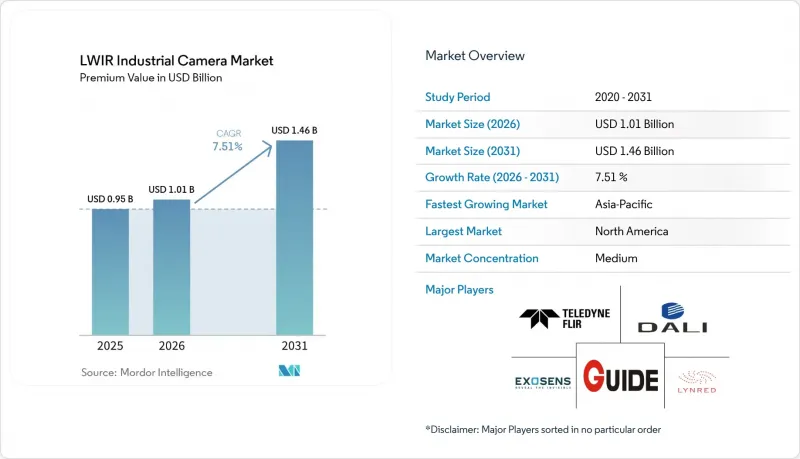
에 따르면 LWIR 산업용 카메라 시장 규모는 2031년까지 14억 6,000만 달러에 달할 것으로 예상되고 있으며, 2026-2031년에 CAGR 7.51%로 확대할 것으로 전망되고 있습니다.
전 세계 LWIR 산업용 카메라 시장의 동향 및 인사이트
산업용 예측 유지보수 및 상태 모니터링이 수요의 기반을 견인
지속적인 열화상 모니터링을 통해 장비가 고장 나기 전에 전기 연결부, 모터, 베어링, 열교환기 등에서 발생하고 있는 문제를 파악할 수 있습니다. 미국 에너지부 보고서에 따르면 예측 유지보수 프로그램을 도입함으로써 사후 대응형 유지보수 비용을 30-40%, 장비 고장을 70-75% 줄일 수 있다고 합니다. NFPA 70B는 2023년에 개정되어, 전기 장비의 유지보수를 12개월 이내의 간격으로 실시하도록 의무화되었습니다. 이 규격에서는 컨디션 3에 해당하는 자산에 대해서는 6개월마다 열화상 조사가 요구됩니다. 이러한 요건으로 인해 개폐기실, 배전 시스템 및 모터 제어 센터에 카메라를 영구적으로 설치하는 것이 촉진되고 있습니다. 이러한 설치를 통해 생성되는 열 데이터 스트림은 LWIR 산업용 카메라 시장 전체의 분석 플랫폼을 지원할 수 있습니다.
AI를 활용한 열화상 분석의 확대가 카메라 활용도를 높인다
AI를 활용한 분석 기술 덕분에 열화상 카메라는 단순한 이미지 촬영 장치에서 고장 상태를 분류할 수 있는 진단 툴로 변모하고 있습니다. 2025년에 실시된 ThermoNet 아키텍처에 관한 연구에서는 기계의 실시간 건전성 모니터링에서 진단 정확도 0.987, 추론 지연 0.0017초라는 결과가 보고되었습니다. 이 연구에서는 24시간 가동된 열화상 데이터세트을 실제 카메라 측정값과 대조하여 검증했습니다. 이러한 시스템은 주변 온도 변화와 고장 징후를 구분함으로써, 유지보수 팀이 작업 지시의 우선순위를 정하는 데 도움을 줍니다. 이 기능을 통해 과거에는 더 높은 감도의 수동 검사 장비가 사용되던 용도에서도 NETD 값이 40-60 mK인 비냉각 카메라의 실용 범위가 확대됩니다. 따라서 AI를 활용한 지속적인 모니터링을 통해 가동 중단 시간을 방지하고 유지보수 비용을 절감함으로써, 열화상 시스템에 대한 투자 효과를 평가하기가 더 쉬워집니다.
초기 시스템 도입 비용 및 교정 비용이 높아 중소기업의 도입을 저해
고정 설치형 시스템을 도입하려면 카메라 본체, 설치용 하드웨어, 소프트웨어 라이선스, 교정, 그리고 SCADA나 CMMS 플랫폼과의 통합에 드는 투자가 필요할 수 있습니다. 이 비용은 외부 열화상 전문가에 의한 정기 점검과 비교했을 때, 중소규모 제조업체에게는 정당화하기 어려울 수 있습니다. 검출기의 응답 특성은 시간이 지남에 따라 변화하므로, 측정 정밀도를 유지하려면 복사 측정 기반의 재교정이 필요합니다. 또한 기술자는 모니터링 대상인 각 자산 클래스별로 복사율 값을 확립해야 합니다. 이러한 요건으로 인해 소규모 사업자의 경우 도입이 지연되는 반면, 대규모 시설에서는 더 많은 자산에 비용을 분산시킬 수 있습니다. LWIR 산업용 카메라 시장에서 ‘카메라-어즈-어-서비스(CaaS)’나 구독형 서비스를 활용하면, 비용을 자본 예산에서 운영 예산으로 전환하여 초기 부담을 줄일 수 있습니다.
부문 분석
2025년, 비냉각 카메라는 제품 유형별 매출의 48.62%를 차지했습니다. 이러한 위상은 극저온 냉각이 필요 없는 상온 모니터링에 대한 적합성을 반영하며, LWIR 산업용 카메라 시장의 폭넓은 활용을 지원하고 있습니다. VOx 마이크로볼로미터 검출기는 8-14µm의 스펙트럼 범위에서 작동하며, 전기 연결부, 모터, 베어링, 공정 배관에서 방출되는 복사를 감지합니다. 이러한 자산군은 예측 유지보수의 일반적인 대상이기 때문에 비냉각형 장치는 지속적인 상태 모니터링 시스템에서 표준적인 선택지로 자리 잡고 있습니다. 소형화, 저전력 소비, 그리고 낮은 소유 비용 또한 분산형 모니터링 시스템으로의 도입을 촉진하고 있습니다.
코어 및 모듈 분야의 LWIR 산업용 카메라 시장 규모는 2031년까지 연평균 성장률(CAGR) 9.34%로 확대될 것으로 예측됩니다. 기계 제조업체와 시스템 통합사업자는 OEM 열화상 코어를 자체 검사 플랫폼에 통합함으로써 용도별 맞춤형 통합을 실현하고, 시스템 수준의 이익률을 유지하고 있습니다. 냉각식 LWIR 카메라는 비파괴 검사, 고속 검사, 그리고 비냉각식의 감도로는 충분하지 않은 가스 가시화 등에 사용되고 있습니다. 통합 시스템은 검출기, 분석 소프트웨어, 통신 인터페이스를 결합하여 안전성이 극히 중요한 화재 감지 및 가스 누출 감시를 실현합니다. 2024년 연구에 따르면 Au-In 과도 액상 접합을 이용한 웨이퍼 레벨 진공 패키징을 통해 MIL-STD 883 기준에서 0.1×10? atm·cc/s라는 극히 낮은 기밀성을 달성했습니다.
2025년에는 고정 설치형 카메라가 폼팩터별 매출의 42.18%를 차지했습니다. LWIR 산업용 카메라 시장에서 영구적인 설치를 통해 스위치기어, 회전 장비 및 공정 용기의 전체 가동 시간 동안 지속적인 감시가 가능해집니다. 이러한 접근 방식은 점검 방문 시에만 상태를 파악하는 정기적인 휴대용 조사와는 다릅니다. 이는 자산 수가 많고 정기적인 열화상 검사가 필요한 시설, 특히 점검 방문 사이에 결함이 발생할 가능성이 있는 시설에 적합합니다. 설치형 네트워크로의 전환은 중요한 접합부나 자산을 상시 가시화해야 할 필요성을 반영하고 있습니다.
임베디드 카메라 코어 및 모듈 시장은 2026-2031년까지 연평균 성장률(CAGR) 10.12%로 확대될 것으로 예측됩니다. 자동화 장비 OEM(Original Equipment Manufacturer)들은 독립형 카메라를 조달하는 대신, 이를 로봇 용접 셀, 육안 검사 스테이션 및 컨베이어 라인의 품질관리 시스템에 통합하고 있습니다. 핸드헬드 카메라는 현장 진단, 정기 조사 및 고정 인프라 비용을 아직 정당화할 수 없는 시설에서 여전히 유용합니다. 라인 스캔 카메라는 섬유, 종이, 강대, 필름의 웹 제조에 대응하는 반면, 팬-틸트-줌(PTZ) 장치는 보안 및 광범위한 스캔에 활용되고 있습니다. Workswell사는 2025년 9월, 고정식 산업용 및 머신 비전 장비를 위해 해상도 1280×1024, NETD 50 mK 미만의 ‘WEOM HD’ 코어를 출시했습니다.
지역별 분석
2025년, 북미는 전 세계 LWIR 산업용 카메라 매출의 34.21%를 차지했습니다. 이 지역에서는 현재 확립된 자동화, 노후화된 전기 인프라, 그리고 상시 감시를 지원하는 규정 준수 요건이 결합되어 시장을 지탱하고 있습니다. 미국에는 주요 카메라 제조사와 시스템 통합사업자가 있는 반면, 멕시코만 연안의 석유화학 시설에서는 가스 가시화, 공정 모니터링, 화재 감지에 카메라가 활용되고 있습니다. 자동차 및 항공우주 시설에서는 예측 유지보수 및 비파괴 검사를 위해 고정형 카메라가 사용되고 있습니다.
캐나다에서는 견고한 감시 장비가 필요한 오일샌드 및 광업 분야의 수요가 더해지고 있습니다. 멕시코에서는 자동차 제조 거점의 확장에 따라 정밀 조립 공정에서의 인라인 검사 수요가 증가하고 있습니다. 2023년 NFPA 70B 요건에 따라 북미 전역의 시설에서 고정형 설비에 대한 지속적인 투자가 촉진되고 있습니다. 유럽에서는 정밀 제조, 화학 처리, 에너지 생산 및 공급망 자립성 확보 요건이 시장을 지원하고 있습니다. 독일은 철강, 유리, 화학, 자동차 생산에 사용되는 공정 모니터링 시스템의 주요 구매국으로 자리매김하고 있습니다.
아시아태평양은 2026-2031년까지 연평균 성장률(CAGR) 9.67%로 성장할 것으로 예측됩니다. 중국은 열화상 장비의 주요 생산국이자 주요 사용자이며, 한편 한국의 반도체 및 디스플레이 시설은 자동화된 공정 제어에 대한 수요를 지원하고 있습니다. 일본은 철강, 화학, 자동차 생산 분야의 설비 갱신 주기를 지원하고 있습니다. 인도에서는 전력 사업, 정유소, 제약 제조 분야에서의 활용이 확대되고 있습니다. 남미, 중동 및 아프리카는 LWIR 산업용 카메라 시장에서 비교적 작은 비중을 차지하고 있지만, 그 수요는 브라질의 석유 및 가스 사업, 걸프 국가들의 정유·공공 사업, 그리고 남아프리카공화국과 이집트의 광업·인프라 활동과 관련이 있습니다.
기타 혜택:
- 엑셀 형식의 시장 예측(ME) 시트
- 3개월간의 애널리스트 지원
자주 묻는 질문
목차
제1장 서론
- 조사 전제조건과 시장 정의
- 조사 범위
제2장 조사 방법
제3장 개요
제4장 시장 구도
- 시장 개요
- 거시경제 요인이 시장에 미치는 영향
- 시장 성장 촉진요인
- 시장 성장 억제요인
- 업계 밸류체인 분석
- 규제 상황
- 기술 전망
- Porter's Five Forces 분석
제5장 시장 규모와 성장 예측
- 제품 유형별
- 폼팩터별
- 용도별
- 최종사용자 산업별
- 지역별
- 북미
- 미국
- 캐나다
- 멕시코
- 남미
- 브라질
- 아르헨티나
- 기타 남미 국가
- 유럽
- 독일
- 영국
- 프랑스
- 이탈리아
- 스페인
- 기타 유럽 국가
- 아시아태평양
- 중국
- 일본
- 한국
- 인도
- 기타 아시아태평양 국가
- 중동
- 사우디아라비아
- 아랍에미리트
- 기타 중동 국가
- 아프리카
- 남아프리카공화국
- 이집트
- 기타 아프리카 국가
- 북미
제6장 경쟁 구도
- 시장 집중도
- 전략적 동향
- 시장 점유율 분석
- 기업 개요
- Teledyne FLIR LLC
- Lynred USA Inc.
- Exosens S.A.
- Telops Inc.
- InfraTec GmbH Infrarotsensorik und Messtechnik
- Optris GmbH
- DIAS Infrared GmbH
- Workswell s.r.o.
- Wuhan Guide Infrared Co., Ltd.
- Zhejiang Dali Technology Co., Ltd.
- Yantai Raytron Technology Co., Ltd.
- Zhejiang ULIRVISION Technology Co., Ltd.
- Global Sensor Technology Co., Ltd.
- AIM Infrarot-Module GmbH
- VIGO System S.A.
- Seek Thermal, Inc.
- Opgal Optronic Industries Ltd.
- Raythink Technology Co., Ltd.
- HIKMICRO Sensing Technology Co., Ltd.
- Infrared Cameras, Inc.
- Sierra-Olympic Technologies, Inc.
- NEC Avio Infrared Technologies Co., Ltd.
제7장 시장 기회와 향후 전망
KSA 26.10.30According to Mordor Intelligence, the LWIR industrial camera market size is expected to reach USD 1.46 billion by 2031, expanding at a CAGR of 7.51% from 2026 to 2031.
Global LWIR Industrial Camera Market Trends and Insights
Industrial Predictive Maintenance and Condition Monitoring Drives Baseline Demand
Continuous thermal monitoring can identify developing faults in electrical connections, motors, bearings, and heat exchangers before equipment fails. The US Department of Energy reported that predictive maintenance programs can reduce reactive maintenance costs by 30-40% and equipment breakdowns by 70-75%. NFPA 70B was revised in 2023 to require electrical equipment maintenance at intervals of no more than 12 months. Condition 3 assets require thermographic surveys every 6 months under that standard. These requirements encourage the permanent installation of cameras in switchgear rooms, electrical distribution systems, and motor control centers. The same installations create thermal data streams that can support analytics platforms across the LWIR industrial camera market.
Expansion of AI-Enabled Thermal Analytics Elevates Camera Utilization
AI-enabled analytics are transforming thermal cameras from imaging devices into diagnostic tools capable of classifying fault conditions. A 2025 study of the ThermoNet architecture reported diagnostic accuracy of 0.987 and inference latency of 0.0017 seconds for real-time machinery health monitoring. The study validated a 24-hour operating thermal dataset against real camera measurements. These systems can help maintenance teams prioritize work orders by separating fault signatures from ambient temperature changes. This capability broadens the practical use of uncooled cameras with NETD values of 40-60 mK in applications once served by higher-sensitivity manual inspection equipment. Continuous AI-supported monitoring can therefore make thermal investments easier to assess through avoided downtime and maintenance savings.
High Initial System and Calibration Costs Limit Small and Medium-Sized Enterprise Adoption
A fixed-mount system may require investment in the camera, mounting hardware, software licenses, calibration, and integration with SCADA or CMMS platforms. This cost can be difficult for small and medium-sized manufacturers to justify against periodic inspections conducted by outside thermographers. Radiometric recalibration is needed to maintain measurement accuracy as detector response changes over time. Technicians also need to establish emissivity values for each monitored asset class. These requirements can delay adoption among smaller operators while larger facilities spread the cost across more assets. Camera-as-a-service and subscription offerings can reduce the initial burden by shifting costs from capital budgets to operating budgets in the LWIR industrial camera market.
Other drivers and restraints analyzed in the detailed report include:
- Falling Uncooled Microbolometer Costs Open Adjacent Deployment Tiers
- Industrial Automation and Inline Quality Inspection Creates Non-Cyclical Volume
- Performance Gap Between Uncooled and Cooled Detectors Restricts High-Precision Applications
For complete list of drivers and restraints, kindly check the Table Of Contents.
Segment Analysis
Uncooled cameras held 48.62% of product-type revenue in 2025. Their position reflects suitability for ambient-temperature monitoring without cryogenic cooling and supports broad use in the LWIR industrial camera market. VOx microbolometer detectors operate in the 8-14 µm spectral range, covering emissions from electrical connections, motors, bearings, and process piping. These asset classes are common targets for predictive maintenance, which makes uncooled units the standard choice for continuous condition-monitoring installations. Smaller size, lower power consumption, and lower ownership costs also support their deployment in distributed monitoring systems.
The LWIR industrial camera market size for cores and modules is projected to expand at a 9.34% CAGR through 2031. Machine builders and system integrators embed OEM thermal cores into proprietary inspection platforms to enable application-specific integration and preserve system-level margins. Cooled LWIR cameras are used for non-destructive testing, high-speed inspection, and gas visualization where uncooled sensitivity is insufficient. Integrated systems combine detectors, analytics software, and communication interfaces for safety-critical fire detection and gas-leak monitoring. A 2024 study found that wafer-level vacuum packaging with Au-In transient liquid phase bonding achieved hermeticity as low as 0.1 X 10⁻⁹ atm*cc/s under MIL-STD 883.
Fixed-mount cameras accounted for 42.18% of form-factor revenue in 2025. Permanent installation supports continuous monitoring of switchgear, rotating equipment, and process vessels throughout operating hours in the LWIR industrial camera market. This approach differs from scheduled handheld surveys that capture conditions only during an inspection visit. It suits facilities with large asset populations and recurring thermographic requirements, particularly where faults can develop between visits. The move toward installed networks reflects the need for persistent visibility of critical junctions and assets.
Embedded camera cores and modules are projected to expand at a 10.12% CAGR from 2026 to 2031. Automation OEMs integrate them into robotic welding cells, visual inspection stations, and conveyor-side quality systems instead of procuring standalone cameras. Handheld cameras remain useful for field diagnostics, periodic surveys, and facilities that cannot yet justify the cost of fixed infrastructure. Line-scan cameras support web manufacturing in textiles, paper, steel strip, and film, while pan-tilt-zoom units serve security and large-area scans. Workswell released its WEOM HD core in September 2025 with 1280 X 1024 resolution and NETD below 50 mK for fixed industrial and machine-vision equipment.
Complete Report Scope:
- By Product Type
- Uncooled LWIR Cameras
- Cooled LWIR Cameras
- LWIR Camera Cores and Modules
- Integrated LWIR Imaging Systems
- By Form Factor
- Fixed-Mount Cameras
- Handheld Cameras
- Line-Scan Cameras
- Pan-Tilt-Zoom Cameras
- Embedded Camera Cores and Modules
- By Application
- Predictive Maintenance and Condition Monitoring
- Process Monitoring and Control
- Quality Assurance and Machine Vision
- Non-Destructive Testing
- Electrical and Power-Equipment Inspection
- Fire Detection and Industrial Safety
- Leak Detection and Gas Visualization
- Other Applications
- By End-User Industry
- Manufacturing
- Power Generation and Utilities
- Oil and Gas
- Automotive and Electric Vehicles
- Electronics and Semiconductors
- Metals
- Chemicals and Petrochemicals
- Food and Beverage
- Aerospace and Defense
- Other End-User Industries
- By Geography
- North America
- United States
- Canada
- Mexico
- South America
- Brazil
- Argentina
- Rest of South America
- Europe
- Germany
- United Kingdom
- France
- Italy
- Spain
- Rest of Europe
- Asia-Pacific
- China
- Japan
- South Korea
- India
- Rest of Asia-Pacific
- Middle East
- Saudi Arabia
- United Arab Emirates
- Rest of Middle East
- Africa
- South Africa
- Egypt
- Rest of Africa
- North America
Geography Analysis
North America held 34.21% of global LWIR industrial camera revenue in 2025. The region currently combines established automation, aging electrical infrastructure, and compliance requirements that support permanent monitoring. The United States includes major camera manufacturers and systems integrators, while Gulf Coast petrochemical facilities use cameras for gas visualization, process monitoring, and fire detection. Automotive and aerospace sites use fixed installations for predictive maintenance and non-destructive testing.
Canada adds demand from oil sands and mining operations that require rugged monitoring equipment. Mexico's expanding automotive manufacturing base supports demand for inline inspection in precision assembly. The 2023 NFPA 70B requirements support recurring investment in fixed installations across North American facilities. Europe is supported by precision manufacturing, chemical processing, energy production, and supply-chain sovereignty requirements. Germany remains an important buyer of process monitoring systems used in steel, glass, chemicals, and automotive production.
Asia-Pacific is projected to expand at a 9.67% CAGR from 2026 to 2031. China is both a significant producer and user of thermal imaging equipment, while South Korea's semiconductor and display facilities support demand for automated process control. Japan supports upgrade cycles in steel, chemical, and automotive production. India is expanding its use in power utilities, oil refineries, and pharmaceutical manufacturing. South America, the Middle East, and Africa are smaller parts of the LWIR industrial camera market, with demand linked to Brazilian oil and gas operations, Gulf refining and utilities, and mining and infrastructure activity in South Africa and Egypt.
- Teledyne FLIR LLC
- Lynred USA Inc.
- Exosens S.A.
- Telops Inc.
- InfraTec GmbH Infrarotsensorik und Messtechnik
- Optris GmbH
- DIAS Infrared GmbH
- Workswell s.r.o.
- Wuhan Guide Infrared Co., Ltd.
- Zhejiang Dali Technology Co., Ltd.
- Yantai Raytron Technology Co., Ltd.
- Zhejiang ULIRVISION Technology Co., Ltd.
- Global Sensor Technology Co., Ltd.
- AIM Infrarot-Module GmbH
- VIGO System S.A.
- Seek Thermal, Inc.
- Opgal Optronic Industries Ltd.
- Raythink Technology Co., Ltd.
- HIKMICRO Sensing Technology Co., Ltd.
- Infrared Cameras, Inc.
- Sierra-Olympic Technologies, Inc.
- NEC Avio Infrared Technologies Co., Ltd.
Additional Benefits:
- The market estimate (ME) sheet in Excel format
- 3 months of analyst support
TABLE OF CONTENTS
1 INTRODUCTION
- 1.1 Study Assumptions and Market Definition
- 1.2 Scope of the Study
2 RESEARCH METHODOLOGY
3 EXECUTIVE SUMMARY
4 MARKET LANDSCAPE
- 4.1 Market Overview
- 4.2 Impact of Macroeconomic Factors on the Market
- 4.3 Market Drivers
- 4.3.1 Industrial Predictive Maintenance and Condition Monitoring
- 4.3.2 Expansion of AI-Enabled Thermal Analytics
- 4.3.3 Falling Uncooled Microbolometer Costs
- 4.3.4 Industrial Automation and Inline Quality Inspection
- 4.3.5 Wafer-Level Packaging and Smaller Pixel Pitches
- 4.3.6 Thermal Monitoring of Battery and Power-Electronics Manufacturing
- 4.4 Market Restraints
- 4.4.1 High Initial System and Calibration Costs
- 4.4.2 Performance Gap Between Uncooled and Cooled Detectors
- 4.4.3 Export Controls and Dual-Use Trade Restrictions
- 4.4.4 Inconsistent Calibration and Emissivity Practices
- 4.5 Industry Value Chain Analysis
- 4.6 Regulatory Landscape
- 4.7 Technological Outlook
- 4.8 Porter's Five Forces Analysis
- 4.8.1 Bargaining Power of Suppliers
- 4.8.2 Bargaining Power of Buyers
- 4.8.3 Threat of New Entrants
- 4.8.4 Threat of Substitutes
- 4.8.5 Intensity of Competitive Rivalry
5 MARKET SIZE AND GROWTH FORECASTS (VALUE)
- 5.1 By Product Type
- 5.1.1 Uncooled LWIR Cameras
- 5.1.2 Cooled LWIR Cameras
- 5.1.3 LWIR Camera Cores and Modules
- 5.1.4 Integrated LWIR Imaging Systems
- 5.2 By Form Factor
- 5.2.1 Fixed-Mount Cameras
- 5.2.2 Handheld Cameras
- 5.2.3 Line-Scan Cameras
- 5.2.4 Pan-Tilt-Zoom Cameras
- 5.2.5 Embedded Camera Cores and Modules
- 5.3 By Application
- 5.3.1 Predictive Maintenance and Condition Monitoring
- 5.3.2 Process Monitoring and Control
- 5.3.3 Quality Assurance and Machine Vision
- 5.3.4 Non-Destructive Testing
- 5.3.5 Electrical and Power-Equipment Inspection
- 5.3.6 Fire Detection and Industrial Safety
- 5.3.7 Leak Detection and Gas Visualization
- 5.3.8 Other Applications
- 5.4 By End-User Industry
- 5.4.1 Manufacturing
- 5.4.2 Power Generation and Utilities
- 5.4.3 Oil and Gas
- 5.4.4 Automotive and Electric Vehicles
- 5.4.5 Electronics and Semiconductors
- 5.4.6 Metals
- 5.4.7 Chemicals and Petrochemicals
- 5.4.8 Food and Beverage
- 5.4.9 Aerospace and Defense
- 5.4.10 Other End-User Industries
- 5.5 By Geography
- 5.5.1 North America
- 5.5.1.1 United States
- 5.5.1.2 Canada
- 5.5.1.3 Mexico
- 5.5.2 South America
- 5.5.2.1 Brazil
- 5.5.2.2 Argentina
- 5.5.2.3 Rest of South America
- 5.5.3 Europe
- 5.5.3.1 Germany
- 5.5.3.2 United Kingdom
- 5.5.3.3 France
- 5.5.3.4 Italy
- 5.5.3.5 Spain
- 5.5.3.6 Rest of Europe
- 5.5.4 Asia-Pacific
- 5.5.4.1 China
- 5.5.4.2 Japan
- 5.5.4.3 South Korea
- 5.5.4.4 India
- 5.5.4.5 Rest of Asia-Pacific
- 5.5.5 Middle East
- 5.5.5.1 Saudi Arabia
- 5.5.5.2 United Arab Emirates
- 5.5.5.3 Rest of Middle East
- 5.5.6 Africa
- 5.5.6.1 South Africa
- 5.5.6.2 Egypt
- 5.5.6.3 Rest of Africa
- 5.5.1 North America
6 COMPETITIVE LANDSCAPE
- 6.1 Market Concentration
- 6.2 Strategic Moves
- 6.3 Market Share Analysis
- 6.4 Company Profiles (includes Global Level Overview, Market Level Overview, Core Segments, Financials as available, Strategic Information, Market Rank/Share, Products and Services, Recent Developments)
- 6.4.1 Teledyne FLIR LLC
- 6.4.2 Lynred USA Inc.
- 6.4.3 Exosens S.A.
- 6.4.4 Telops Inc.
- 6.4.5 InfraTec GmbH Infrarotsensorik und Messtechnik
- 6.4.6 Optris GmbH
- 6.4.7 DIAS Infrared GmbH
- 6.4.8 Workswell s.r.o.
- 6.4.9 Wuhan Guide Infrared Co., Ltd.
- 6.4.10 Zhejiang Dali Technology Co., Ltd.
- 6.4.11 Yantai Raytron Technology Co., Ltd.
- 6.4.12 Zhejiang ULIRVISION Technology Co., Ltd.
- 6.4.13 Global Sensor Technology Co., Ltd.
- 6.4.14 AIM Infrarot-Module GmbH
- 6.4.15 VIGO System S.A.
- 6.4.16 Seek Thermal, Inc.
- 6.4.17 Opgal Optronic Industries Ltd.
- 6.4.18 Raythink Technology Co., Ltd.
- 6.4.19 HIKMICRO Sensing Technology Co., Ltd.
- 6.4.20 Infrared Cameras, Inc.
- 6.4.21 Sierra-Olympic Technologies, Inc.
- 6.4.22 NEC Avio Infrared Technologies Co., Ltd.
7 MARKET OPPORTUNITIES AND FUTURE OUTLOOK
- 7.1 White-Space and Unmet-Need Assessment


