

|
시장보고서
상품코드
2157088
통신 제품 카탈로그 관리 소프트웨어 : 시장 점유율 분석, 업계 동향과 통계, 성장 예측(2026-2031년)Telecom Product Catalog Management Software - Market Share Analysis, Industry Trends & Statistics, Growth Forecasts (2026 - 2031) |
||||||
 Mordor Intelligence
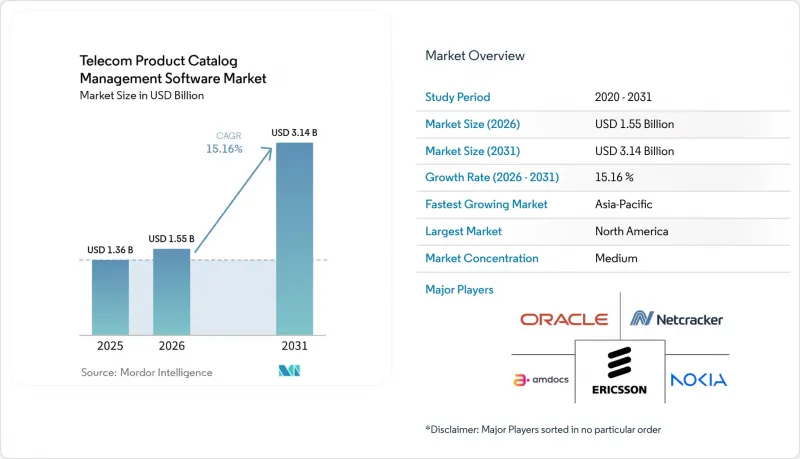
에 따르면 통신 제품 카탈로그 관리 소프트웨어 시장 규모는 2025년 13억 6,000만 달러, 2026년 15억 5,000만 달러에서 2031년까지 31억 4,000만 달러로 확대될 것으로 예측되고 있으며, 2026-2031년까지 연평균 성장률(CAGR)은 15.16%에 달할 전망입니다.
전 세계 통신 제품 카탈로그 관리 소프트웨어 시장의 동향 및 인사이트
5G, IoT, 클라우드 및 엣지 서비스의 복잡화
5G의 등장으로 제품 정의는 단순한 요금제 관리 업무에서 보다 상세한 운영 요구 사항으로 변화했습니다. 프라이빗 네트워크, 네트워크 슬라이스, 엣지 노드 및 IoT 번들에는 서비스 조건과 제공 설정을 연결하는 카탈로그 항목이 필요합니다. 이러한 항목에는 서비스 수준 계약(SLA) 계층, 지연 요구 사항, 업링크 및 다운링크 보장 등이 포함됩니다. TM Forum은 통신사업자 간의 카탈로그 동기화 및 동적인 제품 공개를 지원하기 위해 2025년 8월에 ‘TMF936 Product Catalog API v5.0’을 출시했습니다. 통신 제품 카탈로그 관리 소프트웨어의 시장 도입은, 이러한 제품들이 수작업에 의한 반복적인 코딩 없이 상용 오퍼와 기술적 제공을 연계할 수 있을 때 이점을 얻습니다. 통합된 제품, 서비스, 리소스 모델이 없다면, 팀은 여러 레거시 시스템에서 가격 설정이나 기술 사양을 중복하여 입력해야 합니다.
통신 제안의 신속한 출시 수요
경쟁 환경이 치열해짐에 따라 신규 서비스 출시를 위한 유효 기간이 단축되고 있습니다. 프로모션이나 서비스 제안이 급격히 변화할 가능성이 있으므로, 오퍼 출시 속도는 현재 상업적 성과에 영향을 미치고 있습니다. Netcracker에 따르면 Zain KSA는 2025년 3월 BSS 및 OSS 전환을 완료한 후 제품 개발 기간을 50% 단축했다고 합니다. 기존 플랫폼에서는 복잡한 변경을 수행할 때 긴 통합 작업이나 테스트 주기가 필요할 수 있습니다. 에릭슨은 2025년 6월, 가이드형 B2B 오퍼 설계를 위한 AI 기반 CPQ 툴을 포함한 업데이트된 OSS 및 BSS 포트폴리오를 발표했습니다. 규칙을 중앙 집중화하는 통신 제품 카탈로그 관리 소프트웨어 제공업체는 제품 팀과 IT 팀 간의 반복적인 소통을 줄일 수 있습니다.
레거시 OSS/BSS 통합의 복잡성
레거시 OSS 및 BSS 환경은 카탈로그 현대화에 있으며, 여전히 큰 제약 요인으로 남아 있습니다. 이러한 환경에는 대개 맞춤형 로직, 수동 청구 수정, 구식 요금 체계, 그리고 문서화가 불충분한 통합이 포함되어 있습니다. 이러한 시스템은 카탈로그 중심의 운영을 염두에 두고 설계된 것이 아닙니다. 이러한 기술적 과제 외에도, 레거시 시스템의 한계를 극복하기 위해 발전해 온 내부 프로세스 역시 문제가 되고 있습니다. 팀이 시스템과 운영 관행을 동시에 변경해야 하는 경우, 통신 제품 카탈로그 관리 소프트웨어 시장의 프로젝트는 더 오랜 시간이 소요될 수 있습니다. 이로 인해 판매 주기가 길어질 가능성이 있으며, 이미 대규모 BSS 환경을 관리하고 있는 벤더에게 유리하게 작용할 수 있습니다.
부문 분석
제품 카탈로그 관리 소프트웨어는 2025년에 46.53%의 점유율을 차지할 것으로 예상되며, 이는 네트워크 서비스 사양과는 별도로 상용 제품을 관리하는 통신사업자들 사이에서 확고한 입지를 반영합니다. 이 부문은 기존의 독립형 카탈로그 시스템을 도입한 많은 통신사업자들에게 여전히 표준적인 선택지로 남아 있습니다. 통합형 제품·서비스·리소스 카탈로그 플랫폼은 2031년까지 연평균 성장률(CAGR) 16.21%로 성장할 것으로 예측됩니다. 이러한 성장은 상거래, 과금, 리소스 제공의 모든 영역에 걸친 단일 정보원에 대한 수요를 반영합니다. 이러한 구조를 통해 여러 카탈로그를 동기화해야 할 필요성이 줄어듭니다. 또한 제품, 과금 및 이동 팀에 동일한 상업적 제안에 대한 공통된 참조 기준을 제공합니다. 이러한 공통 참조 기준을 통해 상업 시스템과 기술 시스템 간에 제품 규칙을 반복적으로 변환해야 할 필요성을 줄일 수 있습니다. 이 부문에서 통신 제품 카탈로그 관리 소프트웨어 시장 규모는 제품 설계와 기술적 이동 간의 보다 긴밀한 연계를 요구하는 통신사업자들의 수요에 힘입어 성장하고 있습니다.
Amdocs는 2025년 2월, BSS 및 OSS 영역을 아우르는 중앙 카탈로그인 ‘CatalogONE’을 발표했습니다. 이 제품은 캐리어급 자동화, TM Forum의 오픈 API, AI 어시스턴트를 특징으로 합니다. TM Forum은 ‘Cerillion Enterprise Product Catalog’를 2026년 11월까지 유효한 ODA 컴포넌트 인증으로 인정했습니다. 서비스 카탈로그 관리 소프트웨어는 여전히 중규모 범주에 머물러 있습니다. 각 벤더들은 이를 독립된 시스템이 아닌 통합 BSS 제품군의 구성 요소로 제공하는 경향이 강해지고 있습니다. Cerillion은 2025년 10월, 버전 25.2에서 자사의 ‘Enterprise Product Catalog’와 동일한 퍼블리싱 엔진을 채택한 ‘Service Catalogue’ 모듈을 출시했습니다. 이러한 접근 방식을 통해 벤더는 제품 설계와 서비스 제공 간의 연계를 강화할 수 있습니다. 이를 통해 상업적 제안과 기술적 서비스 설명을 공통의 퍼블리싱 프레임워크 내에 통합하는 것이 가능해집니다. 그 결과, 서비스 변경, 프로모션 도입, 혹은 새로운 제공 규칙이 필요할 때 각 팀이 별도의 정의를 유지해야 하는 부담을 줄일 수 있습니다. 그 결과 탄생한 플랫폼 모델은 카탈로그 기능 전반에 걸친 거버넌스의 일관성을 높이는 데에도 기여합니다. 따라서 통신 업계의 제품 카탈로그 관리 소프트웨어 시장에서는 독립된 모듈보다 통합 플랫폼이 더욱 중요시되고 있습니다.
2025년에는 소프트웨어가 62.14%의 점유율을 차지하며, 신규 카탈로그 도입 및 레거시 시스템 교체 프로그램의 대부분을 차지했습니다. 통신사업자는 일반적으로 온프레미스형 또는 SaaS형 소프트웨어를 구매하는 것부터 BSS 현대화를 시작합니다. 서비스 분야는 2031년까지 연평균 성장률(CAGR) 15.87%로 성장할 것으로 예측됩니다. 이러한 성장은 모델 유지, 규칙 업데이트, API 거버넌스에 필요한 지속적인 작업을 반영한 것입니다. 많은 통신사업자, 특히 Tier-1 규모 미만의 사업자들은 이러한 작업을 수행할 충분한 사내 BSS 자원이 부족합니다. 따라서 통신 제품 카탈로그 관리 소프트웨어 시장의 성장은 기술 및 운영 제공을 결합한 계약에 의해 지원되고 있습니다. 제품 모델, 가격 책정 규칙, API 제어에는 지속적인 주의가 필요하므로 소프트웨어 도입 후에도 서비스 요구 사항은 끝나지 않습니다. 이로 인해 통신사업자와 공급업체 사이에는 일회성 소프트웨어 라이선스 계약보다 더 장기적인 관계가 형성됩니다.
Netcracker사는 Zain KSA사를 대상으로 AI 기반 BSS 플랫폼과 매니지드 딜리버리를 결합한 결과, 제품 개발 기간을 50% 단축하는 데 성공했습니다. 매니지드 딜리버리를 통해 초기 자본 부담을 경감하고, 도입 위험의 일부를 공급업체에 전가할 수 있습니다. Tier-1 조달에서 소프트웨어와 운영 제공이 모두 요구되는 경우, 매니지드 서비스 역량을 갖추지 못한 벤더는 경쟁력이 떨어질 가능성이 있습니다. Amdocs는 2026년 2월 1분기 실적 발표에서 T-Mobile과의 새로운 다년간 매니지드 서비스 및 AI 혁신 계약, 그리고 Vodafone Germany와의 계약 확대를 발표했습니다. 이러한 계약을 통해 벤더의 관여는 초기 도입 단계를 넘어 확대됩니다. 이에 따라 통신사업자가 신제품을 출시하거나 기존 서비스를 개정할 때 필요한 변경 사항을 포함하여, 공급업체는 일상적인 카탈로그 운영에서 직접적인 역할을 담당하게 됩니다. 또한 서비스 제공 품질 및 규칙 관리도 공급업체의 장기적인 상업적 입장의 일부가 됩니다. 통신사업자의 경우, 이를 통해 여러 BSS 툴을 지원해야만 했던 사내 팀에 대한 의존도를 낮출 수 있습니다. 통신 업계의 제품 카탈로그 관리 소프트웨어 시장에서는 도입 후에도 카탈로그 운영을 지속할 수 있는 공급업체에 대한 평가가 높아지고 있습니다.
지역별 분석
2025년, 북미는 지역 시장 점유율의 34.56%를 차지했습니다. 미국, 캐나다, 멕시코의 Tier 1 통신사업자들은 카탈로그를 핵심 구성 요소로 하는 다년간의 BSS 혁신 프로그램을 추진하고 있습니다. 미국의 통신사업자들은 독자적인 레거시 환경을 클라우드 네이티브이자 API 기반 시스템으로 교체하고 있습니다. 이러한 프로젝트에서는 일반적으로 수년에 걸친 소프트웨어 및 서비스 계약이 체결됩니다. Amdocs는 2026년 2월 1분기 실적 발표에서 T-Mobile과의 제휴 관계 연장을 발표했습니다. 캐나다에서는 기업용 광대역 투자 및 네트워크 확장 프로그램을 통해 수요가 증가하고 있습니다.
유럽에서는 독일, 영국, 프랑스, 네덜란드에서 대규모 현대화가 진행되고 있습니다. 데이터 상주 요건과 GDPR 의무가 하이브리드 클라우드 및 프라이빗 클라우드 배포 수요를 지원하고 있습니다. Google Cloud는 2024년, 도이치 통신의 소버린 데이터 플랫폼에 대해 설명했습니다. 남미에서는 장기적인 BSS 혁신 계약이 잇따르고 있습니다. 리버티 라틴아메리카는 2026년 8월, 암독스(Amdocs)와의 10년간 전략적 제휴를 발표했습니다. 이 지역의 절대적인 지출 규모는 북미나 유럽에 미치지 못하지만, 최근 계약 기간이 길어지고 있는 점은 더 대규모의 변혁 프로그램이 진행 중임을 시사합니다.
아시아태평양은 2031년까지 연평균 성장률(CAGR) 16.14%로 성장할 것으로 예측되며, 이는 통신 제품 카탈로그 관리 소프트웨어 시장에서 지역별 가장 높은 성장률입니다. 중국, 인도, 한국, 일본 및 동남아시아에서는 기업 및 소비자 대상의 차별화된 서비스를 통해 5G 수익화를 추진하고 있습니다. 넷크래커는 2025년 12월 태국의 AIS를 대상으로 대규모 클라우드 배포을 완료했습니다. 중동 지역도 BSS 및 OSS 현대화에 투자하고 있으며, 2026년 4월 Cerillion이 Omantel을 대상으로 진행한 프로그램 등이 그 예입니다. 아프리카는 개발도상 시장으로, 통신사업자들은 광범위한 BSS 통합 프로그램을 통해 카탈로그 기능에 대한 투자를 진행하고 있습니다. 이러한 프로그램들은 4G 수익화 및 5G 인프라 투자를 위한 준비를 지원하는 것입니다.
기타 혜택:
- 엑셀 형식의 시장 예측(ME) 시트
- 3개월간의 애널리스트 지원
자주 묻는 질문
목차
제1장 서론
- 조사 전제조건과 시장 정의
- 조사 범위
제2장 조사 방법
제3장 개요
제4장 시장 구도
- 시장 개요
- 거시경제 요인이 시장에 미치는 영향
- 시장 성장 촉진요인
- 시장 성장 억제요인
- 업계 밸류체인 분석
- 규제 상황
- 기술 전망
- Porter's Five Forces 분석
제5장 시장 규모와 성장 예측
- 제품 유형별
- 컴포넌트별
- 배포별
- 조직 규모별
- 용도별
- 최종사용자별
- 지역별
- 북미
- 미국
- 캐나다
- 멕시코
- 남미
- 브라질
- 아르헨티나
- 기타 남미 국가
- 유럽
- 독일
- 영국
- 프랑스
- 이탈리아
- 러시아
- 스페인
- 기타 유럽 국가
- 아시아태평양
- 중국
- 인도
- 일본
- 한국
- 호주
- 기타 아시아태평양 국가
- 중동
- 사우디아라비아
- 아랍에미리트
- 튀르키예
- 기타 중동 국가
- 아프리카
- 남아프리카공화국
- 나이지리아
- 이집트
- 기타 아프리카 국가
- 북미
제6장 경쟁 구도
- 시장 집중도
- 전략적 동향
- 시장 점유율 분석
- 기업 개요
- Amdocs Limited
- NetCracker Technology Corporation
- Ericsson AB
- Nokia Corporation
- Oracle Corporation
- Hansen Technologies Limited
- Cerillion plc
- Comarch S.A.
- Tecnotree Oyj
- Whale Cloud Technology Co., Ltd.
- Marand d.o.o.
- CSG Systems International, Inc.
- Optiva, Inc.
- MATRIXX Software, Inc.
- Qvantel Oy
- Wavelo, Inc.
- CloudSense Limited
- Emeldi Group
제7장 시장 기회와 향후 전망
KSA 26.10.30According to Mordor Intelligence, the telecom product catalog management software market size is projected to expand from USD 1.36 billion in 2025 and USD 1.55 billion in 2026 to USD 3.14 billion by 2031, registering a CAGR of 15.16% between 2026 to 2031.
Global Telecom Product Catalog Management Software Market Trends and Insights
5G, IoT, Cloud, and Edge Service Complexity
5G has changed the product definition from a rate-plan task into a more detailed operational requirement. Private networks, network slices, edge nodes, and IoT bundles require catalog entries that link service terms to fulfillment settings. These entries can include service level agreement tiers, latency requirements, and uplink and downlink commitments. TM Forum released TMF936 Product Catalog API v5.0 in August 2025 to support catalog synchronization and dynamic product publishing across operators. Telecom product catalog management software market adoption benefits when these products can connect commercial offers to technical delivery without repeated manual coding. Without a unified product, service, and resource model, teams must duplicate pricing and technical specifications in several legacy systems.
Demand for Faster Telecom Offer Launches
Competitive conditions have shortened the useful window for new service launches. Offer-launch speed now affects commercial performance because promotions and service propositions can change quickly. Netcracker stated that Zain KSA reduced product development time by 50% after completing its BSS and OSS transformation in March 2025. Traditional platforms can require long integration and testing cycles for complex changes. Ericsson released an updated OSS and BSS portfolio in June 2025, including an AI-driven CPQ tool for guided B2B offer design. Telecom product catalog management software providers that centralize rules can reduce repeated exchanges between product and IT teams.
Legacy OSS/BSS Integration Complexity
Legacy OSS and BSS environments remain a major constraint on catalog modernization. They often include custom logic, manual billing fixes, older tariffs, and poorly documented integrations. These systems were not designed for catalog-led operations. The technical challenge is paired with internal processes that have developed in response to legacy system limitations. Telecom product catalog management software market projects can take longer when teams must change systems and operating practices simultaneously. This can lengthen sales cycles and favor vendors that already manage large BSS environments.
Other drivers and restraints analyzed in the detailed report include:
- Growth of Partner-Led B2B2X Monetization
- Omnichannel Consistency Across Digital and Assisted Sales
- High Migration and Data-Model Harmonization Costs
For complete list of drivers and restraints, kindly check the Table Of Contents.
Segment Analysis
Product Catalog Management Software held 46.53% share in 2025, reflecting its established position among operators that managed commercial products separately from network service specifications. This segment remains the standard choice for many operators with existing standalone catalog systems. Unified Product, Service, and Resource Catalog Platforms are projected to grow at a 16.21% CAGR through 2031. Their growth reflects demand for 1 source of information across commerce, charging, and resource fulfillment. This structure reduces the need to synchronize several catalogs. It also gives product, charging, and fulfillment teams a shared reference for the same commercial offer. That shared reference can reduce the need to repeatedly translate product rules between commercial and technical systems. The Telecom product catalog management software market size for this segment is supported by operator demand for closer links between product design and technical fulfillment.
Amdocs presented CatalogONE in February 2025 as a central catalog spanning the BSS and OSS domains, featuring carrier-grade automation, TM Forum Open APIs, and an AI assistant. TM Forum listed Cerillion Enterprise Product Catalog as an ODA Component Certified through November 2026. Service Catalog Management Software remains a mid-tier category. Vendors are increasingly offering it as a component of unified BSS suites rather than as a separate system. Cerillion released a Service Catalogue module in version 25.2 during October 2025, using the same publishing engine as its Enterprise Product Catalogue. This approach gives vendors a closer connection between product design and service fulfillment. It keeps the commercial offer and the technical service description within a common publishing framework. That can reduce the need for teams to maintain separate definitions when a service changes, when a promotion is introduced, or when a new fulfillment rule is required. The resulting platform model can also make governance more consistent across catalog functions. The telecom product catalog management software industry is therefore placing greater emphasis on combined platforms than isolated modules.
Software held 62.14% share in 2025, accounting for most new catalog deployments and legacy replacement programs. Operators commonly begin BSS modernization by purchasing on-premises or SaaS software. Services are projected to grow at a 15.87% CAGR through 2031. Their expansion reflects the ongoing work required to maintain models, update rules, and govern APIs. Many operators, especially those below Tier-1 scale, lack sufficient in-house BSS capacity for this work. Therefore, growth in the telecom product catalog management software market is supported by contracts that combine technology with operational delivery. The service requirement does not end once the software is installed, as product models, pricing rules, and API controls require ongoing attention. This creates a longer relationship between the operator and supplier than a one-time software license.
Netcracker combined an AI-driven BSS platform with managed delivery for Zain KSA, resulting in a 50% reduction in product development time. Managed delivery can reduce initial capital exposure and shift part of the implementation risk to the supplier. Vendors without managed services capabilities can be less competitive when Tier-1 procurement includes both software and operational delivery. Amdocs reported a new multiyear managed services and AI innovation agreement with T-Mobile and an expanded Vodafone Germany engagement in its February 2026 fiscal first-quarter results. These arrangements extend vendor involvement beyond the first implementation. They give suppliers a direct role in day-to-day catalog operations, including the changes needed when operators launch new products or revise existing offers. They also make the quality of service delivery and rule management part of the supplier's long-term commercial position. For operators, this can reduce reliance on internal teams that must otherwise support several BSS tools. The telecom product catalog management software industry increasingly rewards suppliers that can keep catalog operations running after deployment.
Complete Report Scope:
- By Product Type
- Product Catalog Management Software
- Service Catalog Management Software
- Unified Product, Service, and Resource Catalog Platforms
- By Component
- Software
- Services
- By Deployment
- Cloud
- On-Premises
- By Organization Size
- Large Enterprises
- Small and Medium Enterprises
- By Application
- Order Management
- Revenue and Charging Management
- Customer and Channel Management
- Inventory and Serviceability Management
- Other Applications
- By End User
- Telecommunications Operators
- Internet Service Providers
- Mobile Network Operators
- Fixed and Broadband Operators
- Cable and Converged Communications Providers
- Digital Service Providers and Communications Technology Companies
- By Geography
- North America
- United States
- Canada
- Mexico
- South America
- Brazil
- Argentina
- Rest of South America
- Europe
- Germany
- United Kingdom
- France
- Italy
- Russia
- Spain
- Rest of Europe
- Asia-Pacific
- China
- India
- Japan
- South Korea
- Australia
- Rest of Asia-Pacific
- Middle East
- Saudi Arabia
- United Arab Emirates
- Turkey
- Rest of Middle East
- Africa
- South Africa
- Nigeria
- Egypt
- Rest of Africa
- North America
Geography Analysis
North America held a 34.56% regional share in 2025. Tier-1 operators in the United States, Canada, and Mexico are running multiyear BSS transformation programs with important catalog components. United States carriers are replacing proprietary legacy environments with cloud-native and API-driven systems. These projects commonly produce multiyear software and services agreements. Amdocs reported an extended relationship with T-Mobile in its February 2026 fiscal first-quarter results. Canada contributes to demand through enterprise broadband investment and network expansion programs.
Europe is experiencing significant modernization in Germany, the United Kingdom, France, and the Netherlands. Data residency requirements and GDPR obligations support the demand for hybrid and private cloud deployments. Google Cloud described Deutsche Telekom's sovereign data platform in 2024. South America is attracting longer BSS transformation contracts. Liberty Latin America announced a 10-year strategic engagement with Amdocs in August 2026. The region remains behind North America and Europe in absolute spending, but recent contract durations indicate larger transformation programs.
Asia-Pacific is projected to grow at a 16.14% CAGR through 2031, the fastest regional rate in the Telecom product catalog management software market. China, India, South Korea, Japan, and Southeast Asia are pursuing 5G monetization through differentiated enterprise and consumer offerings. Netcracker completed a large cloud deployment for AIS in Thailand in December 2025. The Middle East is also investing in BSS and OSS modernization, including Cerillion's Omantel program in April 2026. Africa is a developing opportunity where operators are investing in catalog functions through broader BSS consolidation programs. These programs support 4G monetization and preparatory 5G infrastructure investment.
- Amdocs Limited
- NetCracker Technology Corporation
- Ericsson AB
- Nokia Corporation
- Oracle Corporation
- Hansen Technologies Limited
- Cerillion plc
- Comarch S.A.
- Tecnotree Oyj
- Whale Cloud Technology Co., Ltd.
- Marand d.o.o.
- CSG Systems International, Inc.
- Optiva, Inc.
- MATRIXX Software, Inc.
- Qvantel Oy
- Wavelo, Inc.
- CloudSense Limited
- Emeldi Group
Additional Benefits:
- The market estimate (ME) sheet in Excel format
- 3 months of analyst support
TABLE OF CONTENTS
1 INTRODUCTION
- 1.1 Study Assumptions and Market Definition
- 1.2 Scope of the Study
2 RESEARCH METHODOLOGY
3 EXECUTIVE SUMMARY
4 MARKET LANDSCAPE
- 4.1 Market Overview
- 4.2 Impact of Macroeconomic Factors on the Market
- 4.3 Market Drivers
- 4.3.1 5G, IoT, Cloud, and Edge Service Complexity
- 4.3.2 Demand for Faster Telecom Offer Launches
- 4.3.3 Growth of Partner-Led B2B2X Monetization
- 4.3.4 Omnichannel Consistency Across Digital and Assisted Sales
- 4.3.5 AI-Assisted Offer Design and Catalog Enrichment
- 4.3.6 Real-Time Serviceability and Dynamic Pricing Requirements
- 4.4 Market Restraints
- 4.4.1 Legacy OSS/BSS Integration Complexity
- 4.4.2 High Migration and Data-Model Harmonization Costs
- 4.4.3 Fragmented Product, Service, and Resource Taxonomies
- 4.4.4 Catalog Governance Risks Across Multi-Operator Environments
- 4.5 Industry Value Chain Analysis
- 4.6 Regulatory Landscape
- 4.7 Technological Outlook
- 4.8 Porter's Five Forces Analysis
- 4.8.1 Threat of New Entrants
- 4.8.2 Bargaining Power of Suppliers
- 4.8.3 Bargaining Power of Buyers
- 4.8.4 Threat of Substitutes
- 4.8.5 Rivalry Among Existing Competitors
5 MARKET SIZE AND GROWTH FORECASTS (VALUE)
- 5.1 By Product Type
- 5.1.1 Product Catalog Management Software
- 5.1.2 Service Catalog Management Software
- 5.1.3 Unified Product, Service, and Resource Catalog Platforms
- 5.2 By Component
- 5.2.1 Software
- 5.2.2 Services
- 5.3 By Deployment
- 5.3.1 Cloud
- 5.3.2 On-Premises
- 5.4 By Organization Size
- 5.4.1 Large Enterprises
- 5.4.2 Small and Medium Enterprises
- 5.5 By Application
- 5.5.1 Order Management
- 5.5.2 Revenue and Charging Management
- 5.5.3 Customer and Channel Management
- 5.5.4 Inventory and Serviceability Management
- 5.5.5 Other Applications
- 5.6 By End User
- 5.6.1 Telecommunications Operators
- 5.6.2 Internet Service Providers
- 5.6.3 Mobile Network Operators
- 5.6.4 Fixed and Broadband Operators
- 5.6.5 Cable and Converged Communications Providers
- 5.6.6 Digital Service Providers and Communications Technology Companies
- 5.7 By Geography
- 5.7.1 North America
- 5.7.1.1 United States
- 5.7.1.2 Canada
- 5.7.1.3 Mexico
- 5.7.2 South America
- 5.7.2.1 Brazil
- 5.7.2.2 Argentina
- 5.7.2.3 Rest of South America
- 5.7.3 Europe
- 5.7.3.1 Germany
- 5.7.3.2 United Kingdom
- 5.7.3.3 France
- 5.7.3.4 Italy
- 5.7.3.5 Russia
- 5.7.3.6 Spain
- 5.7.3.7 Rest of Europe
- 5.7.4 Asia-Pacific
- 5.7.4.1 China
- 5.7.4.2 India
- 5.7.4.3 Japan
- 5.7.4.4 South Korea
- 5.7.4.5 Australia
- 5.7.4.6 Rest of Asia-Pacific
- 5.7.5 Middle East
- 5.7.5.1 Saudi Arabia
- 5.7.5.2 United Arab Emirates
- 5.7.5.3 Turkey
- 5.7.5.4 Rest of Middle East
- 5.7.6 Africa
- 5.7.6.1 South Africa
- 5.7.6.2 Nigeria
- 5.7.6.3 Egypt
- 5.7.6.4 Rest of Africa
- 5.7.1 North America
6 COMPETITIVE LANDSCAPE
- 6.1 Market Concentration
- 6.2 Strategic Moves
- 6.3 Market Share Analysis
- 6.4 Company Profiles (includes Global Level Overview, Market Level Overview, Core Segments, Financials as available, Strategic Information, Market Rank/Share, Products and Services, Recent Developments)
- 6.4.1 Amdocs Limited
- 6.4.2 NetCracker Technology Corporation
- 6.4.3 Ericsson AB
- 6.4.4 Nokia Corporation
- 6.4.5 Oracle Corporation
- 6.4.6 Hansen Technologies Limited
- 6.4.7 Cerillion plc
- 6.4.8 Comarch S.A.
- 6.4.9 Tecnotree Oyj
- 6.4.10 Whale Cloud Technology Co., Ltd.
- 6.4.11 Marand d.o.o.
- 6.4.12 CSG Systems International, Inc.
- 6.4.13 Optiva, Inc.
- 6.4.14 MATRIXX Software, Inc.
- 6.4.15 Qvantel Oy
- 6.4.16 Wavelo, Inc.
- 6.4.17 CloudSense Limited
- 6.4.18 Emeldi Group
7 MARKET OPPORTUNITIES AND FUTURE OUTLOOK
- 7.1 White-Space and Unmet-Need Assessment


