

|
시장보고서
상품코드
2157098
영국의 프리패브 제품 물류 : 시장 점유율 분석, 업계 동향과 통계, 성장 예측(2026-2031년)United Kingdom Prefabricated Product Logistics - Market Share Analysis, Industry Trends & Statistics, Growth Forecasts (2026 - 2031) |
||||||
 Mordor Intelligence
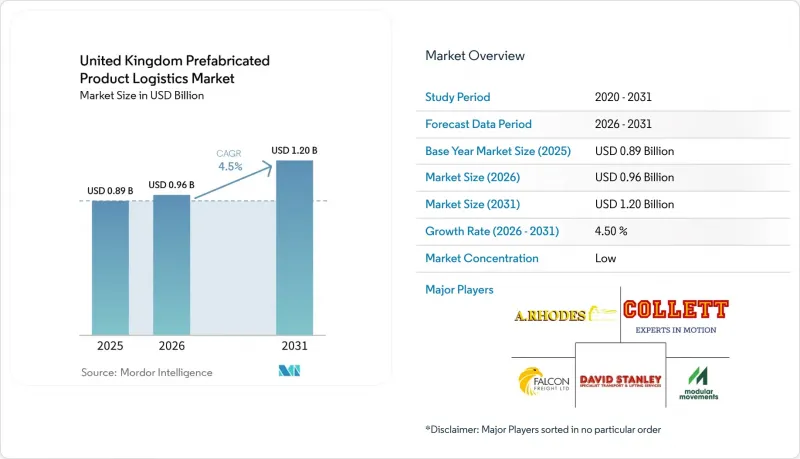
에 따르면 영국의 프리패브 제품 물류 시장 규모는 2025년에 8억 9,000만 달러로 평가되며, 2026년 9억 6,000만 달러에서 2031년까지 12억 달러에 달할 것으로 예측되고 있으며, 예측 기간(2026-2031년)에 CAGR은 4.50%에 달할 전망입니다.
2026년에도 주택 인도, 공공 조달 및 공장 생산형 건설이 영국 조립식 제품 물류 시장을 지속적으로 지원했습니다. 이 보고서는 서비스별(운송, 창고·보관, 부가가치 서비스), 제품 유형별(모듈식 건축, 패널화·구성품화 시스템, 기타 조립식 유형) 및 용도별(주택, 상업용 건물, 기타)로 분류되어 있습니다. 시장 전망은 금액(달러) 기준으로 제시되어 있습니다.
영국 조립식 제품 물류 시장의 동향 및 인사이트
주택 공급 압박과 공공 부문에 대한 수요
현 의회 임기 종료까지 150만 호의 신규 주택을 공급하겠다는 목표는 영국 조립식 주택 물류 시장에 있으며, 여전히 주요 수요 신호로 작용하고 있습니다. 2026-2036년까지의 ‘사회주택 및 저렴한 주택 프로그램’은 기존의 ‘저렴한 주택 프로그램’을 대체하며, 현대적인 건설 기법을 활용한 입찰을 수용했습니다. 이러한 접근 방식은 공장에서 제조된 건축자재의 지속적인 공급과 이에 관련된 운송 활동을 지원했습니다. 또한 공장에서 출하된 물량은 건설 현장, 크레인, 인력 및 현장 접근 체계가 준비된 시점에 도착해야 하므로 납품 조정이 더욱 중요해졌습니다. 납품 시기를 놓치면 설치 공사의 순서가 흐트러질 우려가 있으므로, 물류 기업은 프로젝트 일정을 준수하는 데 있으며, 더욱 중요한 역할을 맡게 되었습니다. 영국의 조립식 제품 물류 시장은 제조업체와 도급업체가 운송 계획을 독립적인 조달이 아닌 프로젝트 수행의 일부로 다루게 됨에 따라 혜택을 받았습니다. 홈즈 잉글랜드(Homes England)는 해당 기관이 지원하는 주택의 총 준공 건수가 2025년 및 2026년의 연간 4만 호에서 2029년 및 2030년까지 연간 8만 호 이상으로 증가할 가능성이 있다고 밝혔습니다. 입찰자는 고정된 요건 없이 오프사이트 공법을 채택할 수 있게 되었으며, 이로 인해 공정의 확실성과 납품 실적이 더욱 중요시되게 되었습니다. 경로 조사와 시간대 계획을 결합한 공급업체는 공장에서 현장까지 확실한 납품이 필요한 프로젝트를 지원하는 데 있으며, 더 유리한 입장에 있었습니다.
숙련된 인력 부족과 현장 생산성의 제약
잉글랜드의 건설 노동자 수는 2025년에 1.3% 감소하여 223만 명에 달했습니다. CITB는 2026년에는 0.9%의 추가 감소가 예상되지만, 2027년부터는 다시 증가세로 돌아설 것으로 전망하고 있습니다. 국가감사원이 인용한 정부의 모형 추산에 따르면 주택 공급에는 31만 7,000명의 추가 인력이 필요한 반면, ‘웜 홈즈 플랜(Warm Homes Plan)’에는 13만 명, 인프라 정비 공약에는 2030년까지 최대 44만 5,000명이 필요할 것으로 예상됩니다. 이러한 인력 부족은 지역에 따라 차이가 있으며, 현장 인력 확보에 영향을 미치고 있습니다. 이로 인해 특히 여러 직종이 긴밀한 순서로 작업을 수행해야 하는 프로젝트에서 기존 건설 작업에 투입될 수 있는 역량이 제한되고 있습니다. 제조업체는 공장 내에서 반복성이 높은 작업을 더 많이 처리할 수 있지만, 이로 인해 완제품의 이동, 보관 및 도착 관리에 대한 부담이 증가했습니다. 전문 업체들은 생산 일정에 맞춘 수령 및 현장 접근 제한을 고려한 설치 작업 조정을 어쩔 수 없이 해야 했습니다. 영국 국가감사원의 보고서에 따르면 2025년에는 영국 전문대학의 60%가 건설 분야 견습 과정을 축소하거나 폐쇄했으며, 56%에서는 대기자 명단이 발생했습니다. 공장 생산으로 인해 일부 현장 작업에 대한 의존도는 낮아진 반면, 전문적인 운송이 필요한 완제품의 수는 증가했습니다. 따라서 건설 작업이 현장 중심에서 관리된 생산 환경으로 전환됨에 따라 영국의 조립식 제품 물류 시장은 업무량이 증가했습니다.
공장에 대한 막대한 설비 투자와 가동률의 위험
조립식 제품의 물류량은 오프사이트 제조업체의 재무 상황과 공장 가동률에 좌우되었습니다. 자동화된 생산 라인, 품질관리 시스템, 전용 공장 부지에는 막대한 설비 투자가 필요했습니다. 생산 중단이나 파산이 발생할 경우, 물류 사업자에게는 사전 예고가 거의 없이 출하량이 사라질 가능성이 있습니다. 그 영향은 운송에 그치지 않고, 보관, 하역, 경로 계획, 현장 지원에 대한 수요도 감소하는 결과로 이어졌습니다. 트레일러나 크레인이 제한된 범위의 모듈 치수에 맞춰 선정된 경우, 설비 투자의 재배치는 어려워질 수 있습니다. 고객 기반의 확대나 계약상 최소 출하량 설정은 어느 정도 보호책이 되었지만, 소규모 기업의 경우 이러한 조치를 확립하기 어려운 경우도 있었습니다. 2026년 3월까지 1년 동안 건설 업계의 파산 건수는 총 4,411건에 달해 전년 대비 5% 감소했으나, 여전히 팬데믹 이전 수준보다 22% 높은 수치였습니다. 소수의 제조업체에 의존하는 기업은 공장 가동률이 손익분기점을 밑돌았을 때 수익 감소에 직면했습니다. 이러한 위험은 특정 모듈 형식에 맞춰 설계된 맞춤형 트레일러나 HIAB 장비를 구입한 사업자들에게 더욱 컸습니다.
부문별 분석
2025년, 영국의 조립식 제품 물류 시장에서 운송 부문은 금액 기준 67.20%의 점유율을 차지했습니다. 이 서비스는 요크셔, 험버사이드, 미들랜드, 남서부의 오프사이트 공장과 영국 전역의 건설 현장을 연결해 주었습니다. 많은 모듈식 및 패널형 화물은 플랫베드 익스텐더, 로우 로더 또는 HIAB가 장착된 리지드 차량이 필요했으므로 도로 운송이 주류를 이루었습니다. 이러한 운송은 ‘2003년 특수 차량 승인 일반 명령(Road Vehicles Authorisation of Special Types General Order 2003)’의 틀 아래에서 이루어졌습니다. 전국 경찰청장 협의회(National Police Chiefs’ Council)의 지침에 따르면 적재량 80,000kg 이하의 화물은 2영업일 전, 150,000kg 이하의 화물은 5영업일 전에 통지해야 했습니다. 폭 6.1 m를 초과하거나 중량이 150,000kg을 초과하는 화물의 경우, 내셔널 하이웨이즈(National Highways)를 통해 특별 허가(Special Order)를 취득해야 합니다.
부가가치 서비스는 2031년까지 연평균 성장률(CAGR) 6.20%를 기록하며, 서비스 카테고리 중 가장 높은 성장률을 보였습니다. 이러한 서비스에는 배송 전 경로 조사, 교통 규제(일시적인 도로 사용 허가) 관리, 리프팅 작업, 크레인 작업, 가설 공사, 보관 및 디지털 추적이 포함되었습니다. 고객들은 운송뿐만 아니라 이러한 관련 업무를 단일 공급업체에 위탁하기를 점점 더 원하게 되었습니다. 복합 서비스를 통해 관계자 간의 인계 횟수가 줄어들었고, 계약업체는 각 조립 부품이 배송 과정의 어느 단계에 있는지 더 명확하게 파악할 수 있게 되었습니다. 또한 여러 기업 간에 책임을 분담하지 않고도 사업자가 현장 준비 상황, 교통 규제 및 크레인 작업 가용성에 관한 변경 사항을 관리하는 데에도 도움이 되었습니다. 이러한 특징들이 영국 조립식 제품 물류 시장에서 부가가치 업무의 급속한 성장을 지원했습니다. GS1 UK와 NBS는 건설 제품에 글로벌 무역 품목 번호(GTIN)를 적용하여 공급망 전반에 걸친 표준화된 식별을 지원하기 위해 2025년에 파트너십을 체결했습니다. 이 노력을 통해 공장 출하부터 현장 입고에 이르는 기록이 더욱 명확해졌습니다. 또한 공장의 완공 예정일과 현장의 준비 상황이 일치하지 않을 경우, 창고 보관 및 저장 기능이 계속해서 완충재 역할을 수행했습니다.
기타 혜택:
- 엑셀 형식의 시장 예측(ME) 시트
- 3개월간의 애널리스트 지원
자주 묻는 질문
목차
제1장 서론
- 조사 전제조건과 시장 정의
- 조사 범위
제2장 조사 방법
제3장 개요
제4장 시장 구도
- 시장 개요
- 시장 성장 촉진요인
- 시장 성장 억제요인
- 밸류·공급망 분석
- 규제 상황
- 기술 전망
- Porter's Five Forces 분석
- 지정학적 이벤트가 시장에 미치는 영향
제5장 시장 규모와 성장 예측
- 서비스별
- 제품 유형별
- 용도별
제6장 경쟁 구도
- 시장 집중도
- 전략적 동향
- 시장 점유율 분석
- 기업 개요
- Modular Movements Ltd
- David Stanley Transport Ltd
- WS Transportation Ltd
- Falcon Freight Ltd
- A. Rhodes Haulage Ltd
- Le Dale Transport Ltd
- AC Lifting Ltd
- Lymer's Assist Ltd
- Collett and Sons Ltd
- Dainton Storage Solutions Ltd
- Neill and Brown Ltd
- Musgrave Transport Ltd
- MRC Crane Hire
- Brookdale Transport
- Nortons Hiab Services
- Network Hiab
- Container Lifting UK
- Warrior Link
- Midlands Portable Buildings
- SJP Transport
제7장 시장 기회와 향후 전망
KSA 26.10.30According to Mordor Intelligence, the United Kingdom prefabricated product logistics market size was valued at USD 0.89 billion in 2025 and estimated to grow from USD 0.96 billion in 2026 to reach USD 1.20 billion by 2031, at a CAGR of 4.50% during the forecast period (2026-2031).
Housing delivery, public procurement, and factory-based construction continued to support the United Kingdom prefabricated product logistics market in 2026. This report is Segmented by Service (Transportation, Warehousing and Storage, Value-Added Services), by Product Type (Modular Buildings, Panelized and Componentized Systems, Other Prefab Types), and by Application (Residential Buildings, Commercial Buildings, Others). The Market Forecasts are Provided in Terms of Value (USD).
United Kingdom Prefabricated Product Logistics Market Trends and Insights
Housing Delivery Pressure and Public Framework Demand
The target of 1.5 million new homes by the end of the current Parliament remained a major demand signal for the United Kingdom prefabricated product logistics market. The Social and Affordable Homes Programme for 2026 to 2036 replaced the prior Affordable Homes Programme and accepted bids that used modern methods of construction. This approach supported a continuing flow of factory-made building components and related transport activity. It also made delivery coordination more important because factory output had to arrive when sites, cranes, labor, and local access arrangements were ready. A missed delivery window could disrupt the sequence of installation work, so logistics firms had a stronger role in protecting project schedules. The United Kingdom prefabricated product logistics market benefited when manufacturers and contractors treated transport planning as part of project delivery rather than a separate purchase. Homes England stated that agency-supported gross housing completions could rise from 40,000 a year in 2025 and 2026 to more than 80,000 a year by 2029 and 2030. Bidders could use off-site methods without a fixed requirement, which placed greater weight on program certainty and delivery performance. Providers that combined route surveys with time-window planning were better placed to support projects that needed dependable factory-to-site delivery.
Skilled Labor Scarcity and On-Site Productivity Constraints
England's construction workforce declined by 1.3% in 2025 to 2.23 million workers, and CITB projected a further 0.9% decline in 2026 before growth returned from 2027. Government modeling cited by the National Audit Office shows that housing delivery requires 317,000 additional workers, while the Warm Homes Plan requires 130,000, and infrastructure commitments require as many as 445,000 by 2030. The shortage is uneven across the country and affects the availability of site labor. It limits the capacity available for conventional construction tasks, particularly where projects need several trades to work in a tight sequence. Manufacturers could complete more repeatable work in factories, but this shifted pressure to the movement, storage, and controlled arrival of finished units. Specialist providers had to coordinate collections with production schedules and installations with site access restrictions. The National Audit Office also reported that 60% of United Kingdom colleges limited or closed construction apprenticeship courses in 2025, while 56% had waiting lists. Factory production reduced dependence on some site activities and raised the number of completed units that needed specialist movement. The United Kingdom prefabricated product logistics market, therefore, gained work as construction tasks moved from sites to controlled production settings.
High Factory CAPEX and Utilization Risk
Prefabricated product logistics volumes depended on the financial condition and factory use rates of off-site manufacturers. Automated production lines, quality systems, and dedicated factory sites required substantial capital investment. A production suspension or insolvency could remove shipment volumes for a logistics provider with little warning. The effect could extend beyond transport because providers also lost demand for storage, lifting, route planning, and site support. Equipment investments can be difficult to redeploy when trailers or cranes are selected for a narrow range of module dimensions. A broader client base and contracted minimum volumes offered some protection, although smaller firms could find these measures difficult to establish. Construction insolvencies totaled 4,411 in the year to March 2026 and remained 22% above pre-pandemic levels despite a 5% year-over-year decline. Firms reliant on a small group of manufacturers faced revenue gaps when factory utilization fell below viable levels. This risk was greater for operators who bought custom trailers or HIAB equipment designed around one module format.
Other drivers and restraints analyzed in the detailed report include:
- Net Zero Compliance and Low-Waste Offsite Delivery
- Industrial and Logistics Facility Expansion
- Certification, Valuation, and Mortgage Acceptance Friction
For complete list of drivers and restraints, kindly check the Table Of Contents.
Segment Analysis
Transportation held 67.20% of the United Kingdom prefabricated product logistics market share by value in 2025. The service linked off-site factories in Yorkshire, Humberside, the Midlands, and the South West with construction sites across the United Kingdom. Road transport dominated because many modular and panelized loads needed flatbed extenders, low-loaders, or HIAB-equipped rigid vehicles. These movements operated under the Road Vehicles Authorisation of Special Types General Order 2003 framework. The National Police Chiefs' Council guidance required 2 working days of notification for loads up to 80,000 kg and 5 days for loads up to 150,000 kg. Loads wider than 6.1 m or heavier than 150,000 kg require a Special Order through National Highways.
Value-added services recorded a 6.20% CAGR through 2031, the highest rate among service categories. These services included pre-delivery route surveys, traffic temporary road order management, lifting, crane work, staging, storage, and digital tracking. Clients increasingly sought one provider for these linked activities instead of transport alone. A combined service reduced the number of handovers between parties and gave the contractor a clearer view of where each assembly was in the delivery process. It also helped providers manage changes in site readiness, traffic controls, and lifting availability without separating responsibilities across several firms. These features supported the faster growth of value-added work within the United Kingdom prefabricated product logistics market. GS1 UK and NBS established a 2025 partnership to apply Global Trade Item Numbers to construction products, supporting standardized identification across supply chains. This approach supported clearer records from factory release through site receipt. Warehousing and storage continued to provide a buffer when factory completion dates and site readiness did not align.
Complete Report Scope:
- By Service
- Transportation
- Road
- Rail
- Air
- Sea and Inland Waterways
- Warehousing and Storage
- Value-Added Services
- Transportation
- By Product Type
- Modular Buildings
- Panelized and Componentized Systems
- Other Prefab Types
- By Application
- Residential Buildings
- Commercial Buildings
- Others
List of Companies Covered in this Report:
- Modular Movements Ltd
- David Stanley Transport Ltd
- WS Transportation Ltd
- Falcon Freight Ltd
- A. Rhodes Haulage Ltd
- Le Dale Transport Ltd
- AC Lifting Ltd
- Lymer's Assist Ltd
- Collett and Sons Ltd
- Dainton Storage Solutions Ltd
- Neill and Brown Ltd
- Musgrave Transport Ltd
- MRC Crane Hire
- Brookdale Transport
- Nortons Hiab Services
- Network Hiab
- Container Lifting UK
- Warrior Link
- Midlands Portable Buildings
- SJP Transport
Additional Benefits:
- The market estimate (ME) sheet in Excel format
- 3 months of analyst support
TABLE OF CONTENTS
1 Introduction
- 1.1 Study Assumptions and Market Definition
- 1.2 Scope of the Study
2 Research Methodology
3 Executive Summary
4 Market Landscape
- 4.1 Market Overview
- 4.2 Market Drivers
- 4.2.1 Housing Delivery Pressure and Public Framework Demand
- 4.2.2 Skilled Labor Scarcity and On-Site Productivity Constraints
- 4.2.3 Net Zero Compliance and Low-Waste Offsite Delivery
- 4.2.4 Traceability Demand for Complex Prefab Supply Chains
- 4.2.5 Planning and Route Constraints on Oversized Loads
- 4.2.6 Industrial and Logistics Facility Expansion
- 4.3 Market Restraints
- 4.3.1 High Factory CAPEX and Utilization Risk
- 4.3.2 Certification, Valuation, and Mortgage Acceptance Friction
- 4.3.3 Insolvency-Driven Trust Deficit Across the Supply Chain
- 4.3.4 Module Size Limits and Transport Complexity
- 4.4 Value / Supply-Chain Analysis
- 4.5 Regulatory Landscape
- 4.6 Technological Outlook
- 4.7 Porter's Five Forces Analysis
- 4.7.1 Bargaining Power of Suppliers
- 4.7.2 Bargaining Power of Buyers
- 4.7.3 Threat of New Entrants
- 4.7.4 Threat of Substitutes
- 4.7.5 Industry Rivalry
- 4.8 Impact of Geopolitical Events on the Market
5 Market Size and Growth Forecasts (Value in USD)
- 5.1 By Service
- 5.1.1 Transportation
- 5.1.1.1 Road
- 5.1.1.2 Rail
- 5.1.1.3 Air
- 5.1.1.4 Sea and Inland Waterways
- 5.1.2 Warehousing and Storage
- 5.1.3 Value-Added Services
- 5.1.1 Transportation
- 5.2 By Product Type
- 5.2.1 Modular Buildings
- 5.2.2 Panelized and Componentized Systems
- 5.2.3 Other Prefab Types
- 5.3 By Application
- 5.3.1 Residential Buildings
- 5.3.2 Commercial Buildings
- 5.3.3 Others
6 Competitive Landscape
- 6.1 Market Concentration
- 6.2 Strategic Moves
- 6.3 Market Share Analysis
- 6.4 Company Profiles (includes Global Level Overview, Market Level Overview, Core Segments, Financials as available, Strategic Information, Geographic Coverage, Products and Services, Recent Developments)
- 6.4.1 Modular Movements Ltd
- 6.4.2 David Stanley Transport Ltd
- 6.4.3 WS Transportation Ltd
- 6.4.4 Falcon Freight Ltd
- 6.4.5 A. Rhodes Haulage Ltd
- 6.4.6 Le Dale Transport Ltd
- 6.4.7 AC Lifting Ltd
- 6.4.8 Lymer's Assist Ltd
- 6.4.9 Collett and Sons Ltd
- 6.4.10 Dainton Storage Solutions Ltd
- 6.4.11 Neill and Brown Ltd
- 6.4.12 Musgrave Transport Ltd
- 6.4.13 MRC Crane Hire
- 6.4.14 Brookdale Transport
- 6.4.15 Nortons Hiab Services
- 6.4.16 Network Hiab
- 6.4.17 Container Lifting UK
- 6.4.18 Warrior Link
- 6.4.19 Midlands Portable Buildings
- 6.4.20 SJP Transport
7 Market Opportunities and Future Outlook
- 7.1 White-Space and Unmet-Need Assessment


