

|
시장보고서
상품코드
2157108
인도네시아의 제4자 물류(4PL) : 시장 점유율 분석, 업계 동향과 통계, 성장 예측(2026-2031년)Indonesia Fourth-party Logistics (4PL) - Market Share Analysis, Industry Trends & Statistics, Growth Forecasts (2026 - 2031) |
||||||
 Mordor Intelligence
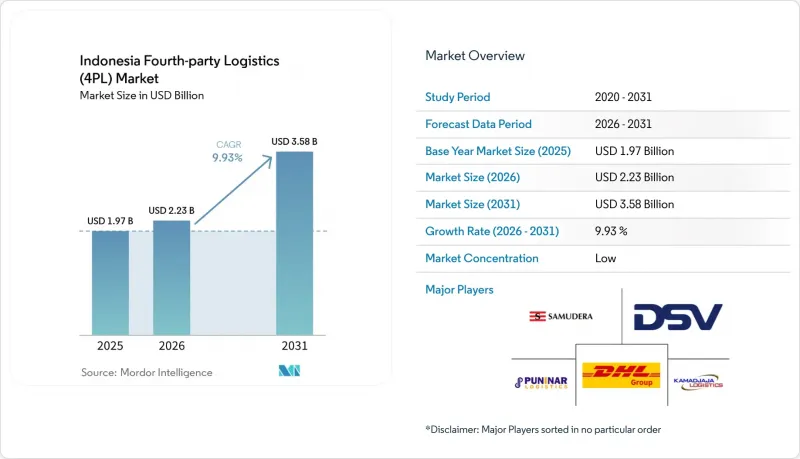
에 따르면 인도네시아의 포스 파티 물류(4PL) 시장 규모는 2025년에 19억 7,000만 달러로 평가되며, 2026년 22억 3,000만 달러에서 2031년까지 35억 8,000만 달러에 달할 것으로 추정되고 있으며, 2026-2031년 예측 기간의 CAGR은 9.93%에 달할 전망입니다.
인도네시아의 지역적 특성으로 인해 1만 7,000개 이상의 섬에 걸친 조정이 필요하며, 단일 운송업체와의 거래 관계만으로는 엔드투엔드 물류를 관리할 수 없는 경우가 적지 않습니다. 이 보고서는 운영 모델(LLP, 솔루션 통합업체, 디지털 플랫폼 4PL), 최종사용자 산업(FMCG, 소매·E-Commerce, 패션, 기술·전자제품, 냉장·의약품, 기타), 기업 규모(중소기업, 대기업) 및 지역(자바, 수마트라, 칼리만탄, 술라웨시, 발리·누사 텡가라, 파푸아·마르쿠)별로 분류되어 있습니다. 시장 전망은 금액(달러) 기준으로 제시되어 있습니다.
인도네시아 4PL(Fourth-Party Logistics) 시장의 동향 및 인사이트
E-Commerce의 복잡성이 증가함에 따라 통합형 4PL 서비스에 대한 수요가 높아지고 있습니다.
인도네시아의 E-Commerce 총거래액(GMV)은 2025년에 710억 달러에 달하며, 전년 대비 14%의 성장률을 기록했습니다. 인도네시아에서는 온라인 판매업체 수가 75% 증가하여, 2025년에는 80만 개의 활성 판매업체가 존재했습니다. 한편, 비디오 커머스는 90%의 성장률을 기록하며 26억 건의 거래를 달성했습니다. 이러한 거래량을 처리하기 위해서는 다수의 개별 판매자에 걸친 주문 관리, 배송 경로 최적화, 반품 처리, 그리고 운송업체 간의 조정이 필요합니다. 인도네시아의 제3자 물류(4PL) 시장은 여러 운송업체를 이용하며 공통의 운영 기반이 필요한 판매업체의 이러한 요구를 충족시킬 수 있습니다. 디지털 플랫폼 제공업체는 기존의 풀서비스 계약보다 소규모 판매업체가 이러한 서비스를 더 쉽게 이용할 수 있도록 할 수 있습니다.
물류의 디지털화가 종단간 공급망 조정을 가속화
인도네시아 세관 당국에 따르면 2026년 현재 ‘국가 물류 생태계’는 55개 항만과 12개 공항을 아우르고 있습니다. 이 프로그램을 통해 대상 거점의 처리 시간은 73%, 물류 비용은 17% 절감되었습니다. 이러한 성과는 데이터 공유와 출하 관리 연동의 효과를 입증하는 것입니다. 인도네시아의 제3자 물류(4PL) 시장은 시스템 간 연동을 강화함으로써 더 낮은 운영 비용으로 컨트롤 타워 서비스를 지원할 수 있습니다. 2026년 9월, 텔콤셀은 스마트 창고 시범 프로젝트를 도입하여 피킹 성능을 25% 향상시키고, 준비 시간을 4시간에서 3시간으로 단축했습니다.
섬 간 인프라의 분절화가 환적의 복잡성을 가중시키고 있습니다.
2025년, 인도네시아의 물류 비용은 GDP의 14.3%를 차지했으나, 선진국 경제의 평균은 8%였습니다. 인도네시아 동부에서는 피더선 운항 빈도, 롤온-롤오프(RoRo) 운송 능력, 수심이 얕은 항만 등의 요인으로 인해 운송 시간이 길어질 가능성이 있습니다. 이러한 상황은 여러 운송업체가 관여하는 서비스 계약에서 비용 증가와 불확실성을 초래하게 됩니다. 인도네시아의 제3자 물류(4PL) 시장은 물류 인프라가 잘 갖춰진 자바섬과 수마트라섬에서 여전히 더 확고하게 자리 잡고 있습니다. 이와 같은 격차로 인해 공급업체가 파푸아, 말루쿠, 칼리만탄 외곽, 누사 텡가라와 같은 지역으로 일관된 운영 모델을 확대하는 데 제약을 받을 수 있습니다.
부문 분석
2025년, 인도네시아의 제3자 물류(4PL) 시장에서 리드 물류 제공업체(LLP)가 시장 점유율의 42.85%를 차지했으나, 디지털 플랫폼형 4PL은 2026-2031년까지 연평균 성장률(CAGR) 16.32%를 기록할 것으로 예측됩니다. LLP 모델은 복잡한 공급망에서 단일 책임 조정자를 필요로 하는 다국적 기업에게 매력적이며, 명확한 서비스 수준, 규정 준수 지원 및 명확한 에스컬레이션 체계를 제공합니다. 자동차 제조업체, 제약 회사 및 산업 그룹은 일반적으로 여러 공급업체, 운송업체 및 여러 섬에 걸친 이러한 수준의 조정이 필요합니다.
디지털 플랫폼형 4PL은 전체 범위의 아웃소싱 모델을 채택하지 않으면서도 공급망의 가시성과 조정을 원하는 고객들 사이에서 그 중요성이 커지고 있습니다. Waresix의 상장 자회사인 PT BSA Logistics Indonesia는 2026년 상반기에 42.6%의 매출 성장을 기록하며, 디지털화된 물류 업무의 확대를 여실히 보여주고 있습니다. 유연한 최소 취급량 및 연계된 워크플로도 디지털 플랫폼이 중견 기업 고객에게 서비스를 제공하는 데 도움이 됩니다. 그 결과, 인도네시아의 4PL 업계는 LLP 및 디지털 운영 모델을 통해 고객별 다양한 요구 사항에 대응하고 있으며, 각 모델은 공급망의 관리 수준 및 아웃소싱 정도에 따라 유연하게 대응하고 있습니다.
기타 혜택:
- 엑셀 형식의 시장 예측(ME) 시트
- 3개월간의 애널리스트 지원
자주 묻는 질문
목차
제1장 서론
- 조사 전제조건과 시장 정의
- 조사 범위
제2장 조사 방법
제3장 개요
- 시장 규모, 성장률 및 예측
- 주요 수요 촉진요인과 4PL 시장의 동향
- 주요 물류 네트워크와 수요 집중
- 경쟁 구도와 주요 4PL 프로바이더
제4장 시장 구도
- 시장 개요와 4PL의 중요성
- 시장 성장 촉진요인
- 시장 성장 억제요인
- 밸류체인 구조와 4PL 서비스 플로우 분석
- 규제 프레임워크 및 4PL 컴플라이언스 요건의 분석
- 기술의 도입과 공급망 디지털화에 관한 분석
- 운송·창고업 투자 동향 분석
- 국내 및 국경간 화물류의 복잡성 평가
- 지역별 물류 투자 및 네트워크 확대의 분석
- Porter's Five Forces 분석
- 지정학적 이벤트가 공급망의 변화에 미치는 영향
제5장 시장 규모와 성장 예측
- 운영 모델별
- 최종사용자 산업별
- 기업 규모별
- 지역별
- Java(자카르타 및 BOD)
- 수마트라
- 보르네오
- 술라웨시
- 발리 및 누사 텡가라
- 파푸아 지역 및 말루쿠 제도
제6장 경쟁 구도
- 시장 집중도
- 전략적 동향
- 시장 점유율 분석
- 기업 개요
- DHL Group
- Kuehne+Nagel International AG
- DSV A/S
- A.P. Moller-Maersk A/S
- CEVA Logistics
- GEODIS
- NX Group
- Rhenus Group
- Toll Group
- PSA BDP
- Puninar Logistics
- Expeditors International
- Kintetsu World Express(Including APL Logistics)
- Yusen Logistics Co., Ltd.
- CJ Logistics Corporation
- LOGISTEED, Ltd.
- PT Samudera Indonesia Tbk
- PT Catur Aman Sentosa
- Janio
- Waresix
- EnviLog
- PT Makmur Berkat Solusi
제7장 시장 기회와 향후 전망
제8장 부록
KSA 26.10.30According to Mordor Intelligence, the Indonesia fourth-party logistics (4PL) market size was valued at USD 1.97 billion in 2025 and is estimated to grow from USD 2.23 billion in 2026 to reach USD 3.58 billion by 2031, at a CAGR of 9.93% during the forecast period 2026-2031.
Indonesia's geography creates coordination needs across more than 17,000 islands, where a single carrier relationship often cannot manage end-to-end movement. This report is Segmented by Operating Model (LLP, Solution Integrator, Digital Platform 4PL), by End-User Industry (FMCG, Retail and E-Commerce, Fashion, Technology and Electronics, Refrigerated and Pharma, and More), by Enterprise Size (SMEs, Large Enterprises), and by Region (Java, Sumatra, Kalimantan, Sulawesi, Bali and Nusa Tenggara, Papua and Maluku). The Market Forecasts are Provided in Terms of Value (USD).
Indonesia Fourth-party Logistics (4PL) Market Trends and Insights
E-Commerce Complexity Increasing Demand for Integrated 4PL Services
Indonesia's e-commerce GMV reached USD 71 billion in 2025 and grew 14% from the prior year. The country had 800,000 active online sellers in 2025 after a 75% increase, while video commerce recorded 2.6 billion transactions after 90% growth. These volumes require order management, routing, returns handling, and carrier coordination across many individual sellers. The Indonesia fourth-party logistics (4PL) market can serve this need, where merchants use more than 1 carrier and need a common operating layer. Digital platform providers can make these services more accessible to smaller sellers than conventional full-service arrangements.
Logistics Digitalization Accelerating End-to-End Supply Chain Orchestration
The National Logistics Ecosystem covers 55 ports and 12 airports in 2026, according to Indonesia's customs authority. The program reduces processing time by 73% and logistics costs by 17% at covered locations. These results strengthen the case for shared data and coordinated shipment management. The Indonesia fourth-party logistics (4PL) market can use greater system connectivity to support control-tower services at a lower operating cost. In September 2026, Telkomsel introduced a smart warehouse pilot that improved picking performance by 25% and reduced preparation time from 4 hours to 3 hours.
Fragmented Inter-Island Infrastructure Increasing Transshipment Complexity
Indonesia's logistics costs represented 14.3% of GDP in 2025, compared with an 8% average in developed economies. Feeder shipping frequency, roll-on and roll-off capacity, and shallow ports can raise transit time in Eastern Indonesia. These conditions add cost and uncertainty to a multi-carrier service agreement. The Indonesia fourth-party logistics (4PL) market remains more established in Java and Sumatra because those locations have stronger logistics infrastructure. The same gap can restrict providers from extending a consistent operating model into Papua, Maluku, outer Kalimantan, and Nusa Tenggara.
Other drivers and restraints analyzed in the detailed report include:
- Manufacturing Localization Expanding Complex Multi-Industry Logistics Requirements
- Real-Time Visibility Demand Driving Control-Tower Adoption
- Data Interoperability Issues Hindering Integrated 4PL Platforms
For complete list of drivers and restraints, kindly check the Table Of Contents.
Segment Analysis
Lead logistics provider (LLP) accounted for 42.85% of the Indonesia fourth-party logistics (4PL) market share in 2025, while digital platform 4PL is forecast to record a 16.32% CAGR from 2026 to 2031. The LLP model appeals to multinational clients seeking one accountable coordinator for complex supply chains, offering defined service levels, compliance support, and a clear escalation structure. Automotive manufacturers, pharmaceutical companies, and industrial groups commonly require this level of coordination across multiple suppliers, carriers, and islands.
Digital platform 4PL is gaining relevance among customers seeking supply chain visibility and coordination without adopting a full-scope outsourcing model. Waresix's listed subsidiary, PT BSA Logistics Indonesia, reported 42.6% revenue growth in H1 2026, highlighting the expansion of digitally enabled logistics operations. Flexible minimum volumes and connected workflows can also help digital platforms serve mid-market customers. As a result, Indonesia's 4PL industry accommodates distinct customer requirements through LLP and digital operating models, with each model addressing different levels of supply chain control and outsourcing.
Complete Report Scope:
- By Operating Model
- Lead Logistics Provider (LLP)
- Solution Integrator
- Digital Platform 4PL
- By End-User Industry
- FMCG
- Retail and E-commerce
- Fashion and Lifestyle
- Technology and Electronics
- Refrigerated and Pharma
- Automotive and Mobility
- Industrial Manufacturing
- Others
- By Enterprise Size
- Small and Medium Enterprises
- Large Enterprises
- By Region
- Java (Jakarta and BOD)
- Sumatra
- Kalimantan
- Sulawesi
- Bali and Nusa Tenggara
- Papua Region and Maluku Islands
List of Companies Covered in this Report:
- DHL Group
- Kuehne+Nagel International AG
- DSV A/S
- A.P. Moller - Maersk A/S
- CEVA Logistics
- GEODIS
- NX Group
- Rhenus Group
- Toll Group
- PSA BDP
- Puninar Logistics
- Expeditors International
- Kintetsu World Express (Including APL Logistics)
- Yusen Logistics Co., Ltd.
- CJ Logistics Corporation
- LOGISTEED, Ltd.
- PT Samudera Indonesia Tbk
- PT Catur Aman Sentosa
- Janio
- Waresix
- EnviLog
- PT Makmur Berkat Solusi
Additional Benefits:
- The market estimate (ME) sheet in Excel format
- 3 months of analyst support
TABLE OF CONTENTS
1 INTRODUCTION
- 1.1 Study Assumptions and Market Definition
- 1.2 Scope of the Study
2 RESEARCH METHODOLOGY
3 EXECUTIVE SUMMARY
- 3.1 Market Size, Growth, and Forecast Outlook
- 3.2 Key Demand Drivers and 4PL Market Trends
- 3.3 Major Logistics Networks and Demand Concentration
- 3.4 Competitive Landscape and Leading 4PL Providers
4 MARKET LANDSCAPE
- 4.1 Market Overview and Importance of 4PL
- 4.2 Market Drivers
- 4.2.1 E-Commerce Complexity Increasing Demand for Integrated 4PL Services
- 4.2.2 Logistics Digitalization Accelerating End-to-End Supply Chain Orchestration
- 4.2.3 Manufacturing Localization Expanding Complex Multi-Industry Logistics Requirements
- 4.2.4 Real-Time Visibility Demand Driving Control-Tower Adoption
- 4.2.5 Healthcare Compliance Increasing Specialized Supply Chain Management Demand
- 4.2.6 Multi-Island Networks Increasing Optimization and Backhaul Coordination Needs
- 4.3 Market Restraints
- 4.3.1 Fragmented Inter-Island Infrastructure Increasing Transshipment Complexity
- 4.3.2 Data Interoperability Issues Hindering Integrated 4PL Platforms
- 4.3.3 Limited Analytics Talent Constraining Advanced Orchestration Capabilities
- 4.3.4 Strategic Control Concerns Limiting 4PL Outsourcing Adoption
- 4.4 Value Chain Structure and 4PL Service Flow Analysis
- 4.5 Regulatory Framework and 4PL Compliance Requirements Analysis
- 4.6 Technology Adoption and Supply Chain Digitalization Analysis
- 4.7 Transportation and Warehousing Investment Trend Analysis
- 4.8 Domestic and Cross-Border Cargo Flow Complexity Assessment
- 4.9 Regional Logistics Investment and Network Expansion Analysis
- 4.10 Porter's Five Forces Analysis
- 4.10.1 Threat of New Entrants
- 4.10.2 Bargaining Power of Buyers
- 4.10.3 Bargaining Power of Suppliers
- 4.10.4 Threat of Substitute Services
- 4.10.5 Intensity of Competitive Rivalry
- 4.11 Impact of Geo-Political Events on Supply Chain Shifts
5 MARKET SIZE AND GROWTH FORECASTS
- 5.1 By Operating Model
- 5.1.1 Lead Logistics Provider (LLP)
- 5.1.2 Solution Integrator
- 5.1.3 Digital Platform 4PL
- 5.2 By End-User Industry
- 5.2.1 FMCG
- 5.2.2 Retail and E-commerce
- 5.2.3 Fashion and Lifestyle
- 5.2.4 Technology and Electronics
- 5.2.5 Refrigerated and Pharma
- 5.2.6 Automotive and Mobility
- 5.2.7 Industrial Manufacturing
- 5.2.8 Others
- 5.3 By Enterprise Size
- 5.3.1 Small and Medium Enterprises
- 5.3.2 Large Enterprises
- 5.4 By Region
- 5.4.1 Java (Jakarta and BOD)
- 5.4.2 Sumatra
- 5.4.3 Kalimantan
- 5.4.4 Sulawesi
- 5.4.5 Bali and Nusa Tenggara
- 5.4.6 Papua Region and Maluku Islands
6 COMPETITIVE LANDSCAPE
- 6.1 Market Concentration
- 6.2 Strategic Moves
- 6.3 Market Share Analysis
- 6.4 Company Profiles (includes Global Level Overview, Market Level Overview, Core Segments, Financials as available, Strategic Information, Geographic Coverage, Products and Services, Recent Developments)
- 6.4.1 DHL Group
- 6.4.2 Kuehne+Nagel International AG
- 6.4.3 DSV A/S
- 6.4.4 A.P. Moller - Maersk A/S
- 6.4.5 CEVA Logistics
- 6.4.6 GEODIS
- 6.4.7 NX Group
- 6.4.8 Rhenus Group
- 6.4.9 Toll Group
- 6.4.10 PSA BDP
- 6.4.11 Puninar Logistics
- 6.4.12 Expeditors International
- 6.4.13 Kintetsu World Express (Including APL Logistics)
- 6.4.14 Yusen Logistics Co., Ltd.
- 6.4.15 CJ Logistics Corporation
- 6.4.16 LOGISTEED, Ltd.
- 6.4.17 PT Samudera Indonesia Tbk
- 6.4.18 PT Catur Aman Sentosa
- 6.4.19 Janio
- 6.4.20 Waresix
- 6.4.21 EnviLog
- 6.4.22 PT Makmur Berkat Solusi
7 MARKET OPPORTUNITIES AND FUTURE OUTLOOK
- 7.1 White-Space Opportunities and Unmet 4PL Service Needs
- 7.2 High-Potential End-User Segments and Growth Opportunities
- 7.3 Strategic Growth Priorities Across 4PL Ecosystem
- 7.4 Future Market Outlook and Emerging Demand Pockets


