

|
시장보고서
상품코드
2157123
영상 기반 산업용 코드 리더 : 시장 점유율 분석, 업계 동향과 통계, 성장 예측(2026-2031년)Image-Based Industrial Code Reader - Market Share Analysis, Industry Trends & Statistics, Growth Forecasts (2026 - 2031) |
||||||
 Mordor Intelligence
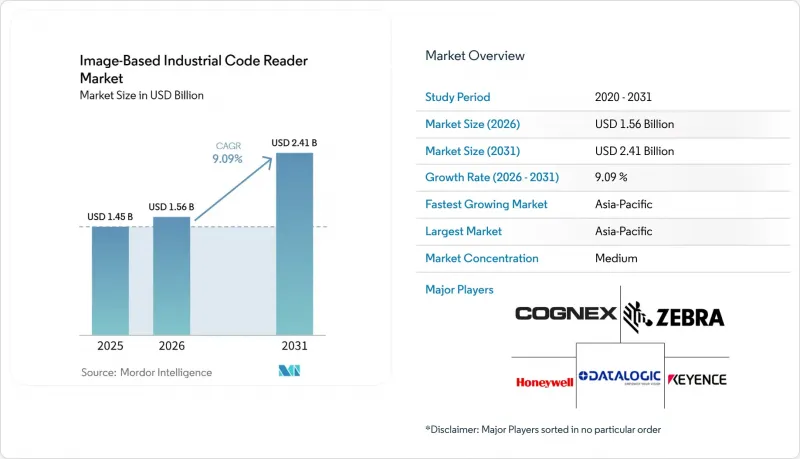
에 따르면 영상 기반 산업용 코드 리더 시장 규모는 2025년에 14억 5,000만 달러로 평가되며, 2026년 15억 6,000만 달러에서 확대하며, 2031년까지 24억 1,000만 달러에 달할 것으로 예측됩니다.
예측 기간(2026-2031년) 동안 연평균 성장률(CAGR)은 9.09%에 달할 것으로 전망됩니다.
전 세계 이미지 기반 산업용 코드 리더 시장의 동향 및 인사이트
규제에 따른 일련번호 부여 및 추적성 의무화
일련번호 부여에 관한 규제는 이미지 기반 산업용 코드 리더 시장의 수요를 견인하는 가장 큰 요인으로 작용하고 있습니다. 이는 규제 시행에 따라 패키지 단위의 검증이 의무화되었기 때문입니다. 미국의 ‘의약품 공급망 보안법(Pharmaceutical Supply Chain Security Act)’에 따르면 2024년 11월 27일 이후 거래 파트너에게 의약품 유통 보안 요건 강화에 대한 대응이 요구됩니다. 유럽의 규정에 따르면 제조업체는 의약품을 판매하거나 유통하기 전에 바코드의 판독 가능성과 데이터의 정확성을 검증해야 합니다. 이러한 요건으로 인해 생산 속도에 맞춰 결과를 기록할 수 있는 교정 완료된 인라인 검증 시스템이 선호되고 있습니다. 이와 유사한 추적성 의무는 전자기기, 섬유 제품, 전기자동차(EV) 배터리 등 관련 제품 범주로도 확대되고 있습니다. 또한 검증 장비의 적합성 요건 측면에서도 교정 완료된 등급과 감사 가능한 기록을 제공할 수 있는 공급업체가 우대받고 있습니다.
제조 자동화 및 인더스트리 4.0 도입
이미지 기반 산업용 코드 리더 시장에서 자동화의 진전에 따라 코드 검증은 오프라인 샘플링에서 연속적인 점검으로 전환되고 있습니다. 오므론은 2026년 6월, 분당 최대 1,200개를 처리할 수 있는 ‘VHV5-SRV 바코드 검증 시스템’을 출시했습니다. 이 시스템은 ISO/IEC 15415, ISO/IEC 15416 및 ISO/IEC TR 29158을 준수하는 실시간 등급 평가를 지원합니다. 인라인 검사는 검증과 생산 활동을 통합하여 재작업 및 감사 부담을 줄일 수 있습니다. 제조 실행 시스템(MES)과 연동된 공장에서는 수작업 검사에 의존하는 시설보다 이러한 시스템을 더 쉽게 도입할 수 있습니다. 이러한 차이는 반도체 패키징이나 자동차 부품 마킹 분야에서 운영상의 격차를 확대시킬 가능성이 있습니다.
높은 통합·교정·검증 비용
통합 및 검증 비용은 이미지 기반 산업용 코드 리더 시장에서의 도입에 큰 장벽이 되고 있습니다. ISO 규격을 준수하는 검증 장비에는 교정 카드, 제어된 조명 및 검증 절차가 필요하며, 이러한 요소들이 지속적인 비용으로 추가됩니다. 엔지니어링에 소요되는 시간으로 인해 인증 비용이 장비 가격을 초과하는 경우도 있습니다. 생명과학 분야 시설에서는 적용되는 전자 기록 및 우수 제조 기준(GMP) 요건에 따라 검증 과정을 문서화하고, 관련 소프트웨어 변경 후 이를 반복해야 합니다. 또한 마킹, 라벨링, 포장 및 검증 장비를 통합하려면 공급업체 간 시스템을 아우르는 맞춤형 인터페이스가 필요할 수도 있습니다. 이러한 제약은 전문적인 통합 지원을 충분히 이용할 수 없는 남미, 중동 및 아프리카에서 특히 심각합니다.
부문 분석
2025년, 이미지 기반 산업용 코드 리더 시장에서 하드웨어가 68.41%의 점유율을 차지했습니다. 정밀 광학 어셈블리, 조명 시스템, 임베디드 프로세서 및 교정 툴이 초기 설비 비용의 대부분을 차지하고 있습니다. 라인 속도에서 ISO 표준을 준수하는 2D 판독을 위해서는 여전히 물리적 하드웨어가 필요합니다. 서비스 부문에서는 규제 대상 고객을 대상으로 교정, 검증 지원 및 유지보수 계약을 제공하고 있습니다. 이로 인해 디지털 기능이 확대되고 있음에도 불구하고 이미지 기반 산업용 코드 리더 시장의 하드웨어에 대한 수요가 지탱되고 있습니다.
소프트웨어는 2031년까지 연평균 성장률(CAGR) 10.24%로 성장할 것으로 예상되며, 이는 구성 요소 중 가장 높은 성장률입니다. 클라우드 연결형 데이터 플랫폼, 결함 분류 툴 및 보고서 작성 모듈을 통해 등급 평가 결과가 공정 정보로 변환됩니다. 코그넥스(Cognex)는 2025년 6월부터 진행된 베타 테스트 기간 중 100개 이상의 제조업체 고객이 이 플랫폼을 사용한 것을 계기로, 2026년에 ‘OneVision’ 플랫폼을 정식 출시했습니다. 이 플랫폼은 여러 생산 거점에 걸친 AI 개발 및 도입을 지원합니다. 이미지 기반 산업용 코드 리더 업계에서는 해당 시장에서 연결형 품질 데이터 툴의 중요성이 점점 더 커지고 있습니다.
2025년에는 인라인 검증이 매출의 57.61%를 차지했습니다. 이는 생산 공정 전반에 걸쳐 코드 검사가 필수적인 이미지 기반 산업용 코드 리더 시장에서 대량 생산 공장에 적합합니다. 의약품 포장, 식품 라벨, 전자기기 조립 라인에서는 이 아키텍처의 활용이 점점 더 늘어나고 있습니다. DSCSA 및 EU FMD 요건으로 인해 배치 종료시 샘플링 방식에서 벗어나는 추세가 가속화되고 있습니다. 데스크톱 및 실험실용 시스템은 통제된 인쇄 환경이나 ISO 감사 업무에서 여전히 중요한 역할을 수행하고 있습니다.
휴대용 검증 시장은 2031년까지 연평균 성장률(CAGR) 10.76%로 확대될 것으로 예측됩니다. 이러한 장치는 고정 설비 설치가 현실적으로 어려운 상황에서 입고 검사, 물류 센터 감사 및 공급업체 적격성 평가를 수행합니다. 영구적인 설치가 필요하지 않아 시설 간을 이동하며 사용할 수 있습니다. 이러한 유연성은 아시아태평양의 급변하는 물류 네트워크에서 중요합니다. 이미지 기반 산업용 코드 리더 시장은 사용자가 다양한 장소에서 표준화된 검사를 필요로 하는 상황에서 장점을 발휘합니다.
지역별 분석
아시아태평양은 2025년 이미지 기반 산업용 코드 리더 시장 점유율의 35.21%를 차지하고 있으며, 2031년까지 연평균 성장률(CAGR) 11.21%로 확대될 것으로 예측됩니다. 대만, 한국, 일본은 반도체 제조 및 첨단 전자기기 생산을 통해 수요를 지원하고 있습니다. 인도의 경우, 미국 및 유럽의 규정 준수 요건이 적용되는 의약품 수출 공급망에서의 수요가 더해지고 있습니다. 중국의 제조 거점과 해당 지역의 E-Commerce(EC)용 분류 인프라는 자동 코드 판독 및 검증의 보급을 촉진하고 있습니다. 이러한 시너지 효과로 인해 해당 지역의 매출은 다른 지역과의 격차를 더욱 벌리고 있습니다.
북미는 미국 의약품 규정 준수 요건의 지원을 받아 2025년에도 중요한 위치를 유지했습니다. 이 지역에는 이미지 기반 산업용 코드 리더 시장에서 여러 거점에 걸친 도입을 지원할 수 있는 확고한 기술 공급업체와 시스템 통합사업자가 존재합니다. 브래디(Brady)사는 2026년 8월, 허니웰(Honeywell)사의 ‘생산성 솔루션 및 서비스’ 사업을 14억 달러에 인수하는 절차를 완료했습니다. 이어 유럽에서는 자동차, 포장, 소비재, 의약품 검증 분야에서 확고한 수요가 있습니다. 브래디사는 이번 인수를 통해 대상 시장이 90억 달러로 확대될 것이라고 밝혔습니다.
남미, 중동 및 아프리카는 이미지 기반 산업용 코드 리더 시장에서 여전히 규모는 작지만 발전 중인 시장입니다. 브라질에서는 의약품 추적성 요건으로 인해 도입이 촉진되고 있으며, 사우디아라비아와 아랍에미리트에서는 GS1 기반의 일련번호 부여가 도입되고 있습니다. 남아프리카는 아프리카내 진출 거점이며, 나이지리아에서는 소비재 분야의 수요가 부상하고 있습니다. 비용에 대한 민감성이나 기술 지원 부족으로 인해 도입이 지연될 가능성은 있으나, 지역 통합 업체들이 모듈식 서비스를 제공하고 있습니다.
기타 혜택:
- 엑셀 형식의 시장 예측(ME) 시트
- 3개월간의 애널리스트 지원
자주 묻는 질문
목차
제1장 서론
- 조사 전제조건과 시장 정의
- 조사 범위
제2장 조사 방법
제3장 개요
제4장 시장 구도
- 시장 개요
- 시장 성장 촉진요인
- 시장 성장 억제요인
- 거시경제 요인이 시장에 미치는 영향
- 업계의 공급망 분석
- 기술 동향
- 규제 상황
- Porter's Five Forces 분석
제5장 시장 규모와 성장 예측
- 컴포넌트별
- 검증 모드별
- 코드 심볼로지별
- 용도별
- 최종사용자 산업별
- 지역별
- 북미
- 미국
- 캐나다
- 멕시코
- 남미
- 브라질
- 아르헨티나
- 기타 남미 국가
- 유럽
- 독일
- 영국
- 프랑스
- 이탈리아
- 스페인
- 기타 유럽 국가
- 아시아태평양
- 중국
- 일본
- 인도
- 한국
- 기타 아시아태평양 국가
- 중동 및 아프리카
- 중동
- 사우디아라비아
- 아랍에미리트
- 튀르키예
- 기타 중동 국가
- 아프리카
- 남아프리카공화국
- 나이지리아
- 기타 아프리카 국가
- 중동
- 북미
제6장 경쟁 구도
- 시장 집중도
- 전략적 동향
- 시장 점유율 분석
- 기업 개요
- Cognex Corporation
- Omron Corporation
- Datalogic S.p.A.
- Zebra Technologies Corporation
- Honeywell International Inc.
- SICK AG
- Axicon Auto ID Ltd
- REA Elektronik GmbH
- Keyence Corporation
- RJS Technologies, Inc.
- Webscan Inc.
- Stratix Corporation
- Mettler-Toledo International Inc.
- Optel Group
- Printronix Auto ID
- Siemens AG
- Panasonic Holdings Corporation
- TSC Auto ID Technology Co., Ltd.
- Opticon Sensors Europe B.V.
- ISRA VISION AG
제7장 시장 기회와 향후 전망
KSA 26.10.30According to Mordor Intelligence, the Image-Based industrial code reader market size was valued at USD 1.45 billion in 2025 and estimated to expand from USD 1.56 billion in 2026 to reach USD 2.41 billion by 2031, at a CAGR of 9.09% during the forecast period (2026-2031).
Global Image-Based Industrial Code Reader Market Trends and Insights
Regulatory Serialization and Traceability Mandates
Serialization mandates are the strongest driver of demand for the Image-Based Industrial Code Reader Market because enforcement now requires package-level verification. The U.S. Drug Supply Chain Security Act required trading partners to meet enhanced drug distribution security requirements as of November 27, 2024. European rules require manufacturers to verify barcode readability and data accuracy before releasing medicinal products for sale or distribution. These requirements favor calibrated inline verification systems that can document results at production speed. Similar traceability obligations are extending into adjacent product categories, including electronics, textiles, and EV batteries. Verifier conformance requirements also favor suppliers that can provide calibrated grading and auditable records.
Manufacturing Automation and Industry 4.0 Implementation
Automation is moving code verification from offline sampling toward continuous checks in the Image-Based Industrial Code Reader Market. Omron introduced the VHV5-SRV Barcode Verification System in June 2026, with a rating of up to 1,200 parts per minute. The system supports real-time grading in accordance with ISO/IEC 15415, ISO/IEC 15416, and ISO/IEC TR 29158. Inline inspection combines verification with production activity and can reduce rework and audit effort. Plants with connected manufacturing execution systems can implement these systems more readily than facilities dependent on manual checks. This difference can widen operating gaps in semiconductor packaging and automotive parts marking.
High Integration, Calibration, and Validation Costs
Integration and validation costs remain a significant barrier to adoption in the Image-Based Industrial Code Reader Market. ISO-compliant verifiers require calibration cards, controlled lighting, and validation procedures, which add recurring expenses. Engineering time can raise the qualification cost beyond the equipment price. Life-sciences sites must document validation and repeat it after relevant software changes, in accordance with applicable electronic-record and good-manufacturing-practice requirements. Integrating marking, labeling, packaging, and verification equipment may also require custom interfaces across vendor systems. The constraint is most acute in South America, the Middle East, and Africa, where specialized integration support is less available.
Other drivers and restraints analyzed in the detailed report include:
- Supply Chain Digitalization and E-Commerce Expansion
- Quality Assurance and First-Pass Yield Improvement
- Legacy ERP, MES, and Printer Compatibility Gaps
For complete list of drivers and restraints, kindly check the Table Of Contents.
Segment Analysis
Hardware held 68.41% of the Image-Based Industrial Code Reader Market share in 2025. Precision optical assemblies, illumination systems, embedded processors, and calibration tools account for much of the initial equipment cost. Physical hardware remains necessary for ISO-compliant 2D grading at line speed. Services provide calibration, validation support, and maintenance agreements for regulated accounts. This supports demand for Image-Based Industrial Code Reader Market hardware, even as digital capabilities expand.
Software is projected to expand at a 10.24% CAGR through 2031, the highest rate among components. Cloud-connected data platforms, defect classification tools, and reporting modules turn grade results into process information. Cognex made its OneVision platform generally available in 2026 after more than 100 manufacturing customers had used it during beta testing from June 2025. The platform supports AI development and deployment across multiple production sites. The Image-Based Industrial Code Reader industry is placing greater value on connected quality data tools within the Image-Based Industrial Code Reader Market.
In-line verification accounted for 57.61% of revenue in 2025. It suits high-volume plants in the Image-Based Industrial Code Reader Market that must inspect codes throughout production. Pharmaceutical packaging, food labeling, and electronics assembly lines increasingly use this architecture. DSCSA and EU FMD requirements have supported the move away from end-of-batch sampling. Desktop and laboratory systems remain important for controlled print setup and ISO audit work.
Portable verification is projected to expand at a 10.76% CAGR through 2031. These devices support incoming goods checks, distribution center audits, and supplier qualification, where fixed equipment is not practical. They can move between facilities without a permanent installation. This flexibility is relevant to fast-changing logistics networks in the Asia-Pacific region. The Image-Based Industrial Code Reader Market benefits where users need standardized checks across varied locations.
Complete Report Scope:
- By Component
- Hardware
- Software
- Services
- By Verification Mode
- In-Line Verification
- Portable Verification
- Desktop and Laboratory Verification
- By Code Symbology
- Data Matrix and GS1 DataMatrix
- QR Code and GS1 QR Code
- PDF417 and MicroPDF417
- Aztec Code
- DotCode
- Other 2D Code Symbologies
- By Application
- Print Quality Verification
- Direct Part Mark Verification
- Label and Package Code Verification
- Serialization and Data Validation
- Product Authentication and Anti-Counterfeiting
- Incoming Goods and Supplier Quality Verification
- Other Applications
- By End-User Industry
- Pharmaceuticals
- Medical Devices
- Automotive and Tires
- Electronics and Semiconductors
- Food and Beverage
- Logistics and Transportation
- Printing, Packaging, and Consumer Goods
- Other End-User Industries
- By Geography
- North America
- United States
- Canada
- Mexico
- South America
- Brazil
- Argentina
- Rest of South America
- Europe
- Germany
- United Kingdom
- France
- Italy
- Spain
- Rest of Europe
- Asia-Pacific
- China
- Japan
- India
- South Korea
- Rest of Asia-Pacific
- Middle East and Africa
- Middle East
- Saudi Arabia
- United Arab Emirates
- Turkey
- Rest of the Middle East
- Africa
- South Africa
- Nigeria
- Rest of Africa
- Middle East
- North America
Geography Analysis
Asia-Pacific held 35.21% of the Image-Based Industrial Code Reader Market share in 2025 and is projected to expand at an 11.21% CAGR through 2031. Taiwan, South Korea, and Japan support demand through semiconductor fabrication and advanced electronics production. India adds demand from pharmaceutical export supply chains subject to U.S. and European compliance requirements. China's manufacturing base and the region's e-commerce sorting infrastructure support wider use of automated code reading and verification. This combination increases the region's revenue separation from other geographies.
North America maintained a significant position in 2025, supported by U.S. pharmaceutical compliance requirements. The region has established technology suppliers and system integrators for multi-site deployments in the Image-Based Industrial Code Reader Market. Brady completed its acquisition of Honeywell's Productivity Solutions and Services business for USD 1.4 billion in August 2026. Europe follows, with established demand for automotive, packaging, consumer goods, and pharmaceutical verification. Brady stated that the acquisition expands its addressable market to USD 9 billion.
South America, the Middle East, and Africa remain smaller but developing markets for the Image-Based Industrial Code Reader Market. Brazil supports adoption through medicine-traceability requirements, while Saudi Arabia and the United Arab Emirates are implementing GS1-based serialization. South Africa is an entry point in Africa, and Nigeria has emerging consumer-goods demand. Cost sensitivity and limited technical support can slow deployments, although regional integrators offer modular services.
- Cognex Corporation
- Omron Corporation
- Datalogic S.p.A.
- Zebra Technologies Corporation
- Honeywell International Inc.
- SICK AG
- Axicon Auto ID Ltd
- REA Elektronik GmbH
- Keyence Corporation
- RJS Technologies, Inc.
- Webscan Inc.
- Stratix Corporation
- Mettler-Toledo International Inc.
- Optel Group
- Printronix Auto ID
- Siemens AG
- Panasonic Holdings Corporation
- TSC Auto ID Technology Co., Ltd.
- Opticon Sensors Europe B.V.
- ISRA VISION AG
Additional Benefits:
- The market estimate (ME) sheet in Excel format
- 3 months of analyst support
TABLE OF CONTENTS
1 INTRODUCTION
- 1.1 Study Assumptions and Market Definition
- 1.2 Scope of the Study
2 RESEARCH METHODOLOGY
3 EXECUTIVE SUMMARY
4 MARKET LANDSCAPE
- 4.1 Market Overview
- 4.2 Market Drivers
- 4.2.1 Regulatory Serialization and Traceability Mandates
- 4.2.2 Manufacturing Automation and Industry 4.0 Implementation
- 4.2.3 Supply Chain Digitalization and E-Commerce Expansion
- 4.2.4 Quality Assurance and First-Pass Yield Improvement
- 4.2.5 ISO/IEC 15415:2024 Decimal Grading Upgrade
- 4.2.6 Verification Data as Closed-Loop Print Process Control
- 4.3 Market Restraints
- 4.3.1 High Integration, Calibration, and Validation Costs
- 4.3.2 Legacy ERP, MES, and Printer Compatibility Gaps
- 4.3.3 Substrate and Marking Variability in Direct Part Marking
- 4.3.4 False Rejects During Standard-Transition and Grade Interpretation
- 4.4 Impact of Macroeconomic Factors on the Market
- 4.5 Industry Supply-Chain Analysis
- 4.6 Technology Outlook
- 4.7 Regulatory Landscape
- 4.8 Porter's Five Forces Analysis
- 4.8.1 Threat of New Entrants
- 4.8.2 Bargaining Power of Suppliers
- 4.8.3 Bargaining Power of Buyers
- 4.8.4 Threat of Substitutes
- 4.8.5 Intensity of Competitive Rivalry
5 MARKET SIZE AND GROWTH FORECASTS (VALUE)
- 5.1 By Component
- 5.1.1 Hardware
- 5.1.2 Software
- 5.1.3 Services
- 5.2 By Verification Mode
- 5.2.1 In-Line Verification
- 5.2.2 Portable Verification
- 5.2.3 Desktop and Laboratory Verification
- 5.3 By Code Symbology
- 5.3.1 Data Matrix and GS1 DataMatrix
- 5.3.2 QR Code and GS1 QR Code
- 5.3.3 PDF417 and MicroPDF417
- 5.3.4 Aztec Code
- 5.3.5 DotCode
- 5.3.6 Other 2D Code Symbologies
- 5.4 By Application
- 5.4.1 Print Quality Verification
- 5.4.2 Direct Part Mark Verification
- 5.4.3 Label and Package Code Verification
- 5.4.4 Serialization and Data Validation
- 5.4.5 Product Authentication and Anti-Counterfeiting
- 5.4.6 Incoming Goods and Supplier Quality Verification
- 5.4.7 Other Applications
- 5.5 By End-User Industry
- 5.5.1 Pharmaceuticals
- 5.5.2 Medical Devices
- 5.5.3 Automotive and Tires
- 5.5.4 Electronics and Semiconductors
- 5.5.5 Food and Beverage
- 5.5.6 Logistics and Transportation
- 5.5.7 Printing, Packaging, and Consumer Goods
- 5.5.8 Other End-User Industries
- 5.6 By Geography
- 5.6.1 North America
- 5.6.1.1 United States
- 5.6.1.2 Canada
- 5.6.1.3 Mexico
- 5.6.2 South America
- 5.6.2.1 Brazil
- 5.6.2.2 Argentina
- 5.6.2.3 Rest of South America
- 5.6.3 Europe
- 5.6.3.1 Germany
- 5.6.3.2 United Kingdom
- 5.6.3.3 France
- 5.6.3.4 Italy
- 5.6.3.5 Spain
- 5.6.3.6 Rest of Europe
- 5.6.4 Asia-Pacific
- 5.6.4.1 China
- 5.6.4.2 Japan
- 5.6.4.3 India
- 5.6.4.4 South Korea
- 5.6.4.5 Rest of Asia-Pacific
- 5.6.5 Middle East and Africa
- 5.6.5.1 Middle East
- 5.6.5.1.1 Saudi Arabia
- 5.6.5.1.2 United Arab Emirates
- 5.6.5.1.3 Turkey
- 5.6.5.1.4 Rest of the Middle East
- 5.6.5.2 Africa
- 5.6.5.2.1 South Africa
- 5.6.5.2.2 Nigeria
- 5.6.5.2.3 Rest of Africa
- 5.6.5.1 Middle East
- 5.6.1 North America
6 COMPETITIVE LANDSCAPE
- 6.1 Market Concentration
- 6.2 Strategic Moves
- 6.3 Market Share Analysis
- 6.4 Company Profiles (includes Global Level Overview, Market Level Overview, Core Segments, Financials as available, Strategic Information, Market RankandShare, Products and Services, Recent Developments)
- 6.4.1 Cognex Corporation
- 6.4.2 Omron Corporation
- 6.4.3 Datalogic S.p.A.
- 6.4.4 Zebra Technologies Corporation
- 6.4.5 Honeywell International Inc.
- 6.4.6 SICK AG
- 6.4.7 Axicon Auto ID Ltd
- 6.4.8 REA Elektronik GmbH
- 6.4.9 Keyence Corporation
- 6.4.10 RJS Technologies, Inc.
- 6.4.11 Webscan Inc.
- 6.4.12 Stratix Corporation
- 6.4.13 Mettler-Toledo International Inc.
- 6.4.14 Optel Group
- 6.4.15 Printronix Auto ID
- 6.4.16 Siemens AG
- 6.4.17 Panasonic Holdings Corporation
- 6.4.18 TSC Auto ID Technology Co., Ltd.
- 6.4.19 Opticon Sensors Europe B.V.
- 6.4.20 ISRA VISION AG
7 MARKET OPPORTUNITIES AND FUTURE OUTLOOK
- 7.1 White-Space and Unmet-Need Assessment


