

|
시장보고서
상품코드
2157131
안료 중간체 : 시장 점유율 분석, 업계 동향과 통계, 성장 예측(2026-2031년)Pigment Intermediates - Market Share Analysis, Industry Trends & Statistics, Growth Forecasts (2026 - 2031) |
||||||
 Mordor Intelligence
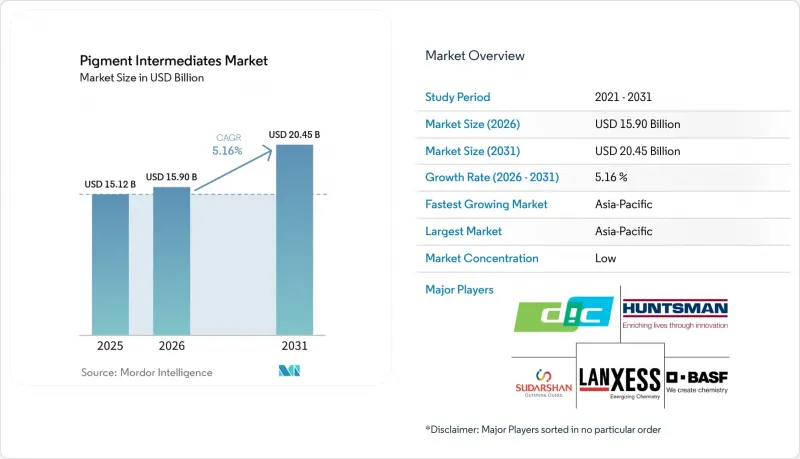
에 따르면 안료 중간체 시장 규모는 2025년에 151억 2,000만 달러로 평가되며, 2026년 159억 달러에서 2031년까지 204억 5,000만 달러에 달할 것으로 추정되고 있으며, 예측 기간(2026-2031년)에 CAGR은 5.16%에 달할 전망입니다.
전 세계 안료 중간체 시장의 동향 및 인사이트
도료·코팅 수요 확대
건설 및 유지보수 공사는 건축용 및 보호용 코팅에 대한 수요를 지속적으로 지원하고 있으며, 이로 인해 안료 중간체 시장에서 착색제 원료에 대한 수요가 증가했습니다. 유로존의 건설 생산액은 2025년 4월, 2024년 4월 대비 3.0% 증가하여, 개보수 공사 및 인프라 공사에서 코팅재 소비를 지원했습니다. 또한 코팅 배합 제조업체들은 엄격하게 규정된 착색제의 화학적 특성이 요구되는 수성, 분체, 고고형분 시스템으로 전환하고 있습니다. 이러한 전환으로 인해 완성된 안료가 색상, 내구성 및 배출 요건을 충족하는 데 도움이 되는 중간체의 수요가 증가하고 있습니다. LANXESS는 2025년 2월, TUV 라인란드 인증의 수명 주기 분석에 기반하여 표준 Bayferrox 등급에 비해 제품의 탄소발자국이 35% 낮은 초미세 황색 산화철 안료를 ‘Scopeblue’ 포트폴리오에 추가했습니다. 따라서 도료 사양에서 표준 등급이 아닌, 배출량이 낮은 것으로 입증된 배합이 우선시될 경우, 안료 중간체 시장은 그 혜택을 누리게 될 것입니다.
섬유, 플라스틱, 종이, 인쇄 잉크 시장의 확대
섬유, 플라스틱, 종이, 인쇄 잉크는 안료 중간체 시장에서 다양한 안료의 화학적 특성과 순도 수준에 대한 수요를 창출하고 있습니다. 연포장재나 식품 접촉용 경질 용기에는 폴리머 가공 과정에서 색상을 유지하고 재료의 문서화 요건을 충족하는 착색제가 요구됩니다. 디지털 잉크젯 인쇄에서는 안료 분산액에 대해 일관된 입자 특성과 고순도 원료에 대한 수요가 증가하고 있습니다. 또한 섬유 인쇄에서는 분산 및 도포 요건에 적합한 중간체가 필요한 수성 안료 시스템이 사용되고 있습니다. 특수 인쇄 등급에서 관리된 색상 품질과 낮은 염분 함량이 요구되는 분야에서는 종이 용도의 중요성이 여전히 높습니다. 이러한 용도는 제품이나 가공 방법에 따라 사양이 다르더라도 안료 중간체 시장 전체에 수요를 창출하고 있습니다.
원자재 및 석유화학제품 가격 변동
원료는 안료 생산 비용의 대부분을 차지하므로 방향족 화합물이나 금속 원료의 가격 변동은 안료 중간체 시장에 즉각적인 영향을 미칠 가능성이 있습니다. 유기계 안료는 벤젠, 아닐린, 프탈산 무수물 등의 원료에 의존하고 있으며, 프탈로시아닌계 안료의 제조에는 구리 원료도 필수적입니다. 완제품 안료의 구매 계약 조정이 원료 비용 변동보다 늦어질 경우, 비통합형 제조업체가 비용 압박을 흡수하기는 어렵습니다. 제조업체들은 여러 공급처로부터의 조달, 재고 계획, 상류 공급업체와의 보다 긴밀한 협력을 통해 대응하고 있습니다. 이러한 조치로 혼란을 완화할 수는 있지만, 석유화학제품이나 금속 비용의 급격한 변동으로 인한 위험을 완전히 배제할 수는 없습니다. 상류 가격이 하류 판매 가격보다 빠르게 상승할 경우, 안료 중간체 시장은 여전히 취약한 상태에 놓이게 됩니다.
부문 분석
2025년에는 유기 중간체가 수요의 45.73%를 차지했습니다. 그 용도는 아조, 프탈로시아닌, 키나크리돈, 벤즈이미다졸론 계열 화합물에 이르기까지 다양하며, 포장용 잉크, 자동차용 도료, 플라스틱 및 기타 착색 용도로 활용되고 있습니다. 각 화합물이 서로 다른 색상, 내구성, 가공 요건을 충족할 수 있으므로 광범위한 최종 용도 기반이 수요를 지원하고 있습니다. 또한 유럽연합(EU)의 화학물질 규제 체계 하에서 납크롬산염 및 카드뮴계 시스템에 대한 규제도 관련 용도에서 유기 대체재 도입 기회를 촉진하고 있습니다. 유기 중간체는 플라스틱, 디지털 인쇄 잉크, 자동차 용도에 힘입어 2031년까지 연평균 성장률(CAGR) 5.55%로 확대될 것으로 예측됩니다. 이러한 성장은 새로운 수요뿐만 아니라, 더 높은 성능과 규정 준수 요건을 충족하는 착색 시스템에 대한 수요를 반영한 것입니다.
DIC 주식회사는 자회사인 선 케미컬을 통해 2025년 11월 루트비히스하펜 공장의 페릴렌 안료 생산 능력을 확대하여, 완제품 및 중간체를 합쳐 최대 200메트릭톤을 증산했습니다. 이번 투자는 도료, 플라스틱, 자동차 용도 분야에서 전 세계 고객이 사용하는 고성능 안료의 지속적인 공급을 지원하기 위한 것입니다. 또한 이는 엄격한 성능 요건이 요구되는 분야에서 제조사들이 유기 안료의 화학 기술에 계속해서 주력하고 있음을 보여줍니다. 무기 중간체는 산화철, 이산화티타늄, 산화크롬 안료를 사용하는 건설 자재 및 인프라 용도에서 여전히 중요한 역할을 하고 있습니다. 랑세스(Lanxess)는 2026년 8월, 크레펠트-벨딩겐(Krefeld-Werdingen)의 산화철 안료 공장에서 분무 건조기를 연속 수소 운전 방식으로 전환하고, 해당 공정에서 사용되던 천연가스를 수소로 대체했습니다. 이 회사에 따르면 이러한 전환을 통해 연간 6,000메트릭톤의 이산화탄소 배출량이 감축되었다고 하며, 이는 무기 안료 생산 분야에서 각 제조사들이 배출량 감축에 대한 기대에 어떻게 대응하고 있는지를 보여줍니다.
지역별 분석
아시아태평양은 2025년 안료 중간체 시장 규모의 46.26%를 차지하고 있으며, 2031년까지 연평균 성장률(CAGR) 5.83%로 확대될 것으로 예측됩니다. 이 지역에서는 중간체 생산 및 완제품 안료 가공에 더해, 섬유, 포장, 플라스틱, 코팅용의 거대한 하류 시장이 하나로 통합되어 있습니다. 중국, 인도, 베트남, 한국은 이러한 상호 연계된 제조 네트워크에서 중요한 역할을 수행하고 있습니다. BASF가 본격적으로 가동에 들어간 잔장(Zhanjiang)의 베르분트(Verbund) 거점은 이 지역의 생산 인프라를 강화하는 것이며, 2026년에는 이 회사의 ‘중간체’ 부문의 수익 성장을 지원할 것으로 예상되었습니다. 이 지역의 성장은 생산 규모뿐만 아니라, 현지 및 수출 지향적인 하류 제조업체들의 수요를 반영하고 있습니다.
안료 중간체 시장에서 아시아태평양의 위상은, 이 지역의 조달 조건이 다른 지역의 고객들에게도 중요함을 보여줍니다. 통합된 사업 운영을 통해 중간체 생산과 안료 제조를 연계할 수 있으며, 이를 통해 공급 조정이 개선되고 외부 구매에 대한 의존도를 낮출 수 있습니다. Sudarshan Chemical Industries는 2025년 3월, 호이바흐 그룹의 전 세계 안료 사업 인수를 완료하고 19개 제조 거점에 걸친 통합 조직을 구축했습니다. 환경 규제 및 품질 인증 요건은 적절한 규정 준수 대응 능력을 갖춘 대형 생산자에게 더욱 유리하게 작용할 가능성이 있습니다.
북미와 유럽은 구매자들이 이동성이 낮고, 문서화되어 있으며, 규정 준수를 충족하는 안료 원료를 중시하므로 여전히 중요한 시장입니다. 미국 지질조사국(USGS) 보고서에 따르면 미국의 합성 산화철 안료 수출량은 2024-2025년에 23% 증가했습니다. 이러한 추세는 관련 국내 및 수출 용도에서 합성 산화철 안료에 대한 수요가 지속되고 있음을 반영합니다. 남미, 중동 및 아프리카에서는 건설 및 인프라 개발과 관련된 추가 수요가 예상됩니다. 문서화 및 물질 규정 준수 요건을 충족하는 제조업체는 이러한 요건이 구매 결정의 한 요소로 작용하는 유럽의 구매자들에 대해 유리한 입지를 확보할 수 있습니다. 따라서 안료 중간체 시장은 아시아태평양의 대량 생산과 성숙한 지역의 전문적인 요구 사항이 결합된 시장으로 자리 잡고 있습니다.
기타 혜택:
- 엑셀 형식의 시장 예측(ME) 시트
- 3개월간의 애널리스트 지원
자주 묻는 질문
목차
제1장 서론
- 조사 전제조건과 시장 정의
- 조사 범위
제2장 조사 방법
제3장 개요
제4장 시장 구도
- 시장 개요
- 시장 성장 촉진요인
- 시장 성장 억제요인
- 밸류체인 분석
- Porter's Five Forces 분석
제5장 시장 규모와 성장 예측
- 유형별
- 용도별
- 지역별
- 아시아태평양
- 중국
- 인도
- 일본
- 한국
- ASEAN 국가
- 기타 아시아태평양 국가
- 북미
- 미국
- 캐나다
- 멕시코
- 유럽
- 독일
- 영국
- 프랑스
- 이탈리아
- 북유럽 국가
- 기타 유럽 국가
- 남미
- 브라질
- 아르헨티나
- 기타 남미 국가
- 중동 및 아프리카
- 사우디아라비아
- 남아프리카공화국
- 기타 중동 및 아프리카 국가
- 아시아태평양
제6장 경쟁 구도
- 시장 집중도
- 전략적 동향
- 시장 점유율·순위 분석
- 기업 개요
- Atul Ltd.
- BASF
- Camex Limited
- DIC CORPORATION
- Heubach GmbH
- Huntsman International LLC
- LANXESS
- Nova International
- Sudarshan Chemical Industries Limited
- Sugai Chemical Industry Co., Ltd.
- Wellton Chemical Co., Ltd.
제7장 시장 기회와 향후 전망
KSA 26.10.30According to Mordor Intelligence, the pigment intermediates market size was valued at USD 15.12 billion in 2025 and is estimated to grow from USD 15.90 billion in 2026 to reach USD 20.45 billion by 2031, at a CAGR of 5.16% during the forecast period (2026-2031).
Global Pigment Intermediates Market Trends and Insights
Growth in Paints and Coatings Demand
Construction and maintenance work continued to support demand for architectural and protective coatings, which increased demand for colorant inputs in the pigment intermediates market. Construction output in the euro area increased 3.0% in April 2025 from April 2024, supporting coatings consumption in renovation and infrastructure work. Coating formulators are also shifting toward waterborne, powder, and high-solids systems that need tightly specified colorant chemistries. This shift raises demand for intermediates that help finished pigments meet color, durability, and emissions requirements. LANXESS expanded its Scopeblue portfolio in February 2025 with micronized yellow iron oxide pigments that had a product carbon footprint 35% lower than standard Bayferrox grades, based on a TUV Rheinland-certified life-cycle analysis. The pigment intermediates market, therefore, benefits when coating specifications favor documented lower-emission formulations rather than standard grades.
Expansion of Textiles, Plastics, Paper and Printing Inks
Textiles, plastics, paper, and printing inks create demand for different pigment chemistries and purity levels within the pigment intermediates market. Flexible packaging and rigid food-contact containers require colorants that maintain color during polymer processing and meet material documentation needs. Digital inkjet printing raises the need for consistent particle properties and high-purity inputs in pigment dispersions. Textile printing also uses aqueous pigment systems that require intermediates suited to dispersion and application requirements. Paper applications remain relevant where specialty printing grades require controlled color quality and low salt content. These uses create demand across the pigment intermediates market, even as specifications differ by product and processing method.
Raw Material and Petrochemical Price Volatility
Raw materials are a large share of pigment production cost, so changes in aromatic and metal inputs can affect the pigment intermediates market quickly. Organic systems rely on feedstocks such as benzene, aniline, and phthalic anhydride, while phthalocyanine chemistries also depend on copper inputs. Cost pressure is difficult for non-integrated producers to absorb when purchase contracts for finished pigments adjust more slowly than feedstock costs. Producers respond through multi-source purchasing, inventory planning, and closer integration with upstream suppliers. These actions can reduce disruption, but they do not remove exposure to sharp changes in petrochemical or metal costs. The pigment intermediates market remains vulnerable when upstream prices rise faster than downstream selling prices.
Other drivers and restraints analyzed in the detailed report include:
- Asia-Pacific Manufacturing and Export Capacity Expansion
- Demand for High-Performance and Sustainable Colorants
- Environmental, Safety and Waste-Management Compliance Costs
For complete list of drivers and restraints, kindly check the Table Of Contents.
Segment Analysis
Organic intermediates held 45.73% of demand in 2025. Their use spans azo, phthalocyanine, quinacridone, and benzimidazolone chemistries that serve packaging inks, automotive coatings, plastics, and other colorant applications. The broad end-use base supports demand because each chemistry can meet different color, durability, and processing requirements. Restrictions on lead chromate and cadmium-based systems also support replacement opportunities for organic alternatives in relevant applications under the European Union chemicals framework. Organic intermediates are projected to advance at a 5.55% CAGR through 2031, supported by plastics, digital printing inks, and automotive applications. This growth reflects both new demand and the need for colorant systems that meet higher performance and compliance requirements.
DIC CORPORATION, through its subsidiary Sun Chemical, expanded perylene pigment capacity at its Ludwigshafen facility in November 2025, adding up to 200 metric tons of finished goods and intermediates. The investment supports supply continuity for high-performance pigments used by global customers in coatings, plastics, and automotive applications. It also indicates continued producer attention to organic pigment chemistries where performance requirements are demanding. Inorganic intermediates retain an important role in construction materials and infrastructure applications that use iron oxide, titanium dioxide, and chromium oxide pigments. LANXESS converted a spray dryer at its Krefeld-Uerdingen iron oxide pigment plant to continuous hydrogen operation in August 2026, replacing natural gas in that process. The company stated that the conversion reduced carbon dioxide emissions by 6,000 metric tons per year, showing how producers are addressing emissions expectations in inorganic pigment production.
Complete Report Scope:
- By Type
- Organic Intermediates
- Inorganic Intermediates
- By Application
- Paints and Coatings
- Construction Materials
- Printing Inks
- Textiles
- Paper
- Plastics
- Other Applications
- By Geography
- Asia-Pacific
- China
- India
- Japan
- South Korea
- ASEAN Countries
- Rest of Asia-Pacific
- North America
- United States
- Canada
- Mexico
- Europe
- Germany
- United Kingdom
- France
- Italy
- NORDIC Countries
- Rest of Europe
- South America
- Brazil
- Argentina
- Rest of South America
- Middle East and Africa
- Saudi Arabia
- South Africa
- Rest of Middle East and Africa
- Asia-Pacific
Geography Analysis
Asia-Pacific held 46.26% of the pigment intermediates market size in 2025 and is projected to advance at a 5.83% CAGR through 2031. The region combines intermediate production, finished pigment processing, and large downstream bases for textiles, packaging, plastics, and coatings. China, India, Vietnam, and South Korea are important parts of these connected manufacturing networks. BASF's fully operational Zhanjiang Verbund site adds to the region's production infrastructure and was expected to support earnings growth in the company's Intermediates division during 2026. Regional growth reflects production scale as well as demand from local and export-oriented downstream manufacturers.
Asia-Pacific's position in the pigment intermediates market also makes sourcing conditions in the region important for customers elsewhere. Integrated operations can connect intermediate output with pigment manufacturing, which can improve supply coordination and reduce dependence on external purchases. Sudarshan Chemical Industries Limited completed the acquisition of Heubach Group's global pigment business in March 2025, creating a combined organization with operations across 19 manufacturing sites. Environmental controls and quality certification requirements can further favor large producers with adequate compliance capabilities.
North America and Europe remain important because buyers place a premium on low-migration, documented, and compliant pigment inputs. The United States Geological Survey reported that U.S. exports of synthetic iron oxide pigments increased 23% from 2024 to 2025. This activity reflects continuing demand for synthetic iron oxide pigments in relevant domestic and export uses. South America and the Middle East and Africa offer additional demand linked to construction and infrastructure activity. Producers that meet documentation and substance-compliance requirements can be well placed to serve European buyers, where those requirements form part of purchasing decisions. The pigment intermediates market, therefore, combines high-volume production in Asia-Pacific with specialized requirements in mature regions.
- Atul Ltd.
- BASF
- Camex Limited
- DIC CORPORATION
- Heubach GmbH
- Huntsman International LLC
- LANXESS
- Nova International
- Sudarshan Chemical Industries Limited
- Sugai Chemical Industry Co., Ltd.
- Wellton Chemical Co., Ltd.
Additional Benefits:
- The market estimate (ME) sheet in Excel format
- 3 months of analyst support
TABLE OF CONTENTS
1 Introduction
- 1.1 Study Assumptions and Market Definition
- 1.2 Scope of the Study
2 Research Methodology
3 Executive Summary
4 Market Landscape
- 4.1 Market Overview
- 4.2 Market Drivers
- 4.2.1 Growth in Paints and Coatings Demand
- 4.2.2 Expansion of Textiles, Plastics, Paper and Printing Inks
- 4.2.3 Asia-Pacific Manufacturing and Export Capacity Expansion
- 4.2.4 Demand for High-Performance and Sustainable Colorants
- 4.2.5 Integration of Pigment Intermediates and Finished Pigment Production
- 4.3 Market Restraints
- 4.3.1 Raw Material and Petrochemical Price Volatility
- 4.3.2 Environmental, Safety and Waste-Management Compliance Costs
- 4.3.3 Dependence on Concentrated Asian Chemical Supply Chains
- 4.4 Value Chain Analysis
- 4.5 Porter's Five Forces Analysis
- 4.5.1 Bargaining Power of Suppliers
- 4.5.2 Bargaining Power of Buyers
- 4.5.3 Threat of New Entrants
- 4.5.4 Threat of Substitutes
- 4.5.5 Competitive Rivalry
5 Market Size and Growth Forecasts (Value)
- 5.1 By Type
- 5.1.1 Organic Intermediates
- 5.1.2 Inorganic Intermediates
- 5.2 By Application
- 5.2.1 Paints and Coatings
- 5.2.2 Construction Materials
- 5.2.3 Printing Inks
- 5.2.4 Textiles
- 5.2.5 Paper
- 5.2.6 Plastics
- 5.2.7 Other Applications
- 5.3 By Geography
- 5.3.1 Asia-Pacific
- 5.3.1.1 China
- 5.3.1.2 India
- 5.3.1.3 Japan
- 5.3.1.4 South Korea
- 5.3.1.5 ASEAN Countries
- 5.3.1.6 Rest of Asia-Pacific
- 5.3.2 North America
- 5.3.2.1 United States
- 5.3.2.2 Canada
- 5.3.2.3 Mexico
- 5.3.3 Europe
- 5.3.3.1 Germany
- 5.3.3.2 United Kingdom
- 5.3.3.3 France
- 5.3.3.4 Italy
- 5.3.3.5 NORDIC Countries
- 5.3.3.6 Rest of Europe
- 5.3.4 South America
- 5.3.4.1 Brazil
- 5.3.4.2 Argentina
- 5.3.4.3 Rest of South America
- 5.3.5 Middle East and Africa
- 5.3.5.1 Saudi Arabia
- 5.3.5.2 South Africa
- 5.3.5.3 Rest of Middle East and Africa
- 5.3.1 Asia-Pacific
6 Competitive Landscape
- 6.1 Market Concentration
- 6.2 Strategic Moves
- 6.3 Market Share (%)/Ranking Analysis
- 6.4 Company Profiles (includes Global Overview, Market Overview, Core Segments, Financials as available, Strategic Information, Products and Services, and Recent Developments)
- 6.4.1 Atul Ltd.
- 6.4.2 BASF
- 6.4.3 Camex Limited
- 6.4.4 DIC CORPORATION
- 6.4.5 Heubach GmbH
- 6.4.6 Huntsman International LLC
- 6.4.7 LANXESS
- 6.4.8 Nova International
- 6.4.9 Sudarshan Chemical Industries Limited
- 6.4.10 Sugai Chemical Industry Co., Ltd.
- 6.4.11 Wellton Chemical Co., Ltd.
7 Market Opportunities and Future Outlook
- 7.1 White-Space and Unmet-Need Assessment

(주말 및 공휴일 제외)


