

|
시장보고서
상품코드
2157134
이소부티르산 : 시장 점유율 분석, 업계 동향과 통계, 성장 예측(2026-2031년)Isobutyric Acid - Market Share Analysis, Industry Trends & Statistics, Growth Forecasts (2026 - 2031) |
||||||
 Mordor Intelligence
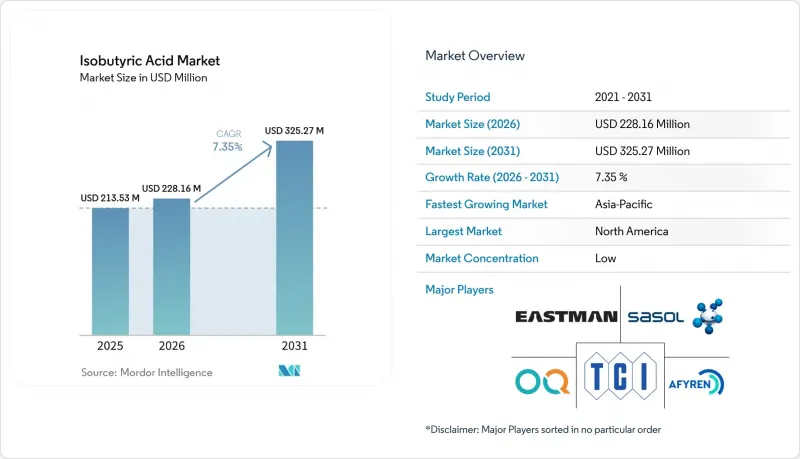
에 따르면 세계의 이소부티르산 시장 규모는 2025년에 2억 1,353만 달러로 평가되어 예측 기간(2026-2031년)에 CAGR 7.35%로 확대하며, 2026년 2억 2,816만 달러에서 2031년에는 3억 2,527만 달러에 달할 것으로 추정되고 있습니다.
전 세계 이소부티르산 시장의 동향 및 인사이트
의약품 및 특수 화학 중간체의 수요 확대
제약 업계에서는 고순도 이소부티르산이 의약품 유효 성분(API) 합성시 C4 중간체로 사용되고 있습니다. 제조사들은 이 물질을 항염증약, 진통제, 항경련제 제조는 물론, 부형제 배합 및 약제 안정화에도 활용하고 있습니다. 전 세계 처방약 지출액은 종양학, 면역학, 당뇨병 치료제 수요에 힘입어 2025년에는 1조 7,000억 달러에 달했습니다. 인도와 중국에서의 수탁제조(CMO) 활동 확대가 의약품 지출 전체의 성장률을 상회하는 속도로 지역 수요를 견인하고 있습니다. 유럽 의약품·의료 품질청(EDQM) 및 미국 약전(USP)의 요건에 따라 순도 98% 이상의 원료 조달이 요구되고 있습니다. 이러한 요건으로 인해 이소부티르산 시장에서 품질 기준 및 공급업체 적격성 평가의 중요성이 높아지고 있습니다.
사료용 기능성 첨가제의 수요 증가
항생제계 성장 촉진제에 대한 규제로 인해 이소부티르산 및 그 염류의 사용 범위가 방부제 용도에서 가축 사료첨가제 배합으로 확대되고 있습니다. 유럽연합 집행위원회 시행규칙(EU) 2025/2186에 따라 프로피온산, 프로피온산 나트륨 및 프로피온산 암모늄의 육상 동물용 사료첨가제로서의 승인이 갱신되었습니다. 이러한 규제 방향은 사료 프로그램에서 기능성 대체재로서 유기산의 사용을 지원하고 있습니다. 이소부티르산은 돼지와 가금류에 적용될 경우, 장내 pH를 낮추고 병원성 세균의 세포막을 파괴하며 사료 전환율을 개선할 수 있습니다. 수요 증가는 사육 두수 및 항생제 규제 시행 시기에 따라 좌우됩니다. 그 결과, 유럽 및 동남아시아 시장은 이소부티르산 시장에 성장 기회를 제공하고 있습니다.
프로필렌 및 석유화학 원료 가격 변동
합성 생산은 주요 탄소 원료로서 프로필렌에 의존하고 있으며, 생산자는 석유화학제품의 가격 변동 영향을 받습니다. 2025년 10월, 원유 가격 하락과 폴리프로필렌 수요 감소로 인해 프로필렌 가격은 하락했으나, 2026년에는 공급 차질로 인해 상류 공정의 비용 압박이 가중되었습니다. 특히 중국에서 프로판 탈수소 공정에 의존하는 생산자들은 프로판 공급 차질이나 중동의 물류 상황에 영향을 받기 쉬운 경향이 있습니다. 통합형 나프타 크래커 사업자는 서로 다른 비용 구조를 가지고 있으며, 그 결과 원료에 대한 의존도에 지역별 차이가 발생하고 있습니다. 이러한 차이로 인해 중국의 수출 가격과 유럽의 계약 가격 간의 격차가 확대될 가능성이 있습니다. 그 결과, 이소부티르산 시장에서 고정 가격에 따른 공급 계약을 유지하는 것이 더욱 어려워질 수 있습니다.
부문별 분석
2025년, 산업용 등급은 이소부티르산 시장 점유율의 63.71%를 차지하고 있으며, 2026-2031년에 연평균 성장률(CAGR) 7.63%로 확대될 것으로 예측됩니다. 이러한 위상은 에스테르 생산, 도료 중간체, 동물 사료 및 화학 합성 분야의 수요를 반영한 것입니다. 이러한 용도 기반 접근 방식은 단일 고객 부문의 취약점이 미치는 영향을 제한합니다. 또한 산업용 등급의 사양은 도료 및 화학 중간체 용도에서 대규모 조달을 가능하게 합니다. 중국 및 유럽의 공급망에서는 산업용 등급과 시약용 등급의 생산이 밀접하게 연결되어 있는 경우가 많기 때문에 산업용 등급의 공급이 부족해지면 실험실용 공급 상황에도 영향을 미칠 가능성이 있습니다.
EU의 산업 배출 규제로 인해 유럽 생산자들의 운영 비용 기반이 상승하고 있습니다. 이러한 비용 차이로 인해 도착 가격이 주요 구매 기준이 되는 규제 대상이 아닌 시장에서 중국 공급업체가 우위를 점할 가능성이 있습니다. 시약 등급은 실험실, 의약품 합성 및 표준물질 용도로 사용됩니다. 도쿄 화학 공업, 후지필름 와코 순약 및 상하이 알라딘 생화 기술은 이러한 용도를 위해 인증된 제품을 공급하고 있습니다. 시약 등급 제품의 매출 규모는 작지만, 전문 유통업체에게는 높은 이익률을 가져다줍니다. 인도와 중국에서 제네릭 의약품 파이프라인이 확대됨에 따라 이소부티르산 업계에서는 학술·연구 기관 이외의 고객으로부터의 수요도 증가하고 있습니다.
2025년에는 순도 98% 이상의 제품이 이소부티르산 시장 점유율의 70.05%를 차지할 것으로 예상되며, 2031년까지 연평균 성장률(CAGR) 7.82%로 성장할 것으로 전망됩니다. 이 성장률은 시장 전체의 예측치를 상회하는 것으로, 그 배경에는 제약 업계의 구매자나 고급 에스테르 제조업체들이 더욱 엄격한 순도 기준을 요구하고 있기 때문입니다. 고순도 원료를 사용함으로써 완성된 의약품 제제나 향료용 에스테르에 포함된 잔류 불순물을 줄일 수 있습니다. 부적합 위험의 저감은 조달 과정에서 중요한 판단 기준이 되고 있습니다. 제약 및 식품 업계의 고객들은 적합성 감사나 제품 시험을 통해 순도 요건을 정하는 경우가 많으며, 이를 통해 이소부티르산 시장내 공급업체와의 관계가 강화되고 있습니다.
순도 98% 미만의 등급은 도료, 가소제, 농약 등 비용을 중시하는 용도로 사용됩니다. 산동성, 절강성, 장쑤성의 생산자들은 원료 통합과 낮은 생산 비용을 활용하여 이 부문에 대응하고 있습니다. 기술적 허용 범위가 넓기 때문에 구매자는 이러한 용도에서 가격을 우선시할 수 있습니다. 이익률 압박으로 인해 일부 생산자들은 고순도 사양으로의 전환을 추진하고 있습니다. 이러한 전환으로 인해 상품 기반 입장에 따른 비용 우위는 낮아질 가능성이 있는 반면, 이소부티르산 업계에서 고순도 소재가 수행하는 고유한 역할은 유지될 것입니다.
지역별 분석
2025년, 북미는 전 세계 이소부티르산 시장 점유율의 34.27%를 차지했습니다. 미국은 생산 시장이자 소비 시장으로서의 역할을 수행하고 있습니다. 이스트만 케미컬(Eastman Chemical)은 테네시주 킹스포트와 텍사스주 롱뷰에 제조 거점을 두고 있으며, 이 지역의 공급 기반을 지원하고 있습니다. 의약품 제조 및 향료·화장품 용도가 프리미엄 등급 원료에 대한 수요를 견인하고 있습니다. 미국 농무부(USDA)의 재생 가능 화학 물질에 대한 지원은 바이오 유래 대체재에 새로운 기회를 제공하고 있습니다. 라이고스(Ligos)사의 USDA ‘BioPreferred’ 인증을 획득한 원료는 다른 지역에서는 이용할 수 없는 연방 정부의 조달 경로에 접근할 수 있습니다.
아시아태평양은 2026-2031년까지 연평균 성장률(CAGR) 8.17%로 성장할 것으로 예측됩니다. 중국은 생산 능력과 소비를 모두 갖추고 있는 반면, 인도에서는 의약품 중간체에 대한 수요가 증가하고 있습니다. 생산은 산동성, 절강성, 장쑤성에 집중되어 있으며, 이 지역의 생산자들은 프로판 탈수소 및 스팀 크래킹 복합 시설에서 프로필렌을 조달하고 있습니다. 하이데라바드와 아메다바드에서의 제네릭 의약품 제조는 고순도 원료의 사용을 지원하고 있습니다. 일본과 한국에서는 향료, 방향제, 전자 화학 약품의 배합에 고사양 등급이 요구되고 있습니다. 아세안(ASEAN) 국가들로부터 축산 및 가공 식품용 수요가 증가하고 있으며, 해당 지역의 이소부티르산 시장을 지원하고 있습니다.
유럽은 독일, 프랑스, 영국, 베네룩스 국가의 의약품, 향료, 화장품 산업에 힘입어 지역 시장에서 2위의 규모를 차지하고 있습니다. 2025년 5월 OQ Chemicals에서 사명을 변경한 OXEA는 독일 오버하우젠에 생산 거점을 두고 있습니다. 이 지역에서 항생제 성장 촉진제에서 벗어나는 추세는 가금류 및 돼지 생산자들의 유기산 채택을 촉진하고 있습니다. AFYREN사의 생-아볼드 바이오리파이너리는 유럽 바이어들에게 바이오 유래 산의 지역적 공급원을 제공하고 있습니다. 브라질, 아르헨티나, 사우디아라비아는 축산 용도, 농업용 화학제품, 특수 화학제품 분야에서 비교적 소규모의 수요 거점으로 자리 잡고 있습니다. 이러한 신흥 시장은 예측 기간 후반에 더 큰 기여를 할 것으로 예상됩니다.
기타 혜택:
- 엑셀 형식의 시장 예측(ME) 시트
- 3개월간의 애널리스트 지원
자주 묻는 질문
목차
제1장 서론
- 조사 전제조건과 시장 정의
- 조사 범위
제2장 조사 방법
제3장 개요
제4장 시장 구도
- 시장 개요
- 시장 성장 촉진요인
- 시장 성장 억제요인
- 밸류체인 분석
- Porter's Five Forces 분석
제5장 시장 규모와 성장 예측
- 등급별
- 순도별
- 유형별
- 최종사용자 산업별
- 지역별
- 아시아태평양
- 중국
- 인도
- 일본
- 한국
- ASEAN 국가
- 기타 아시아태평양 국가
- 북미
- 미국
- 캐나다
- 멕시코
- 유럽
- 독일
- 영국
- 프랑스
- 이탈리아
- 북유럽 국가
- 기타 유럽 국가
- 남미
- 브라질
- 아르헨티나
- 기타 남미 국가
- 중동 및 아프리카
- 사우디아라비아
- 남아프리카공화국
- 기타 중동 및 아프리카 국가
- 아시아태평양
제6장 경쟁 구도
- 시장 집중도
- 전략적 동향
- 시장 점유율·순위 분석
- 기업 개요
- AFYREN
- Eastman Chemical Company
- FUJIFILM Wako Pure Chemical Corporation
- Hubei Jusheng Technology Co., Ltd.
- Jiangsu Dynamic Chemical Co., Ltd.
- Lygos, Inc.
- Nanjing Chemical Material Corp.
- OQ Chemicals GmbH
- Perstorp Holding AB
- Sasol
- Shanghai Aladdin Biochemical Technology Co., Ltd.
- Snowco
- Tokyo Chemical Industry Co., Ltd.
- Weifang Qiyi Chemical Co., Ltd.
- Yufeng International Group Co., Ltd.
제7장 시장 기회와 향후 전망
KSA 26.10.30According to Mordor Intelligence, the global isobutyric acid market size was valued at USD 213.53 million in 2025 and is estimated to grow from USD 228.16 million in 2026 to USD 325.27 million by 2031, at a CAGR of 7.35% during the forecast period (2026-2031).
Global Isobutyric Acid Market Trends and Insights
Expansion of Pharmaceutical and Specialty-Chemical Intermediates
The pharmaceutical sector uses high-purity isobutyric acid as a C4 intermediate in the synthesis of active pharmaceutical ingredients (APIs). Manufacturers use the material to produce anti-inflammatory drugs, analgesics, and anticonvulsants, as well as in excipient formulations and drug stabilization. Global prescription medicine spending reached USD 1.7 trillion in 2025, driven by oncology, immunology, and diabetes therapies. Contract manufacturing activity in India and China drives regional demand at a rate exceeding overall pharmaceutical spending growth. Requirements from the European Directorate for the Quality of Medicines & HealthCare (EDQM) and the United States Pharmacopeia support procuring materials with purity levels above 98%. These requirements increase the importance of quality standards and supplier qualification in the isobutyric acid market.
Rising Animal-Feed Functional Additive Demand
Restrictions on antibiotic growth promoters are expanding the use of isobutyric acid and its salts from preservative applications to livestock feed additive formulations. Commission Implementing Regulation (EU) 2025/2186 renewed the authorization of propionic acid, sodium propionate, and ammonium propionate as feed additives for terrestrial animal species. This regulatory direction supports the use of organic acids as functional alternatives in animal feed programs. Isobutyric acid can reduce gut pH, disrupt pathogenic bacterial membranes, and improve feed conversion in swine and poultry applications. Demand growth depends on herd size and the timing of antibiotic restrictions. Consequently, European and Southeast Asian markets present growth opportunities for the isobutyric acid market.
Propylene and Petrochemical Feedstock Price Volatility
Synthetic production relies on propylene as a primary carbon feedstock, exposing producers to petrochemical price cycles. Propylene prices weakened in October 2025 due to lower crude oil prices and reduced polypropylene demand, before supply disruptions increased upstream cost pressures in 2026. Producers with exposure to propane dehydrogenation, particularly in China, are sensitive to propane supply disruptions and Middle East logistics conditions. Integrated naphtha cracker operators have a different cost profile, resulting in regional variations in feedstock exposure. This divergence can widen the gap between Chinese export prices and European contract prices. Consequently, supply agreements with fixed prices may become more difficult to maintain in the isobutyric acid market.
Other drivers and restraints analyzed in the detailed report include:
- Growth in Food, Flavor, and Fragrance Ester Applications
- Shift Toward Renewable and Low-Carbon Organic Acids
- Corrosive-Handling, Storage, and Bio-Based Cost Requirements
For complete list of drivers and restraints, kindly check the Table Of Contents.
Segment Analysis
Industrial grade held 63.71% of the isobutyric acid market share in 2025 and is projected to expand at a CAGR of 7.63% from 2026 to 2031. Its position reflects demand from ester production, coating intermediates, animal nutrition, and chemical synthesis. This application-based approach limits exposure to weaknesses in any single customer segment. Industrial-grade specifications also support large-scale procurement for coatings and chemical intermediate applications. Supply chains in China and Europe often link industrial-grade and reagent-grade production; therefore, tighter industrial-grade supply can also affect availability for laboratory customers.
EU industrial emissions requirements are increasing the operating cost base for European producers. This cost differential may give Chinese suppliers an advantage in non-regulated markets, where landed cost is the primary purchasing criterion. Reagent grade is used in laboratories, pharmaceutical synthesis, and reference-standard applications. Tokyo Chemical Industry, FUJIFILM Wako Pure Chemical, and Shanghai Aladdin Biochemical Technology supply certified products for these applications. Although the reagent-grade category has a smaller revenue base, it generates higher margins for specialty distributors. Expanding generic drug pipelines in India and China are increasing demand beyond academic and research customers in the isobutyric acid industry.
Material with more than 98% purity accounted for 70.05% of the isobutyric acid market share in 2025 and is forecast to grow at a CAGR of 7.82% through 2031. This rate exceeds the overall market forecast because pharmaceutical buyers and premium ester producers require tighter purity thresholds. Higher-purity material can reduce residual impurities in finished drug formulations and flavor esters. Lower rejection risk has become a measurable procurement consideration. Pharmaceutical and food customers often establish purity requirements through qualification audits and product testing, thereby strengthening supplier relationships in the isobutyric acid market.
The less-than-98%-purity tier serves cost-sensitive applications in coatings, plasticizers, and agricultural chemicals. Producers in Shandong, Zhejiang, and Jiangsu leverage feedstock integration and lower production costs to serve this segment. Broader technical tolerances enable buyers to prioritize price in these applications. Margin pressure is encouraging some producers to shift toward higher-purity specifications. This transition may reduce the cost advantage associated with a commodity-based position while maintaining a distinct role for high-purity material in the isobutyric acid industry.
Complete Report Scope:
- By Grade
- Reagent Grade
- Industrial Grade
- By Purity
- More Than 98%
- Less Than 98%
- By Type
- Synthetic Isobutyric Acid
- Renewable Isobutyric Acid
- By End-User Industry
- Animal Feed
- Chemical Intermediates
- Food and Flavors
- Pharmaceuticals
- Perfumes
- Protective Coatings
- Other End-Uses
- By Geography
- Asia-Pacific
- China
- India
- Japan
- South Korea
- ASEAN Countries
- Rest of Asia-Pacific
- North America
- United States
- Canada
- Mexico
- Europe
- Germany
- United Kingdom
- France
- Italy
- NORDIC Countries
- Rest of Europe
- South America
- Brazil
- Argentina
- Rest of South America
- Middle East and Africa
- Saudi Arabia
- South Africa
- Rest of Middle East and Africa
- Asia-Pacific
Geography Analysis
North America accounted for 34.27% of the global isobutyric acid market share in 2025. The United States serves as a production and consumption market. Eastman Chemical Company operates manufacturing sites in Kingsport, Tennessee, and Longview, Texas, supporting the regional supply base. Pharmaceutical manufacturing and flavor and fragrance applications drive demand for premium-grade material. USDA support for renewable chemicals creates opportunities for bio-based variants. Lygos' USDA BioPreferred-certified material can access federal procurement channels unavailable in all regions.
Asia-Pacific is projected to grow at a CAGR of 8.17% from 2026 to 2031. China combines production capacity with consumption, while demand for pharmaceutical intermediates is increasing in India. Production is concentrated in Shandong, Zhejiang, and Jiangsu, where producers access propylene from propane dehydrogenation and steam-cracking complexes. Generic drug manufacturing in Hyderabad and Ahmedabad supports the use of high-purity material. Japan and South Korea require high-specification grades for flavor, fragrance, and electronic chemical formulations. Demand from ASEAN countries for livestock production and processed foods is increasing, supporting the regional isobutyric acid market.
Europe holds the second-largest regional market position, supported by the pharmaceutical, flavor, and fragrance industries in Germany, France, the United Kingdom, and Benelux. OXEA, which rebranded from OQ Chemicals in May 2025, operates a production site in Oberhausen, Germany, that isn't. The region's transition away from antibiotic growth promoters supports the adoption of organic acids among poultry and swine producers. AFYREN's Saint-Avold biorefinery provides European buyers with a regional source of bio-based acids. Brazil, Argentina, and Saudi Arabia represent smaller demand centers for livestock applications, agricultural chemicals, and specialty chemicals. These emerging markets are projected to contribute more during the later years of the forecast period.
- AFYREN
- Eastman Chemical Company
- FUJIFILM Wako Pure Chemical Corporation
- Hubei Jusheng Technology Co., Ltd.
- Jiangsu Dynamic Chemical Co., Ltd.
- Lygos, Inc.
- Nanjing Chemical Material Corp.
- OQ Chemicals GmbH
- Perstorp Holding AB
- Sasol
- Shanghai Aladdin Biochemical Technology Co., Ltd.
- Snowco
- Tokyo Chemical Industry Co., Ltd.
- Weifang Qiyi Chemical Co., Ltd.
- Yufeng International Group Co., Ltd.
Additional Benefits:
- The market estimate (ME) sheet in Excel format
- 3 months of analyst support
TABLE OF CONTENTS
1 Introduction
- 1.1 Study Assumptions and Market Definition
- 1.2 Scope of the Study
2 Research Methodology
3 Executive Summary
4 Market Landscape
- 4.1 Market Overview
- 4.2 Market Drivers
- 4.2.1 Expansion of Pharmaceutical and Specialty-Chemical Intermediates
- 4.2.2 Rising Animal-Feed Functional Additive Demand
- 4.2.3 Growth in Food, Flavor and Fragrance Ester Applications
- 4.2.4 Shift Toward Renewable and Low-Carbon Organic Acids
- 4.2.5 CO2-to-Isobutyric-Acid Bioconversion Advances
- 4.3 Market Restraints
- 4.3.1 Propylene and Petrochemical Feedstock Price Volatility
- 4.3.2 Corrosive-Handling, Storage and Transport Requirements
- 4.3.3 Limited Bio-Based Scale and Cost Parity
- 4.4 Value Chain Analysis
- 4.5 Porter's Five Forces Analysis
- 4.5.1 Bargaining Power of Suppliers
- 4.5.2 Bargaining Power of Buyers
- 4.5.3 Threat of New Entrants
- 4.5.4 Threat of Substitutes
- 4.5.5 Competitive Rivalry
5 Market Size and Growth Forecasts (Value)
- 5.1 By Grade
- 5.1.1 Reagent Grade
- 5.1.2 Industrial Grade
- 5.2 By Purity
- 5.2.1 More Than 98%
- 5.2.2 Less Than 98%
- 5.3 By Type
- 5.3.1 Synthetic Isobutyric Acid
- 5.3.2 Renewable Isobutyric Acid
- 5.4 By End-User Industry
- 5.4.1 Animal Feed
- 5.4.2 Chemical Intermediates
- 5.4.3 Food and Flavors
- 5.4.4 Pharmaceuticals
- 5.4.5 Perfumes
- 5.4.6 Protective Coatings
- 5.4.7 Other End-Uses
- 5.5 By Geography
- 5.5.1 Asia-Pacific
- 5.5.1.1 China
- 5.5.1.2 India
- 5.5.1.3 Japan
- 5.5.1.4 South Korea
- 5.5.1.5 ASEAN Countries
- 5.5.1.6 Rest of Asia-Pacific
- 5.5.2 North America
- 5.5.2.1 United States
- 5.5.2.2 Canada
- 5.5.2.3 Mexico
- 5.5.3 Europe
- 5.5.3.1 Germany
- 5.5.3.2 United Kingdom
- 5.5.3.3 France
- 5.5.3.4 Italy
- 5.5.3.5 NORDIC Countries
- 5.5.3.6 Rest of Europe
- 5.5.4 South America
- 5.5.4.1 Brazil
- 5.5.4.2 Argentina
- 5.5.4.3 Rest of South America
- 5.5.5 Middle East and Africa
- 5.5.5.1 Saudi Arabia
- 5.5.5.2 South Africa
- 5.5.5.3 Rest of Middle East and Africa
- 5.5.1 Asia-Pacific
6 Competitive Landscape
- 6.1 Market Concentration
- 6.2 Strategic Moves
- 6.3 Market Share (%)/Ranking Analysis
- 6.4 Company Profiles (includes Global Overview, Market Overview, Core Segments, Financials as available, Strategic Information, Products and Services, and Recent Developments)
- 6.4.1 AFYREN
- 6.4.2 Eastman Chemical Company
- 6.4.3 FUJIFILM Wako Pure Chemical Corporation
- 6.4.4 Hubei Jusheng Technology Co., Ltd.
- 6.4.5 Jiangsu Dynamic Chemical Co., Ltd.
- 6.4.6 Lygos, Inc.
- 6.4.7 Nanjing Chemical Material Corp.
- 6.4.8 OQ Chemicals GmbH
- 6.4.9 Perstorp Holding AB
- 6.4.10 Sasol
- 6.4.11 Shanghai Aladdin Biochemical Technology Co., Ltd.
- 6.4.12 Snowco
- 6.4.13 Tokyo Chemical Industry Co., Ltd.
- 6.4.14 Weifang Qiyi Chemical Co., Ltd.
- 6.4.15 Yufeng International Group Co., Ltd.
7 Market Opportunities and Future Outlook
- 7.1 White-Space and Unmet-Need Assessment


