

|
시장보고서
상품코드
2157136
수소화 스티렌계 블록 코폴리머 : 시장 점유율 분석, 업계 동향과 통계, 성장 예측(2026-2031년)Hydrogenated Styrene Block Copolymers - Market Share Analysis, Industry Trends & Statistics, Growth Forecasts (2026 - 2031) |
||||||
 Mordor Intelligence
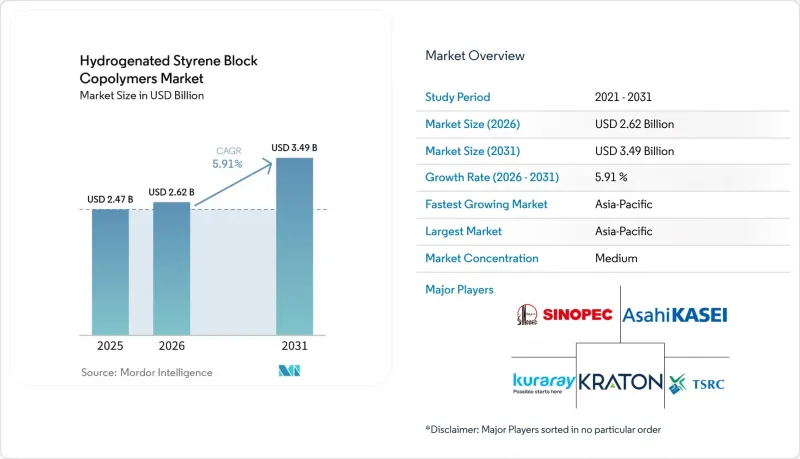
에 따르면 수소화 스티렌 블록 코폴리머 시장 규모는 2025년에 24억 7,000만 달러로 평가되며, 2026년 26억 2,000만 달러에서 2031년까지 34억 9,000만 달러에 달할 것으로 추정되고 있으며, 예측 기간(2026-2031년)에 CAGR은 5.91%에 달할 전망입니다.
전 세계 수소화 스티렌 블록 공중합체 시장의 동향 및 인사이트
자동차 경량화 및 전기자동차 부품의 내구성
전기자동차의 아키텍처에 따라 수소화 스티렌 블록 공중합체는 배터리 인클로저, 고전압 케이블 절연체, 열 인터페이스 층 및 할로겐 프리 그로밋 시스템 분야에서 새로운 용도로 활용되고 있습니다. 이러한 부품에는 압축 영구 변형 성능을 유지하면서 -40°C에서 120°C 이상의 온도 범위에서 작동 가능한 엘라스토머 컴파운드가 요구됩니다. SEBS 배합은 이러한 까다로운 용도에서 수년간 실적을 쌓아 왔습니다. 크라톤(Kraton)은 2026년 8월, 오일 프리 열가소성 엘라스토머 컴파운드용 차세대 SEBS 등급인 ‘MD1672’를 출시했습니다. 이 등급은 실온에서의 압축 영구 변형을 최대 30% 개선하고, 차단성을 향상시키는 동시에 휘발성 유기 화합물(VOC) 및 포깅 배출량을 저감합니다. 자동차 제조사들이 내구성, 저배출성, 효율적인 가공성을 겸비한 소재를 요구하는 가운데, 수소화 스티렌 블록 코폴리머 시장은 그 혜택을 누릴 가능성이 있습니다.
의료용 등급, 비PVC 소재의 적합성 평가
의료기기 용도의 경우, 공급업체가 생체 적합성, 추출물 및 가공의 일관성을 입증할 수 있을 때 수소화 스티렌 블록 코폴리머가 채택됩니다. 쿠라레의 ‘셉톤(SEPTON)’ 의료용 등급에는 2000 시리즈의 스티렌-에틸렌-프로필렌-스티렌 계열 소재, 4000 시리즈의 스티렌-에틸렌-에틸렌프로필렌-스티렌 계열 소재 및 8000 시리즈의 스티렌·에틸렌·부틸렌·스티렌 계열 소재가 포함됩니다. 이러한 등급은 혈액과의 상호작용 시험 및 세포 독성 시험을 포함한 ISO 10993 시험 기록 외에도, 미국 약전(USP) 클래스 VI 적합성 인증서를 보유하고 있습니다. 아사히카세이 주식회사의 의료용 튜브용 ‘TUFTEC’ 및 ‘S.O.E.’ 등급은 가소제를 포함하지 않으며, 121°C에서의 증기 멸균을 견딜 수 있습니다. 이 회사에 따르면 실용 시험에서 이러한 소재는 폴리염화비닐(PVC)에 비해 이소소르비드 모노니트레이트 및 미코나졸의 흡착량이 적은 것으로 확인되었습니다. 의료용 인증 절차에는 시간이 소요되며, 인증을 받지 않은 대체 제품의 경우 시장 진입 장벽이 높기 때문에 수소화 스티렌 블록 공중합체 시장의 수요는 장기적으로 확대될 전망입니다.
스티렌, 부타디엔, 이소프렌 원료 가격의 변동성
수소화 스티렌 블록 공중합체 생산자들은 서로 다른 석유화학 공급 경로를 통해 스티렌, 부타디엔, 이소프렌을 조달하고 있습니다. 가격 변동이 반드시 동시에 발생하는 것은 아니기 때문에 이러한 위험에 노출됨으로써 이익률 계획 수립이 어려워지고 있습니다. 2025년 초, 걸프 코스트 지역의 크래커 설비 가동 중단으로 인해 스티렌 가격은 35%, 부타디엔 가격은 28% 상승했습니다. 쿠라레는 2026년, 원자재비 및 에너지비가 사내에서 흡수할 수 있는 범위를 초과함에 따라 ‘셉톤’ 및 ‘하이브랄’의 전 세계 가격 인상을 발표했습니다. 자체적으로 모노머를 공급할 수 있는 제조업체는 외부 구매에 의존하는 기업보다 이러한 비용 변동을 보다 효과적으로 관리할 수 있습니다. 이러한 제약으로 인해 원자재 가격이 급등할 경우, 하류 고객은 경쟁 소재의 적합성을 평가하게 될 수도 있습니다.
부문별 분석
2025년, 스티렌-에틸렌-부틸렌-스티렌(SEBS)은 수소화 스티렌 블록 공중합체 시장 점유율의 57.73%를 차지했습니다. 이러한 높은 점유율은 가공유 및 폴리프로필렌과의 호환성뿐만 아니라, 다양한 용도에서 입증된 내열성 및 내화학성을 반영한 것입니다. 핫멜트 접착제, 자동차용 실, 의료용 튜브는 모두 이 소재의 유연한 배합 특성을 활용하고 있습니다. 이 제품군의 수소화 스티렌 블록 공중합체 시장 규모는 적합한 용도에서의 사용에 의해 지원되고 있습니다. 2023년과 2024년에 기초 수소화 특허가 만료됨에 따라 범용 소재 간의 경쟁이 격화되고 있습니다. 이러한 경쟁으로 인해 표준 트리블록 폴리머의 공급뿐만 아니라 배합, 공급 신뢰성 및 고객 승인 실적이 더욱 중요하게 여겨지게 되었습니다.
스티렌·에틸렌·프로필렌·스티렌(SEPS)은 광학적 투명성이나 저온 유연성 등의 요구 사항에 힘입어 2031년까지 연평균 성장률(CAGR) 6.24%로 성장할 것으로 예측됩니다. 의료용 반창고, 약물전달용 라미네이트, 고급 화장품 포장재 등은 이러한 특성이 중요한 대표적인 용도입니다. 쿠라레의 2000 시리즈 스티렌·에틸렌·프로필렌·스티렌 및 4000 시리즈 스티렌·에틸렌·에틸렌·프로필렌·스티렌 제품은 ISO 10993 생체적합성 인증을 획득했습니다. 쿠라레의 ‘셉톤 바이오’ 시리즈는 사탕수수 유래의 β-파르네센을 사용하고 있으며, 바이오 함유율은 최대 80%에 달합니다. 이러한 제품 라인업을 통해 공급업체 간의 경쟁은 단순한 표준 소재뿐만 아니라, 인증을 받았거나 차별화된 등급으로 확대되고 있습니다.
지역별 분석
아시아태평양은 2025년에 수소화 스티렌 블록 공중합체 시장의 43.16% 점유율을 차지할 것으로 예상되며, 2031년까지 연평균 성장률(CAGR) 6.51%로 확대될 것으로 전망됩니다. 이 지역에서는 대규모 제조 수요, 현지 생산 능력 확대, 그리고 점점 더 전문화되는 용도가 결합되어 시장을 촉진하고 있습니다. 중국석유화공그룹(Sinopec)은 2024년 11월, 신규 시설 내에서 연간 5만 메트릭톤 규모의 스티렌·에틸렌·부틸렌·스티렌(SEBS) 생산 능력을 가동하기 시작했습니다. 이 프로젝트를 통해 중국 내에서 상업 규모의 수소화 스티렌 블록 공중합체 제조 공정 기술이 확립되었습니다. 일본과 한국은 의료용 및 고성능 자동차용 소재의 기술 거점으로서의 위상을 유지하고 있습니다. 아사히카세이 주식회사, 쿠라레, JSR 주식회사, 제온 주식회사는 해당 지역에서 특수 등급 개발을 지원하는 연구개발 거점을 보유하고 있습니다.
인도의 의료기기 및 특수 화학 제품 제조 개발은 이 지역의 새로운 수요 원천이 되고 있습니다. 베트남, 인도네시아, 태국의 접착제 및 신발 산업 클러스터는 수소화 소재 공급에 있으며, 여전히 주로 수입에 의존하고 있습니다. 이러한 공급 구조는 지역 판매 대리점을 지원하고, 고객이 인증 등급의 제품을 쉽게 구할 수 있게 해줄 뿐만 아니라, 전 세계 여러 지역 고객 그룹 및 용도 분야에서 수요가 점차 증가함에 따라 궁극적으로 현지 생산의 근거가 될 가능성이 있습니다. 북미와 유럽에서는 의료기기 인증, 전기자동차 실링, 고성능 건축용 접착제에 대한 관심이 계속되고 있습니다. 미국에서는 의료 규정 준수 요건 및 확대되는 전기자동차 제조 거점과 관련된 수요가 있습니다. 유럽에서는 재활용 가능한 내장재와 저배출 부품 설계를 요구하는 자동차 공급망의 수요가 있습니다.
크라톤 코퍼레이션은 2025년 10월, 프랑스 베르에서 수소화 스티렌 블록 공중합체의 생산을 중단하는 한편, 글로벌 네트워크를 통해 고객에 대한 공급을 유지할 것이라고 발표했습니다. 이 결정은 범용 등급의 전 세계적 공급 과잉을 반영한 것으로, 유럽의 조달 패턴에 변화를 가져올 가능성이 있습니다. 남미, 중동 및 아프리카는 비교적 소규모의 소비 지역이지만, 브라질과 사우디아라비아가 각 하위 지역의 수요를 주도하고 있습니다. 브라질의 건설용 접착제 시장 및 자동차 공급망의 수요는 대부분 수입으로 충당되고 있습니다. 남아프리카의 포장 및 헬스케어 분야에서는 가소제가 포함되지 않은 소재로의 대체 수요가 확산되고 있습니다.
기타 혜택:
- 엑셀 형식의 시장 예측(ME) 시트
- 3개월간의 애널리스트 지원
자주 묻는 질문
목차
제1장 서론
- 조사 전제조건과 시장 정의
- 조사 범위
제2장 조사 방법
제3장 개요
제4장 시장 구도
- 시장 개요
- 시장 성장 촉진요인
- 시장 성장 억제요인
- 밸류체인 분석
- Porter's Five Forces 분석
제5장 시장 규모와 성장 예측
- 제품 유형별
- 용도별
- 최종 용도 산업별
- 지역별
- 아시아태평양
- 중국
- 인도
- 일본
- 한국
- ASEAN 국가
- 기타 아시아태평양 국가
- 북미
- 미국
- 캐나다
- 멕시코
- 유럽
- 독일
- 영국
- 프랑스
- 이탈리아
- 북유럽 국가
- 기타 유럽 국가
- 남미
- 브라질
- 아르헨티나
- 기타 남미 국가
- 중동 및 아프리카
- 사우디아라비아
- 남아프리카공화국
- 기타 중동 및 아프리카 국가
- 아시아태평양
제6장 경쟁 구도
- 시장 집중도
- 전략적 동향
- 시장 점유율·순위 분석
- 기업 개요
- Asahi Kasei Corporation
- BASF
- China Petrochemical Corporation
- Dynasol Group
- JSR Corporation
- Kraton Corporation
- KURARAY CO., LTD.
- LCY Chemical Corp.
- Ningbo Changhong Polymer
- Teknor Apex Company
- TSRC
- Versalis S.p.A.
- ZEON CORPORATION
제7장 시장 기회와 향후 전망
KSA 26.10.30According to Mordor Intelligence, the hydrogenated styrene block copolymers market size was valued at USD 2.47 billion in 2025 and is estimated to grow from USD 2.62 billion in 2026 to reach USD 3.49 billion by 2031, at a CAGR of 5.91% during the forecast period (2026-2031).
Global Hydrogenated Styrene Block Copolymers Market Trends and Insights
Automotive Lightweighting and Electric Vehicle Component Durability
Electric vehicle architectures create uses for hydrogenated styrene block copolymers in battery enclosures, high-voltage cable insulation, thermal interface layers, and halogen-free grommet systems. These parts require elastomer compounds that can operate from -40 °C to above 120 °C while maintaining compression-set performance. SEBS formulations have established qualification histories for these demanding uses. Kraton Corporation launched its MD1672 next-generation SEBS grade in August 2026 for oil-free thermoplastic elastomer compounds. The grade provides up to 30% improved room-temperature compression set, improved barrier properties, and lower volatile organic compound (VOC) and fogging emissions. The hydrogenated styrene block copolymers market can benefit as automotive manufacturers seek materials that combine durability, lower emissions, and efficient processing.
Medical-Grade, Non-PVC Material Qualification
Medical-device applications support hydrogenated styrene block copolymers where suppliers can document biocompatibility, extractables, and processing consistency. KURARAY CO., LTD.'s SEPTON medical grades include the 2000-series Styrene Ethylene Propylene Styrene materials, 4000-series Styrene Ethylene Ethylene Propylene Styrene materials, and 8000-series Styrene Ethylene Butylene Styrene materials. These grades carry ISO 10993 testing records, including blood-interaction and cytotoxicity testing, along with United States Pharmacopeia Class VI documentation. Asahi Kasei Corporation's TUFTEC and S.O.E. grades for medical tubing are plasticizer-free and can withstand steam sterilization at 121 °C. The company states that the materials showed lower adsorption for isosorbide mononitrate and miconazole than polyvinyl chloride in its application testing. The hydrogenated styrene block copolymers market gains a longer demand runway because medical qualification work takes time and creates a high barrier for unqualified alternatives.
Styrene, Butadiene, and Isoprene Feedstock Volatility
Hydrogenated styrene block copolymer producers rely on styrene, butadiene, and isoprene from separate petrochemical supply streams. This exposure makes margin planning difficult because price movements do not necessarily occur at the same time. The styrene prices rose 35% and butadiene prices rose 28% in early 2025 after Gulf Coast cracker outages. KURARAY CO., LTD. announced global SEPTON and HYBRAR price revisions during 2026 as raw material and utility costs exceeded the company's ability to absorb them internally. Producers with captive monomer supply can manage these cost movements more effectively than companies that depend on external purchases. This constraint can lead downstream customers to qualify competing materials when material prices rise sharply.
Other drivers and restraints analyzed in the detailed report include:
- Growth of High-Performance Hot-Melt Adhesives and Sealants
- Asia-Pacific Infrastructure and Manufacturing Expansion
- High Hydrogenation Catalyst and Qualification Costs
For complete list of drivers and restraints, kindly check the Table Of Contents.
Segment Analysis
Styrene ethylene butylene styrene (SEBS) held 57.73% of the hydrogenated styrene block copolymers market share in 2025. Its large position reflects compatibility with processing oils and polypropylene, along with proven heat and chemical resistance in varied applications. Adhesive hot melts, automotive seals, and medical tubing all use the material's flexible compounding profile. The hydrogenated styrene block copolymers market size for this product family is supported by its use across qualified applications. Commodity competition has intensified after foundational hydrogenation patents expired during 2023 and 2024. This competition has placed greater importance on formulations, supply reliability, and customer approval records than on standard tri-block polymer supply alone.
Styrene ethylene propylene styrene (SEPS) is projected to advance at a 6.24% CAGR through 2031, supported by optical clarity and low-temperature flexibility requirements. Medical plasters, drug-delivery laminates, and premium cosmetic packaging are relevant uses where these properties matter. KURARAY CO., LTD.'s 2000-series Styrene Ethylene Propylene Styrene and 4000-series Styrene Ethylene Ethylene Propylene Styrene products have ISO 10993 biocompatibility documentation. KURARAY CO., LTD.'s SEPTON BIO-series uses sugarcane-derived beta-farnesene and offers up to 80% bio-content. These product options direct supplier competition toward certified or differentiated grades rather than standard material alone.
Complete Report Scope:
- By Product Type
- Styrene Ethylene Butylene Styrene (SEBS)
- Styrene Ethylene Propylene Styrene (SEPS)
- Others
- By Application
- Adhesives and Sealants
- Paints and Coatings
- Films
- Others
- By End-Use Industry
- Automotive
- Construction
- Footwear
- Chemicals
- Healthcare
- Others
- By Geography
- Asia-Pacific
- China
- India
- Japan
- South Korea
- ASEAN Countries
- Rest of Asia-Pacific
- North America
- United States
- Canada
- Mexico
- Europe
- Germany
- United Kingdom
- France
- Italy
- NORDIC Countries
- Rest of Europe
- South America
- Brazil
- Argentina
- Rest of South America
- Middle East and Africa
- Saudi Arabia
- South Africa
- Rest of Middle East and Africa
- Asia-Pacific
Geography Analysis
Asia-Pacific held 43.16% of the hydrogenated styrene block copolymers market share in 2025 and is projected to advance at a 6.51% CAGR through 2031. The region brings together large-scale manufacturing demand, local capacity additions, and increasingly specialized applications. China Petrochemical Corporation commissioned 50,000 metric tons per year of styrene ethylene butylene styrene capacity within its new facility in November 2024. The project established a commercial-scale domestic hydrogenated styrene block copolymer process technology in China. Japan and South Korea remain technology centers for medical-grade and high-performance automotive materials. Asahi Kasei Corporation, KURARAY CO., LTD., JSR Corporation, and ZEON CORPORATION have research and manufacturing operations that support specialty grade development in the region.
India's medical-device and specialty chemical manufacturing development adds another source of regional demand. Adhesive and footwear clusters in Vietnam, Indonesia, and Thailand continue to rely mainly on imported supplies for hydrogenated materials. This supply structure can support regional distributors, improve customer access to qualified grades, and create an eventual case for localized production as demand rise over time across several regional customer groups and application areas globally. North America and Europe remain focused on medical-device qualification, electric vehicle sealing, and high-performance construction adhesives. The United States has demand linked to medical compliance requirements and a growing electric vehicle manufacturing footprint. Europe has demand from automotive supply chains that are seeking recyclable interior materials and lower-emission component designs.
Kraton Corporation announced in October 2025 that it would stop hydrogenated styrene block copolymer production at Berre, France, while maintaining customer supply through its global network. The decision reflects global overcapacity in commodity grades and may alter European sourcing patterns. South America and Middle East and Africa represent smaller consumption areas, with Brazil and Saudi Arabia serving as demand anchors in their subregions. Brazil's construction adhesive activity and automotive supply chain create demand that is largely supplied by imports. South Africa's packaging and healthcare sectors follow wider substitution interest in plasticizer-free materials.
- Asahi Kasei Corporation
- BASF
- China Petrochemical Corporation
- Dynasol Group
- JSR Corporation
- Kraton Corporation
- KURARAY CO., LTD.
- LCY Chemical Corp.
- Ningbo Changhong Polymer
- Teknor Apex Company
- TSRC
- Versalis S.p.A.
- ZEON CORPORATION
Additional Benefits:
- The market estimate (ME) sheet in Excel format
- 3 months of analyst support
TABLE OF CONTENTS
1 Introduction
- 1.1 Study Assumptions and Market Definition
- 1.2 Scope of the Study
2 Research Methodology
3 Executive Summary
4 Market Landscape
- 4.1 Market Overview
- 4.2 Market Drivers
- 4.2.1 Automotive Lightweighting and Electric Vehicle Component Durability
- 4.2.2 Medical-Grade, Non-PVC Material Qualification
- 4.2.3 Growth of High-Performance Hot-Melt Adhesives and Sealants
- 4.2.4 Asia-Pacific Infrastructure and Manufacturing Expansion
- 4.2.5 Recyclable Multilayer Films and Polymer Compatibilization
- 4.3 Market Restraints
- 4.3.1 Styrene, Butadiene, and Isoprene Feedstock Volatility
- 4.3.2 High Hydrogenation Catalyst and Qualification Costs
- 4.3.3 Substitution by TPU, TPO, POE, PEBA, Silicone, and Engineered Olefins
- 4.4 Value Chain Analysis
- 4.5 Porter's Five Forces Analysis
- 4.5.1 Threat of New Entrants
- 4.5.2 Bargaining Power of Suppliers
- 4.5.3 Bargaining Power of Buyers
- 4.5.4 Threat of Substitutes
- 4.5.5 Competitive Rivalry
5 Market Size and Growth Forecasts (Value)
- 5.1 By Product Type
- 5.1.1 Styrene Ethylene Butylene Styrene (SEBS)
- 5.1.2 Styrene Ethylene Propylene Styrene (SEPS)
- 5.1.3 Others
- 5.2 By Application
- 5.2.1 Adhesives and Sealants
- 5.2.2 Paints and Coatings
- 5.2.3 Films
- 5.2.4 Others
- 5.3 By End-Use Industry
- 5.3.1 Automotive
- 5.3.2 Construction
- 5.3.3 Footwear
- 5.3.4 Chemicals
- 5.3.5 Healthcare
- 5.3.6 Others
- 5.4 By Geography
- 5.4.1 Asia-Pacific
- 5.4.1.1 China
- 5.4.1.2 India
- 5.4.1.3 Japan
- 5.4.1.4 South Korea
- 5.4.1.5 ASEAN Countries
- 5.4.1.6 Rest of Asia-Pacific
- 5.4.2 North America
- 5.4.2.1 United States
- 5.4.2.2 Canada
- 5.4.2.3 Mexico
- 5.4.3 Europe
- 5.4.3.1 Germany
- 5.4.3.2 United Kingdom
- 5.4.3.3 France
- 5.4.3.4 Italy
- 5.4.3.5 NORDIC Countries
- 5.4.3.6 Rest of Europe
- 5.4.4 South America
- 5.4.4.1 Brazil
- 5.4.4.2 Argentina
- 5.4.4.3 Rest of South America
- 5.4.5 Middle East and Africa
- 5.4.5.1 Saudi Arabia
- 5.4.5.2 South Africa
- 5.4.5.3 Rest of Middle East and Africa
- 5.4.1 Asia-Pacific
6 Competitive Landscape
- 6.1 Market Concentration
- 6.2 Strategic Moves
- 6.3 Market Share (%)/Ranking Analysis
- 6.4 Company Profiles (includes Global Overview, Market Overview, Core Segments, Financials as available, Strategic Information, Products and Services, and Recent Developments)
- 6.4.1 Asahi Kasei Corporation
- 6.4.2 BASF
- 6.4.3 China Petrochemical Corporation
- 6.4.4 Dynasol Group
- 6.4.5 JSR Corporation
- 6.4.6 Kraton Corporation
- 6.4.7 KURARAY CO., LTD.
- 6.4.8 LCY Chemical Corp.
- 6.4.9 Ningbo Changhong Polymer
- 6.4.10 Teknor Apex Company
- 6.4.11 TSRC
- 6.4.12 Versalis S.p.A.
- 6.4.13 ZEON CORPORATION
7 Market Opportunities and Future Outlook
- 7.1 White-Space and Unmet-Need Assessment


