

|
시장보고서
상품코드
2157137
정제 니켈 : 시장 점유율 분석, 업계 동향과 통계, 성장 예측(2026-2031년)Refined Nickel - Market Share Analysis, Industry Trends & Statistics, Growth Forecasts (2026 - 2031) |
||||||
 Mordor Intelligence
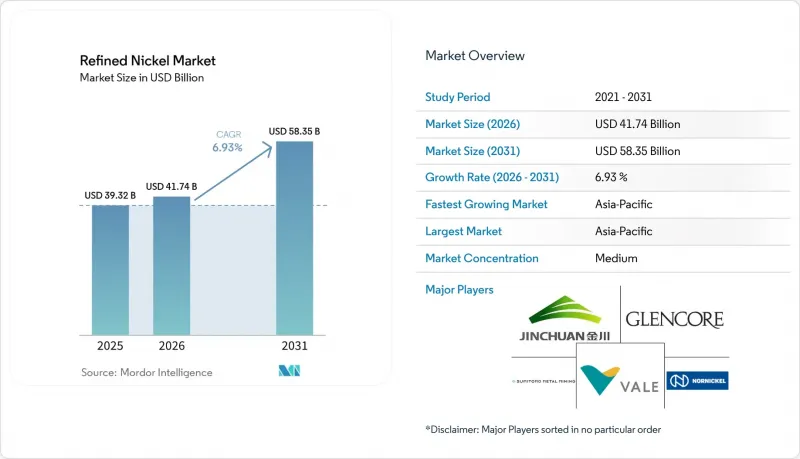
에 따르면 정제 니켈 시장 규모는 2025년 393억 2,000만 달러, 2026년 417억 4,000만 달러에서 2031년까지 583억 5,000만 달러로 확대될 것으로 예측되고 있으며, 2026-2031년까지 연평균 성장률(CAGR)은 6.93%에 달할 전망입니다.
세계 정제 니켈 시장의 동향 및 분석
스테인리스강 및 특수강 수요
스테인리스강은 건설, 기계, 운송 장비 및 공정 산업 분야에서 니켈을 함유한 오스테나이트계 강종이 사용되고 있으므로 정제 니켈 시장의 주요 수요원으로 자리매김하고 있습니다. INSG는 2026년에 스테인리스강이 1차 니켈 총 소비량의 3분의 2 이상을 차지할 것으로 예측하고 있으며, 이는 생산자와 트레이더에게 있으며, 주요 수요 기반으로서의 역할이 앞으로도 지속될 것임을 지원하고 있습니다. 중국과 인도네시아는 인프라 구축, 기계 생산, 수출용 제조, 그리고 국내 니켈 가공과 밀접하게 관련된 스테인리스강 생산 능력을 통해 이러한 수요를 지원하고 있습니다. 스크랩 이용 확대는 내식성과 내구성이 요구되는 분야에서 여전히 중요한 300계 스테인리스강 유형에 대한 니켈 수요를 저해하지 않으면서 배출량과 비용을 절감할 수 있습니다. 항공우주 및 에너지 장비에 사용되는 특수강은, 특히 고온이나 가혹한 작동 조건에 노출되는 부품의 경우, 정제 금속 시장에서는 규모는 작지만 고부가가치의 판로를 제공하고 있습니다. 이러한 용도는 배터리의 화학 조성 변화의 영향을 덜 받기 때문에 스테인리스강 구매 전반이 가격 변동의 영향을 받을 때에도 고품질 소재에 대한 수요를 지탱하고 있습니다.
고니켈 배터리 및 에너지 저장 분야로의 도입
정제 니켈 시장은 장거리 주행 차량이나 대형 전기자동차, 그리고 배터리의 무게와 에너지 밀도가 제품 설계에 직접적인 영향을 미치는 용도에서 니켈 함량이 높은 NMC 양극재에 대한 수요의 혜택을 받고 있습니다. 제조사가 비용 절감을 우선시하는 모델에서는 LFP 셀을 채택하고 있는 경우에도, 에너지 밀도가 차량의 성능이나 주행 거리에 영향을 미치는 분야에서는 이러한 양극재가 여전히 중요한 역할을 하고 있습니다. 2025년, 전 세계 배터리 에너지 저장 용량은 301.7기가와트에 달하여 전년 대비 66% 증가했으며, 배터리 공급망 전반에 걸쳐 훨씬 더 큰 수요 기반이 형성되었습니다. 따라서 고정형 에너지 저장 시스템은 용량의 상당 부분이 니켈 함유 양극재가 아닌 LFP 화학계를 채택하고 있음에도 불구하고 배터리 소재에 새로운 판로를 창출하고 있습니다. 미국의 조달 규정에 따라 자동차 제조사들은 중국이 지배하는 공급망 이외의 클래스 1 니켈 공급업체 인증을 추진하도록 권장받고 있으며, 이로 인해 추적 가능성이 있는 소재에 대한 평가가 변화하고 있습니다. 이는 필요한 조달 기준을 충족하고 차량 프로그램의 운영 기간 중 안정적으로 공급 가능한 소재에 대한 장기 공급 계약 협상을 촉진하는 요인이 되고 있습니다.
니켈 시장의 공급 과잉과 가격 변동
공급 과잉은 가격을 하락시키고 정제업체 및 광산 개발업체의 미래 현금 흐름에 대한 불확실성을 높이기 때문에 정제 니켈 시장 전반의 투자에 있으며, 주요 제약 요인으로 남아 있습니다. 2025년에는 인도네시아산 니켈 선철 및 혼합 수산화물 침전물의 생산량이 일부 최종 용도 분야의 소비량을 상회하는 속도로 증가함에 따라 시장에서는 20만 9,000톤의 공급 과잉이 기록되었습니다. 2025년 10월까지 LME와 SHFE의 창고 재고 합계는 28만 9,500톤을 넘어섰으며, 이는 거래소의 가시 재고에 얼마나 많은 자재가 존재하는지를 보여줍니다. LME 니켈 가격은 2025년 4월 톤당 1만 3,815달러에서 2026년 5월 톤당 1만 9,365달러 사이에서 거래되어, 생산자, 소비자 및 재고 보유자에게 광범위한 가격대가 형성되었습니다. 가격 변동은 이익률 계획을 어렵게 만들며, 사업자가 신규 생산 능력에 대한 명확한 투자 수익률을 전망할 수 없는 경우, 장기 사이클 프로젝트 결정을 지연시킬 가능성이 있습니다. 총 공급량은 여전히 확보되어 있지만, 소유권, 원산지, 품질 특성을 중요시하는 일부 유럽 및 미국 바이어들에게는 규격에 부합하는 클래스 1 소재를 확보하기가 더욱 어려운 상황입니다.
부문 분석
2025년, 표준 순도의 정제 니켈은 정제 니켈 시장의 60.15%를 차지하고 있으며, 이는 일부 특수 용도의 소비자 그룹보다는 스테인리스강 제조업체가 필요로 하는 대량의 금속 수요를 반영한 것입니다. 스테인리스강 생산은 확립된 현물 시장과 구매자에게 예측 가능한 품질 및 납품 조건을 제공하는 장기 제철소 공급 계약을 통해 이러한 위상을 지원하고 있습니다. LME에 등록된 음극, 원형, 펠릿은 널리 인정받고 있으며, 취급이 용이하고 확립된 용해 공정에 적합하므로 스테인리스강 공급망에서 여전히 중요한 위치를 차지하고 있습니다. 이 부문은 기존의 취급 시스템과 인정받은 제품 규격의 혜택을 받고 있으며, 이를 통해 고객이 공정을 변경하거나 대체 원료의 적합성을 확인할 필요가 줄어듭니다.
순도 99.9% 이상의 고순도 니켈은 기술 요구 사항이 점점 더 엄격해짐에 따라 표준 등급을 상회하는 연평균 성장률(CAGR) 7.34%로 2031년까지 확대될 것으로 예측됩니다. 배터리 양극 전구체, 특수 전기 도금 및 초합금의 경우, 미세한 변동도 성능, 생산 일관성 또는 인증에 영향을 미칠 수 있으므로 불순물에 대한 엄격한 관리가 요구됩니다. NMC 811의 제조에는 99.95%를 초과하는 순도와 코발트 및 구리 함량의 엄격한 관리가 필요하며, 이는 주로 스테인리스강에 사용되는 금속과는 명확히 구별됩니다. 노릴스크 니켈(Nornickel)은 2025년에 자사의 ‘Nornickel Plating Grade’ 제품 판매량이 30% 증가했다고 보고했는데, 이는 유서 깊은 제련 업체들이 자사 제품 포트폴리오 내에서 더 높은 부가가치를 창출할 수 있는 판매 기회를 모색하고 있음을 보여줍니다. 또한 유럽의 지속가능 금융 정책은 자본 접근성을 에너지 전환에서 정제 재료가 수행하는 역할과 더욱 밀접하게 연계함으로써 고순도 정제 프로젝트를 지원할 가능성이 있습니다.
2025년, 정제 니켈 시장 규모의 52.54%를 전기 정제 및 전기 추출이 차지하고 있으며, 이는 검증된 정제 시설의 방대한 도입 실적이 지원하고 있습니다. 노릴스크 니켈, 스미토모 금속 광산, 진촨 그룹이 운영하는 기존 시설은 일관된 가공 공정, 오랜 가동 실적, 그리고 구매자와의 확고한 관계를 통해 이 기술의 위상을 지원하고 있습니다. 이러한 사업체들은 인지도가 높은 브랜드, 통합된 공정, 그리고 거래소 및 산업 요건을 충족하는 고순도 소재 생산 경험을 보유하고 있습니다. 황화광석의 공급은 인도네시아 이외 지역의 전기 제련도 지원하고 있으며, 라테라이트 광석이나 HPAL 처리에 대한 의존도가 낮은 지역에서 이 방식이 중요한 위치를 차지하고 있습니다.
습식 제련은 라텔라이트 기반 처리 능력의 확대와 배터리 소재 중간체의 수요에 힘입어 2031년까지 연평균 성장률(CAGR) 7.56%로 성장할 것으로 예측됩니다. 이러한 성장은 인도네시아, 필리핀, 호주의 HPAL-MHP에서 황산니켈로의 생산 능력과 밀접한 관련이 있으며, 이들 지역에서는 사업자들이 광석 처리와 하류 화학 변환을 연계하고 있습니다. Nickel Industries의 ENC 프로젝트는 MHP, 황산니켈, 니켈 음극재의 새로운 생산 능력을 추가하고 있으며, 통합형 사업을 통해 실현 가능한 폭넓은 제품 구성을 보여주고 있습니다. 배터리 재활용도 전해 제련을 지원할 가능성이 있습니다. 연구에 따르면 리튬이온 배터리의 블랙매스 침출액에서 니켈 침전 효율은 78%에서 93%이며, 침전물의 순도는 90% 이상인 것으로 나타났습니다. 열제련을 통한 정제는 여전히 중요한 역할을 하고 있지만, 배터리용 화학 물질 수요에 더 직접적에 대응할 수 있는 라텔라이트 기반 처리 방식의 경쟁에 직면해 있습니다.
지역별 분석
아시아태평양은 2025년 정제 니켈 시장 점유율의 62.22%를 차지하고 있으며, 2031년까지 연평균 성장률(CAGR) 8.09%로 성장할 것으로 예측됩니다. 중국, 인도네시아, 일본, 한국은 대규모 소비량에 더해 가공 능력 및 고부가가치 제조 능력을 모두 갖추고 있습니다. 2025년, 중국은 전 세계 1차 니켈 소비량의 65% 이상을 차지했습니다. 중국의 1차 니켈 소비량은 2026년에 4.3% 증가할 것으로 예측됩니다. 인도네시아의 소비량은 2025년에 5.3% 증가할 것으로 예상되며, 2026년에는 10.3% 증가할 것으로 전망됩니다. 인도네시아의 스테인리스 제철소 및 배터리 공장에서는 국내에서 생산된 NPI 및 MHP가 소비되고 있습니다. 일본은 여전히 고품질 제련 거점을 유지하고 있는 반면, 인도는 스테인리스강 및 전기자동차 관련 활동을 통해 수요를 확대하고 있습니다.
북미와 유럽에서는 소비량 증가세가 완만하지만, 현지 가공 및 규제 준수 공급에 대한 관심이 높아지고 있습니다. 미국의 1차 니켈 소비량은 2025년에 5.2% 증가하고, 2026년에는 0.8% 증가할 것으로 예측됩니다. 미국의 ‘섹션 232’ 조치는 국내 스테인리스강 생산과 제철소의 수요를 지원하고 있습니다. 유럽의 니켈 사용량은 2025년에 0.5% 감소한 후, 2026년에는 1.8% 회복될 것으로 예측됩니다. 유럽연합(EU)의 ‘중요 원자재법’은 전략적 프로젝트에 대한 투자와 2030년까지 국내 가공 비율 40%라는 목표를 지원하고 있습니다. 이러한 정책으로 인해 지역 조달 요건을 충족하는 소재에 대한 독자적인 수요 기반이 형성되고 있습니다.
남미의 공급원으로는 발레 베이스 메탈스(Vale Base Metals)의 브라질 사업, 셰릿 인터내셔널(Sherritt International)의 쿠바 모아(Moa) 합작 사업, 그리고 사우스32(South32)의 콜롬비아 세로 마토소(Cerro Matoso) 사업이 포함됩니다. 발레 베이스 메탈스는 2026년 2월, 캐나다의 톰슨 니켈 벨트(Thompson Nickel Belt)에 최대 2억 달러를 투자하기 위한 컨소시엄을 구성했습니다. 셰릿(Sherritt)은 2025년에 모아에서 2만 5,240톤의 정제 니켈을 생산하고, 2026년에는 2만 6,000-2만 8,000톤을 생산할 전망이라고 밝혔습니다. 중동 및 아프리카는 여전히 소규모 공급 지역에 머물러 있습니다. 중국의 생산자들은 정책 환경이 더욱 엄격해지는 가운데, 인도네시아 이외의 지역에서 사업 기회를 모색하고 있습니다.
기타 혜택:
- 엑셀 형식의 시장 전망(ME) 시트
- 3개월간의 애널리스트 지원
자주 묻는 질문
목차
제1장 서론
- 조사 전제조건과 시장 정의
- 조사 범위
제2장 조사 방법
제3장 개요
제4장 시장 구도
- 시장 개요
- 시장 성장 촉진요인
- 시장 성장 억제요인
- 밸류체인 분석
- Porter's Five Forces 분석
제5장 시장 규모와 성장 예측
- 순도 등급별
- 생산 기술별
- 용도별
- 최종 용도 산업별
- 지역별
- 아시아태평양
- 중국
- 인도
- 일본
- 한국
- ASEAN 국가
- 기타 아시아태평양 국가
- 북미
- 미국
- 캐나다
- 멕시코
- 유럽
- 독일
- 영국
- 프랑스
- 이탈리아
- 북유럽 국가
- 러시아
- 기타 유럽 국가
- 남미
- 브라질
- 아르헨티나
- 기타 남미 국가
- 중동 및 아프리카
- 사우디아라비아
- 남아프리카공화국
- 기타 중동 및 아프리카 국가
- 아시아태평양
제6장 경쟁 구도
- 시장 집중도
- 전략적 동향
- 시장 점유율·순위 분석
- 기업 개요
- Anglo American
- BHP
- Eramet
- Glencore
- IGO Limited
- Jinchuan Group Co., Ltd.
- Nickel Industries Limited
- Norilsk Nickel
- PT Aneka Tambang Tbk
- Sherritt International Corporation
- South32
- Sumitomo Metal Mining Co., Ltd.
- TSINGSHAN HOLDING GROUP
- Vale
- Zhejiang Huayou Cobalt Co., Ltd.
제7장 시장 기회와 향후 전망
KSA 26.10.30According to Mordor Intelligence, the refined nickel market size is projected to expand from USD 39.32 billion in 2025 and USD 41.74 billion in 2026 to USD 58.35 billion by 2031, registering a CAGR of 6.93% between 2026 and 2031.
Global Refined Nickel Market Trends and Insights
Stainless Steel And Special Steel Demand
Stainless steel remains the main source of demand in the refined nickel market because it uses nickel-bearing austenitic grades across construction, machinery, transport equipment, and process industries. INSG expects stainless steel to account for more than two-thirds of total primary nickel consumption in 2026, confirming its continuing role as the volume base for producers and traders. China and Indonesia support this demand through infrastructure work, machinery production, export manufacturing, and stainless steel capacity that is closely linked to domestic nickel processing. Greater use of scrap can lower emissions and costs without eliminating nickel demand from 300-series stainless grades, which remain important where corrosion resistance and durability are required. Special steels used in aerospace and energy equipment provide a smaller but higher-value outlet for refined metal, particularly in components exposed to high temperatures or demanding operating conditions. These applications are less exposed to battery chemistry changes and support demand for high-grade material when broader stainless purchasing is affected by price movements.
High-Nickel Battery And Energy-Storage Deployment
The refined nickel market benefits from demand for nickel-rich NMC cathodes in long-range vehicles, larger electric vehicle formats, and uses where battery weight and energy density directly affect the product design. These cathodes remain relevant where energy density affects vehicle performance and driving range, even as manufacturers use LFP cells in models where lower cost is the priority. Global battery energy storage capacity reached 301.7 gigawatts in 2025, a 66% increase from the prior year, creating a much larger base for demand across the wider battery supply chain. Stationary storage, therefore, creates an additional channel for battery materials, even though much of its capacity uses LFP chemistry rather than nickel-bearing cathodes. United States sourcing rules are encouraging automakers to qualify Class 1 nickel suppliers outside Chinese-controlled supply chains, which changes the value placed on traceable material. This supports long-term offtake discussions for material that meets required sourcing standards and can be supplied consistently through the operating life of vehicle programs.
Nickel Market Surpluses And Price Volatility
Supply surpluses remain a major constraint on investment across the refined nickel market because they lower prices and make future cash flows less certain for refiners and mine developers. The market recorded a 209,000-tonne surplus in 2025 as Indonesian nickel pig iron and mixed hydroxide precipitate output increased faster than consumption in several end uses. Combined LME and SHFE warehouse stocks exceeded 289,500 tonnes by October 2025, showing the extent of material available in visible exchange inventories. LME nickel traded between USD 13,815 per ton in April 2025 and USD 19,365 per tonne in May 2026, creating a broad range for producers, consumers, and inventory holders. Price volatility makes margin planning difficult and can delay long-cycle project decisions when operators cannot establish a clear return on new capacity. Aggregate supply can still coexist with tighter availability of compliant Class 1 material for certain Western buyers that require ownership, origin, and quality characteristics.
Other drivers and restraints analyzed in the detailed report include:
- Industrialization And Infrastructure Investment
- Strategic Localization Of Critical-Mineral Processing
- LFP Battery Substitution And Slower High-Nickel EV Penetration
For complete list of drivers and restraints, kindly check the Table Of Contents.
Segment Analysis
Standard purity refined nickel held 60.15% of the refined nickel market in 2025, reflecting the large volume of metal needed by stainless steel producers rather than a narrow group of specialty consumers. Stainless steel production supports this position through established spot markets and long-term mill supply agreements that give buyers predictable quality and delivery arrangements. LME-registered cathodes, rounds, and pellets remain important to the stainless supply chain because they are widely recognized, easy to handle, and suitable for established melting practices. The segment benefits from existing handling systems and recognized product standards, which reduce the need for customers to alter processes or qualify alternative feedstocks.
High purity nickel with 99.9% or greater purity is forecast to expand at a 7.34% CAGR through 2031, ahead of standard grades as technical requirements become more demanding. Battery cathode precursors, specialty electroplating, and superalloys require tight control over impurities because minor variations can affect performance, production consistency, or qualification. NMC 811 production requires purity above 99.95% and closely controlled cobalt and copper content, creating a clear distinction from metal used primarily in stainless steel. Norilsk Nickel reported 30% volume growth for its Nornickel Plating Grade product in 2025, showing how established refiners are seeking higher-value sales within their product portfolios. European sustainable-finance policy could also support high-purity refining projects by making access to capital more closely tied to the role of refined materials in the energy transition.
Electrorefining and electrowinning held 52.54% of the refined nickel market size in 2025, supported by a substantial installed base of proven refinery operations. Established facilities operated by Norilsk Nickel, Sumitomo Metal Mining, and Jinchuan Group support this technology's position through integrated processing, long operating histories, and established relationships with buyers. These operations have recognized brands, integrated processes, and experience producing high-purity material that can meet exchange and industrial requirements. Sulfide ore feed also supports electrorefining outside Indonesia, giving this route an important position in regions that are less reliant on laterite ore and HPAL processing.
Hydrometallurgical refining is forecast to grow at a 7.56% CAGR through 2031, driven by the growth of laterite-based processing capacity and the need for battery-material intermediates. This expansion is tied to HPAL-MHP-to-sulfate capacity in Indonesia, the Philippines, and Australia, where operators are connecting ore processing with downstream chemical conversion. Nickel Industries' ENC project adds new capacity for MHP, nickel sulfate, and nickel cathode, illustrating the wider product mix available from integrated operations. Battery recycling can also support electrowinning, as research showed nickel deposition efficiencies of 78% to 93% from lithium-ion battery black mass leachate and deposit purity above 90%. Pyrometallurgical refining retains a role but faces pressure from laterite-based processing routes that can serve battery-chemical demand more directly.
Complete Report Scope:
- By Purity Grade
- High Purity (99.9%+)
- Standard Purity (Below 99.9%)
- By Production Technology
- Electrorefining and Electrowinning
- Pyrometallurgical Refining
- Hydrometallurgical Refining
- Others
- By Application
- Stainless Steel
- Batteries
- Plating
- Other Applications
- By End-Use Industry
- Industrial Machinery
- Metallurgy
- Electronics
- Automotive and Transportation
- Building and Construction
- Other End-Use Industries
- By Geography
- Asia-Pacific
- China
- India
- Japan
- South Korea
- ASEAN Countries
- Rest of Asia-Pacific
- North America
- United States
- Canada
- Mexico
- Europe
- Germany
- United Kingdom
- France
- Italy
- NORDIC Countries
- Russia
- Rest of Europe
- South America
- Brazil
- Argentina
- Rest of South America
- Middle East and Africa
- Saudi Arabia
- South Africa
- Rest of Middle East and Africa
- Asia-Pacific
Geography Analysis
Asia-Pacific accounted for 62.22% of the refined nickel market share in 2025 and is forecast to grow at an 8.09% CAGR through 2031. China, Indonesia, Japan, and South Korea combine large consumption with processing and high-grade manufacturing capacity. China accounted for more than 65% of global primary nickel consumption in 2025. Chinese primary nickel consumption is forecast to grow 4.3% in 2026. Indonesia's consumption grew 5.3% in 2025 and is forecast to increase 10.3% in 2026. Its stainless mills and battery plants consume NPI and MHP within the country. Japan retains a premium refining base, while India adds demand through stainless steel and electric vehicle activity.
North America and Europe have slower volume growth but greater interest in local processing and compliant supply. The United States primary nickel consumption grew 5.2% in 2025 and is forecast to grow 0.8% in 2026. United States Section 232 measures support domestic stainless steel production and mill demand. Europe's nickel usage is forecast to recover 1.8% in 2026 after a 0.5% decline in 2025. The European Union's Critical Raw Materials Act supports investment in strategic projects and a 40% domestic processing target by 2030. These policies create a separate demand base for material that meets regional sourcing requirements.
South American supply includes Vale Base Metals' Brazilian operations, Sherritt International's Moa joint venture in Cuba, and South32's Cerro Matoso operation in Colombia. Vale Base Metals formed a consortium in February 2026 to invest up to USD 200 million in the Thompson Nickel Belt in Canada. Sherritt produced 25,240 tonnes of finished nickel at Moa in 2025 and guided for 26,000 to 28,000 tonnes in 2026. The Middle East and Africa remain smaller supply regions. Chinese producers are assessing opportunities outside Indonesia as policy conditions become more restrictive.
- Anglo American
- BHP
- Eramet
- Glencore
- IGO Limited
- Jinchuan Group Co., Ltd.
- Nickel Industries Limited
- Norilsk Nickel
- PT Aneka Tambang Tbk
- Sherritt International Corporation
- South32
- Sumitomo Metal Mining Co., Ltd.
- TSINGSHAN HOLDING GROUP
- Vale
- Zhejiang Huayou Cobalt Co., Ltd.
Additional Benefits:
- The market estimate (ME) sheet in Excel format
- 3 months of analyst support
TABLE OF CONTENTS
1 INTRODUCTION
- 1.1 Study Assumptions and Market Definition
- 1.2 Scope of the Study
2 RESEARCH METHODOLOGY
3 EXECUTIVE SUMMARY
4 MARKET LANDSCAPE
- 4.1 Market Overview
- 4.2 Market Drivers
- 4.2.1 Stainless Steel and Special Steel Demand
- 4.2.2 High-Nickel Battery and Energy-Storage Deployment
- 4.2.3 Industrialization and Infrastructure Investment
- 4.2.4 Strategic Localization of Critical-Mineral Processing
- 4.2.5 Sulfur-Route and MHP-to-Sulfate Integration in Asia-Pacific
- 4.3 Market Restraints
- 4.3.1 Nickel Market Surpluses and Price Volatility
- 4.3.2 LFP Battery Substitution and Slower High-Nickel EV Penetration
- 4.3.3 Sulfur and Strait-of-Hormuz Logistics Exposure
- 4.4 Value Chain Analysis
- 4.5 Porter's Five Forces Analysis
- 4.5.1 Bargaining Power of Suppliers
- 4.5.2 Bargaining Power of Buyers
- 4.5.3 Threat of New Entrants
- 4.5.4 Threat of Substitutes
- 4.5.5 Competitive Rivalry
5 MARKET SIZE AND GROWTH FORECASTS (VALUE)
- 5.1 By Purity Grade
- 5.1.1 High Purity (99.9%+)
- 5.1.2 Standard Purity (Below 99.9%)
- 5.2 By Production Technology
- 5.2.1 Electrorefining and Electrowinning
- 5.2.2 Pyrometallurgical Refining
- 5.2.3 Hydrometallurgical Refining
- 5.2.4 Others
- 5.3 By Application
- 5.3.1 Stainless Steel
- 5.3.2 Batteries
- 5.3.3 Plating
- 5.3.4 Other Applications
- 5.4 By End-Use Industry
- 5.4.1 Industrial Machinery
- 5.4.2 Metallurgy
- 5.4.3 Electronics
- 5.4.4 Automotive and Transportation
- 5.4.5 Building and Construction
- 5.4.6 Other End-Use Industries
- 5.5 By Geography
- 5.5.1 Asia-Pacific
- 5.5.1.1 China
- 5.5.1.2 India
- 5.5.1.3 Japan
- 5.5.1.4 South Korea
- 5.5.1.5 ASEAN Countries
- 5.5.1.6 Rest of Asia-Pacific
- 5.5.2 North America
- 5.5.2.1 United States
- 5.5.2.2 Canada
- 5.5.2.3 Mexico
- 5.5.3 Europe
- 5.5.3.1 Germany
- 5.5.3.2 United Kingdom
- 5.5.3.3 France
- 5.5.3.4 Italy
- 5.5.3.5 NORDIC Countries
- 5.5.3.6 Russia
- 5.5.3.7 Rest of Europe
- 5.5.4 South America
- 5.5.4.1 Brazil
- 5.5.4.2 Argentina
- 5.5.4.3 Rest of South America
- 5.5.5 Middle East and Africa
- 5.5.5.1 Saudi Arabia
- 5.5.5.2 South Africa
- 5.5.5.3 Rest of Middle East and Africa
- 5.5.1 Asia-Pacific
6 COMPETITIVE LANDSCAPE
- 6.1 Market Concentration
- 6.2 Strategic Moves
- 6.3 Market Share (%)/Ranking Analysis
- 6.4 Company Profiles (includes Global Level Overview, Market Level Overview, Core Segments, Financials as available, Strategic Information, Products and Services, Recent Developments)
- 6.4.1 Anglo American
- 6.4.2 BHP
- 6.4.3 Eramet
- 6.4.4 Glencore
- 6.4.5 IGO Limited
- 6.4.6 Jinchuan Group Co., Ltd.
- 6.4.7 Nickel Industries Limited
- 6.4.8 Norilsk Nickel
- 6.4.9 PT Aneka Tambang Tbk
- 6.4.10 Sherritt International Corporation
- 6.4.11 South32
- 6.4.12 Sumitomo Metal Mining Co., Ltd.
- 6.4.13 TSINGSHAN HOLDING GROUP
- 6.4.14 Vale
- 6.4.15 Zhejiang Huayou Cobalt Co., Ltd.
7 MARKET OPPORTUNITIES AND FUTURE OUTLOOK
- 7.1 White-Space and Unmet-Need Assessment


