|
시장보고서
상품코드
1954641
바이메탈 밴드 톱 블레이드 시장 - 규모, 점유율, 성장률, 산업 분석 : 유형별, 용도별, 지역별 인사이트 및 예측(2026-2034년)Bi-Metal Band Saw Blade Market Size, Share, Growth and Global Industry Analysis By Type & Application, Regional Insights and Forecast to 2026-2034 |
||||||

바이메탈 밴드 톱 블레이드 시장 성장 요인
세계의 바이메탈 밴드 톱 블레이드 시장은 2025년 5억 7,000만 달러로 평가되었고, 2026년 6억 170만 달러에서 2034년까지 9억 9,570만 달러로 성장해 예측 기간(2026-2034년)에 CAGR 6.50%를 나타낼 것으로 전망됩니다.
아시아태평양은 중국, 인도, 일본의 급속한 산업화, 활발한 제조업 활동, 자동차 생산 확대에 힘입어 2025년 39.50%의 점유율로 세계 시장을 선도했습니다.
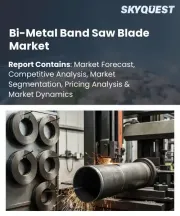
바이메탈 밴드 톱 블레이드는 유연성을 담당하는 스프링 강과 절단 성능을 담당하는 고속 강의 두 유형의 금속층을 사용하여 제조됩니다. 이 블레이드는 구조용 강재, 파이프, 알루미늄, 구리, 청동 및 주철 절단에 널리 사용됩니다. 뛰어난 내구성, 강화된 유연성, 강력한 치아 성능, 비용 효율성, 긴 수명 등의 이점을 갖추고 있으며, 자동차, 항공우주, 방위, 기계 제조 산업에서 폭넓게 활용되고 있습니다.
COVID-19의 영향
COVID-19 팬데믹은 세계 록다운과 제조 활동 중단으로 시장에 악영향을 미쳤습니다. 자동차, 건설, 기계 부문의 생산 활동이 혼란스러워 절삭 공구 수요가 직접 감소했습니다.
예를 들어, Nachi Fujikoshi Group 그룹은 2019년부터 2020년까지 순매출이 19.3% 감소했다고 보고했습니다. 독일의 자동차 생산량은 2020년 전년 대비 28.7% 감소하여 칼날 수요에 큰 영향을 미쳤습니다. 그러나 팬데믹 후 제조업 및 인프라 프로젝트의 회복으로 성장세가 회복되고 있습니다.
시장 동향
기술 혁신을 통한 제품 혁신 추진
기술 혁신은 시장의 주요 동향으로 계속되고 있습니다. Bichamp Cutting Technology, Simonds International LLC, and Stanley Black & Decker (Lenox Tools) 등의 주요 기업은 개선된 코팅 및 초경 칩 기술을 채택한 첨단 블레이드를 도입하고 있습니다.
예를 들어, 2020년 8월에는 Lenox Tools가 알루미늄, 스테인리스 스틸, 주철의 절단용으로 설계된 HONEX 기술을 채용한 GEN-TECH 초경 칩 부착 밴드톱 블레이드를 발매했습니다. 질화 티타늄 및 알루미나 티타늄 나이탈리아드 등의 용도 특화형 코팅의 채용 증가는 내마모성과 블레이드 수명을 향상시켜 수요를 밀어 올리고 있습니다.
시장 성장 촉진요인
중장비 및 자동차 생산 확대
중장비의 생산 확대는 정밀 절삭 공구 수요를 크게 견인하고 있습니다. 중국 건설기계공업협회(CCMA)에 따르면 중국의 중장비 판매량은 2020년부터 2021년까지 39% 증가했습니다.
또한, 세계 자동차 생산 증가는 구조용 강철 및 주철 부품의 절단을 위한 블레이드 수요를 촉진하고 있습니다. 도시화의 진전과 생활수준의 향상으로 차량, 기계, 가구, 장식용 인테리어 수요가 증가하고, 시장의 성장을 더욱 추진하고 있습니다.
바이메탈 블레이드의 뛰어난 강도, 내구성 및 비용 효율성으로 제조업체는 운영 비용 절감과 생산성 향상을 실현할 수 있어 업계 전반의 채용이 확대되고 있습니다.
억제요인
원재료 가격 변동
고속 강철 및 초경 재료의 가격 변동은 생산 비용에 큰 영향을 미칩니다. 세계은행 그룹에 따르면 금속 원료 가격은 2020년부터 2021년까지 23.9% 상승했습니다. 강재나 초경재료의 비용 상승에 더해, 환율의 변동도 제조 경비를 증가시키고, 이익률을 저하시키기 때문에 시장 성장을 억제하는 요인이 됩니다.
부문 분석
치아 유형별
본 시장은 치아 유형별로 레귤러, 훅, 스킵의 3유형로 구분됩니다.
2026년에는 금속 가공 및 자동차 부문의 강한 수요에 견인되며, 레귤러 부문은 41.62%의 시장 점유율로 지배적입니다. 이 블레이드는 내구성과 비용 효율적인 절삭 솔루션을 제공합니다.
훅 부문은 합금, 스테인레스 스틸 및 주철 절단에 적합하기 때문에 6.7%라는 최고의 CAGR로 성장할 것으로 예측됩니다.
스킵 부문은 알루미늄, 황동, 구리와 같은 비철금속 절단 수요로 꾸준한 성장을 보이고 있습니다.
제품 유형별
시장은 제품 유형별로 고속강과 초경칩으로 구분됩니다.
2026년에는 고속강 부문이 55.36%라는 최대 점유율을 차지하고 있으며, 중소기업에서의 보급이 이를 지원하고 있습니다.
초경칩 부문은 높은 견고성과 우수한 절삭 효율로 빠르게 성장하고 있습니다.
용도별
강재 부문은 자동차 및 기계 제조 분야에서의 강한 수요에 힘입어 2026년에는 33.80%의 점유율로 시장을 선도할 것으로 예측됩니다.
알루미늄 부문은 항공우주 및 경량 자동차 용도 수요 증가로 인해 가장 높은 CAGR로 성장할 것으로 예측됩니다.
최종 사용자별
기계 제조 부문은 산업화의 진전을 배경으로 2026년에는 33.80%의 점유율을 차지했습니다.
자동차 부문은 세계 자동차 생산 증가로 큰 점유율을 차지하고 있습니다.
지역별 인사이트
아시아태평양
아시아태평양은 2025년 2억 2,490만 달러, 2026년 2억 3,840만 달러로 시장을 선도했습니다.
- 중국은 2026년까지 1억 290만 달러에 이를 것으로 예측됩니다.
- 일본 시장 규모는 2026년까지 5,050만 달러에 달할 것으로 예측되고 있습니다.
- 인도는 2026년까지 3,330만 달러에 달할 것으로 예측되고 있습니다.
북미
미국 시장은 자동차 산업과 건설 산업의 견조한 성장에 힘입어 2026년까지 1억 3,260만 달러에 달할 것으로 예측됩니다.
유럽
- 독일은 2026년까지 3,730만 달러에 달할 것으로 예측되고 있습니다.
- 영국은 2026년까지 2,630만 달러에 달할 것으로 예측되고 있습니다.
남미 및 중동, 아프리카는 건설 및 제조업 활동 증가로 꾸준한 성장이 예상됩니다.
원재료 가격의 변동이 과제가 되는 것, 지속적인 기술 혁신, 자동차 생산 확대, 인프라 정비에 의해 2034년까지 장기적인 시장 확대가 지속될 것으로 전망됩니다.
목차
제1장 서론
제2장 주요 요약
제3장 시장 역학
- 매크로 및 마이크로 경제 지표
- 성장 촉진요인, 억제요인, 기회 및 동향
- COVID-19의 영향
제4장 경쟁 구도
- 주요 기업이 채용하는 사업 전략
- 주요 기업의 통합 SWOT 분석
- 세계 바이메탈 밴드 톱 블레이드 시장의 주요 기업 점유율/순위(2025년)
제5장 세계의 바이메탈 밴드 톱 블레이드 시장 규모(추정치 및 예측치) : 부문별(2021-2034년)
- 주요 분석 결과
- 치아 유형별
- 레귤러
- 훅
- 스킵
- 제품 유형별
- 초경칩
- 고속강
- 용도별
- 강재
- 알루미늄
- 주철
- 기타(금형 강, 베어링 강 등)
- 최종 사용자별
- 자동차
- 항공우주 및 방위
- 기계 제조
- 금형가공업
- 기타(군사 산업 등)
- 지역별
- 북미
- 유럽
- 아시아태평양
- 남미
- 중동 및 아프리카
제6장 북미의 바이메탈 밴드 톱 블레이드 시장 규모(추정치 및 예측치) : 부문별(2021-2034년)
- 국가별
- 미국
- 캐나다
- 멕시코
제7장 유럽의 바이메탈 밴드 톱 블레이드 시장 규모(추정치 및 예측치) : 부문별(2021-2034년)
- 국가별
- 독일
- 영국
- 프랑스
- 이탈리아
- 기타 유럽 국가
제8장 아시아태평양의 바이메탈 밴드 톱 블레이드 시장 규모(추정치 및 예측치) : 부문별(2021-2034년)
- 국가별
- 중국
- 일본
- 인도
- 한국
- 기타 아시아태평양
제9장 남미의 바이메탈 밴드 톱 블레이드 시장 규모(추정치 및 예측치) : 부문별(2021-2034년)
- 국가별
- 브라질
- 아르헨티나
- 기타 남미 국가
제10장 중동 및 아프리카의 바이메탈 밴드 톱 블레이드 시장 규모(추정치 및 예측치) : 부문별(2021-2034년)
- 국가별
- GCC
- 남아프리카
- 기타 중동 및 아프리카
제11장 주요 10개 기업의 기업 프로파일
- Benxi Tool Co Ltd
- Bichamp Cutting Technology Co Ltd
- Dalian Special Steel Products Co Ltd
- Eberlestrabe 28
- Hakansson Saws India Pvt Ltd
- LS Starrett Company
- Simonds International LLC
- Snap-On Incorporated(BAHCO-SNAP Europe)
- Stanley Black & Decker Inc(Lenox Tools)
- Wikus
Growth Factors of bi-metal band saw blade Market
The global bi-metal band saw blade market was valued at USD 570 million in 2025 and is projected to grow from USD 601.7 million in 2026 to USD 995.7 million by 2034, registering a CAGR of 6.50% during the forecast period (2026-2034).
Asia Pacific dominated the global market with a 39.50% share in 2025, supported by rapid industrialization, strong manufacturing activity, and expanding automotive production across China, India, and Japan.
Bi-metal band saw blades are manufactured using two different metal layers-spring steel for flexibility and high-speed steel for cutting performance. These blades are widely used for cutting structural steel, pipes, aluminum, copper, bronze, and cast iron. Their advantages include superior durability, enhanced flexibility, strong teeth performance, cost efficiency, and longer operational life. They are extensively used across automotive, aerospace, defense, and machine manufacturing industries.
COVID-19 Impact
The COVID-19 pandemic negatively affected the market due to global lockdowns and halted manufacturing operations. Production activities in automotive, construction, and machinery sectors were disrupted, directly reducing demand for cutting tools.
For example, Nachi Fujikoshi Group reported a 19.3% decline in net sales from 2019 to 2020. Germany's automotive production declined by 28.7% in 2020 compared to 2019, which significantly impacted blade demand. However, post-pandemic recovery in manufacturing and infrastructure projects has restored growth momentum.
Market Trends
Technological Advancements Driving Product Innovation
Technological innovation remains a key trend in the market. Leading companies such as Bichamp Cutting Technology, Simonds International LLC, and Stanley Black & Decker (Lenox Tools) are introducing advanced blades with improved coatings and carbide-tipped technology.
For instance, in August 2020, Lenox Tools launched a GEN-TECH carbide-tipped band saw blade using HONEX technology, designed for cutting aluminum, stainless steel, and cast iron. The rising use of application-specific coatings such as titanium nitride and aluminum titanium nitride enhances wear resistance and blade longevity, boosting demand.
Market Growth Drivers
Expanding Heavy Machinery and Automotive Production
Growing production of heavy machinery significantly drives demand for precision cutting tools. According to the China Construction Machinery Association (CCMA), heavy machinery sales in China increased by 39% from 2020 to 2021.
Additionally, increasing automotive manufacturing globally fuels blade demand for cutting structural steel and cast iron components. Rising urbanization and higher living standards have increased demand for vehicles, machinery, furniture, and decorative interiors, further supporting market growth.
The superior strength, durability, and cost efficiency of bi-metal blades enable manufacturers to reduce operational costs and improve productivity, strengthening their adoption across industries.
Restraining Factors
Volatility in Raw Material Prices
Fluctuations in prices of high-speed steel and carbide materials significantly impact production costs. According to the World Bank Group, metal raw material prices increased by 23.9% from 2020 to 2021. Rising steel and carbide costs, along with exchange rate fluctuations, increase manufacturing expenses and reduce profit margins, restraining market growth.
Segmentation Analysis
By Tooth Type
The market is segmented into regular, hook, and skip.
The regular segment dominated with a 41.62% market share in 2026, driven by strong demand from metal fabrication and automotive sectors. These blades provide durability and cost-effective cutting solutions.
The hook segment is projected to grow at the highest CAGR of 6.7%, owing to its suitability for cutting alloys, stainless steel, and cast iron.
The skip segment is witnessing steady growth due to demand for cutting non-ferrous metals such as aluminum, brass, and copper.
By Product Type
The market is divided into high-speed steel and carbide tipped.
The high-speed steel segment held the largest share of 55.36% in 2026, supported by widespread adoption in small and medium industries.
The carbide-tipped segment is growing rapidly due to higher robustness and superior cutting efficiency.
By Application
The steel segment is expected to dominate with a 33.80% share in 2026, driven by strong usage in automotive and machine manufacturing.
The aluminum segment is projected to grow at the highest CAGR due to increasing demand from aerospace and lightweight automotive applications.
By End User
The machine manufacturing segment held a 33.80% share in 2026, supported by rising industrialization.
The automotive sector also accounts for a significant share due to increasing vehicle production globally.
Regional Insights
Asia Pacific
Asia Pacific led the market with USD 224.9 million in 2025 and USD 238.4 million in 2026.
- China projected to reach USD 102.9 million by 2026
- Japan projected to reach USD 50.5 million by 2026
- India projected to reach USD 33.3 million by 2026
North America
The U.S. market is projected to reach USD 132.6 million by 2026, supported by strong automotive and construction industries.
Europe
- Germany projected to reach USD 37.3 million by 2026
- UK projected to reach USD 26.3 million by 2026
South America and Middle East & Africa are expected to grow steadily due to increasing construction and manufacturing activities.
Competitive Landscape
Key players include:
- Wikus
- Simonds International LLC
- Bichamp Cutting Technology
- Stanley Black & Decker (Lenox Tools)
- Snap-On Incorporated (BAHCO)
- L.S. Starrett Company
- Dalian Special Steel Products
- Benxi Tool Co Ltd
Companies focus on product launches, R&D investments, acquisitions, and geographic expansion to strengthen market position.
Conclusion
The global bi-metal band saw blade market is set to grow steadily from USD 570 million in 2025 to USD 601.7 million in 2026, reaching USD 995.7 million by 2034, at a CAGR of 6.50%.
Asia Pacific dominated the market in 2025 with a 39.50% share, driven by strong manufacturing and automotive growth. Increasing heavy machinery production, technological advancements in blade coatings, and rising industrialization are major growth drivers.
Although raw material price volatility poses challenges, continuous innovation, expanding automotive production, and infrastructure development are expected to sustain long-term market expansion through 2034.
Segmentation By Tooth Type, By Product Type, By Application, By End User, and By Region
By Tooth Type * Regular
- Hook
- Skip
By Product Type * Carbide Tipped
- High-speed Steel
By Application * Steel
- Aluminum
- Cast Iron
- Others (Mold Steels, Bearing Steels)
By End User * Automotive
- Aerospace & Defense
- Machine Manufacturing
- Mold Processing Industry
- Others (Military Industry)
By Region * North America (By Tooth Type, By Product Type, By Application, By End User, By Country)
- U.S. (By End User)
- Canada (By End User)
- Mexico (By End User)
- Europe (By Tooth Type, By Product Type, By Application, By End User, By Country)
- Germany (By End User)
- U.K. (By End User)
- France (By End User)
- Italy (By End User)
- Rest of Europe
- Asia Pacific (By Tooth Type, By Product Type, By Application, By End User, By Country)
- China (By End User)
- Japan (By End User)
- India (By End User)
- South Korea (By End User)
- Rest of Asia Pacific
- South America (By Tooth Type, By Product Type, By Application, By End User, By Country)
- Brazil (By End User)
- Argentina (By End User)
- Rest of South America
- Middle East & Africa (By Tooth Type, By Product Type, By Application, By End User, By Country)
- GCC (By End User)
- South Africa (By End User)
- Rest of Middle East & Africa
Table of Content
1. Introduction
- 1.1. Definition, By Segment
- 1.2. Research Methodology/Approach
- 1.3. Data Sources
2. Executive Summary
3. Market Dynamics
- 3.1. Macro and Micro Economic Indicators
- 3.2. Drivers, Restraints, Opportunities and Trends
- 3.3. Impact of COVID-19
4. Competition Landscape
- 4.1. Business Strategies Adopted by Key Players
- 4.2. Consolidated SWOT Analysis of Key Players
- 4.3. Global Bi-Metal Band Saw Blade Market Key Players Market Share/Ranking, 2025
5. Global Bi-Metal Band Saw Blade Market Size Estimates and Forecasts, By Segments, 2021-2034
- 5.1. Key Findings
- 5.2. By Tooth Type (USD)
- 5.2.1. Regular
- 5.2.2. Hook
- 5.2.3. Skip
- 5.3. By Product Type (USD)
- 5.3.1. Carbide Tipped
- 5.3.2. High-Speed Steel
- 5.4. By Application (USD)
- 5.4.1. Steel
- 5.4.2. Aluminum
- 5.4.3. Cast Iron
- 5.4.4. Others (Mold Steels, Bearing Steels, etc.)
- 5.5. By End User (USD)
- 5.5.1. Automotive
- 5.5.2. Aerospace & Defense
- 5.5.3. Machine Manufacturing
- 5.5.4. Mold Processing Industry
- 5.5.5. Others (Military Industry, etc.)
- 5.6. By Region (USD)
- 5.6.1. North America
- 5.6.2. Europe
- 5.6.3. Asia Pacific
- 5.6.4. South America
- 5.6.5. Middle East & Africa
6. North America Bi-Metal Band Saw Blade Market Size Estimates and Forecasts, By Segments, 2021-2034
- 6.1. Key Findings
- 6.2. By Tooth Type (USD)
- 6.2.1. Regular
- 6.2.2. Hook
- 6.2.3. Skip
- 6.3. By Product Type (USD)
- 6.3.1. Carbide Tipped
- 6.3.2. High-Speed Steel
- 6.4. By Application (USD)
- 6.4.1. Steel
- 6.4.2. Aluminum
- 6.4.3. Cast Iron
- 6.4.4. Others (Mold Steels, Bearing Steels, etc.)
- 6.5. By End User (USD)
- 6.5.1. Automotive
- 6.5.2. Aerospace & Defense
- 6.5.3. Machine Manufacturing
- 6.5.4. Mold Processing Industry
- 6.5.5. Others (Military Industry, etc.)
- 6.6. By Country (USD)
- 6.6.1. U.S.
- 6.6.2. Canada
- 6.6.3. Mexico
7. Europe Bi-Metal Band Saw Blade Market Size Estimates and Forecasts, By Segments, 2021-2034
- 7.1. Key Findings
- 7.2. By Tooth Type (USD)
- 7.2.1. Regular
- 7.2.2. Hook
- 7.2.3. Skip
- 7.3. By Product Type (USD)
- 7.3.1. Carbide Tipped
- 7.3.2. High-Speed Steel
- 7.4. By Application (USD)
- 7.4.1. Steel
- 7.4.2. Aluminum
- 7.4.3. Cast Iron
- 7.4.4. Others (Mold Steels, Bearing Steels, etc.)
- 7.5. By End User (USD)
- 7.5.1. Automotive
- 7.5.2. Aerospace & Defense
- 7.5.3. Machine Manufacturing
- 7.5.4. Mold Processing Industry
- 7.5.5. Others (Military Industry, etc.)
- 7.6. By Country (USD)
- 7.6.1. Germany
- 7.6.2. U.K.
- 7.6.3. France
- 7.6.4. Italy
- 7.6.5. Rest of Europe
8. Asia Pacific Bi-Metal Band Saw Blade Market Size Estimates and Forecasts, By Segments, 2021-2034
- 8.1. Key Findings
- 8.2. By Tooth Type (USD)
- 8.2.1. Regular
- 8.2.2. Hook
- 8.2.3. Skip
- 8.3. By Product Type (USD)
- 8.3.1. Carbide Tipped
- 8.3.2. High-Speed Steel
- 8.4. By Application (USD)
- 8.4.1. Steel
- 8.4.2. Aluminum
- 8.4.3. Cast Iron
- 8.4.4. Others (Mold Steels, Bearing Steels, etc.)
- 8.5. By End User (USD)
- 8.5.1. Automotive
- 8.5.2. Aerospace & Defense
- 8.5.3. Machine Manufacturing
- 8.5.4. Mold Processing Industry
- 8.5.5. Others (Military Industry, etc.)
- 8.6. By Country (USD)
- 8.6.1. China
- 8.6.2. Japan
- 8.6.3. India
- 8.6.4. South Korea
- 8.6.5. Rest of Asia Pacific
9. South America Bi-Metal Band Saw Blade Market Size Estimates and Forecasts, By Segments, 2021-2034
- 9.1. Key Findings
- 9.2. By Tooth Type (USD)
- 9.2.1. Regular
- 9.2.2. Hook
- 9.2.3. Skip
- 9.3. By Product Type (USD)
- 9.3.1. Carbide Tipped
- 9.3.2. High-Speed Steel
- 9.4. By Application (USD)
- 9.4.1. Steel
- 9.4.2. Aluminum
- 9.4.3. Cast Iron
- 9.4.4. Others (Mold Steels, Bearing Steels, etc.)
- 9.5. By End User (USD)
- 9.5.1. Automotive
- 9.5.2. Aerospace & Defense
- 9.5.3. Machine Manufacturing
- 9.5.4. Mold Processing Industry
- 9.5.5. Others (Military Industry, etc.)
- 9.6. By Country (USD)
- 9.6.1. Brazil
- 9.6.2. Argentina
- 9.6.3. Rest of South America
10. Middle East & Africa Bi-Metal Band Saw Blade Market Size Estimates and Forecasts, By Segments, 2021-2034
- 10.1. Key Findings
- 10.2. By Tooth Type (USD)
- 10.2.1. Regular
- 10.2.2. Hook
- 10.2.3. Skip
- 10.3. By Product Type (USD)
- 10.3.1. Carbide Tipped
- 10.3.2. High-Speed Steel
- 10.4. By Application (USD)
- 10.4.1. Steel
- 10.4.2. Aluminum
- 10.4.3. Cast Iron
- 10.4.4. Others (Mold Steels, Bearing Steels, etc.)
- 10.5. By End User (USD)
- 10.5.1. Automotive
- 10.5.2. Aerospace & Defense
- 10.5.3. Machine Manufacturing
- 10.5.4. Mold Processing Industry
- 10.5.5. Others (Military Industry, etc.)
- 10.6. By Country (USD)
- 10.6.1. GCC
- 10.6.2. South Africa
- 10.6.3. Rest of Middle East & Africa
11. Company Profiles for Top 10 Players (Based on data availability in public domain and/or on paid databases)
- 11.1. Benxi Tool Co Ltd
- 11.1.1. Overview
- 11.1.2. Offerings/Business Segments
- 11.1.3. Employee Size
- 11.1.4. Key Financials
- 11.1.5. Recent Developments
- 11.2. Bichamp Cutting Technology Co Ltd
- 11.2.1. Overview
- 11.2.2. Offerings/Business Segments
- 11.2.3. Employee Size
- 11.2.4. Key Financials
- 11.2.5. Recent Developments
- 11.3. Dalian Special Steel Products Co Ltd
- 11.3.1. Overview
- 11.3.2. Offerings/Business Segments
- 11.3.3. Employee Size
- 11.3.4. Key Financials
- 11.3.5. Recent Developments
- 11.4. Eberlestrabe 28
- 11.4.1. Overview
- 11.4.2. Offerings/Business Segments
- 11.4.3. Employee Size
- 11.4.4. Key Financials
- 11.4.5. Recent Developments
- 11.5. Hakansson Saws India Pvt Ltd
- 11.5.1. Overview
- 11.5.2. Offerings/Business Segments
- 11.5.3. Employee Size
- 11.5.4. Key Financials
- 11.5.5. Recent Developments
- 11.6. L.S. Starrett Company
- 11.6.1. Overview
- 11.6.2. Offerings/Business Segments
- 11.6.3. Employee Size
- 11.6.4. Key Financials
- 11.6.5. Recent Developments
- 11.7. Simonds International LLC
- 11.7.1. Overview
- 11.7.2. Offerings/Business Segments
- 11.7.3. Employee Size
- 11.7.4. Key Financials
- 11.7.5. Recent Developments
- 11.8. Snap-On Incorporated (BAHCO-SNAP Europe)
- 11.8.1. Overview
- 11.8.2. Offerings/Business Segments
- 11.8.3. Employee Size
- 11.8.4. Key Financials
- 11.8.5. Recent Developments
- 11.9. Stanley Black & Decker Inc (Lenox Tools)
- 11.9.1. Overview
- 11.9.2. Offerings/Business Segments
- 11.9.3. Employee Size
- 11.9.4. Key Financials
- 11.9.5. Recent Developments
- 11.10. Wikus
- 11.10.1. Overview
- 11.10.2. Offerings/Business Segments
- 11.10.3. Employee Size
- 11.10.4. Key Financials
- 11.10.5. Recent Developments