|
시장보고서
상품코드
1666699
풍력 터빈 시장 기회, 성장 촉진요인, 산업 동향 분석, 예측(2025-2034년)Wind Turbine Market Opportunity, Growth Drivers, Industry Trend Analysis, and Forecast 2025 - 2034 |
||||||

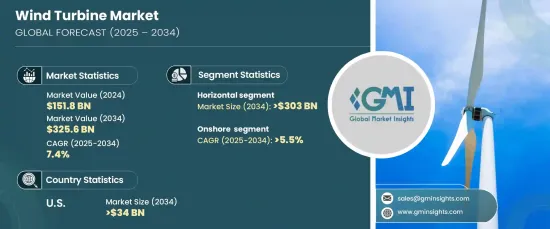
풍력 터빈 세계 시장은 2024년 1,518억 달러로 평가되며 2025년부터 2034년까지 CAGR 7.4%로 성장할 것으로 예상됩니다. 풍력 터빈은 바람의 운동 에너지를 기계 에너지로 변환하여 발전에 이용하는 중요한 장치입니다. 이 재생에너지원은 화석 연료에 대한 의존도를 줄이고 기후 변화 문제를 해결하는 데 매우 중요합니다.
풍력에너지와 전력 저장 솔루션의 통합과 기업의 지속가능성에 대한 관심이 높아지면서 시장 성장의 주요 동력이 되고 있습니다. 각국이 야심찬 재생에너지 목표를 실행하는 가운데, 풍력에너지는 세계 탈탄소화 전략의 핵심이 되고 있습니다. 개발업체들은 친환경적이고 지속가능한 풍력발전 프로젝트를 우선시하고, 친환경 건설 및 운영을 촉진하기 위한 인증 및 모범 사례를 채택하고 있으며, 이는 풍력 터빈의 채택을 더욱 촉진하고 있습니다.
| 시장 범위 | |
|---|---|
| 시작 연도 | 2024년 |
| 예측 연도 | 2025-2034년 |
| 시작 금액 | 1,518억 달러 |
| 예상 금액 | 3,256억 달러 |
| CAGR | 7.4% |
축 유형별로는 수평축 풍력 터빈(HAWT)이 2034년까지 3,030억 달러에 달할 것으로 예상되며, HAWT의 효율성, 확장성, 다양한 용도에 대한 적응성이 이러한 성장의 요인으로 작용할 것으로 보입니다. 블레이드 소재, 공기역학 및 구조 설계의 발전으로 성능이 크게 향상되어 특히 더 강하고 안정적인 바람을 포착하는 해상 풍력발전소에서 선호되는 선택이 되고 있습니다.
육상 설치는 2034년까지 CAGR 5.5%로 성장할 것으로 예상됩니다. 이러한 성장을 뒷받침하는 것은 기술 혁신, 경제성, 재생에너지 도입을 촉진하기 위한 정부의 노력의 증가입니다. 제조업체들은 용량 계수가 높은 대형 터빈 개발에 집중하여 더 적은 장치로 더 많은 발전을 가능하게 하고, 메가 와트당 설치 비용을 낮추고 있습니다. 또한, 기존 풍력발전소를 최신의 효율적인 터빈으로 리파워링하여 풍력발전소의 생산 수명을 연장하고 에너지 출력을 향상시키고 있습니다.
미국 풍력 터빈 시장은 기술 발전, 물류 개선, 혁신적인 비즈니스 전략으로 인해 2034년까지 340억 달러 규모의 시장을 창출할 것으로 예상됩니다. 풍력에너지와 전력 저장 시스템의 통합과 기후 변화 대응을 위한 재생에너지에 대한 수요 증가가 시장 확대에 박차를 가하고 있습니다. 세제 혜택, 고정가격매입제도, 재생에너지 목표, 풍력에너지 비용 하락 등의 지원 정책이 성장을 촉진하고 있습니다.
전반적으로 풍력 터빈 시장은 기술 발전, 우호적인 규제 프레임워크, 지속가능성에 대한 전 세계적인 관심 증가가 시장 확대의 원동력이 되어 강력한 성장이 예상됩니다. 이 분야는 보다 깨끗하고 지속가능한 에너지 시스템으로의 전환에 있어 전 세계적으로 매우 중요한 역할을 할 것으로 예상됩니다.
목차
제1장 조사 방법과 조사 범위
- 조사 설계
- 기본 추정과 계산
- 예측 모델
- 1차 조사와 검증
- 1차 소스
- 데이터 마이닝 소스
- 시장 정의
제2장 주요 요약
제3장 업계 인사이트
- 업계 생태계
- 규제 상황
- 업계에 대한 영향요인
- 성장 촉진요인
- 업계의 잠재적 리스크·과제
- 성장 가능성 분석
- Porters 분석
- 공급 기업의 교섭력
- 구매자의 교섭력
- 신규 참여업체의 위협
- 대체품의 위협
- PESTEL 분석
제4장 경쟁 구도
- 소개
- 전략 대시보드
- 혁신과 테크놀러지 전망
제5장 시장 규모 및 예측 : 축별, 2021-2034년
- 주요 동향
- 수평(HAWT)
- 상풍력
- 하풍력
- 수직(VAWT)
제6장 시장 규모 및 예측 : 설비별, 2021-2034년
- 주요 동향
- 온쇼어
- 오프쇼어
제7장 시장 규모 및 예측 : 연결성별, 2021-2034년
- 주요 동향
- 그리드 연결
- 독립형
제8장 시장 규모 및 예측 : 정격별, 2021-2034년
- 주요 동향
- 100 kW 미만
- 100 kW-250 kW
- 250 kW-500 kW
- 500 kW-1 MW
- 1 MW-2 MW
- 2 MW 이상
제9장 시장 규모 및 예측 : 용도별, 2021-2034년
- 주요 동향
- 주택
- 상업·산업
- 유틸리티
제10장 시장 규모 및 예측 : 지역별, 2021-2034년
- 주요 동향
- 북미
- 미국
- 캐나다
- 멕시코
- 유럽
- 독일
- 스페인
- 영국
- 프랑스
- 이탈리아
- 스웨덴
- 아시아태평양
- 중국
- 일본
- 한국
- 인도
- 호주
- 중동 및 아프리카
- 남아프리카공화국
- 이집트
- 라틴아메리카
- 브라질
- 칠레
- 아르헨티나
제11장 기업 개요
- Envision group
- Enercon
- General Electric
- Goldwind
- Mingyang Smart Energy Group Co., Ltd.
- Nordex
- Siemens Gamesa Renewable Energy
- Suzlon Energy
- Senvion
- Vestas
- Zhejiang Windey Co., Ltd.
The Global Wind Turbine Market was valued at USD 151.8 billion in 2024 and is projected to grow at a CAGR of 7.4% from 2025 to 2034. Wind turbines are essential devices that convert the kinetic energy of wind into mechanical energy, which is then used to generate electricity. This renewable energy source is crucial in reducing reliance on fossil fuels and addressing the challenges of climate change.
The increasing integration of wind energy with storage solutions and the rising focus on sustainability by corporations are key drivers of market growth. Wind energy is becoming a cornerstone of global decarbonization strategies as countries implement ambitious renewable energy targets. Developers are prioritizing environmentally sustainable wind projects, adopting certifications and best practices to promote eco-friendly construction and operations, further boosting the adoption of wind turbines.
| Market Scope | |
|---|---|
| Start Year | 2024 |
| Forecast Year | 2025-2034 |
| Start Value | $151.8 Billion |
| Forecast Value | $325.6 Billion |
| CAGR | 7.4% |
By axis type, horizontal axis wind turbines (HAWTs) are expected to dominate, with USD 303 billion by 2034. Their efficiency, scalability, and adaptability across various applications contribute to this growth. Advancements in blade materials, aerodynamics, and structural designs have significantly enhanced their performance, making them the preferred choice, especially for offshore wind farms that capture stronger, more consistent winds.
Onshore installations are set to grow at a CAGR of 5.5% through 2034. This growth is supported by technological innovations, economic feasibility, and increasing government initiatives promoting renewable energy adoption. Manufacturers focus on developing larger turbines with higher capacity factors, enabling more power generation with fewer units and lowering installation costs per megawatt. Repowering existing wind farms with modern, efficient turbines is also extending their productive lifespan and boosting energy output.
U.S. wind turbine market is anticipated to generate USD 34 billion by 2034, driven by technological advancements, improved logistics, and innovative business strategies. The integration of wind energy with storage systems and the growing demand for renewable solutions to combat climate change fuel the market's expansion. Supportive policies, including tax incentives, feed-in tariffs, renewable energy targets, and declining wind energy costs, stimulate growth.
Overall, the wind turbine market is poised for robust growth, with technological advancement, supportive regulatory frameworks, and increasing global emphasis on sustainability driving its expansion. The sector is set to play a pivotal role in the transition to cleaner and more sustainable energy systems worldwide.
Table of Contents
Chapter 1 Methodology & Scope
- 1.1 Research design
- 1.2 Base estimates & calculations
- 1.3 Forecast model
- 1.4 Primary research & validation
- 1.4.1 Primary sources
- 1.4.2 Data mining sources
- 1.5 Market definitions
Chapter 2 Executive Summary
- 2.1 Industry synopsis, 2021 – 2034
Chapter 3 Industry Insights
- 3.1 Industry ecosystem
- 3.2 Regulatory landscape
- 3.3 Industry impact forces
- 3.3.1 Growth drivers
- 3.3.2 Industry pitfalls & challenges
- 3.4 Growth potential analysis
- 3.5 Porter's analysis
- 3.5.1 Bargaining power of suppliers
- 3.5.2 Bargaining power of buyers
- 3.5.3 Threat of new entrants
- 3.5.4 Threat of substitutes
- 3.6 PESTEL analysis
Chapter 4 Competitive landscape, 2024
- 4.1 Introduction
- 4.2 Strategic dashboard
- 4.3 Innovation & technology landscape
Chapter 5 Market Size and Forecast, By Axis, 2021 – 2034 (USD Million & MW)
- 5.1 Key trends
- 5.2 Horizontal (HAWTs)
- 5.2.1 Up-wind
- 5.2.2 Down-wind
- 5.3 Vertical (VAWTs)
Chapter 6 Market Size and Forecast, By Installation, 2021 – 2034 (USD Million & MW)
- 6.1 Key trends
- 6.2 Onshore
- 6.3 Offshore
Chapter 7 Market Size and Forecast, By Connectivity, 2021 – 2034 (USD Million & MW)
- 7.1 Key trends
- 7.2 Grid connected
- 7.3 Stand alone
Chapter 8 Market Size and Forecast, By Rating, 2021 – 2034 (USD Million & MW)
- 8.1 Key trends
- 8.2 < 100 kW
- 8.3 100 kW to 250 kW
- 8.4 > 250 kW to 500 kW
- 8.5 > 500 kW to 1 MW
- 8.6 1 MW to 2 MW
- 8.7 > 2 MW
Chapter 9 Market Size and Forecast, By Application, 2021 – 2034 (USD Million & MW)
- 9.1 Key trends
- 9.2 Residential
- 9.3 Commercial & industrial
- 9.4 Utility
Chapter 10 Market Size and Forecast, By Region, 2021 – 2034 (USD Million & MW)
- 10.1 Key trends
- 10.2 North America
- 10.2.1 U.S.
- 10.2.2 Canada
- 10.2.3 Mexico
- 10.3 Europe
- 10.3.1 Germany
- 10.3.2 Spain
- 10.3.3 UK
- 10.3.4 France
- 10.3.5 Italy
- 10.3.6 Sweden
- 10.4 Asia Pacific
- 10.4.1 China
- 10.4.2 Japan
- 10.4.3 South Korea
- 10.4.4 India
- 10.4.5 Australia
- 10.5 Middle East & Africa
- 10.5.1 South Africa
- 10.5.2 Egypt
- 10.6 Latin America
- 10.6.1 Brazil
- 10.6.2 Chile
- 10.6.3 Argentina
Chapter 11 Company Profiles
- 11.1 Envision group
- 11.2 Enercon
- 11.3 General Electric
- 11.4 Goldwind
- 11.5 Mingyang Smart Energy Group Co., Ltd.
- 11.6 Nordex
- 11.7 Siemens Gamesa Renewable Energy
- 11.8 Suzlon Energy
- 11.9 Senvion
- 11.10 Vestas
- 11.11 Zhejiang Windey Co., Ltd.