|
시장보고서
상품코드
1716610
지구물리학 서비스 시장 기회, 성장 촉진요인, 산업 동향 분석 및 예측(2025-2034년)Geophysical Services Market Opportunity, Growth Drivers, Industry Trend Analysis, and Forecast 2025 - 2034 |
||||||

세계의 지구물리학 서비스 시장은 2024년에 158억 달러에 달했고, 2025년부터 2034년까지 연평균 복합 성장률(CAGR) 6.3%를 나타낼 것으로 예측됩니다.
이 성장은 석유 및 가스 탐사, 광업, 재생가능에너지 채굴에 있어서의 기술진보가 원동력이 되고 있습니다. 탐사 예산에 큰 영향을 미치고 나아가 지구물리학 서비스 수요에도 영향을 미칩니다. 그리고 비용 절감을 가져와 새로운 기회를 창출하고 있습니다. 또한 지속 가능한 자원 탐사와 해상 풍력에너지의 개발에 주목의 고조는 업계 내에 새로운 분야를 개척하고 있습니다.
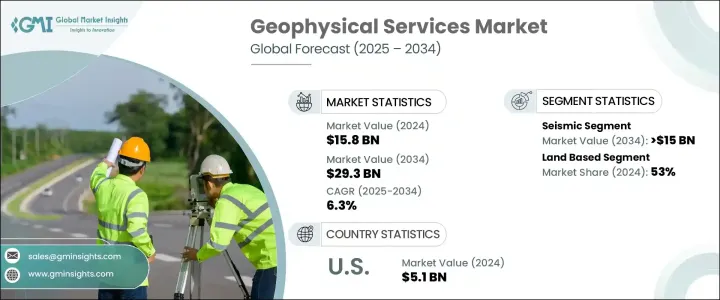
시장은 기술별로 구분되며, 지진탐사 서비스는 2034년까지 150억 달러 이상에 달할 것으로 예상되고 있습니다. 무인항공기(UAV)를 사용해 실시되는 경우가 많은 자기 탐사나 지층 탐사는 비용 대 효과가 높고, 광범위를 커버할 수 있기 때문에 광물 탐사로 인기를 모으고 있습니다.
| 시장 범위 | |
|---|---|
| 시작 연도 | 2024년 |
| 예측 연도 | 2025-2034년 |
| 시작 금액 | 158억 달러 |
| 예측 금액 | 293억 달러 |
| CAGR | 6.3% |
이 시장은 지열에너지 분야와 인프라 개발 분야에서도 성장하고 있으며, 중력 조사와 원격 센싱 조사가 보충적인 조사 방법으로 인기가 높아지고 있습니다.
측량의 유형에 대해서는 육상측량이 2024년에 53% 시장 점유율을 차지했고 2034년까지 연평균 복합 성장률(CAGR)6% 이상의 속도로 성장할 것으로 예측되고 있습니다. 활용한 데이터 처리와 자율형 지상 측량 시스템의 이용이 진행됨으로써 작업 효율이 향상하고 있습니다.
미국에서는 2024년에 51억 달러로 평가된 지구물리학 서비스 시장이 대폭 성장해 2034년에는 293억 달러 이상에 이를 것으로 예상되고 있습니다. 생산성 향상을 위한 지진 탐사 이미징과 드론 측량의 자동화에서는 AI가 중요한 역할을 하고 있습니다.
목차
제1장 조사 방법과 조사 범위
제2장 주요 요약
제3장 업계 인사이트
- 생태계 분석
- 규제 상황
- 업계에 미치는 영향요인
- 성장 촉진요인
- 업계의 잠재적 위험 및 과제
- 성장 가능성 분석
- Porter's Five Forces 분석
- PESTEL 분석
제4장 경쟁 구도
- 전략 대시보드
- 혁신과 지속가능성 전망
제5장 시장 규모와 예측 : 기술별(2021-2034년)
- 주요 동향
- 지진
- 자기
- 전자기
- 그라디오메트릭
- 기타
제6장 시장 규모와 예측 : 조사 유형별(2021-2034년)
- 주요 동향
- 육상 베이스
- 해상 베이스
- 항공 베이스
제7장 시장 규모와 예측 : 최종 용도별(2021-2034년)
- 주요 동향
- 석유 및 가스
- 광업
- 농업
- 기타
제8장 시장 규모와 예측 : 지역별(2021-2034년)
- 주요 동향
- 북미
- 미국
- 캐나다
- 유럽
- 영국
- 독일
- 프랑스
- 노르웨이
- 러시아
- 아시아태평양
- 중국
- 일본
- 인도
- 호주
- 중동 및 아프리카
- UAE
- 사우디아라비아
- 이라크
- 이란
- 남아프리카
- 라틴아메리카
- 브라질
- 아르헨티나
제9장 기업 프로파일
- Abitibi Geophysics
- China Oilfield Services Limited
- CGG
- Dawson Geophysical Company
- EGS(International) Ltd
- Fugro
- Getech Group plc
- Gardline Limited
- HESP
- NUVIA Dynamics Inc.
- PGS
- Paradigm Group BV
- Ramboll Group A/S
- SLB
- SAExploration
- Spectrum Geophysics
- TGS
- Weatherford
The Global Geophysical Services Market reached USD 15.8 billion in 2024 and is predicted to grow at a CAGR of 6.3% from 2025 to 2034. This growth is driven by technological advancements in the exploration of oil and gas, mining, and renewable energy extraction. Innovations such as seismic imaging, electromagnetic surveying, and advanced data processing techniques enable more accurate subsurface mapping and high-quality imaging. Furthermore, government investments in infrastructure development and environmental projects are further bolstering the market's expansion. Fluctuating oil prices have a significant impact on exploration budgets, which in turn affects the demand for geophysical services. However, the integration of artificial intelligence (AI) and autonomous systems in data processing is improving operational efficiency and reducing costs, creating new opportunities. Additionally, the increasing focus on sustainable resource exploration and the development of offshore wind energy is opening up new sectors within the industry.
The market is segmented by technology, with seismic services expected to generate over USD 15 billion by 2034. Seismic technology, which continues to evolve with advancements in 3D and 4D imaging, holds a dominant position, particularly in oil and gas exploration and renewable energy subsurface mapping. Magnetic and gradiometric surveys, often conducted using unmanned aerial vehicles (UAVs), are gaining traction in mineral exploration due to their cost-effectiveness and ability to cover large areas. The advancements in airborne electromagnetic (EM) technology have made it possible to obtain more detailed images of deep subsurfaces, boosting the demand for EM methods, particularly in groundwater and environmental assessments.
| Market Scope | |
|---|---|
| Start Year | 2024 |
| Forecast Year | 2025-2034 |
| Start Value | $15.8 Billion |
| Forecast Value | $29.3 Billion |
| CAGR | 6.3% |
The market is also growing in the geothermal energy sector and infrastructure development, with gravity and remote sensing surveys gaining popularity as supplementary survey techniques. The use of cloud computing and AI is enhancing the interpretation and operational efficiency of these technologies, contributing to further growth.
Regarding survey types, land-based surveys held a 53% market share in 2024 and are projected to grow at a rate exceeding 6% CAGR through 2034. Land surveys remain crucial for oil and gas, mining, and infrastructure projects, with the increasing use of AI-powered data processing and autonomous ground survey systems improving operational efficiency. In contrast, marine-based surveys, driven by the expansion of offshore wind energy and oil and gas exploration, are gaining momentum due to advances in deepwater seismic and EM techniques.
In the U.S., the geophysical services market, valued at USD 5.1 billion in 2024, is expected to grow substantially, reaching over USD 29.3 billion by 2034. The market's growth is fueled by ongoing oil and gas exploration, mineral surveys, and offshore wind farm development, with AI playing a key role in automating seismic imaging and drone surveying to enhance productivity. The increasing use of satellite and aerial photography for infrastructure and environmental assessments is further driving the demand for land and electromagnetic surveys.
Table of Contents
Chapter 1 Methodology & Scope
- 1.1 Market definitions
- 1.2 Base estimates & calculations
- 1.3 Forecast calculation
- 1.4 Data sources
- 1.4.1 Primary
- 1.4.2 Secondary
- 1.4.2.1 Paid
- 1.4.2.2 Public
Chapter 2 Executive Summary
- 2.1 Industry synopsis, 2021 - 2034
Chapter 3 Industry Insights
- 3.1 Industry ecosystem analysis
- 3.2 Regulatory landscape
- 3.3 Industry impact forces
- 3.3.1 Growth drivers
- 3.3.2 Industry pitfalls & challenges
- 3.4 Growth potential analysis
- 3.5 Porter's analysis
- 3.5.1 Bargaining power of suppliers
- 3.5.2 Bargaining power of buyers
- 3.5.3 Threat of new entrants
- 3.5.4 Threat of substitutes
- 3.6 PESTEL Analysis
Chapter 4 Competitive landscape, 2024
- 4.1 Strategic dashboard
- 4.2 Innovation & sustainability landscape
Chapter 5 Market Size and Forecast, By Technology, 2021 - 2034 (USD Million)
- 5.1 Key trends
- 5.2 Seismic
- 5.3 Magnetic
- 5.4 Electromagnetic
- 5.5 Gradiometric
- 5.6 Others
Chapter 6 Market Size and Forecast, By Survey Type, 2021 - 2034 (USD Million)
- 6.1 Key trends
- 6.2 Land based
- 6.3 Marine based
- 6.4 Aerial based
Chapter 7 Market Size and Forecast, By End Use, 2021 - 2034 (USD Million)
- 7.1 Key trends
- 7.2 Oil & gas
- 7.3 Mining
- 7.4 Agriculture
- 7.5 Others
Chapter 8 Market Size and Forecast, By Region, 2021 - 2034 (USD Million)
- 8.1 Key trends
- 8.2 North America
- 8.2.1 U.S.
- 8.2.2 Canada
- 8.3 Europe
- 8.3.1 UK
- 8.3.2 Germany
- 8.3.3 France
- 8.3.4 Norway
- 8.3.5 Russia
- 8.4 Asia Pacific
- 8.4.1 China
- 8.4.2 Japan
- 8.4.3 India
- 8.4.4 Australia
- 8.5 Middle East & Africa
- 8.5.1 UAE
- 8.5.2 Saudi Arabia
- 8.5.3 Iraq
- 8.5.4 Iran
- 8.5.5 South Africa
- 8.6 Latin America
- 8.6.1 Brazil
- 8.6.2 Argentina
Chapter 9 Company Profiles
- 9.1 Abitibi Geophysics
- 9.2 China Oilfield Services Limited
- 9.3 CGG
- 9.4 Dawson Geophysical Company
- 9.5 EGS (International) Ltd
- 9.6 Fugro
- 9.7 Getech Group plc
- 9.8 Gardline Limited
- 9.9 HESP
- 9.10 NUVIA Dynamics Inc.
- 9.11 PGS
- 9.12 Paradigm Group B.V.
- 9.13 Ramboll Group A/S
- 9.14 SLB
- 9.15 SAExploration
- 9.16 Spectrum Geophysics
- 9.17 TGS
- 9.18 Weatherford