|
시장보고서
상품코드
1618184
요격 미사일 시장 기회, 성장 촉진요인, 산업 동향 분석 및 예측(2024-2032년)Interceptor Missiles Market Opportunity, Growth Drivers, Industry Trend Analysis, and Forecast 2024 - 2032 |
||||||

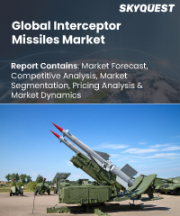
세계 요격 미사일 시장은 2023년 106억 달러로 평가되었고, 2024-2032년간 연평균 5.7% 성장할 것으로 예상됩니다. 다양한 플랫폼에 배치할 수 있는 다재다능한 요격 미사일에 대한 수요 증가가 시장 성장의 원동력이 되고 있습니다. 방위군은 육상 부대나 해군 함정 등 여러 발사 플랫폼에 통합할 수 있는 유연한 미사일 시스템을 선호하고 있으며, 이를 통해 작전 유연성을 높이고 물류를 간소화할 수 있습니다. 이러한 추세는 군이 진화하는 위협에 대응하기 위해 멀티 도메인 작전에 중점을 두면서 탄력을 받고 있으며, 이는 적응성이 높은 미사일 시스템에 대한 수요 증가로 이어지고 있습니다. 시장은 사거리에 따라 단거리, 중거리, 장거리 요격 미사일로 구분됩니다.
장거리 미사일 부문은 예측 기간 동안 5.5% 이상의 CAGR을 나타낼 것으로 예상됩니다. 장거리 탄도 미사일 위협에 대한 우려가 커지면서 장거리 요격 시스템에 대한 대규모 투자가 이루어지고 있습니다. 이러한 시스템은 대륙간탄도미사일과 같은 고고도 위협이 목표물에 도달하기 전에 무력화시키는 데 중요한 역할을 합니다. 다층 미사일 방어 시스템의 일부인 장거리 요격 미사일은 발사부터 탄착까지 미사일 궤도 전체에 걸쳐 위협으로부터 방어하는 데 필수적입니다.
요격 미사일 시장은 유형별로 지대공 미사일과 수대공 미사일로 구분됩니다. 지대공 부문은 2023년 압도적인 시장 점유율을 차지하며 65억 달러 이상의 매출을 기록할 것으로 예상됩니다. 최신 지대공 미사일 시스템, 특히 레이더 및 표적 기술의 발전으로 스텔스 및 극초음속 미사일을 포함한 다양한 공중 위협을 감지, 추적 및 요격하는 능력이 크게 향상되고 있습니다. 또한, 업계는 이동성과 모듈성을 중시하여 운송이 용이하고 다양한 운영 플랫폼에 적응할 수 있는 SAM 시스템을 설계하고 있습니다.
| 시장 범위 | |
|---|---|
| 시작 연도 | 2023년 |
| 예측 연도 | 2024-2032년 |
| 시작 가격 | 106억 달러 |
| 예상 가격 | 171억 달러 |
| CAGR | 5.7% |
이러한 특징은 다양한 전투 환경에서 신속한 배치와 유연성을 필요로 하는 군사력에 매우 중요합니다. 지역별 분석에서 북미가 2023년 세계 요격 미사일 시장을 주도하며 시장 점유율의 40% 이상을 차지할 것으로 예상됩니다. 미국은 미사일 방어 시스템, 특히 극초음속 미사일 위협에 대응하기 위해 막대한 투자를 지속하고 있습니다. 최첨단 미사일 방어 기술은 이러한 위협을 무력화하기 위해 개발되고 있으며, 이는 세계 미사일 방어 상황에서 미국의 주요 시장 진출기업로서 미국의 입지를 강화하고 있습니다.
목차
제1장 조사 방법과 조사 범위
제2장 주요 요약
제3장 산업 인사이트
- 생태계 분석
- 밸류체인에 영향을 미치는 요인
- 이익률 분석
- 변혁
- 향후 전망
- 제조업체
- 유통업체
- 공급업체 상황
- 이익률 분석
- 주요 뉴스와 이니셔티브
- 규제 상황
- 영향요인
- 성장 촉진요인
- 요격 미사일 유연성과 멀티 플랫폼 통합 증가
- 지정학적 긴장과 국방 지출 증가
- 극초음속 미사일 방어 시스템에 수요 증가
- 미사일 방어 시스템 기술적 진보
- 장거리 요격 미사일에 대한 수요 증가
- 산업의 잠재적 리스크와 과제
- 높은 개발·생산비용
- 지정학적 긴장과 군비 관리 협정
- 성장 촉진요인
- 성장 가능성 분석
- Porter's Five Forces 분석
- PESTEL 분석
제4장 경쟁 구도
- 서론
- 기업 점유율 분석
- 경쟁 포지셔닝 매트릭스
- 전략 전망 매트릭스
제5장 시장 추정·예측 : 유형별, 2021-2032년
- 주요 동향
- 지대공
- 물대공
제6장 시장 추정·예측 : 범위별, 2021-2032년
- 주요 동향
- 단거리
- 중거리
- 장거리
제7장 위협 유형별 시장 추정·예측 : 위협 유형별, 2021-2032년
- 주요 동향
- 극초음속 미사일
- 아음속 미사일
- 초음속 미사일
제8장 시장 추정·예측 : 컴포넌트별, 2021-2032년
- 주요 동향
- 유도 시스템
- 추진 시스템
- 센서
- 관성 항법 시스템(INS)
제9장 시장 추정·예측 : 지역별, 2021-2032년
- 주요 동향
- 북미
- 미국
- 캐나다
- 유럽
- 영국
- 독일
- 프랑스
- 이탈리아
- 스페인
- 러시아
- 아시아태평양
- 중국
- 인도
- 일본
- 한국
- 호주
- 라틴아메리카
- 브라질
- 멕시코
- 중동 및 아프리카
- 남아프리카공화국
- 사우디아라비아
- 아랍에미리트(UAE)
제10장 기업 개요
- BAE Systems
- Bharat Dynamics
- China Aerospace Science and Industry Corporation
- Denel Dynamics
- General Dynamics
- Hanwha
- Israel Aerospace Industries
- Kongsberg Defence & Aerospace
- L3Harris
- Lockheed Martin
- MBDA
- Mitsubishi Heavy Industries
- Northrop Grumman
- Rafael Advanced Defense Systems
- Raytheon Technologies
- Roketsan
The Global Interceptor Missiles Market was valued at USD 10.6 billion in 2023 and is projected to grow at a CAGR of 5.7% from 2024 to 2032. The increasing demand for versatile interceptor missiles, capable of being deployed across various platforms, is driving market growth. Defense forces prioritize flexible missile systems that can be integrated with multiple launch platforms, such as land-based units and naval ships, which enhances operational flexibility and streamlines logistics. This trend is gaining momentum as militaries focus on multi-domain operations to tackle evolving threats, leading to a rising demand for adaptable missile systems. The market is segmented based on range into short-range, medium-range, and long-range interceptor missiles.
The long-range segment is anticipated to experience a CAGR of over 5.5% during the forecast period. Growing concerns over long-range ballistic missile threats are prompting significant investments in long-range interceptor systems. These systems play a crucial role in neutralizing high-altitude threats, such as intercontinental ballistic missiles, before they can reach their targets. As a part of layered missile defense systems, long-range interceptors are integral in safeguarding against threats throughout the entire missile trajectory, from launch to impact.
The interceptor missiles market is also segmented by type into surface-to-air and water-to-air missiles. The surface-to-air segment captured a dominant market share in 2023, generating revenue of over USD 6.5 billion. Advancements in modern surface-to-air missile systems, particularly in radar and targeting technologies, have significantly enhanced their ability to detect, track, and intercept various aerial threats, including stealth and hypersonic missiles. Additionally, the industry emphasizes mobility and modularity, designing SAM systems that are easy to transport and adaptable to various operational platforms.
| Market Scope | |
|---|---|
| Start Year | 2023 |
| Forecast Year | 2024-2032 |
| Start Value | $10.6 Billion |
| Forecast Value | $17.1 Billion |
| CAGR | 5.7% |
These features are critical for military forces that require rapid deployment and flexibility in diverse combat environments. In terms of regional analysis, North America led the global interceptor missiles market in 2023, accounting for over 40% of the market share. The U.S. continues to make substantial investments in missile defense systems, particularly to counter hypersonic missile threats. These advanced, highly maneuverable weapons present unique challenges, prompting innovations in U.S. defense systems.Cutting-edge missile defense technologies are being developed to neutralize these threats, bolstering the U.S. position as a key player in the global missile defense landscape.
Table of Contents
Chapter 1 Methodology & Scope
- 1.1 Market scope & definition
- 1.2 Base estimates & calculations
- 1.3 Forecast calculations
- 1.4 Data sources
- 1.4.1 Primary
- 1.4.2 Secondary
- 1.4.2.1 Paid sources
- 1.4.2.2 Public sources
Chapter 2 Executive Summary
- 2.1 Industry synopsis, 2021-2032
Chapter 3 Industry Insights
- 3.1 Industry ecosystem analysis
- 3.1.1 Factor affecting the value chain
- 3.1.2 Profit margin analysis
- 3.1.3 Disruptions
- 3.1.4 Future outlook
- 3.1.5 Manufacturers
- 3.1.6 Distributors
- 3.2 Supplier landscape
- 3.3 Profit margin analysis
- 3.4 Key news & initiatives
- 3.5 Regulatory landscape
- 3.6 Impact forces
- 3.6.1 Growth drivers
- 3.6.1.1 Increasing flexibility and multi-platform integration in the interceptor missiles
- 3.6.1.2 Rise in geopolitical tensions and defense spending
- 3.6.1.3 Rising demand for hypersonic missile defense systems
- 3.6.1.4 Technological advancements in missile defense systems
- 3.6.1.5 Growing demand for long-range interceptor missiles
- 3.6.2 Industry pitfalls & challenges
- 3.6.2.1 High development and production costs
- 3.6.2.2 Geopolitical tensions and arms control agreements
- 3.6.1 Growth drivers
- 3.7 Growth potential analysis
- 3.8 Porter's analysis
- 3.9 PESTEL analysis
Chapter 4 Competitive Landscape, 2023
- 4.1 Introduction
- 4.2 Company market share analysis
- 4.3 Competitive positioning matrix
- 4.4 Strategic outlook matrix
Chapter 5 Market Estimates & Forecast, By Type, 2021-2032 (USD Million)
- 5.1 Key trends
- 5.2 Surface to air
- 5.3 Water to air
Chapter 6 Market Estimates & Forecast, By Range, 2021-2032 (USD Million)
- 6.1 Key trends
- 6.2 Short range
- 6.3 Medium range
- 6.4 Long range
Chapter 7 Market Estimates & Forecast, By Threat Type, 2021-2032 (USD Million)
- 7.1 Key trends
- 7.2 Hypersonic missiles
- 7.3 Subsonic missiles
- 7.4 Supersonic missiles
Chapter 8 Market Estimates & Forecast, By Component, 2021-2032 (USD Million)
- 8.1 Key trends
- 8.2 Guidance systems
- 8.3 Propulsion systems
- 8.4 Sensors
- 8.5 Inertial navigation systems (INS)
Chapter 9 Market Estimates & Forecast, By Region, 2021-2032 (USD Million)
- 9.1 Key trends
- 9.2 North America
- 9.2.1 U.S.
- 9.2.2 Canada
- 9.3 Europe
- 9.3.1 UK
- 9.3.2 Germany
- 9.3.3 France
- 9.3.4 Italy
- 9.3.5 Spain
- 9.3.6 Russia
- 9.4 Asia Pacific
- 9.4.1 China
- 9.4.2 India
- 9.4.3 Japan
- 9.4.4 South Korea
- 9.4.5 Australia
- 9.5 Latin America
- 9.5.1 Brazil
- 9.5.2 Mexico
- 9.6 MEA
- 9.6.1 South Africa
- 9.6.2 Saudi Arabia
- 9.6.3 UAE
Chapter 10 Company Profiles
- 10.1 BAE Systems
- 10.2 Bharat Dynamics
- 10.3 China Aerospace Science and Industry Corporation
- 10.4 Denel Dynamics
- 10.5 General Dynamics
- 10.6 Hanwha
- 10.7 Israel Aerospace Industries
- 10.8 Kongsberg Defence & Aerospace
- 10.9 L3Harris
- 10.10 Lockheed Martin
- 10.11 MBDA
- 10.12 Mitsubishi Heavy Industries
- 10.13 Northrop Grumman
- 10.14 Rafael Advanced Defense Systems
- 10.15 Raytheon Technologies
- 10.16 Roketsan