|
시장보고서
상품코드
1664832
상업용 오존 발생기 시장 기회, 성장 촉진요인, 산업 동향 분석, 예측(2025-2034년)Commercial Ozone Generator Market Opportunity, Growth Drivers, Industry Trend Analysis, and Forecast 2025 - 2034 |
||||||

세계의 상업용 오존 발생기 시장은 2024년에 1억 5,000만 달러에 달하며, 2025-2034년에 CAGR 6.9%로 성장할 것으로 예측됩니다.
이 장비는 상업적 환경에서 광범위하게 사용할 수 있도록 오존을 생성하도록 설계되었습니다. 코로나 방전 및 자외선 등의 방법을 사용하여 강력한 산화제인 오존을 생성합니다. 상업용 오존 발생기는 주거용 장비에 비해 고출력으로 설계되었으며, 자동 제어, 인터넷 지원 인터페이스, 실시간 성능 모니터링과 같은 고급 기능을 갖춘 경우가 많습니다.
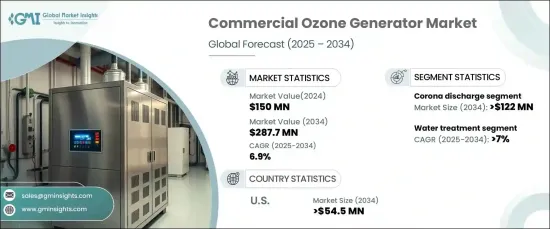
소독 및 정화를 위한 친환경적이고 화학물질을 사용하지 않는 솔루션을 장려하는 정부 및 규제기관의 노력이 오존 발생기 채택을 촉진하고 있습니다. 사무실, 공장 등 깨끗하고 안전한 상업 공간을 유지하려는 요구가 높아지면서 시장 수요가 증가하고 있습니다. 또한 기술의 발전으로 자동 작동 및 실시간 모니터링과 같은 기능을 갖춘 작고 효율적이며 사용하기 쉬운 오존 시스템의 개발이 진행되고 있으며, 이는 오존 시스템의 사용을 더욱 촉진하고 있습니다.
| 시장 범위 | |
|---|---|
| 시작연도 | 2024년 |
| 예측연도 | 2025-2034년 |
| 시작 금액 | 1억 5,000만 달러 |
| 예상 금액 | 2억 8,770만 달러 |
| CAGR | 6.9% |
식품 가공 분야에서는 장비의 살균, 미생물 증식 억제, 제품 보존성 향상을 위해 오존 기술의 도입이 진행되고 있으며, 이는 시장 성장에 긍정적인 영향을 미치고 있습니다. 기술 측면에서 코로나 방전 분야는 2034년까지 1억 2,200만 달러 이상의 평가액을 달성할 것으로 예상됩니다. 이러한 성장은 낮은 에너지 소비로 고농도 오존을 생성할 수 있는 능력에 기인합니다. 시스템의 신뢰성, 사용 편의성 및 운영 효율성을 높이기 위한 지속적인 기술 혁신으로 인해 코로나 방전 기술은 다양한 용도에서 더욱 매력적으로 변모하고 있습니다.
수처리 분야는 2034년까지 연평균 7% 이상의 높은 성장률을 보일 것으로 예상됩니다. 오존은 박테리아, 바이러스, 유기 오염물질을 제거하는 탁월한 산화 능력으로 인해 염소와 같은 전통적인 살균제의 대안으로 선호되고 있습니다. 특히 지자체 수처리 시설의 경우, 수질 기준을 관리하는 규제가 강화되고 있으며, 규정 준수 요건을 충족하기 위해 오존 발생기 도입이 가속화되고 있습니다.
미국의 상업용 오존 발생기 시장은 2034년까지 5,450만 달러 규모에 달할 것으로 예상됩니다. 엄격한 대기 및 수질 규제 강화와 더불어 지속가능하고 친환경적인 솔루션에 대한 수요 증가가 제품 보급을 촉진하고 있습니다. 유해한 부산물 감소와 환경 보호에 대한 관심이 높아지면서 산업 및 도시 개발이 증가함에 따라 효과적인 대기 및 수처리 솔루션에 대한 수요가 증가하면서 시장이 발전하고 있습니다.
목차
제1장 조사 방법과 조사 범위
- 시장의 정의
- 기본 추정과 계산
- 예측 계산
- 1차 조사와 검증
- 1차 소스
- 데이터 마이닝 소스
- 시장 정의
제2장 개요
제3장 업계 인사이트
- 업계 에코시스템
- 규제 상황
- 업계에 대한 영향요인
- 성장 촉진요인
- 업계의 잠재적 리스크·과제
- 성장 가능성 분석
- Porter의 산업 분석
- 공급 기업의 교섭력
- 바이어의 교섭력
- 신규 진출업체의 위협
- 대체품의 위협
- PESTEL 분석
제4장 경쟁상황
- 서론
- 전략 대시보드
- 혁신·기술 전망
제5장 시장 규모·예측 : 기술별, 2021-2034년
- 주요 동향
- 자외선
- 저온 플라즈마
- 코로나 방전
- 전해
제6장 시장 규모·예측 : 용도별, 2021-2034년
- 주요 동향
- 수처리
- 실험실 ·의료장비
- 공기 처리
- 기타
제7장 시장 규모·예측 : 용량별, 2021-2034년
- 주요 동향
- 5 gm/hr 이하
- 5 gm/hr-100 gm/hr
- 100 gm/hr-1 kg/hr
- 1 kg/hr-5 kg/hr
- 5 kg/hr 이상
제8장 시장 규모·예측 : 지역별, 2021-2034년
- 주요 동향
- 북미
- 미국
- 캐나다
- 유럽
- 독일
- 영국
- 프랑스
- 러시아
- 이탈리아
- 스페인
- 아시아태평양
- 중국
- 호주
- 인도
- 일본
- 한국
- 중동 및 아프리카
- 사우디아라비아
- 아랍에미리트
- 이집트
- 터키
- 남아프리카공화국
- 라틴아메리카
- 브라질
- 아르헨티나
제9장 기업 개요
- Corotec
- DEL Ozone
- EBARA Technologies
- Faraday Ozone
- Lenntech Water Treatment
- Oxidation Technologies
- ORAIPL
- Oxyzone
- Ozone Solutions
- Toshiba
The Global Commercial Ozone Generator Market was valued at USD 150 million in 2024 and is projected to grow at a CAGR of 6.9% from 2025 to 2034. These devices are engineered to generate ozone for extensive use in commercial environments. Using methods like corona discharge and ultraviolet light, these systems produce ozone, a potent oxidizing agent. Compared to residential units, commercial ozone generators are designed for higher output and often include advanced features such as automated controls, internet-enabled interfaces, and real-time performance monitoring.
Growing efforts by governments and regulatory bodies to promote eco-friendly and chemical-free solutions for disinfection and purification are driving the adoption of ozone generators. The increasing need for maintaining clean and safe commercial spaces, including offices and factories, is boosting market demand. Additionally, technological advancements are leading to the development of compact, efficient, and user-friendly ozone systems equipped with features like automated operations and real-time monitoring, further encouraging their use.
| Market Scope | |
|---|---|
| Start Year | 2024 |
| Forecast Year | 2025-2034 |
| Start Value | $150 Million |
| Forecast Value | $287.7 Million |
| CAGR | 6.9% |
The food processing sector is increasingly integrating ozone technology to sterilize equipment, control microbial growth, and enhance product shelf life, which is positively influencing market growth. In terms of technology, the corona discharge segment is expected to achieve a valuation exceeding USD 122 million by 2034. This growth is attributed to its ability to produce high concentrations of ozone with low energy consumption. Ongoing innovation to enhance system reliability, ease of use, and operational efficiency is making corona discharge technology more appealing across a broad spectrum of applications.
Water treatment applications are anticipated to experience robust growth, with a projected CAGR of over 7% through 2034. The superior oxidizing capabilities of ozone in removing bacteria, viruses, and organic pollutants make it a preferred alternative to traditional disinfectants like chlorine. Stricter regulations governing water quality standards, especially in municipal water treatment facilities, are fueling the adoption of ozone generators to meet compliance requirements.
In the United States, the commercial ozone generator market is set to surpass USD 54.5 million by 2034. Heightened enforcement of stringent air and water quality regulations, coupled with the rising demand for sustainable and environmentally friendly solutions, is driving product uptake. The growing focus on reducing harmful byproducts and aligning with green initiatives, along with increasing industrial and urban development, is amplifying the need for effective air and water treatment solutions, thereby propelling the market forward.
Table of Contents
Chapter 1 Methodology & Scope
- 1.1 Market definitions
- 1.2 Base estimates & calculations
- 1.3 Forecast calculation
- 1.4 Primary research & validation
- 1.4.1 Primary sources
- 1.4.2 Data mining sources
- 1.5 Market definitions
Chapter 2 Executive Summary
- 2.1 Industry synopsis, 2021 – 2034
Chapter 3 Industry Insights
- 3.1 Industry ecosystem
- 3.2 Regulatory landscape
- 3.3 Industry impact forces
- 3.3.1 Growth drivers
- 3.3.2 Industry pitfalls & challenges
- 3.4 Growth potential analysis
- 3.5 Porter's analysis
- 3.5.1 Bargaining power of suppliers
- 3.5.2 Bargaining power of buyers
- 3.5.3 Threat of new entrants
- 3.5.4 Threat of substitutes
- 3.6 PESTEL analysis
Chapter 4 Competitive landscape, 2024
- 4.1 Introduction
- 4.2 Strategic dashboard
- 4.3 Innovation & technology landscape
Chapter 5 Market Size and Forecast, By Technology, 2021 – 2034 (USD Million & Units)
- 5.1 Key trends
- 5.2 Ultraviolet
- 5.3 Cold plasma
- 5.4 Corona discharge
- 5.5 Electrolytic
Chapter 6 Market Size and Forecast, By Application, 2021 – 2034 (USD Million & Units)
- 6.1 Key trends
- 6.2 Water Treatment
- 6.3 Laboratory & medical equipment
- 6.4 Air Treatment
- 6.5 Others
Chapter 7 Market Size and Forecast, By Capacity, 2021 – 2034 (USD Million & Units)
- 7.1 Key trends
- 7.2 ≤ 5 gm/hr
- 7.3 5 gm/hr - 100 gm/hr
- 7.4 100 gm/hr - 1 kg/hr
- 7.5 1 kg/hr - 5 kg/hr
- 7.6 > 5 kg/hr
Chapter 8 Market Size and Forecast, By Region, 2021 – 2034 (USD Million & Units)
- 8.1 Key trends
- 8.2 North America
- 8.2.1 U.S.
- 8.2.2 Canada
- 8.3 Europe
- 8.3.1 Germany
- 8.3.2 UK
- 8.3.3 France
- 8.3.4 Russia
- 8.3.5 Italy
- 8.3.6 Spain
- 8.4 Asia Pacific
- 8.4.1 China
- 8.4.2 Australia
- 8.4.3 India
- 8.4.4 Japan
- 8.4.5 South Korea
- 8.5 Middle East & Africa
- 8.5.1 Saudi Arabia
- 8.5.2 UAE
- 8.5.3 Egypt
- 8.5.4 Turkey
- 8.5.5 South Africa
- 8.6 Latin America
- 8.6.1 Brazil
- 8.6.2 Argentina
Chapter 9 Company Profiles
- 9.1 Corotec
- 9.2 DEL Ozone
- 9.3 EBARA Technologies
- 9.4 Faraday Ozone
- 9.5 Lenntech Water Treatment
- 9.6 Oxidation Technologies
- 9.7 ORAIPL
- 9.8 Oxyzone
- 9.9 Ozone Solutions
- 9.10 Toshiba