|
시장보고서
상품코드
1665069
가스 연소 수관식 화학 보일러 시장 기회, 성장 촉진요인, 산업 동향 분석 및 예측(2025-2034년)Gas Fired Water Tube Chemical Boiler Market Opportunity, Growth Drivers, Industry Trend Analysis, and Forecast 2025 - 2034 |
||||||

세계의 가스 연소 수관식 화학 보일러 시장은 2024년에 4억 6,340만 달러의 평가액을 달성했고, 2025년부터 2034년에 걸쳐 4.2%의 연평균 복합 성장률(CAGR)로 견조하게 성장할 것으로 예측되고 있습니다.
이 성장 궤도는 보다 깨끗한 에너지 솔루션에 대한 수요가 증가하고 배출을 최소화하면서 효율을 높이기 위해 고안된 보일러 기술의 지속적인 발전에 힘쓰고 있습니다. 급속한 산업화, 가속화하는 도시화, 에너지 인프라에 대한 투자 증가의 복합적인 영향으로 예측 기간 동안 큰 시장 기회가 생길 것으로 보입니다.

매시간 10MMBTU 미만의 보일러는 2034년까지 시장에 2억 달러를 기여할 것으로 예상됩니다. 이러한 컴팩트하면서도 고효율 모델은 소규모 운영에 대응하여 현저한 비용 절감과 연료 소비 절감을 실현합니다. 세계의 산업계가 에너지 효율과 환경의 지속가능성을 우선시하는 가운데, 이러한 시스템에서 스마트 제어기술의 채용이 시장 역학을 크게 형성할 것으로 예상됩니다. 게다가 엄격한 환경규제를 준수하기 위한 보일러 성능 강화를 위한 관민 양부문의 투자는 시장 성장을 가속하는 데 있어 매우 중요한 역할을 할 것으로 보입니다.
| 시장 범위 | |
|---|---|
| 시작 연도 | 2024년 |
| 예측 연도 | 2025-2034년 |
| 시작 금액 | 4억 6,340만 달러 |
| 예측 금액 | 7억 480만 달러 |
| CAGR | 4.2% |
비응축식 가스 연소 수관식 화학 보일러 분야는 2034년까지의 CAGR이 4%로 예측되어 대폭적인 확대가 전망되고 있습니다. 이러한 성장은 최첨단 기술 혁신을 통해 우수한 에너지 효율과 온실가스 배출을 줄일 수 있기 때문입니다. 첨단 제어 시스템의 통합과 함께 산업 운영에서 디지털화와 자동화의 채택이 확대됨에 따라 시장 수요가 더욱 커질 것으로 보입니다. 게다가, 화학 부문에서 중소기업의 존재감이 증가하고 운영 비용 절감에 대한 주력은 이 부문의 성장 궤도를 확고히할 것으로 예상됩니다.
미국에서는 2034년까지 1억 6,000만 달러를 창출할 것으로 예상됩니다. 미국의 산업 부문은 에너지 효율이 높고 환경 친화적인 솔루션을 중시하고 있으며, 대폭적인 확대를 계속하고 있습니다. 정부의 장려책, 기술의 진보, 산업 인프라의 근대화가 이러한 보일러의 채용을 가속화하고 있습니다. 연소 기술의 혁신, 첨단 열교환기 개발, 연방 및 주 수준의 리베이트 및 장려금의 가용성 등이 유리한 시장 환경을 창출하여 향후 수년간 지속적인 사업 성장을 위한 길을 열고 있습니다.
목차
제1장 조사 방법과 조사 범위
- 시장 범위와 정의
- 시장 추계·예측 파라미터
- 예측 계산
- 데이터 소스
- 1차 데이터
- 2차 데이터
- 유료
- 공개
제2장 주요 요약
제3장 업계 인사이트
- 생태계 분석
- 규제 상황
- 업계에 미치는 영향요인
- 성장 촉진요인
- 업계의 잠재적 위험 및 과제
- 성장 가능성 분석
- Porter's Five Forces 분석
- 공급기업의 협상력
- 구매자의 협상력
- 신규 참가업체의 위협
- 대체품의 위협
- PESTEL 분석
제4장 경쟁 구도
- 소개
- 전략적 전망
- 혁신과 지속가능성의 전망
제5장 시장 규모와 예측 : 용량별(2021-2034년, MMBTU/hr, 100만 달러)
- 주요 동향
- 10 MMBTU/hr 미만
- 10-25 MMBTU/hr
- 25-50 MMBTU/hr
- 50-75 MMBTU/hr
- 75-100 MMBTU/hr
- 100-175 MMBTU/hr
- 175-250 MMBTU/hr
- 250 MMBTU/hr
제6장 시장 규모와 예측 : 기술별(2021-2034년, MMBTU/hr, 100만 달러)
- 주요 동향
- 응축
- 비응축
제7장 시장 규모와 예측 : 지역별(2021-2034년, MMBTU/hr, 100만 달러)
- 주요 동향
- 북미
- 미국
- 캐나다
- 멕시코
- 유럽
- 영국
- 프랑스
- 독일
- 이탈리아
- 러시아
- 스페인
- 아시아태평양
- 중국
- 호주
- 인도
- 일본
- 한국
- 중동 및 아프리카
- 사우디아라비아
- 아랍에미리트(UAE)
- 터키
- 남아프리카
- 이집트
- 라틴아메리카
- 브라질
- 아르헨티나
제8장 기업 프로파일
- Alfa Laval
- Babcock &Wilcox
- Babcock Wanson
- Bosch Industriekessel
- Clayton Industries
- Cleaver-Brooks
- Cochran
- Forbes Marshall
- Hoval
- Hurst Boiler &Welding
- Kawasaki Thermal Engineering
- Miura America
- Rentech Boiler Systems
- SUPERIOR BOILER
- Thermax
- Thermodyne Boilers
- Victory Energy Operations
- Viessmann
The Global Gas Fired Water Tube Chemical Boiler Market achieved a valuation of USD 463.4 million in 2024 and is anticipated to grow at a robust CAGR of 4.2% between 2025 and 2034. This upward trajectory is fueled by the increasing demand for cleaner energy solutions and continuous advancements in boiler technology designed to enhance efficiency while minimizing emissions. The combined impact of rapid industrialization, accelerated urbanization, and rising investments in energy infrastructure is set to unlock significant market opportunities during the forecast period.
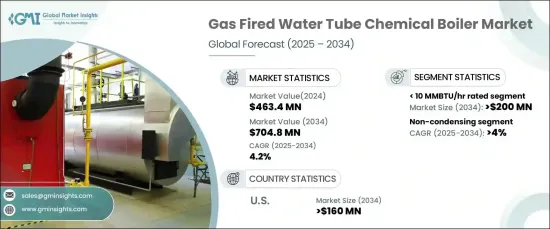
Boilers with a capacity of less than 10 MMBTU/hr are projected to contribute USD 200 million to the market by 2034. These compact yet highly efficient models cater to smaller-scale operations, delivering notable cost savings and reduced fuel consumption. As industries worldwide prioritize energy efficiency and environmental sustainability, the adoption of smart control technologies in these systems is expected to shape market dynamics significantly. Furthermore, both public and private sector investments in enhancing boiler performance to comply with stringent environmental regulations will play a pivotal role in driving market growth.
| Market Scope | |
|---|---|
| Start Year | 2024 |
| Forecast Year | 2025-2034 |
| Start Value | $463.4 Million |
| Forecast Value | $704.8 Million |
| CAGR | 4.2% |
The non-condensing gas-fired water tube chemical boiler segment is set to experience substantial expansion, with a projected CAGR of 4% through 2034. This growth is attributed to the segment's ability to provide superior energy efficiency and lower greenhouse gas emissions powered by cutting-edge technological innovations. The growing adoption of digitalization and automation in industrial operations, coupled with the integration of advanced control systems, will further augment market demand. Additionally, the increasing presence of small and medium-sized enterprises in the chemical sector, along with a focus on operational cost reduction, is expected to solidify the segment's growth trajectory.
In the United States, the gas-fired water tube chemical boiler market is forecast to generate USD 160 million by 2034. The industrial sector in the U.S. is undergoing significant expansion, underscored by a strong emphasis on energy-efficient and environmentally conscious solutions. Government incentives, technological advancements, and the modernization of industrial infrastructure are accelerating the adoption of these boilers. Innovations in combustion technology, the development of advanced heat exchangers, and the availability of federal and state-level rebates and incentives are creating a favorable market landscape, paving the way for sustained business growth in the coming years.
Table of Contents
Chapter 1 Methodology & Scope
- 1.1 Market scope & definitions
- 1.2 Market estimates & forecast parameters
- 1.3 Forecast calculation
- 1.4 Data sources
- 1.4.1 Primary
- 1.4.2 Secondary
- 1.4.2.1 Paid
- 1.4.2.2 Public
Chapter 2 Executive Summary
- 2.1 Industry synopsis, 2021 - 2034
Chapter 3 Industry Insights
- 3.1 Industry ecosystem analysis
- 3.2 Regulatory landscape
- 3.3 Industry impact forces
- 3.3.1 Growth drivers
- 3.3.2 Industry pitfalls & challenges
- 3.4 Growth potential analysis
- 3.5 Porter's analysis
- 3.5.1 Bargaining power of suppliers
- 3.5.2 Bargaining power of buyers
- 3.5.3 Threat of new entrants
- 3.5.4 Threat of substitutes
- 3.6 PESTEL analysis
Chapter 4 Competitive Landscape, 2024
- 4.1 Introduction
- 4.2 Strategic outlook
- 4.3 Innovation & sustainability landscape
Chapter 5 Market Size and Forecast, By Capacity, 2021 – 2034 (Units, MMBTU/hr & USD Million)
- 5.1 Key trends
- 5.2 < 10 MMBTU/hr
- 5.3 10 - 25 MMBTU/hr
- 5.4 25 - 50 MMBTU/hr
- 5.5 50 - 75 MMBTU/hr
- 5.6 75 - 100 MMBTU/hr
- 5.7 100 - 175 MMBTU/hr
- 5.8 175 - 250 MMBTU/hr
- 5.9 > 250 MMBTU/hr
Chapter 6 Market Size and Forecast, By Technology, 2021 – 2034 (Units, MMBTU/hr & USD Million)
- 6.1 Key trends
- 6.2 Condensing
- 6.3 Non-condensing
Chapter 7 Market Size and Forecast, By Region, 2021 – 2034 (Units & USD Million)
- 7.1 Key trends
- 7.2 North America
- 7.2.1 U.S.
- 7.2.2 Canada
- 7.2.3 Mexico
- 7.3 Europe
- 7.3.1 UK
- 7.3.2 France
- 7.3.3 Germany
- 7.3.4 Italy
- 7.3.5 Russia
- 7.3.6 Spain
- 7.4 Asia Pacific
- 7.4.1 China
- 7.4.2 Australia
- 7.4.3 India
- 7.4.4 Japan
- 7.4.5 South Korea
- 7.5 Middle East & Africa
- 7.5.1 Saudi Arabia
- 7.5.2 UAE
- 7.5.3 Turkey
- 7.5.4 South Africa
- 7.5.5 Egypt
- 7.6 Latin America
- 7.6.1 Brazil
- 7.6.2 Argentina
Chapter 8 Company Profiles
- 8.1 Alfa Laval
- 8.2 Babcock & Wilcox
- 8.3 Babcock Wanson
- 8.4 Bosch Industriekessel
- 8.5 Clayton Industries
- 8.6 Cleaver-Brooks
- 8.7 Cochran
- 8.8 Forbes Marshall
- 8.9 Hoval
- 8.10 Hurst Boiler & Welding
- 8.11 Kawasaki Thermal Engineering
- 8.12 Miura America
- 8.13 Rentech Boiler Systems
- 8.14 SUPERIOR BOILER
- 8.15 Thermax
- 8.16 Thermodyne Boilers
- 8.17 Victory Energy Operations
- 8.18 Viessmann