|
시장보고서
상품코드
1665206
유리병 및 용기 시장(2025-2034년) : 시장 기회, 촉진요인, 업계 동향 분석 및 예측Glass Bottles and Containers Market Opportunity, Growth Drivers, Industry Trend Analysis, and Forecast 2025 - 2034 |
||||||

유리병 및 용기 세계 시장은 2024년에 753억 달러를 달성하였고, 2025-2034년에 걸쳐 CAGR 4.4%로 확대할 것으로 예측하고 있습니다.
환경친화적이고 비용효율적인 포장 솔루션에 대한 수요가 증가함에 따라 이 시장의 성장을 뒷받침하고 있습니다. 제조업체와 소비자 모두 운송 비용 절감과 이산화탄소 배출량 감소의 이점을 제공하는 경량 유리 병을 선택하고 있으며 따라서 지속 가능성 목표를 달성하면서 환경 실적 개선을 목표로 하는 기업에게 유리병은 매력적인 선택지가 되고 있습니다.
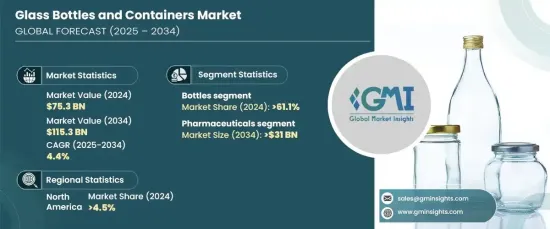
다양한 제품 유형 중에서 유리병이 시장을 독점하고 있으며 2024년에는 61.1%라는 큰 점유율을 차지하였습니다. 이 성장의 주요 요인은 식음료, 의약품, 퍼스널케어 등 여러 산업에서 재활용 가능하고 환경친화적인 포장에 대한 수요가 증가하고 있다는 점입니다. 유리병은 비반응성, 지속 가능성, 고급스러운 외관으로 인해 높게 평가되고 있으며 고품질의 제품을 포장할 수 있기 때문에 제조업체가 선호하는 옵션입니다. 또한, 경량 유리 제조와 내구성 강화의 지속적인 발전이 특히 식음료 부문에서 유리병 채택 증가에 기여하고 있습니다.
| 시장 범위 | |
|---|---|
| 시작년 | 2024년 |
| 예측연도 | 2025-2034년 |
| 시작금액 | 753억 달러 |
| 예측금액 | 1,153억 달러 |
| CAGR | 4.4% |
유리병 및 용기 시장은 식음료, 의약품, 화장품 및 퍼스널케어, 화학, 기타 등 최종 이용 산업에 의해서도 구분됩니다. 제약산업은 큰 성장을 이루고 있으며 CAGR 4.6%로 성장하여 2034년에는 추정 310억 달러에 이를 전망입니다. 보호성이 높고 반응성이 없으며 지속 가능한 포장 솔루션에 대한 수요는 특히 의약품 부문에서 강해지고 있습니다. 유리병은 오염을 방지하고 제품의 안정성을 유지하는 탁월한 특성으로 인해 용액 의약품, 면역제 및 기타 민감한 제품 포장에 널리 사용됩니다.
2024년 북미는 유리병 및 용기 세계 시장에서 4.5%의 점유율을 차지하였습니다. 특히 음료산업에서의 고급 포장에 대한 수요 증가가 이 지역의 시장 성장을 가속하는 주 요인 중 하나입니다. 소비자는 제품의 고급스러움을 반영한 고품질의 시각 요소를 발휘하는 유리병에 점점 매료되고 있습니다. 이에 따라 제조업체는 브랜드 차별화와 소비자 경험의 향상을 도모하기 위해 혁신적인 병 디자인, 독특한 마무리감, 그리고 선명한 색채를 도입하고 있습니다. 게다가 유리 포장을 통해 장인적이고 고급스러운 이미지를 전하고자 하는 소규모 음료 제조업체의 대두가 시장을 더욱 전진시키고 있습니다.
목차
제1장 조사 방법 및 조사 범위
- 시장 범위 및 정의
- 기본 추정 및 계산
- 예측 계산
- 데이터 소스
- 1차 데이터
- 2차 자료
- 유료 정보원
- 공공 정보원
제2장 주요 요약
제3장 산업 인사이트
- 생태계 분석
- 밸류체인에 영향을 주는 요인
- 변혁
- 미래 전망
- 제조업체
- 유통업체
- 이익률 분석
- 주요 뉴스 및 대처
- 규제 상황
- 영향요인
- 성장 촉진요인
- 가볍고 지속 가능한 유리 포장 솔루션에 대한 수요 증가
- 프리미엄 음료 부문의 성장
- 재사용 가능하고 회수 가능한 유리 용기로 이동
- 플라스틱의 사용과 폐기에 관한 규제 증가
- 유리 포장과 관련된 강한 브랜드 정체성 및 지각 품질
- 산업의 잠재적 리스크 및 과제
- 에너지 집약형 제조 공정
- 재생 유리 원료의 이용 가능성 제한
- 성장 촉진요인
- 성장 가능성 분석
- Porter's Five Forces 분석
- PESTEL 분석
제4장 경쟁 구도
- 소개
- 기업 점유율 분석
- 경쟁 포지셔닝 매트릭스
- 전략 전망 매트릭스
제5장 시장 추정 및 예측 : 제품별(2021-2034년)
- 주요 동향
- 병
- 단지
- 바이알 앰풀
제6장 시장 추정 및 예측 : 용도별(2021-2034년)
- 주요 동향
- 음료
- 의약품
- 포장 식품
- 향수 및 향료
- 스킨케어 제품
- 기타
제7장 시장 추정 및 예측 : 최종 이용 산업별(2021-2034년)
- 주요 동향
- 식음료
- 의약품
- 화장품 및 퍼스널케어
- 화학제품
- 기타
제8장 시장 추정 및 예측 : 지역별(2021-2034년)
- 주요 동향
- 북미
- 미국
- 캐나다
- 유럽
- 영국
- 독일
- 프랑스
- 이탈리아
- 스페인
- 러시아
- 아시아태평양
- 중국
- 인도
- 일본
- 한국
- 호주
- 라틴아메리카
- 브라질
- 멕시코
- 중동 및 아프리카
- 남아프리카
- 사우디아라비아
- 아랍에미리트(UAE)
제9장 기업 프로파일
- AGI Glaspac
- Ameri Glass
- Anchor Glass Container
- Ardagh Group
- BPL Offset
- Croxons
- Encirc
- Gerresheimer
- Glaspack
- Glassworks International
- Jiangsu Rongtai Glass Products
- Kaufman Container
- KP Glas
- Orora Packaging Australia
- Outshinery Creative
- Owens-Illinois
- Saxco International
- SCHOTT Pharma
- SGD Pharma
- Shandong Sinobottles Packaging
- Stevanato Group
- TricorBraun Canada
- United Bottles and Packaging
- Vitro
The Global Glass Bottles And Containers Market was valued at USD 75.3 billion in 2024 and is projected to expand at a CAGR of 4.4% from 2025 to 2034. The increasing demand for eco-friendly and cost-effective packaging solutions is driving this market's growth. Both manufacturers and consumers are increasingly choosing lightweight glass bottles, which offer the benefits of reduced transportation costs and lower carbon emissions. This makes them an appealing choice for companies looking to improve their environmental footprint while meeting sustainability goals.
Among the various product types, glass bottles dominate the market, holding a substantial share of 61.1% in 2024. This growth is primarily driven by the rising demand for recyclable and eco-conscious packaging across several industries, including food and beverages, pharmaceuticals, and personal care. Glass bottles are highly valued for their non-reactive properties, sustainability, and premium appeal. Their ability to package high-quality products makes them the preferred choice for manufacturers. Additionally, ongoing advancements in lightweight glass production and enhanced durability are contributing to the increasing adoption of glass bottles, especially within the food and beverage sector.
| Market Scope | |
|---|---|
| Start Year | 2024 |
| Forecast Year | 2025-2034 |
| Start Value | $75.3 Billion |
| Forecast Value | $115.3 Billion |
| CAGR | 4.4% |
The market for glass bottles and containers is also segmented by end-use industries such as food and beverages, pharmaceuticals, cosmetics and personal care, chemicals, and others. The pharmaceutical industry is poised for significant growth, with a projected CAGR of 4.6%, reaching an estimated USD 31 billion by 2034. The demand for protective, non-reactive, and sustainable packaging solutions is intensifying, particularly in the pharmaceutical sector. Glass bottles are widely used for packaging sensitive products like solution medicines, immunizers, and other delicate goods, as their superior properties prevent contamination and maintain product stability.
In 2024, North America held a 4.5% share of the global glass bottles and containers market. The growing demand for premium packaging, particularly in the beverage industry, is one of the key factors driving market growth in this region. Consumers are increasingly drawn to high-quality, visually appealing glass bottles that reflect the premium nature of the product they contain. In response, manufacturers are introducing innovative bottle designs, unique finishes, and vibrant colors to differentiate their brands and enhance consumer experiences. Additionally, the rise of small-scale beverage producers, who are seeking to convey an artisanal, premium image through glass packaging, is further propelling the market forward.
Table of Contents
Chapter 1 Methodology & Scope
- 1.1 Market scope & definitions
- 1.2 Base estimates & calculations
- 1.3 Forecast calculations
- 1.4 Data sources
- 1.4.1 Primary
- 1.4.2 Secondary
- 1.4.2.1 Paid sources
- 1.4.2.2 Public sources
Chapter 2 Executive Summary
- 2.1 Industry synopsis, 2021-2034
Chapter 3 Industry Insights
- 3.1 Industry ecosystem analysis
- 3.1.1 Factor affecting the value chain
- 3.1.2 Disruptions
- 3.1.3 Future outlook
- 3.1.4 Manufacturers
- 3.1.5 Distributors
- 3.2 Profit margin analysis
- 3.3 Key news & initiatives
- 3.4 Regulatory landscape
- 3.5 Impact forces
- 3.5.1 Growth drivers
- 3.5.1.1 Increasing demand for lightweight and sustainable glass packaging solutions
- 3.5.1.2 Growth in the premium beverage sector
- 3.5.1.3 Shift towards reusable and returnable glass containers
- 3.5.1.4 Increasing regulations on plastic use and waste
- 3.5.1.5 Strong brand identity and perceived quality associated with glass packaging
- 3.5.2 Industry pitfalls & challenges
- 3.5.2.1 Energy-intensive manufacturing process
- 3.5.2.2 Limited availability of recycled glass material
- 3.5.1 Growth drivers
- 3.6 Growth potential analysis
- 3.7 Porter’s analysis
- 3.8 PESTEL analysis
Chapter 4 Competitive Landscape, 2024
- 4.1 Introduction
- 4.2 Company market share analysis
- 4.3 Competitive positioning matrix
- 4.4 Strategic outlook matrix
Chapter 5 Market Estimates & Forecast, By Product, 2021-2034 (USD Billion & Kilo Tons)
- 5.1 Key trends
- 5.2 Bottles
- 5.3 Jars
- 5.4 Vials & ampoules
Chapter 6 Market Estimates & Forecast, By Application, 2021-2034 (USD Billion & Kilo Tons)
- 6.1 Key trends
- 6.2 Beverages
- 6.3 Medicines
- 6.4 Packaged foods
- 6.5 Perfumes and fragrances
- 6.6 Skincare products
- 6.7 Others
Chapter 7 Market Estimates & Forecast, By End Use Industry, 2021-2034 (USD Billion & Kilo Tons)
- 7.1 Key trends
- 7.2 Food & beverage
- 7.3 Pharmaceuticals
- 7.4 Cosmetics & personal care
- 7.5 Chemicals
- 7.6 Others
Chapter 8 Market Estimates & Forecast, By Region, 2021-2034 (USD Billion & Kilo Tons)
- 8.1 Key trends
- 8.2 North America
- 8.2.1 U.S.
- 8.2.2 Canada
- 8.3 Europe
- 8.3.1 UK
- 8.3.2 Germany
- 8.3.3 France
- 8.3.4 Italy
- 8.3.5 Spain
- 8.3.6 Russia
- 8.4 Asia Pacific
- 8.4.1 China
- 8.4.2 India
- 8.4.3 Japan
- 8.4.4 South Korea
- 8.4.5 Australia
- 8.5 Latin America
- 8.5.1 Brazil
- 8.5.2 Mexico
- 8.6 MEA
- 8.6.1 South Africa
- 8.6.2 Saudi Arabia
- 8.6.3 UAE
Chapter 9 Company Profiles
- 9.1 AGI Glaspac
- 9.2 Ameri Glass
- 9.3 Anchor Glass Container
- 9.4 Ardagh Group
- 9.5 BPL Offset
- 9.6 Croxons
- 9.7 Encirc
- 9.8 Gerresheimer
- 9.9 Glaspack
- 9.10 Glassworks International
- 9.11 Jiangsu Rongtai Glass Products
- 9.12 Kaufman Container
- 9.13 KP Glas
- 9.14 Orora Packaging Australia
- 9.15 Outshinery Creative
- 9.16 Owens-Illinois
- 9.17 Saxco International
- 9.18 SCHOTT Pharma
- 9.19 SGD Pharma
- 9.20 Shandong Sinobottles Packaging
- 9.21 Stevanato Group
- 9.22 TricorBraun Canada
- 9.23 United Bottles and Packaging
- 9.24 Vitro