|
시장보고서
상품코드
1665224
유틸리티 규모 마이크로그리드 시장 : 기회, 성장 촉진요인, 산업 동향 분석, 예측(2025-2034년)Utility Scale Microgrid Market Opportunity, Growth Drivers, Industry Trend Analysis, and Forecast 2025 - 2034 |
||||||

세계의 유틸리티 규모 마이크로그리드 시장은 2024년 27억 달러로 평가됐으며 2025-2034년까지 CAGR 18.5%로 예측되어 강력한 성장을 이룰 전망입니다.
유틸리티 규모 마이크로그리드는 독립적으로 또는 주전력 네트워크와 함께 작동 할 수있는 국부적인 에너지 시스템이며 에너지 전망에 혁명을 가져옵니다. 태양전지판, 풍력 터빈, 에너지 저장 기술과 같은 분산 에너지 자원을 통합함으로써 이러한 시스템은 정해진 지역 내에서 안정적인 발전, 저장 및 배전을 보장합니다. 송전망의 회복력을 높이고 에너지 이용을 최적화하고 재생 가능 에너지의 통합을 촉진하는 능력은 현대 에너지 인프라의 초석으로 자리 잡고 있습니다.

특히 집중형 송전망의 확대가 비싸고 비효율적인 원격지나 농촌에서는 에너지 자립에 대한 수요가 마이크로그리드 도입의 큰 원동력이 되고 있습니다. 세계 정부와 규제 당국은 지원 시책, 재정적 인센티브, 자금 제공 프로그램을 통해 마이크로그리드의 전개를 가속화하고 있으며, 시장 확대를 위한 비옥한 토양을 만들어 내고 있습니다.
| 시장 범위 | |
|---|---|
| 시작 연도 | 2024년 |
| 예측 연도 | 2025-2034년 |
| 시작 금액 | 27억 달러 |
| 예측 금액 | 160억 달러 |
| CAGR | 18.5% |
그리드 유형별로 분류하면 시장에는 AC, DC, 하이브리드 시스템이 있으며, DC 부문은 눈부신 성장을 이루며 2034년에는 52억 달러에 달할 것으로 예상됩니다. 직류 시스템은 재생 가능 에너지원과의 원활한 호환성으로 인기를 끌고 있으며 직류에서 교류로의 변환으로 인한 에너지 손실을 없애고 있습니다. 이러한 시스템은 운영 비용 절감, 효율성 향상, 설계 및 유지 보수의 단순화를 실현하기 때문에 최신 마이크로그리드 설치에 점점 더 선호되는 옵션이되었습니다.
연결성에 따라 시장은 그리드 연결과 오프 그리드로 분류되며 그리드 연결 유형은 예측 기간 동안 CAGR 18.5%로 성장할 것으로 예측됩니다. 이러한 시스템은 정전 및 송전망이 중단될 때 신뢰할 수 있는 백업 전력이 필요한 중요한 요구를 충족합니다. 게다가 부하의 밸런스를 취해 수요 피크시에 전력을 보충할 수 있기 때문에 집중형 송전망에 대한 부담이 경감되어 보급의 원동력이 되고 있습니다.
미국의 유틸리티 규모 마이크로그리드 시장은 2034년까지 13억 달러 시장 규모에 이를 것으로 예상됩니다. 이러한 재해는 비상시 운영을 유지하고 신속한 복구 작업을 지원할 수 있는 탄력적인 에너지 시스템의 필요성을 돋보이게 합니다. 금융 우대 조치, 보조금, 세액 공제를 포함한 연방 및 주 수준의 이니셔티브는 마이크로그리드 기술에 대한 투자에 더욱 박차를 가하고 있습니다.
목차
제1장 조사 방법과 조사 범위
- 시장의 정의
- 기본 추정과 계산
- 예측 계산
- 1차 조사와 검증
- 1차 정보
- 데이터 마이닝 소스
- 시장 정의
제2장 주요 요약
제3장 산업 인사이트
- 산업 생태계
- 규제 상황
- 산업에 미치는 영향요인
- 성장 촉진요인
- 산업의 잠재적 리스크 및 과제
- 성장 가능성 분석
- Porter's Five Forces 분석
- 공급기업의 협상력
- 구매자의 협상력
- 신규 참가업체의 위협
- 대체품의 위협
- PESTEL 분석
제4장 경쟁 구도
- 소개
- 전략 대시보드
- 혁신과 지속가능성의 전망
제5장 시장 규모와 예측 : 접속성별, 2021-2034년
- 주요 동향
- 그리드 연결
- 오프 그리드
제6장 시장 규모와 예측 : 전원별, 2021-2034년
- 주요 동향
- 디젤 발전기
- 천연가스
- 태양광 발전
- CHP
- 기타
제7장 시장 규모와 예측 : 축전 디바이스별, 2021-2034년
- 주요 동향
- 리튬 이온
- 납축전지
- 플로우 배터리
- 플라이휠
- 기타
제8장 시장 규모와 예측 : 그리드 유형별, 2021-2034년
- 주요 동향
- 교류
- 직류
- 하이브리드
제9장 시장 규모와 예측 : 지역별, 2021-2034년
- 주요 동향
- 북미
- 미국
- 캐나다
- 멕시코
- 유럽
- 독일
- 프랑스
- 영국
- 러시아
- 스페인
- 이탈리아
- 덴마크
- 아시아태평양
- 중국
- 일본
- 한국
- 인도
- 호주
- 중동 및 아프리카
- 사우디아라비아
- 아랍에미리트(UAE)
- 남아프리카
- 라틴아메리카
- 브라질
- 아르헨티나
- 칠레
제10장 기업 프로파일
- Ameresco
- Bloom Energy
- Caterpillar
- Eaton
- General Electric
- PG&E
- Piller Power Systems
- S&C Electric Company
- Stellar Energy
- Schneider Electric
The Global Utility Scale Microgrid Market, valued at USD 2.7 billion in 2024, is set to experience robust growth with a projected CAGR of 18.5% from 2025 to 2034. Utility-scale microgrids, localized energy systems capable of operating independently or in conjunction with the main power grid, are revolutionizing the energy landscape. By integrating distributed energy resources such as solar panels, wind turbines, and energy storage technologies, these systems ensure reliable electricity generation, storage, and distribution within defined areas. Their ability to enhance grid resilience, optimize energy usage, and facilitate renewable energy integration positions them as a cornerstone of modern energy infrastructure.
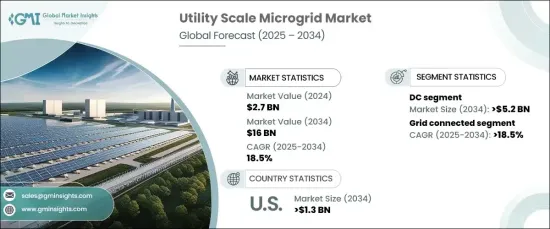
The demand for energy independence is a major driver of microgrid adoption, particularly in remote and rural regions where extending centralized grids is cost-prohibitive and inefficient. Governments and regulatory authorities worldwide are accelerating the deployment of microgrids through supportive policies, financial incentives, and funding programs, creating fertile ground for market expansion.
| Market Scope | |
|---|---|
| Start Year | 2024 |
| Forecast Year | 2025-2034 |
| Start Value | $2.7 Billion |
| Forecast Value | $16 Billion |
| CAGR | 18.5% |
Segmented by grid type, the market includes AC, DC, and hybrid systems, with the DC segment expected to achieve remarkable growth, reaching USD 5.2 billion by 2034. DC systems are gaining popularity due to their seamless compatibility with renewable energy sources, eliminating energy losses from DC-to-AC conversions. These systems also offer reduced operational costs, improved efficiency, and simplified design and maintenance, making them an increasingly preferred choice for modern microgrid installations.
By connectivity, the market is categorized into grid-connected and off-grid systems, with the grid-connected segment projected to grow at a CAGR of 18.5% over the forecast period. These systems address the critical need for reliable backup power during outages and grid disruptions. Additionally, their ability to balance loads and supplement power during peak demand periods alleviates stress on centralized grids, driving their widespread adoption.
The U.S. utility-scale microgrid market is anticipated to generate USD 1.3 billion by 2034, fueled by the growing frequency of natural disasters that disrupt power supplies. These events highlight the necessity of resilient energy systems capable of sustaining operations during emergencies and supporting swift recovery efforts. Federal and state-level initiatives, including financial incentives, grants, and tax credits, are further spurring investments in microgrid technologies.
Table of Contents
Chapter 1 Methodology & Scope
- 1.1 Market definition
- 1.2 Base estimates & calculations
- 1.3 Forecast calculation
- 1.4 Primary research & validation
- 1.4.1 Primary sources
- 1.4.2 Data mining sources
- 1.5 Market definition
Chapter 2 Executive Summary
- 2.1 Industry synopsis, 2021 – 2034
Chapter 3 Industry Insights
- 3.1 Industry ecosystem
- 3.2 Regulatory landscape
- 3.3 Industry impact forces
- 3.3.1 Growth drivers
- 3.3.2 Industry pitfalls & challenges
- 3.4 Growth potential analysis
- 3.5 Porter's analysis
- 3.5.1 Bargaining power of suppliers
- 3.5.2 Bargaining power of buyers
- 3.5.3 Threat of new entrants
- 3.5.4 Threat of substitutes
- 3.6 PESTEL analysis
Chapter 4 Competitive landscape, 2024
- 4.1 Introduction
- 4.2 Strategic dashboard
- 4.3 Innovation & sustainability landscape
Chapter 5 Market Size and Forecast, By Connectivity, 2021 – 2034 (USD Billion & MW)
- 5.1 Key trends
- 5.2 Grid connected
- 5.3 Off grid
Chapter 6 Market Size and Forecast, By Power Source, 2021 – 2034 (USD Billion & MW)
- 6.1 Key trends
- 6.2 Diesel generators
- 6.3 Natural gas
- 6.4 Solar PV
- 6.5 CHP
- 6.6 Others
Chapter 7 Market Size and Forecast, By Storage Device, 2021 – 2034 (USD Billion & MW)
- 7.1 Key trends
- 7.2 Lithium-ion
- 7.3 Lead Acid
- 7.4 Flow battery
- 7.5 Flywheels
- 7.6 Others
Chapter 8 Market Size and Forecast, By Grid Type, 2021 – 2034 (USD Billion & MW)
- 8.1 Key trends
- 8.2 AC
- 8.3 DC
- 8.4 Hybrid
Chapter 9 Market Size and Forecast, By Region, 2021 – 2034 (USD Billion & MW)
- 9.1 Key trends
- 9.2 North America
- 9.2.1 U.S.
- 9.2.2 Canada
- 9.2.3 Mexico
- 9.3 Europe
- 9.3.1 Germany
- 9.3.2 France
- 9.3.3 UK
- 9.3.4 Russia
- 9.3.5 Spain
- 9.3.6 Italy
- 9.3.7 Denmark
- 9.4 Asia Pacific
- 9.4.1 China
- 9.4.2 Japan
- 9.4.3 South Korea
- 9.4.4 India
- 9.4.5 Australia
- 9.5 Middle East and Africa
- 9.5.1 Saudi Arabia
- 9.5.2 UAE
- 9.5.3 South Africa
- 9.6 Latin America
- 9.6.1 Brazil
- 9.6.2 Argentina
- 9.6.3 Chile
Chapter 10 Company Profiles
- 10.1 Ameresco
- 10.2 Bloom Energy
- 10.3 Caterpillar
- 10.4 Eaton
- 10.5 General Electric
- 10.6 PG&E
- 10.7 Piller Power Systems
- 10.8 S&C Electric Company
- 10.9 Stellar Energy
- 10.10 Schneider Electric