

|
시장보고서
상품코드
1665265
경막 대체물 시장 : 시장 기회, 성장 촉진요인, 산업 동향 분석, 예측(2025-2034년)Dura Substitutes Market Opportunity, Growth Drivers, Industry Trend Analysis, and Forecast 2025 - 2034 |
||||||

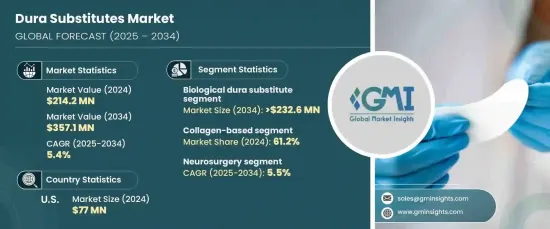
세계의 경막 대체물 시장은 2024년에 2억 1,420만 달러에 이르렀고, 2025년부터 2034년까지 CAGR 5.4%로 강력한 성장을 이룰 것으로 예측되고 있습니다. 이 성장 궤도를 뒷받침하는 것은 의료 기술의 진보, 저침습 치료에 대한 기호 증가, 신경 외과 치료에 대한 의식 증가, 고령화 인구의 확대 등입니다. 이러한 요인이 결합되어 다양한 의료 용도에서 경막 대체물의 채용이 진행되고 있습니다.
생체 재료와 수술 절차의 혁신은 경막 대체물의 성능과 품질을 현저하게 향상시킵니다. 생체적합성, 내구성, 흡수성 향상을 목표로 설계된 최신 재료는 수술 성적을 향상시켜 뇌신경외과 진료에 필수적인 구성 요소로서 경막 대체물의 역할을 확고히 하고 있습니다. 의료기술이 계속 진화함에 따라 첨단 경막 대체물에 대한 수요가 증가하고 시장 성장이 더욱 가속화될 것으로 보입니다.
| 시장 범위 | |
|---|---|
| 시작 연도 | 2024년 |
| 예측 연도 | 2025-2034년 |
| 시작 금액 | 2억 1,420만 달러 |
| 예측 금액 | 3억 5,710만 달러 |
| CAGR | 5.4% |
제품 유형별로 시장은 생물학적 경막 대체물과 합성 경막 대체물로 분류됩니다. 생물학적 경막 대체물은 콜라겐이나 동물 조직과 같은 천연 유래의 것으로 CAGR 5.1%로 성장하여 2034년에는 2억 3,260만 달러에 달할 것으로 예측되고 있습니다. 이러한 대체물은 탁월한 생체적합성을 제공하고 면역 반응 및 거부 반응과 관련된 위험을 줄이기 위해 장기적인 조직 복구를 필요로 하는 치료에 선호되는 선택입니다. 신체와의 원활한 통합으로 안정적인 수요가 확보되고 수술 용도에서 신뢰할 수 있는 솔루션으로 확립되었습니다.
시장은 용도별로도 세분화되어 있어 신경외과, 척추외과, 외상 및 사고 수복, 수술 후 수복, 기타가 포함됩니다. 신경외과 부문은 CAGR 5.5% 예측으로 큰 성장을 기록하며 2034년에는 1억 5,590만 달러에 이를 것으로 예상됩니다. 신경질환과 연령 관련 질환의 유병률 증가와 신경외과 수술의 빈도 증가는 내구성이 높고 효과적인 경막 대체물에 대한 수요를 촉진하고 있습니다. 이 물질은 경막 수복에 필수적이며 신경 외과 치료에 중요한 역할을 강화하고 있습니다.
미국의 경막 대체물 시장은 2024년 7,700만 달러로 평가되었으며, 2034년까지 연평균 복합 성장률(CAGR) 5%로 성장할 것으로 예측됩니다. 이 나라의 첨단 의료 인프라와 저침습 절차를 포함한 신경 외과 수술 방법의 지속적인 혁신은 고성능 및 생체 적합성 대체물을 채택하는 데 박차를 가하고 있습니다. 이러한 진보는 수술 결과의 개선과 환자의 조기 회복을 가능하게 하고, 이 지역에서 시장 확대를 더욱 뒷받침하고 있습니다.
목차
제1장 조사 방법 및 조사 범위
제2장 주요 요약
제3장 산업 인사이트
- 생태계 분석
- 산업에 미치는 영향요인
- 성장 촉진요인
- 신경질환의 유병률 증가
- 수술 기술의 진보
- 외과 수술에 대한 인식 및 채용 증가
- 저침습 수술에 대한 수요 증가
- 산업의 잠재적 리스크 및 과제
- 경막 대체물의 고비용
- 신흥 시장에서의 한정적 제품 공급
- 성장 촉진요인
- 성장 가능성 분석
- 규제 상황
- 기술
- 갭 분석
- Porter's Five Forces 분석
- PESTEL 분석
- 향후 시장 동향
- 밸류체인 분석
제4장 경쟁 구도
- 서문
- 기업 매트릭스 분석
- 기업 점유율 분석
- 주요 시장 진출기업의 경쟁 분석
- 경쟁 포지셔닝 매트릭스
- 전략 대시보드
제5장 시장 추정 및 예측 : 제품 유형별(2021-2034년)
- 주요 동향
- 생물학적 경막 대체물
- 합성 경막 대체물
제6장 시장 추정 및 예측 : 재료별(2021-2034년)
- 주요 동향
- 콜라겐베이스
- 폴리머
- 기타
제7장 용도별 시장 추정 및 예측 : 용도별(2021-2034년)
- 주요 동향
- 뇌신경외과
- 척추외과
- 외상 및 사고 수복
- 수술 후 수복
- 기타
제8장 시장 추정 및 예측 : 최종 용도별(2021-2034년)
- 주요 동향
- 병원
- 외래수술센터(ASC)
- 기타
제9장 시장 추정 및 예측 : 지역별(2021-2034년)
- 주요 동향
- 북미
- 미국
- 캐나다
- 유럽
- 독일
- 영국
- 프랑스
- 스페인
- 이탈리아
- 네덜란드
- 아시아태평양
- 중국
- 일본
- 인도
- 호주
- 한국
- 라틴아메리카
- 브라질
- 멕시코
- 아르헨티나
- 중동 및 아프리카
- 남아프리카
- 사우디아라비아
- 아랍에미리트(UAE)
제10장 기업 프로파일
- ACERA SURGICAL
- B. Braun
- Baxter
- Bennett
- Biosynth
- Cook Medical
- DePuy Synthes
- GUNZE
- INTEGRA
- Medprin
- Medtronic
- Natus
- Severn Healthcare Technologies
- Stryker
- GORE
The Global Dura Substitutes Market reached USD 214.2 million in 2024 and is projected to experience robust growth at a compound annual growth rate (CAGR) of 5.4% from 2025 to 2034. This growth trajectory is propelled by ongoing advancements in medical technologies, the increasing preference for minimally invasive procedures, rising awareness of neurosurgical treatments, and the expanding aging population. Collectively, these factors are driving the adoption of Dura substitutes in various medical applications.
Innovations in biomaterials and surgical techniques are significantly enhancing the performance and quality of dura substitutes. Modern materials, designed for improved biocompatibility, durability, and absorbability, are elevating surgical outcomes and solidifying the role of dura substitutes as essential components in neurosurgical practices. As medical technology continues to evolve, the demand for advanced dura substitutes is poised to rise, further accelerating market growth.
| Market Scope | |
|---|---|
| Start Year | 2024 |
| Forecast Year | 2025-2034 |
| Start Value | $214.2 Million |
| Forecast Value | $357.1 Million |
| CAGR | 5.4% |
By product type, the market is categorized into biological and synthetic dura substitutes. Biological dura substitutes, derived from natural sources like collagen and animal tissues, are anticipated to grow at a CAGR of 5.1%, reaching USD 232.6 million by 2034. These substitutes offer exceptional biocompatibility and reduce risks associated with immune responses or rejection, making them a preferred choice for procedures requiring long-term tissue repair. Their seamless integration with the body ensures consistent demand and establishes them as a reliable solution in surgical applications.
The market is also segmented by application, including neurosurgery, spinal surgery, trauma and accident repairs, post-surgical repair, and others. The neurosurgery segment is expected to register significant growth with a projected CAGR of 5.5%, reaching USD 155.9 million by 2034. The increasing prevalence of neurological disorders and age-related conditions, coupled with the growing frequency of neurosurgical procedures, is driving demand for highly durable and effective dura substitutes. These materials are indispensable for repairing dura mater, reinforcing their critical role in neurosurgical treatments.
The U.S. Dura substitutes market, valued at USD 77 million in 2024, is forecasted to grow at a CAGR of 5% through 2034. The country's advanced healthcare infrastructure, combined with ongoing innovations in neurosurgical methods, including minimally invasive techniques, is fueling the adoption of high-performance, biocompatible substitutes. These advancements are enabling improved surgical outcomes and faster patient recovery, further supporting market expansion in the region.
Table of Contents
Chapter 1 Methodology and Scope
- 1.1 Market scope and definitions
- 1.2 Research design
- 1.2.1 Research approach
- 1.2.2 Data collection methods
- 1.3 Base estimates and calculations
- 1.3.1 Base year calculation
- 1.3.2 Key trends for market estimation
- 1.4 Forecast model
- 1.5 Primary research and validation
- 1.5.1 Primary sources
- 1.5.2 Data mining sources
Chapter 2 Executive Summary
- 2.1 Industry 3600 synopsis
Chapter 3 Industry Insights
- 3.1 Industry ecosystem analysis
- 3.2 Industry impact forces
- 3.2.1 Growth drivers
- 3.2.1.1 Increasing prevalence of neurological disorders
- 3.2.1.2 Advancements in surgical techniques
- 3.2.1.3 Increasing surgical awareness and adoption
- 3.2.1.4 Rising demand for minimally invasive procedures
- 3.2.2 Industry pitfalls and challenges
- 3.2.2.1 High cost of dura substitutes
- 3.2.2.2 Limited product availability in emerging markets
- 3.2.1 Growth drivers
- 3.3 Growth potential analysis
- 3.4 Regulatory landscape
- 3.5 Technology landscape
- 3.6 Gap analysis
- 3.7 Porter's analysis
- 3.8 PESTEL analysis
- 3.9 Future market trends
- 3.10 Value chain analysis
Chapter 4 Competitive Landscape, 2024
- 4.1 Introduction
- 4.2 Company matrix analysis
- 4.3 Company market share analysis
- 4.4 Competitive analysis of major market players
- 4.5 Competitive positioning matrix
- 4.6 Strategy dashboard
Chapter 5 Market Estimates and Forecast, By Product Type, 2021 – 2034 ($ Mn)
- 5.1 Key trends
- 5.2 Biological dura substitute
- 5.3 Synthetic dura substitute
Chapter 6 Market Estimates and Forecast, By Material, 2021 – 2034 ($ Mn)
- 6.1 Key trends
- 6.2 Collagen-based
- 6.3 Polymers
- 6.4 Other materials
Chapter 7 Market Estimates and Forecast, By Application, 2021 – 2034 ($ Mn)
- 7.1 Key trends
- 7.2 Neurosurgery
- 7.3 Spinal surgery
- 7.4 Trauma/accident
- 7.5 Post-surgical repair
- 7.6 Other applications
Chapter 8 Market Estimates and Forecast, By End Use, 2021 – 2034 ($ Mn)
- 8.1 Key trends
- 8.2 Hospitals
- 8.3 Ambulatory surgical centers
- 8.4 Other end users
Chapter 9 Market Estimates and Forecast, By Region, 2021 – 2034 ($ Mn)
- 9.1 Key trends
- 9.2 North America
- 9.2.1 U.S.
- 9.2.2 Canada
- 9.3 Europe
- 9.3.1 Germany
- 9.3.2 UK
- 9.3.3 France
- 9.3.4 Spain
- 9.3.5 Italy
- 9.3.6 Netherlands
- 9.4 Asia Pacific
- 9.4.1 China
- 9.4.2 Japan
- 9.4.3 India
- 9.4.4 Australia
- 9.4.5 South Korea
- 9.5 Latin America
- 9.5.1 Brazil
- 9.5.2 Mexico
- 9.5.3 Argentina
- 9.6 Middle East and Africa
- 9.6.1 South Africa
- 9.6.2 Saudi Arabia
- 9.6.3 UAE
Chapter 10 Company Profiles
- 10.1 ACERA SURGICAL
- 10.2 B. Braun
- 10.3 Baxter
- 10.4 Bennett
- 10.5 Biosynth
- 10.6 Cook Medical
- 10.7 DePuy Synthes
- 10.8 GUNZE
- 10.9 INTEGRA
- 10.10 Medprin
- 10.11 Medtronic
- 10.12 Natus
- 10.13 Severn Healthcare Technologies
- 10.14 Stryker
- 10.15 GORE


