|
시장보고서
상품코드
1665359
미니 그리드 시장 기회, 성장 촉진요인, 산업 동향 분석, 예측(2025-2034년)Mini Grid Market Opportunity, Growth Drivers, Industry Trend Analysis, and Forecast 2025 - 2034 |
||||||

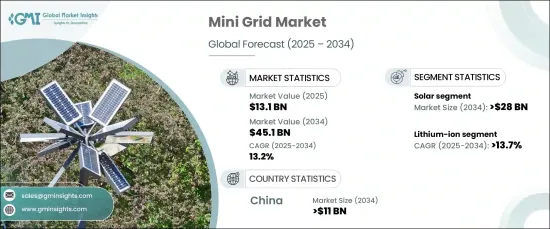
세계의 미니 그리드 시장은 2024년에 131억 달러로 평가되며, 2025-2034년에 13.2%의 견고한 CAGR로 확대할 것으로 예측됩니다. 미니 그리드는 독립적으로 또는 주 전력망과 연계하여 작동하도록 설계된 국소 에너지 시스템입니다. 태양광, 풍력, 수력 등 재생 에너지원을 활용하고 첨단 에너지 저장 솔루션과 결합하여 오프 그리드 및 원격지에 안정적인 전력을 공급합니다. 미니 그리드는 특히 기존 전력망 인프라를 이용할 수 없거나 신뢰할 수 없는 지역에서 커뮤니티, 기업, 중요한 서비스를 지원하고 탄력적인 에너지 공급을 보장하는 데 중요한 역할을 합니다.
전력망 고장, 자연재해 및 기타 혼란으로부터 보호하기 위한 안정적인 독립 전원에 대한 수요 증가는 미니 그리드 채택의 주요 원동력이 되고 있습니다. 또한 첨단 전력 저장 기술 및 스마트 그리드 솔루션에 대한 투자 증가는 효율성과 확장성을 강화하여 시장의 상승 궤도에 박차를 가하고 있습니다.
| 시장 범위 | |
|---|---|
| 시작연도 | 2024년 |
| 예측연도 | 2025-2034년 |
| 시작 금액 | 131억 달러 |
| 예상 금액 | 451억 달러 |
| CAGR | 13.2% |
시장은 연료 유형별로 세분화되어 태양광, 수력, 디젤/HFO, 기타 카테고리로 나뉩니다. 특히 태양에너지는 2034년까지 280억 달러 규모 시장을 창출할 것으로 예상되는 등 괄목할 만한 성장이 예상됩니다. 특히 태양이 풍부한 지역에서 널리 이용 가능하므로 태양에너지는 오프 그리드 및 농촌 지역의 미니 그리드 시스템에서 유력한 선택이 되고 있습니다. 기술 발전과 규모의 경제가 태양광발전의 보급을 가속화하는 한편, 탄소 배출량이 적은 친환경 연료로의 전환은 태양광발전의 우위를 더욱 강화하고 있습니다.
에너지 저장 솔루션은 미니 그리드 시장의 또 다른 중요한 측면으로 납축, 리튬이온 및 기타 저장 유형으로 나뉩니다. 리튬이온 부문은 2034년까지 13.7%의 연평균 복합 성장률(CAGR)을 나타낼 것으로 예상되며, 큰 성장이 예상됩니다. 높은 에너지 밀도로 잘 알려진 리튬이온 배터리는 작고 가벼운 에너지 저장을 제공하므로 공간 제약이 있는 미니 그리드에 적합합니다. 충전 및 방전시 에너지 손실을 최소화하는 뛰어난 효율성과 잦은 교체 필요성을 줄여주는 긴 수명이 결합되어 리튬이온 배터리는 장기적으로 운영 비용을 낮춰주는 선호되는 선택이 될 수 있습니다.
중국의 미니 그리드 시장은 재생 에너지와 미니 그리드 기술에 대한 막대한 투자로 2034년까지 110억 달러 규모에 달할 것으로 예상됩니다. 이러한 노력은 에너지 안보를 강화하고, 탄소 배출량을 줄이고, 지속가능한 농촌 개발을 촉진하기 위한 중국 전략의 핵심입니다. 중국의 풍부한 태양광 및 풍력 자원은 농촌의 전기화 및 저렴한 청정에너지 공급을 위한 노력과 함께 시장 성장을 더욱 촉진할 것으로 보입니다.
목차
제1장 조사 방법과 조사 범위
- 시장의 정의
- 기본 추정과 계산
- 예측 계산
- 1차 조사와 검증
- 1차 정보
- 데이터 마이닝 소스
- 시장 정의
제2장 개요
제3장 산업 인사이트
- 산업 에코시스템
- 규제 상황
- 산업에 대한 영향요인
- 촉진요인
- 산업의 잠재적 리스크·과제
- 성장 가능성 분석
- Porter의 산업 분석
- 공급 기업의 교섭력
- 바이어의 교섭력
- 신규 진출업체의 위협
- 대체품의 위협
- PESTEL 분석
제4장 경쟁상황
- 서론
- 전략 대시보드
- 혁신과 지속가능성 전망
제5장 시장 규모·예측 : 연료별, 2021-2034년
- 주요 동향
- 솔라
- 수력
- 디젤/HFO
- 기타
제6장 시장 규모·예측 : 에너지 저장 디바이스별, 2021-2034년
- 주요 동향
- 납산
- 리튬이온
- 기타
제7장 시장 규모·예측 : 소비자 유형별, 2021-2034년
- 주요 동향
- 비즈니스
- 가정용
- 일반 가정
제8장 시장 규모·예측 : 지역별, 2021-2034년
- 주요 동향
- 아시아태평양
- 중국
- 인도
- 인도네시아
- 미얀마
- 필리핀
- 아프리카
- 짐바브웨
- 우간다
- 나이지리아
- 탄자니아
- 라틴아메리카
- 콜롬비아
- 멕시코
- 기타
제9장 기업 개요
- Central Electronics Limited
- ENGIE
- Greenage Africa
- GSOL Energy
- Husk Power Systems
- Nuru SASU
- OMC Power
- PowerGen Renewable Energy
- Solar Philippines
- Zola Electric
The Global Mini Grid Market, valued at USD 13.1 billion in 2024, is projected to expand at a robust CAGR of 13.2% from 2025 to 2034. Mini grids are localized energy systems designed to operate independently or in conjunction with the main power grid. Leveraging renewable energy sources such as solar, wind, or hydro, combined with advanced energy storage solutions, these systems provide reliable power to off-grid and remote areas. Mini grids play a vital role in ensuring a resilient energy supply, supporting communities, businesses, and critical services, especially in regions where traditional grid infrastructure is either unavailable or unreliable.
The growing demand for stable, independent power sources to safeguard against grid failures, natural disasters, and other disruptions is a key driver for the adoption of mini grids. Additionally, increasing investments in advanced storage technologies and smart grid solutions are set to enhance efficiency and scalability, fueling the market's upward trajectory.
| Market Scope | |
|---|---|
| Start Year | 2024 |
| Forecast Year | 2025-2034 |
| Start Value | $13.1 Billion |
| Forecast Value | $45.1 Billion |
| CAGR | 13.2% |
Segmented by fuel type, the market includes solar, hydro, diesel/HFO, and other categories. Solar energy, in particular, is expected to experience remarkable growth, with projections indicating it will generate USD 28 billion by 2034. Its widespread availability, especially in sun-rich regions, positions solar energy as a leading choice for mini grid systems in off-grid and rural areas. Technological advancements and economies of scale are accelerating solar adoption, while the global shift towards eco-friendly fuels with lower carbon emissions further bolsters solar's dominance.
Energy storage solutions are another critical aspect of the mini grid market, divided into lead-acid, lithium-ion, and other storage types. The lithium-ion segment is poised for significant growth, with a forecasted CAGR of 13.7% through 2034. Known for their high energy density, lithium-ion batteries offer compact and lightweight energy storage, making them ideal for space-constrained mini grids. Their superior efficiency in minimizing energy losses during charging and discharging, coupled with longer lifespans that reduce the need for frequent replacements, positions lithium-ion batteries as a preferred choice, lowering operational costs over time.
China's mini grid market is anticipated to achieve a valuation of USD 11 billion by 2034, driven by substantial investments in renewable energy and mini grid technologies. These efforts are central to China's strategy to enhance energy security, reduce carbon emissions, and foster sustainable rural development. The country's abundant solar and wind resources, along with initiatives to electrify rural areas and provide affordable, clean energy, are set to propel market growth further.
Table of Contents
Chapter 1 Methodology & Scope
- 1.1 Market definitions
- 1.2 Base estimates & calculations
- 1.3 Forecast calculation
- 1.4 Primary research & validation
- 1.4.1 Primary sources
- 1.4.2 Data mining sources
- 1.5 Market definitions
Chapter 2 Executive Summary
- 2.1 Industry synopsis, 2021 – 2034
Chapter 3 Industry Insights
- 3.1 Industry ecosystem
- 3.2 Regulatory landscape
- 3.3 Industry impact forces
- 3.3.1 Growth drivers
- 3.3.2 Industry pitfalls & challenges
- 3.4 Growth potential analysis
- 3.5 Porter's analysis
- 3.5.1 Bargaining power of suppliers
- 3.5.2 Bargaining power of buyers
- 3.5.3 Threat of new entrants
- 3.5.4 Threat of substitutes
- 3.6 PESTEL analysis
Chapter 4 Competitive landscape, 2024
- 4.1 Introduction
- 4.2 Strategic dashboard
- 4.3 Innovation & sustainability landscape
Chapter 5 Market Size and Forecast, By Fuel, 2021 – 2034 (USD Billion & MW)
- 5.1 Key trends
- 5.2 Solar
- 5.3 Hydro
- 5.4 Diesel/HFO
- 5.5 Others
Chapter 6 Market Size and Forecast, By Storage Device, 2021 – 2034 (USD Billion & MW)
- 6.1 Key trends
- 6.2 Lead acid
- 6.3 Lithium-Ion
- 6.4 Others
Chapter 7 Market Size and Forecast, By Consumer Type, 2021 – 2034 (USD Billion & MW)
- 7.1 Key trends
- 7.2 Business
- 7.3 Household
- 7.4 Public
Chapter 8 Market Size and Forecast, By Region, 2021 – 2034 (USD Billion & MW)
- 8.1 Key trends
- 8.2 Asia Pacific
- 8.2.1 China
- 8.2.2 India
- 8.2.3 Indonesia
- 8.2.4 Myanmar
- 8.2.5 Philippines
- 8.3 Africa
- 8.3.1 Zimbabwe
- 8.3.2 Uganda
- 8.3.3 Nigeria
- 8.3.4 Tanzania
- 8.4 Latin America
- 8.4.1 Colombia
- 8.4.2 Mexico
- 8.5 Rest of World
Chapter 9 Company Profiles
- 9.1 Central Electronics Limited
- 9.2 ENGIE
- 9.3 Greenage Africa
- 9.4 GSOL Energy
- 9.5 Husk Power Systems
- 9.6 Nuru SASU
- 9.7 OMC Power
- 9.8 PowerGen Renewable Energy
- 9.9 Solar Philippines
- 9.10 Zola Electric