|
시장보고서
상품코드
1665395
유리섬유 도어 시장 기회, 성장 촉진요인, 산업 동향 분석, 예측(2025-2034년)Fiberglass Doors Market Opportunity, Growth Drivers, Industry Trend Analysis, and Forecast 2025 - 2034 |
||||||

세계의 유리섬유 도어 시장은 2024년에는 206억 달러로 평가되며, 2025-2034년에 CAGR 6.1%로 성장할 것으로 예측됩니다. 이러한 성장은 지속가능한 건축자재에 대한 수요 증가가 주요 요인입니다. 유리섬유 도어는 우수한 단열성으로 인해 인기를 얻고 있으며, 실내 온도를 유지하고 에너지 소비를 줄이는 데 도움이 됩니다. 이는 에너지 효율을 높이고 이산화탄소 배출량을 줄이려는 전 세계적인 노력과 일치하며, 친환경적인 건설 방법을 촉진하는 건축 규정의 발전도 촉진하고 있습니다.
유리섬유 도어는 재활용 가능한 재료를 사용하여 제조되며, 환경 파괴의 원인이 될 수 있는 기존의 대안에 대한 지속가능한 대안을 제공합니다. 친환경 인증에 대한 관심이 높아지면서 에너지 효율이 높은 건축 기준을 충족할 수 있는 유리섬유 도어의 채택이 가속화되고 있습니다. 소비자들은 또한 폐기물을 최소화하고 장기적으로 가치를 제공하는 유리섬유 도어의 내구성과 낮은 정비성에 매력을 느끼고 있습니다. 또한 에너지 효율이 높은 재료의 사용을 장려하기 위한 정부의 인센티브 정책은 유리섬유 도어의 채택을 촉진하는 데 중요한 역할을 하고 있습니다.
| 시장 범위 | |
|---|---|
| 시작연도 | 2024년 |
| 예측연도 | 2025-2034년 |
| 시작 금액 | 206억 달러 |
| 예상 금액 | 367억 달러 |
| CAGR | 6.1% |
시장은 제품 유형별로 싱글 엔트리 도어, 더블 엔트리 도어, 슬라이딩 도어, 기타로 구분됩니다. 싱글 엔트리 도어는 주요 제품 유형으로 2024년 91억 5,000만 달러의 매출을 기록하며, 2034년에는 168억 3,000만 달러에 달할 것으로 전망됩니다. 이 문은 에너지 비용 절감에 기여하는 우수한 단열 특성과 환경적 요인에 대한 복원력으로 선호되고 있습니다. 다양한 건축 스타일에 적합한 맞춤형 디자인과 마감으로 다양한 건축 스타일에 적합하여 수요를 더욱 촉진하고 있습니다.
유통 측면에서 시장은 직접 채널과 간접 채널로 나뉩니다. 간접 부문은 2024년 53.10%의 시장 점유율을 차지하며, 2034년에는 200억 2,000만 달러에 달할 것으로 예상됩니다. 이 채널의 성공은 유통업체, 도매업체, 소매업체의 광범위한 네트워크에 기인하며, 이를 통해 제조업체는 보다 광범위한 고객층에 도달할 가능성이 있습니다. 잘 구축된 판매 및 배송 시스템을 활용함으로써 제조업체는 다양한 지역 시장에 효율적으로 대응하고 지역적 취향에 맞게 조정할 수 있습니다. 이러한 접근의 용이성과 편의성으로 인해 간접 채널은 시장 확대를 위한 바람직한 방법으로 자리매김하고 있습니다.
북미의 유리섬유 도어 시장은 미국이 주도하고 있으며, 2024년 이 지역 시장 점유율의 57.5%를 차지했습니다. 견고한 건설 산업과 에너지 효율적이고 지속가능한 건축 관행에 대한 관심이 수요를 주도하고 있습니다. 첨단 제조 능력과 친환경 소재에 대한 정부의 지원은 미국 시장을 더욱 강화시키고 있습니다. 잘 구축된 유통망으로 인해 유리섬유 도어는 내구성과 에너지 절약형 솔루션을 찾는 소비자들에게 널리 보급되고 매력적인 선택이 되고 있습니다.
목차
제1장 조사 방법과 조사 범위
- 시장 범위와 정의
- 기본 추정과 계산
- 예측 계산
- 데이터 소스
- 1차 데이터
- 2차 데이터
- 유료 정보원
- 공적 정보원
제2장 개요
제3장 산업 인사이트
- 에코시스템 분석
- 밸류체인에 영향을 미치는 요인
- 이익률 분석
- 변혁
- 향후 전망
- 제조업체
- 유통업체
- 소매업체
- 공급업체 상황
- 이익률 분석
- 주요 뉴스와 구상
- 규제 상황
- 영향요인
- 촉진요인
- 지속가능 건축에 대한 수요 증가
- 미적 매력과 커스터마이즈
- 제조 기술의 진보
- 산업의 잠재적 리스크·과제
- 높은 초기 비용
- 대체 재료와의 경쟁
- 촉진요인
- 잠재 성장력의 분석
- 소비자 행동 분석
- Porter의 산업 분석
- PESTEL 분석
제4장 경쟁 구도
- 서론
- 기업 점유율 분석
- 경쟁 포지셔닝 매트릭스
- 전략 전망 매트릭스
제5장 시장 추정·예측 : 제품 유형별, 2021-2034년
- 주요 동향
- 싱글 엔트리 도어
- 더블 엔트리 도어
- 슬라이딩 도어
- 기타
제6장 시장 추정·예측 : 디자인별, 2021-2034년
- 주요 동향
- 차내
- 차외
제7장 시장 추정·예측 : 설치별, 2021-2034년
- 주요 동향
- 모바일
- 제조
제8장 시장 추정·예측 : 가격별, 2021-2034년
- 주요 동향
- 저가격
- 중가격
- 고가격
제9장 시장 추정·예측 : 용도별, 2021-2034년
- 주요 동향
- 주택용
- 상업용
- 산업용
제10장 시장 추정·예측 : 최종 용도별, 2021-2034년
- 주요 동향
- 신축
- 교체/리노베이션
제11장 시장 추정·예측 : 유통 채널별, 2021-2034년
- 주요 동향
- 직접 판매
- 간접 판매
제12장 시장 추정·예측 : 지역별, 2021-2034년
- 주요 동향
- 북미
- 미국
- 캐나다
- 유럽
- 영국
- 독일
- 프랑스
- 이탈리아
- 스페인
- 러시아
- 아시아태평양
- 중국
- 인도
- 일본
- 한국
- 호주
- 라틴아메리카
- 브라질
- 멕시코
- 중동 및 아프리카
- 남아프리카공화국
- 사우디아라비아
- 아랍에미리트
제13장 기업 개요
- Anderson
- ASSA ABLOY
- Bayer Built Woodworks
- ETO Doors
- Everlast Group
- Feather River Doors
- Fibertec Windows and Doors
- Glasscraft Door
- JELD-WEN
- Kohltech Windows and Entrance Systems
- Masonite
- Pella
- Plastpro
- Taylor Entrance Systems
- Therma-Tru
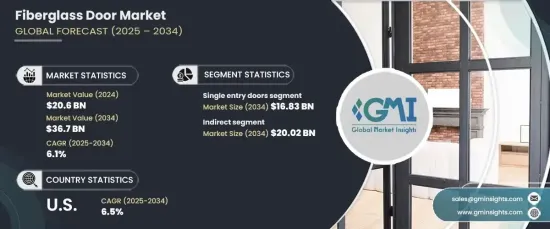
The Global Fiberglass Doors Market was valued at USD 20.6 billion in 2024 and is projected to grow at a CAGR of 6.1% from 2025 to 2034. This growth is largely driven by the increasing demand for sustainable construction materials. Fiberglass doors have gained popularity due to their superior insulation properties, which help maintain indoor temperatures and reduce energy consumption. This aligns with global efforts to enhance energy efficiency and reduce carbon footprints, further supported by evolving building regulations promoting eco-friendly construction practices.
Fiberglass doors are manufactured using recyclable materials, offering a sustainable alternative to traditional options that may contribute to environmental degradation. The growing emphasis on green certifications has bolstered the adoption of these doors as they help meet standards for energy-efficient construction. Consumers are also drawn to the durability and low-maintenance features of fiberglass doors, which minimize waste and provide long-lasting value. Additionally, government incentives aimed at encouraging the use of energy-efficient materials have played a significant role in boosting their adoption.
| Market Scope | |
|---|---|
| Start Year | 2024 |
| Forecast Year | 2025-2034 |
| Start Value | $20.6 Billion |
| Forecast Value | $36.7 Billion |
| CAGR | 6.1% |
The market is segmented by product type into single entry doors, double entry doors, sliding doors, and others. Single entry doors emerged as a dominant product type, generating USD 9.15 billion in revenue in 2024 and projected to reach USD 16.83 billion by 2034. These doors are favored for their exceptional insulation properties, which contribute to reduced energy costs, as well as their resilience against environmental factors. Their customizable designs and finishes make them suitable for a variety of architectural styles, further driving demand.
In terms of distribution, the market is divided into direct and indirect channels. The indirect segment held a 53.10% market share in 2024 and is forecasted to reach USD 20.02 billion by 2034. This channel's success can be attributed to its extensive network of distributors, wholesalers, and retailers, which allows manufacturers to reach a broader customer base. By leveraging established sales and delivery systems, manufacturers can efficiently cater to diverse regional markets and adapt to local preferences. This accessibility and convenience have positioned the indirect channel as a preferred method for market expansion.
The United States led the fiberglass doors market in North America, accounting for 57.5% of the region's market share in 2024. A robust construction industry, coupled with a focus on energy-efficient and sustainable building practices, has driven demand. Advanced manufacturing capabilities and government support for environmentally friendly materials have further strengthened the market in the US. With a well-established distribution network, fiberglass doors have become a widely accessible and attractive option for consumers seeking durable and energy-saving solutions.
Table of Contents
Chapter 1 Methodology & Scope
- 1.1 Market scope & definitions
- 1.2 Base estimates & calculations
- 1.3 Forecast calculations
- 1.4 Data sources
- 1.4.1 Primary
- 1.4.2 Secondary
- 1.4.2.1 Paid sources
- 1.4.2.2 Public sources
Chapter 2 Executive Summary
- 2.1 Industry 3600 synopsis, 2021-2034
Chapter 3 Industry Insights
- 3.1 Industry ecosystem analysis
- 3.1.1 Factor affecting the value chain
- 3.1.2 Profit margin analysis
- 3.1.3 Disruptions
- 3.1.4 Future outlook
- 3.1.5 Manufacturers
- 3.1.6 Distributors
- 3.1.7 Retailers
- 3.2 Supplier landscape
- 3.3 Profit margin analysis
- 3.4 Key news & initiatives
- 3.5 Regulatory landscape
- 3.6 Impact forces
- 3.6.1 Growth drivers
- 3.6.1.1 Rising demand for sustainable construction
- 3.6.1.2 Aesthetic appeal and customization
- 3.6.1.3 Advancements in manufacturing technology
- 3.6.2 Industry pitfalls & challenges
- 3.6.2.1 High initial cost
- 3.6.2.2 Competition from alternative materials
- 3.6.1 Growth drivers
- 3.7 Growth potential analysis
- 3.8 Consumer behavior analysis
- 3.9 Porter’s analysis
- 3.10 PESTEL analysis
Chapter 4 Competitive Landscape, 2024
- 4.1 Introduction
- 4.2 Company market share analysis
- 4.3 Competitive positioning matrix
- 4.4 Strategic outlook matrix
Chapter 5 Market Estimates & Forecast, By Product Type, 2021-2034 (USD Billion) (Million Units)
- 5.1 Key trends
- 5.2 Single entry doors
- 5.3 Double entry doors
- 5.4 Sliding doors
- 5.5 Others
Chapter 6 Market Estimates & Forecast, By Design, 2021-2034 (USD Billion) (Million Units)
- 6.1 Key trends
- 6.2 Interior
- 6.3 Exterior
Chapter 7 Market Estimates & Forecast, By Installation, 2021-2034 (USD Billion) (Million Units)
- 7.1 Key trends
- 7.2 Mobile
- 7.3 Manufactured
Chapter 8 Market Estimates & Forecast, By Price Range 2021-2034 (USD Billion) (Million Units)
- 8.1 Key trends
- 8.2 Low
- 8.3 Medium
- 8.4 High
Chapter 9 Market Estimates & Forecast, By Application 2021-2034 (USD Billion) (Million Units)
- 9.1 Key trends
- 9.2 Residential
- 9.3 Commercial
- 9.4 Industrial
Chapter 10 Market Estimates & Forecast, By End Use 2021-2034 (USD Billion) (Million Units)
- 10.1 Key trends
- 10.2 New construction
- 10.3 Replacement/renovation
Chapter 11 Market Estimates & Forecast, By Distribution Channel, 2021-2034 (USD Billion) (Million Units)
- 11.1 Key trends
- 11.2 Direct
- 11.3 Indirect
Chapter 12 Market Estimates & Forecast, By Region, 2021-2034 (USD Billion) (Million Units)
- 12.1 Key trends
- 12.2 North America
- 12.2.1 United States
- 12.2.2 Canada
- 12.3 Europe
- 12.3.1 Unites kingdom
- 12.3.2 Germany
- 12.3.3 France
- 12.3.4 Italy
- 12.3.5 Spain
- 12.3.6 Russia
- 12.4 Asia Pacific
- 12.4.1 China
- 12.4.2 India
- 12.4.3 Japan
- 12.4.4 South Korea
- 12.4.5 Australia
- 12.5 Latin America
- 12.5.1 Brazil
- 12.5.2 Mexico
- 12.6 Middle East & Africa
- 12.6.1 South Africa
- 12.6.2 Saudi Arabia
- 12.6.3 United Arab Emirates
Chapter 13 Company Profiles
- 13.1 Anderson
- 13.2 ASSA ABLOY
- 13.3 Bayer Built Woodworks
- 13.4 ETO Doors
- 13.5 Everlast Group
- 13.6 Feather River Doors
- 13.7 Fibertec Windows and Doors
- 13.8 Glasscraft Door
- 13.9 JELD-WEN
- 13.10 Kohltech Windows and Entrance Systems
- 13.11 Masonite
- 13.12 Pella
- 13.13 Plastpro
- 13.14 Taylor Entrance Systems
- 13.15 Therma-Tru