|
시장보고서
상품코드
1666916
세라믹 매트릭스 복합재료 시장 기회, 성장 촉진요인, 산업 동향 분석, 예측(2025-2034년)Ceramic Matrix Composites Market Opportunity, Growth Drivers, Industry Trend Analysis, and Forecast 2025 - 2034 |
||||||

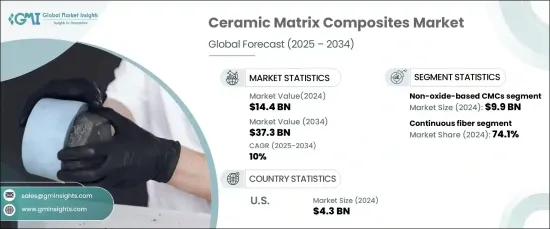
세계의 세라믹 매트릭스 복합재료 시장은 강력한 성장을 달성하고 있으며, 2024년에는 144억 달러에 달하며, 2025-2034년 CAGR은 10%로 확대할 것으로 예측됩니다.
세라믹 매트릭스 복합재료는 뛰어난 강도 대 중량비, 뛰어난 고온 저항성, 탁월한 내구성으로 산업에 혁명을 불러일으키고 있습니다. 이러한 첨단 소재는 항공우주, 국방, 에너지 분야와 같이 가혹한 조건에서의 성능이 가장 중요한 용도에 필수적입니다. 기존 금속과 합금을 대체할 수 있는 경량, 고강도 대체 소재에 대한 관심이 높아지면서 CMC는 연비 향상과 이산화탄소 배출량 감소를 추구하는 데 있으며, 중요한 요소로 자리 잡고 있습니다. CMC는 다양한 용도에서 채택이 확대되면서 현대 엔지니어링과 기술에서 그 중요성이 강조되고 있습니다.
항공우주 및 방위 산업은 CMC 수요의 최전선에 있으며, 터빈 블레이드, 배기 시스템, 항공기 및 우주선 구조 보강재와 같은 고성능 부품에 CMC를 사용하고 있습니다. 연료 효율을 높이고 지속가능한 목표를 달성하기 위한 전 세계의 노력이 강화되는 가운데, CMC의 고유한 특성은 필수적인 재료 선택이 되고 있습니다. 뛰어난 기계적 강도와 내열성을 유지하면서 무게를 크게 줄일 수 있는 CMC는 최첨단 항공 및 우주 기술의 까다로운 요구 사항을 충족합니다.
| 시장 범위 | |
|---|---|
| 시작연도 | 2024년 |
| 예측연도 | 2025-2034년 |
| 시작 금액 | 144억 달러 |
| 예상 금액 | 373억 달러 |
| CAGR | 10% |
매트릭스 재료의 관점에서 CMC 시장은 산화물 기반과 비산화물 기반 복합재료로 나뉩니다. 비산화물 기반 CMC는 2024년 99억 달러의 매출을 창출하며 시장을 독점하고 있습니다. 탄화규소(SiC)와 탄소를 주성분으로 하는 이 복합재료는 뛰어난 기계적 강도, 내열성 및 마모 특성으로 유명합니다. 이러한 특성으로 인해 항공우주, 자동차, 에너지 등 성능 저하 없이 가혹한 조건을 견뎌야 하는 산업에서 특히 유용하게 사용되고 있습니다.
섬유 유형별 시장 세분화에서 연속 섬유 강화 세라믹 매트릭스 복합재(CF-CMC)가 시장 점유율의 74.1%를 차지하며 높은 선호도를 보였으며, CF-CMC는 강도, 열 안정성 및 내손상성이 우수하여 높은 인기를 누리고 있습니다. 세라믹 매트릭스 내에 세라믹 또는 탄소 연속 섬유가 내장되어 있으며, 열충격과 기계적 스트레스에 대한 탁월한 내성을 발휘합니다. 이러한 탄력성으로 인해 CF-CMC는 첨단 추진 시스템 및 주요 산업 구조 부품과 같은 고성능 용도에 선택되는 소재가 되었습니다.
미국은 북미 세라믹 매트릭스 복합재료 시장을 선도하고 있으며, 2024년에는 43억 달러의 매출을 창출했습니다. 미국의 우위는 탄탄한 항공우주 및 방위 분야, 풍부한 R&D 투자, 대형 제조업체의 존재에 기인합니다. 항공 및 에너지와 같은 산업에서 경량 및 고강도 소재에 대한 수요가 증가함에 따라 미국 시장은 CMC 기술 혁신과 채택의 최전선에 서 있습니다.
목차
제1장 조사 방법과 조사 범위
- 시장 범위와 정의
- 기본 추정과 계산
- 예측 계산
- 데이터 소스
- 1차
- 2차
- 유료 소스
- 공적 소스
제2장 개요
제3장 업계 인사이트
- 업계 에코시스템 분석
- 밸류체인에 영향을 미치는 요인
- 이익률 분석
- 변혁
- 향후 전망
- 제조업체
- 유통업체
- 공급업체 상황
- 이익률 분석
- 주요 뉴스와 구상
- 규제 상황
- 영향요인
- 성장 촉진요인
- 항공우주·방위 분야에서의 높은 수요
- 승용차 부품에 대한 주목의 증가
- 재생에너지 용도의 성장
- 업계의 잠재적 리스크·과제
- 높은 제조 비용과 재료 비용
- 대체 복합재료와의 경쟁
- 성장 촉진요인
- 성장 가능성 분석
- Porter의 산업 분석
- PESTEL 분석
제4장 경쟁 구도
- 서론
- 기업 시장 점유율 분석
- 경쟁 포지셔닝 매트릭스
- 전략 전망 매트릭스
제5장 시장 규모·예측 : 매트릭스 재료별, 2021-2034년
- 주요 동향
- 산화물계 CMC
- 비산화물계 CMC
제6장 시장 규모·예측 : 섬유 유형별, 2021-2034년
- 주요 동향
- 연속 섬유
- 비연속/SiC 위스커
제7장 시장 규모·예측 : 최종 용도별, 2021-2034년
- 주요 동향
- 항공우주·방위
- 자동차
- 에너지·전력
- 산업용
- 기타
제8장 시장 규모·예측 : 지역별, 2021-2034년
- 주요 동향
- 북미
- 미국
- 캐나다
- 유럽
- 영국
- 독일
- 프랑스
- 이탈리아
- 스페인
- 러시아
- 아시아태평양
- 중국
- 인도
- 일본
- 한국
- 호주
- 라틴아메리카
- 브라질
- 멕시코
- 중동 및 아프리카
- 남아프리카공화국
- 사우디아라비아
- 아랍에미리트
제9장 기업 개요
- Applied Thin Films, Inc.
- CeramTec GmbH
- COI Ceramics, Inc.
- CoorsTek, Inc.
- General Electric Company
- Kyocera Corporation
- Lancer Systems
- Morgan Advanced Materials
- Reinhold Industries, Inc.
- Renegade Materials Corporation
- Rolls-Royce plc
The Global Ceramic Matrix Composites Market is experiencing robust growth, reaching USD 14.4 billion in 2024, with projections to expand at a CAGR of 10% from 2025 to 2034. Ceramic matrix composites are revolutionizing industries due to their exceptional strength-to-weight ratio, superior high-temperature tolerance, and unparalleled durability. These advanced materials are indispensable in applications where performance under extreme conditions is paramount, including aerospace, defense, and energy sectors. The increasing emphasis on lightweight, high-strength alternatives to traditional metals and alloys has positioned CMCs as a critical component in the quest for greater fuel efficiency and reduced carbon emissions. Their growing adoption across a diverse range of applications underscores their importance in modern engineering and technology.
The aerospace and defense industries are at the forefront of CMC demand, relying on these materials for high-performance components such as turbine blades, exhaust systems, and structural reinforcements for aircraft and spacecraft. As global efforts to enhance fuel efficiency and achieve sustainability targets intensify, the unique properties of CMCs have made them an essential material choice. Their ability to significantly reduce weight while maintaining superior mechanical strength and thermal resistance ensures they meet the stringent requirements of cutting-edge aviation and space technologies.
| Market Scope | |
|---|---|
| Start Year | 2024 |
| Forecast Year | 2025-2034 |
| Start Value | $14.4 Billion |
| Forecast Value | $37.3 Billion |
| CAGR | 10% |
In terms of matrix materials, the CMC market is divided into oxide-based and non-oxide-based composites. Non-oxide-based CMCs dominate the market, generating USD 9.9 billion in revenue in 2024. These composites, predominantly comprising silicon carbide (SiC) and carbon, are celebrated for their remarkable mechanical intensity, thermal resistivity, and wear properties. These attributes make them particularly valuable in industries such as aerospace, automotive, and energy, where materials must endure extreme conditions without compromising performance.
The market segmentation by fiber type reveals a strong preference for continuous fiber-reinforced ceramic matrix composites (CF-CMCs), which account for 74.1% of the market share. CF-CMCs are highly sought after due to their superior strength, thermal stability, and damage tolerance. By embedding continuous fibers, either ceramic or carbon, within the ceramic matrix, these composites deliver unmatched resistance to thermal shocks and mechanical stresses. This resilience positions CF-CMCs as the material of choice for high-performance applications, including advanced propulsion systems and structural components in critical industries.
The U.S. leads the North American ceramic matrix composites market, generating USD 4.3 billion in revenue in 2024. The country's dominance stems from its robust aerospace and defense sectors, substantial R&D investments, and the presence of major manufacturers. The increasing demand for lightweight, high-strength materials across industries like aviation and energy ensures that the U.S. market remains at the forefront of innovation and adoption in CMC technology.
Table of Contents
Chapter 1 Methodology & Scope
- 1.1 Market scope & definition
- 1.2 Base estimates & calculations
- 1.3 Forecast calculation
- 1.4 Data sources
- 1.4.1 Primary
- 1.4.2 Secondary
- 1.4.2.1 Paid sources
- 1.4.2.2 Public sources
Chapter 2 Executive Summary
- 2.1 Industry synopsis, 2021-2034
Chapter 3 Industry Insights
- 3.1 Industry ecosystem analysis
- 3.1.1 Factor affecting the value chain
- 3.1.2 Profit margin analysis
- 3.1.3 Disruptions
- 3.1.4 Future outlook
- 3.1.5 Manufacturers
- 3.1.6 Distributors
- 3.2 Supplier landscape
- 3.3 Profit margin analysis
- 3.4 Key news & initiatives
- 3.5 Regulatory landscape
- 3.6 Impact forces
- 3.6.1 Growth drivers
- 3.6.1.1 High demand in aerospace and defense
- 3.6.1.2 Rising focus on lightweight automotive components
- 3.6.1.3 Growth in renewable energy applications
- 3.6.2 Industry pitfalls & challenges
- 3.6.2.1 High production and material costs
- 3.6.2.2 Competition from alternative composite materials
- 3.6.1 Growth drivers
- 3.7 Growth potential analysis
- 3.8 Porter’s analysis
- 3.9 PESTEL analysis
Chapter 4 Competitive Landscape, 2024
- 4.1 Introduction
- 4.2 Company market share analysis
- 4.3 Competitive positioning matrix
- 4.4 Strategic outlook matrix
Chapter 5 Market Size and Forecast, By Matrix Material, 2021-2034 (USD Billion) (Kilo Tons)
- 5.1 Key trends
- 5.2 Oxide-based CMCs
- 5.3 Non-oxide-based CMCs
Chapter 6 Market Size and Forecast, By Fiber Type, 2021-2034 (USD Billion) (Kilo Tons)
- 6.1 Key trends
- 6.2 continuous fiber
- 6.3 Discontinuous/SiC whisker
Chapter 7 Market Size and Forecast, By End Use, 2021-2034 (USD Billion) (Kilo Tons)
- 7.1 Key trends
- 7.2 Aerospace & defense
- 7.3 Automotive
- 7.4 Energy & power
- 7.5 Industrial
- 7.6 Others
Chapter 8 Market Size and Forecast, By Region, 2021-2034 (USD Billion) (Kilo Tons)
- 8.1 Key trends
- 8.2 North America
- 8.2.1 U.S.
- 8.2.2 Canada
- 8.3 Europe
- 8.3.1 UK
- 8.3.2 Germany
- 8.3.3 France
- 8.3.4 Italy
- 8.3.5 Spain
- 8.3.6 Russia
- 8.4 Asia Pacific
- 8.4.1 China
- 8.4.2 India
- 8.4.3 Japan
- 8.4.4 South Korea
- 8.4.5 Australia
- 8.5 Latin America
- 8.5.1 Brazil
- 8.5.2 Mexico
- 8.6 MEA
- 8.6.1 South Africa
- 8.6.2 Saudi Arabia
- 8.6.3 UAE
Chapter 9 Company Profiles
- 9.1 Applied Thin Films, Inc.
- 9.2 CeramTec GmbH
- 9.3 COI Ceramics, Inc.
- 9.4 CoorsTek, Inc.
- 9.5 General Electric Company
- 9.6 Kyocera Corporation
- 9.7 Lancer Systems
- 9.8 Morgan Advanced Materials
- 9.9 Reinhold Industries, Inc.
- 9.10 Renegade Materials Corporation
- 9.11 Rolls-Royce plc