|
시장보고서
상품코드
1666976
금속 합금 시장 기회, 성장 촉진요인, 산업 동향 분석, 예측(2025-2034년)Metal Alloys Market Opportunity, Growth Drivers, Industry Trend Analysis, and Forecast 2025 - 2034 |
||||||

세계 금속 합금 시장은 2024년 3,437억 달러로 평가되며 2025년부터 2034년까지 연평균 4.5%로 성장할 것으로 예상됩니다.
이러한 성장의 주요 원동력으로는 적층 가공 기술의 발전과 플렉서블 패키징의 수요 확대 등을 들 수 있습니다. 금속 합금은 두 가지 이상의 금속 또는 금속과 비금속을 결합하여 강화된 강도, 경도, 가벼움과 같은 특정 특성을 구현하는 재료입니다. 이러한 고유한 특성으로 인해 금속 합금은 운송, 건설, 기계, 포장 등 다양한 산업에서 매우 중요하며, 시장 확대를 더욱 촉진하고 있습니다.
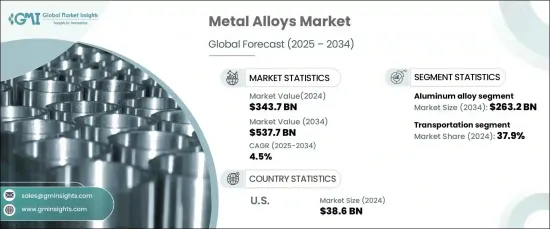
시장은 재료의 종류에 따라 알루미늄 합금, 스테인리스 합금, 청동 합금, 니켈 합금, 기타로 분류됩니다. 이 중 알루미늄 합금은 2024년 1,740억 달러의 수익을 창출하고 2034년에는 2,632억 달러에 달할 것으로 예측됩니다. 알루미늄 합금은 가볍고 내식성이 뛰어나 자동차, 항공우주, 해양 등 산업에 매우 적합합니다. 전 세계적으로 자동차 생산량이 지속적으로 증가함에 따라 우수한 내구성과 낮은 유지보수성으로 인해 특히 운송 분야에서 알루미늄 합금에 대한 수요도 증가하고 있습니다.
| 시장 범위 | |
|---|---|
| 시작 연도 | 2024년 |
| 예측 연도 | 2025-2034년 |
| 시작 금액 | 3,437억 달러 |
| 예상 금액 | 5,377억 달러 |
| CAGR | 4.5% |
용도별로는 운송, 건설, 포장, 기계, 전기, 기타 산업으로 구분됩니다. 운송 부문이 37.9%로 가장 큰 점유율을 차지하고 있습니다. 이러한 성장은 경제 상황의 개선과 소비자의 구매력 향상으로 인해 자동차 및 상용차를 포함한 경량 차량에 대한 수요가 증가하고 있는 것이 주요 요인입니다. 연료비 상승과 엄격한 배기가스 규제로 인해 연비가 좋고 친환경적인 자동차에 대한 요구가 특히 북미와 유럽의 운송 부문에서 금속 합금에 대한 수요를 더욱 촉진하고 있습니다.
미국의 금속 합금 시장은 2024년 386억 달러로 평가되며, 이 지역의 성장에 크게 기여할 것으로 예상됩니다. 미국 내 금속 합금에 대한 수요는 주로 연비와 성능을 향상시키기 위해 내구성이 뛰어나면서도 가벼운 소재를 필요로 하는 자동차 및 항공우주 부문의 번영에 의해 주도되고 있습니다. 또한, 건설 산업은 현대 인프라 프로젝트에 필수적인 스테인리스 스틸 및 기타 내식성 소재의 주요 수요처로, 특히 스테인리스 스틸과 기타 내식성 소재의 주요 수요처입니다. 지속가능성, 전기자동차, 에너지 효율적인 건설에 대한 지속적인 추진은 이러한 주요 부문에서 첨단 금속 합금에 대한 수요를 지속적으로 견인하고 있습니다.
목차
제1장 조사 방법과 조사 범위
- 시장 범위와 정의
- 기본 추정과 계산
- 예측 계산
- 데이터 소스
- 1차 데이터
- 2차 데이터
- 유료 정보 출처
- 공적 정보 출처
제2장 주요 요약
제3장 업계 인사이트
- 생태계 분석
- 밸류체인에 영향을 미치는 요인
- 이익률 분석
- 파괴
- 향후 전망
- 제조업체
- 유통업체
- 공급업체 상황
- 이익률 분석
- 주요 뉴스와 대처
- 규제 상황
- 영향요인
- 성장 촉진요인
- 금속 기반 구조물에 대한 수요 증가와 함께 새로운 인프라나 기존 건설 공간 유지보수에 대한 요구가 높아지고 있습니다.
- 아시아태평양의 자동차 성장
- 업계의 잠재적 리스크와 과제
- 금속 합금 생산에 따른 환경에 대한 영향
- 성장 촉진요인
- 성장 가능성 분석
- Porters 분석
- PESTEL 분석
제4장 경쟁 구도
- 소개
- 기업 점유율 분석
- 경쟁 포지셔닝 매트릭스
- 전략 전망 매트릭스
제5장 시장 규모 및 예측 : 소재별, 2021-2034년
- 주요 동향
- 스테인리스 합금
- 알루미늄 합금
- 청동 합금
- 니켈 합금
- 기타
제6장 시장 규모 및 예측 : 용도별, 2021-2034년
- 주요 동향
- 운송
- 건설
- 포장
- 기계
- 전기
- 기타
제7장 시장 규모 및 예측 : 프로세스별, 2021-2034년
- 주요 동향
- 주조
- 열간·냉간 압연
- 기타
제8장 시장 규모 및 예측 : 지역별, 2021-2034년
- 주요 동향
- 북미
- 미국
- 캐나다
- 유럽
- 영국
- 독일
- 프랑스
- 이탈리아
- 스페인
- 러시아
- 아시아태평양
- 중국
- 인도
- 일본
- 한국
- 호주
- 라틴아메리카
- 브라질
- 멕시코
- 중동 및 아프리카
- 남아프리카공화국
- 사우디아라비아
- 아랍에미리트
제9장 기업 개요
- Alcoa Corporation
- ArcelorMittal
- Baosteel
- Dynacast
- Jindal Stainless
- Kaiser Aluminum
- Kobe Steel
- Nippon Steel Corporation
- Novelis
- POSCO
- Rio Tinto
- RUSAL
The Global Metal Alloys Market was valued at USD 343.7 billion in 2024 and is expected to grow at a CAGR of 4.5% between 2025 and 2034. Key drivers of this growth include advancements in additive manufacturing and the expanding demand for flexible packaging. Metal alloys are materials created by combining two or more metals, or a metal and a non-metal, to achieve specific properties such as enhanced strength, hardness, and lightness. These unique characteristics make metal alloys crucial for a wide array of industries, including transportation, construction, machinery, and packaging, further fueling market expansion.
The market is divided by material type, with segments including aluminum alloy, stainless steel alloy, bronze alloys, nickel alloys, and others. Among these, aluminum alloys generated USD 174 billion in revenue in 2024 and are projected to reach USD 263.2 billion by 2034. Aluminum alloys are favored for their lightweight nature and corrosion resistance, making them highly suitable for industries such as automotive, aerospace, and marine. As vehicle production continues to rise globally, the demand for aluminum alloys, especially in transportation, is also growing, driven by their superior durability and low maintenance.
| Market Scope | |
|---|---|
| Start Year | 2024 |
| Forecast Year | 2025-2034 |
| Start Value | $343.7 Billion |
| Forecast Value | $537.7 Billion |
| CAGR | 4.5% |
By application, the market is segmented into transportation, construction, packaging, machinery, electrical, and other industries. The transportation sector commands the largest share, accounting for 37.9% share. This growth is largely attributed to the increasing demand for lightweight vehicles, including cars and commercial vehicles, because of improving economic conditions and rising consumer purchasing power. The need for fuel-efficient and environmentally friendly vehicles, driven by rising fuel costs and stringent emission regulations, further supports the demand for metal alloys in the transportation sector, particularly in North America and Europe.
U.S. metal alloys market was valued at USD 38.6 billion in 2024 and is a significant contributor to regional growth. The demand for metal alloys in the U.S. is primarily driven by the thriving automotive and aerospace sectors, which require durable yet lightweight materials to improve fuel efficiency and performance. Additionally, the construction industry is a major consumer of metal alloys, particularly stainless steel and other corrosion-resistant materials essential for modern infrastructure projects. The ongoing push toward sustainability, electric vehicles, and energy-efficient construction continues to drive the demand for advanced metal alloys in these key sectors.
Table of Contents
Chapter 1 Methodology & Scope
- 1.1 Market scope & definition
- 1.2 Base estimates & calculations
- 1.3 Forecast calculation
- 1.4 Data sources
- 1.4.1 Primary
- 1.4.2 Secondary
- 1.4.2.1 Paid sources
- 1.4.2.2 Public sources
Chapter 2 Executive Summary
- 2.1 Industry synopsis, 2021-2034
Chapter 3 Industry Insights
- 3.1 Industry ecosystem analysis
- 3.1.1 Factor affecting the value chain
- 3.1.2 Profit margin analysis
- 3.1.3 Disruptions
- 3.1.4 Future outlook
- 3.1.5 Manufacturers
- 3.1.6 Distributors
- 3.2 Supplier landscape
- 3.3 Profit margin analysis
- 3.4 Key news & initiatives
- 3.5 Regulatory landscape
- 3.6 Impact forces
- 3.6.1 Growth drivers
- 3.6.1.1 Increasing need for new infrastructure and maintenance of existing construction spaces along with the growing demand for metal-based structures
- 3.6.1.2 Automotive growth in Asia Pacific
- 3.6.2 Industry pitfalls & challenges
- 3.6.2.1 Environmental impacts associated with the production of metal alloys
- 3.6.1 Growth drivers
- 3.7 Growth potential analysis
- 3.8 Porter’s analysis
- 3.9 PESTEL analysis
Chapter 4 Competitive Landscape, 2024
- 4.1 Introduction
- 4.2 Company market share analysis
- 4.3 Competitive positioning matrix
- 4.4 Strategic outlook matrix
Chapter 5 Market Size and Forecast, By Material, 2021-2034 (USD Billion) (Kilo Tons)
- 5.1 Key trends
- 5.2 Stainless steel alloy
- 5.3 Aluminum alloy
- 5.4 Bronze alloys
- 5.5 Nickel alloys
- 5.6 Others
Chapter 6 Market Size and Forecast, By Application, 2021-2034 (USD Billion) (Kilo Tons)
- 6.1 Key trends
- 6.2 Transportation
- 6.3 Construction
- 6.4 Packaging
- 6.5 Machinery
- 6.6 Electrical
- 6.7 Others
Chapter 7 Market Size and Forecast, By Process, 2021-2034 (USD Billion) (Kilo Tons)
- 7.1 Key trends
- 7.2 Casting
- 7.3 Hot & cold rolling
- 7.4 Others
Chapter 8 Market Size and Forecast, By Region, 2021-2034 (USD Billion) (Kilo Tons)
- 8.1 Key trends
- 8.2 North America
- 8.2.1 U.S.
- 8.2.2 Canada
- 8.3 Europe
- 8.3.1 UK
- 8.3.2 Germany
- 8.3.3 France
- 8.3.4 Italy
- 8.3.5 Spain
- 8.3.6 Russia
- 8.4 Asia Pacific
- 8.4.1 China
- 8.4.2 India
- 8.4.3 Japan
- 8.4.4 South Korea
- 8.4.5 Australia
- 8.5 Latin America
- 8.5.1 Brazil
- 8.5.2 Mexico
- 8.6 MEA
- 8.6.1 South Africa
- 8.6.2 Saudi Arabia
- 8.6.3 UAE
Chapter 9 Company Profiles
- 9.1 Alcoa Corporation
- 9.2 ArcelorMittal
- 9.3 Baosteel
- 9.4 Dynacast
- 9.5 Jindal Stainless
- 9.6 Kaiser Aluminum
- 9.7 Kobe Steel
- 9.8 Nippon Steel Corporation
- 9.9 Novelis
- 9.10 POSCO
- 9.11 Rio Tinto
- 9.12 RUSAL