

|
시장보고서
상품코드
1666992
항공기 시트 커버 시장 기회, 성장 촉진요인, 산업 동향 분석 및 예측(2025-2034년)Aircraft Seat Upholstery Market Opportunity, Growth Drivers, Industry Trend Analysis, and Forecast 2025 - 2034 |
||||||

세계 항공기 시트 커버 시장은 2024년 20억 달러로 평가되었고, 2025-2034년 연평균 4.1% 성장할 것으로 예상됩니다.
항공사는 승객의 비행 경험을 향상시키기 위해 승객의 편안함과 개인화를 우선시하고 있습니다. 항공 여행이 전 세계적으로 확대됨에 따라 객실 인테리어, 특히 좌석의 현대화가 중요한 초점이 되고 있습니다. 항공사들은 편안함, 안전, 기능성에 대한 승객의 기대치가 높아짐에 따라 인체공학적이고 공간 효율적인 좌석 솔루션에 중점을 두고 있습니다. 지속 가능한 소재와 경량 설계의 통합은 연료 소비와 운항 비용을 절감하는 동시에 승객의 만족도를 높이는 데 도움이 되고 있습니다. 이러한 추세는 특히 프리미엄 클래스 객실에서 두드러지게 나타나고 있으며, 첨단 좌석 솔루션은 차별화된 브랜드 아이덴티티를 창출하고 있습니다.

스마트 패브릭과 항균 코팅과 같은 혁신적인 소재를 채택하여 위생과 편안함을 향상시킴으로써 기술 발전이 시장을 변화시키고 있습니다. 가볍고 유연한 실내 장식 소재는 연료 효율을 향상시킬 뿐만 아니라 항공사가 좌석 배치를 쉽게 재구성할 수 있도록 하여 다양한 객실 클래스에 대한 적응성을 보장합니다. 이러한 소재는 미적 매력과 내구성, 환경적 지속가능성을 결합하여 항공 표준 및 승객의 기대에 부합하도록 설계되었습니다.
| 시장 범위 | |
|---|---|
| 시작 연도 | 2024년 |
| 예측 연도 | 2025-2034년 |
| 시작 금액 | 20억 달러 |
| 예상 금액 | 30억 달러 |
| CAGR | 4.1% |
시트 커버를 기준으로 시장에는 바닥 커버, 등받이, 등받이, 팔걸이, 머리 받침대, 뒷좌석 포켓 등의 부문이 포함됩니다. 등받이는 2024년 시장 점유율의 37.5% 이상을 차지했으며, 향후 몇 년동안 크게 성장할 것으로 예상됩니다. 인체공학적 등받이는 현재 특히 장거리 비행에서 승객의 편안함을 높이기 위해 허리를 지지하고 자세를 개선하는 디자인을 특징으로 합니다. 형상 기억 폼, 조절 가능한 부품 및 통기성 원단을 통합하여 편안함과 체온 조절을 최적화합니다. 항공사는 승객의 편안함을 높은 수준으로 유지하면서 환경적 목표에 부합하기 위해 재활용 섬유 및 복합재 대체품 등 지속 가능하고 가벼운 소재를 사용하고 있습니다.
좌석 유형별로는 일등석, 비즈니스석, 이코노미석, 프리미엄 이코노미석으로 분류되며, 비즈니스석 부문은 2034년까지 연평균 5% 이상의 CAGR을 나타낼 것으로 예상되고 있습니다. 현재 비즈니스석 좌석에는 조절 가능한 요추 지지대, 맞춤형 리클라이닝 옵션, 온도 조절 소재 등 개인 맞춤형 기능이 탑재되어 있습니다. 이 좌석은 고급스러운 동시에 지속 가능한 비행 경험을 보장하기 위해 첨단 실내 장식 기술을 사용하여 제작되었습니다. 재활용 가죽과 바이오 섬유는 편안함, 내구성, 환경 보호의 균형을 유지하면서 인기를 얻고 있습니다.
북미가 시장을 주도하고 있으며, 2034년까지 11억 달러를 넘어설 것으로 예상됩니다. 미국 항공사들은 환경 규제와 승객의 선호도에 대응하기 위해 바이오 가죽 및 난연성 직물과 같은 친환경 소재의 사용을 늘리고 있습니다. 통합 온도 제어 및 강화된 지지 시스템을 갖춘 스마트 의자 커버와 같은 혁신은 이 지역의 지속 가능한 항공에 대한 노력을 반영합니다.
목차
제1장 조사 방법과 조사 범위
- 시장 범위와 정의
- 기본 추정과 계산
- 예측 계산
- 데이터 소스
- 1차 데이터
- 2차 데이터
- 유료 정보원
- 공적 정보원
제2장 주요 요약
제3장 업계 인사이트
- 생태계 분석
- 밸류체인에 영향을 미치는 요인
- 이익률 분석
- 파괴
- 향후 전망
- 제조업체
- 유통업체
- 공급업체 상황
- 이익률 분석
- 주요 뉴스
- 규제 상황
- 영향요인
- 성장 촉진요인
- 업계의 잠재적 리스크&과제
- 성장 가능성 분석
- Porter의 Five Forces 분석
- PESTEL 분석
제4장 경쟁 구도
- 서론
- 기업 점유율 분석
- 경쟁 포지셔닝 매트릭스
- 전략 전망 매트릭스
제5장 시장 추산·예측 : 소재별, 2021년-2034년
- 주요 동향
- 패브릭
- 가죽
- 비닐
제6장 시장 추산·예측 : 시트 커버별, 2021-2034년
- 주요 동향
- 보텀 커버
- 백레스트
- 암레스트
- 헤드레스트
- 시트 리어 포켓
제7장 시장 추산·예측 : 시트 유형별, 2021년-2034년
- 주요 동향
- 퍼스트 클래스
- 비즈니스 클래스
- 프리미엄 이코노미 클래스
- 이코노미 클래스
제8장 시장 추산·예측 : 항공기 유형별, 2021년-2034년
- 주요 동향
- 협폭동체 항공기
- 광폭동체 항공기
- 비즈니스 제트기
제9장 시장 추산·예측 : 최종 용도별, 2021년-2034년
- 주요 동향
- OEM
- 애프터마켓
제10장 시장 추산·예측 : 지역별, 2021-2034년
- 주요 동향
- 북미
- 미국
- 캐나다
- 유럽
- 영국
- 독일
- 프랑스
- 이탈리아
- 스페인
- 러시아
- 아시아태평양
- 중국
- 인도
- 일본
- 한국
- 호주
- 라틴아메리카
- 브라질
- 멕시코
- 중동 및 아프리카
- 남아프리카공화국
- 사우디아라비아
- 아랍에미리트(UAE)
제11장 기업 개요
- ACM Aircraft Cabin Modification
- Botany Weaving
- Douglass Interior Products
- Dretloh Aircraft Supply
- ELeather
- Franklin Products
- Intech Aerospace
- International Aero Services
- J&C Aero
- Lantal Textiles
- MGR Foamtex
- Omnavia Interiors
- Perrone Performance Leathers &Textiles
- Spectra Interior Products
- Tapis
- Tritex
The Global Aircraft Seat Upholstery Market, valued at USD 2 billion in 2024, is projected to grow at a CAGR of 4.1% between 2025 and 2034. Airlines are increasingly prioritizing passenger comfort and personalization to enhance the flying experience. As air travel expands globally, modernizing cabin interiors, particularly seating, has become a key focus. Airlines are emphasizing ergonomic and space-efficient seating solutions to meet evolving passenger expectations for comfort, safety, and functionality. The integration of sustainable materials and lightweight designs is helping reduce fuel consumption and operational costs while elevating passenger satisfaction. This trend is particularly prominent in premium-class cabins, where advanced seating solutions create a distinctive brand identity.
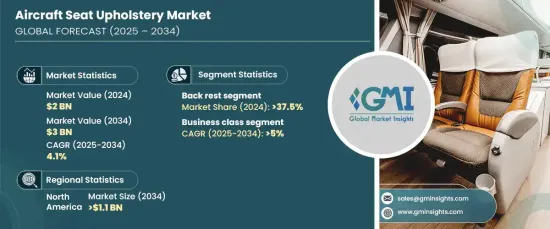
Technological advancements are transforming the market as companies adopt innovative materials like smart fabrics and antibacterial coatings to enhance hygiene and comfort. Lightweight and flexible upholstery materials not only improve fuel efficiency but also enable airlines to easily reconfigure seating arrangements, ensuring adaptability across various cabin classes. These materials are designed to combine aesthetic appeal with durability and environmental sustainability, aligning with aviation standards and passenger expectations.
| Market Scope | |
|---|---|
| Start Year | 2024 |
| Forecast Year | 2025-2034 |
| Start Value | $2 Billion |
| Forecast Value | $3 Billion |
| CAGR | 4.1% |
Based on seat covers, the market includes segments like bottom covers, backrests, armrests, headrests, and seat rear pockets. Backrests accounted for over 37.5% of the market share in 2024 and are anticipated to grow significantly in the coming years. Ergonomic backrests now feature lower-back support and posture-improving designs for enhanced passenger comfort, particularly on long-haul flights. The incorporation of memory foam, adjustable components, and breathable fabrics helps optimize comfort and temperature regulation. Airlines are adopting sustainable and lightweight materials, such as recycled textiles and composite alternatives, to align with environmental goals while maintaining high standards of passenger comfort.
By seat type, the market is categorized into first class, business class, economy class, and premium economy class, with the business class segment expected to witness a CAGR exceeding 5% through 2034. Business class seats now include personalized features like adjustable lumbar support, customizable recline options, and temperature-regulating materials. These seats are crafted using advanced upholstery techniques to ensure a luxurious yet sustainable flying experience. Recycled leather and bio-based textiles are gaining traction, balancing comfort, durability, and environmental consciousness.
North America led the market and is expected to surpass USD 1.1 billion by 2034. Airlines in the United States are increasingly utilizing eco-friendly materials like bio-based leather and flame-retardant fabrics to meet environmental regulations and passenger preferences. Innovations such as smart upholstery with integrated temperature controls and enhanced support systems reflect the region's commitment to sustainable aviation.
Table of Contents
Chapter 1 Methodology & Scope
- 1.1 Market scope & definitions
- 1.2 Base estimates & calculations
- 1.3 Forecast calculations
- 1.4 Data sources
- 1.4.1 Primary
- 1.4.2 Secondary
- 1.4.2.1 Paid sources
- 1.4.2.2 Public sources
Chapter 2 Executive Summary
- 2.1 Industry synopsis, 2021-2034
Chapter 3 Industry Insights
- 3.1 Industry ecosystem analysis
- 3.1.1 Factor affecting the value chain
- 3.1.2 Profit margin analysis
- 3.1.3 Disruptions
- 3.1.4 Future outlook
- 3.1.5 Manufacturers
- 3.1.6 Distributors
- 3.2 Supplier landscape
- 3.3 Profit margin analysis
- 3.4 Key news & initiatives
- 3.5 Regulatory landscape
- 3.6 Impact forces
- 3.6.1 Growth drivers
- 3.6.1.1 Rising passenger expectations for comfort
- 3.6.1.2 Demand for environmentally friendly materials, such as biodegradable fabrics, recycled textiles, and sustainable leather
- 3.6.1.3 Rising integration of smart fabrics, temperature control, and adjustable features into seat upholstery
- 3.6.1.4 Increase in premium travel and cabin class upgrades
- 3.6.1.5 Ongoing expansion of airline fleets and renovation of older aircraft to offer upgraded seating configurations
- 3.6.2 Industry pitfalls & challenges
- 3.6.2.1 Balancing durability and sustainability in aircraft seat upholstery
- 3.6.2.2 Stringent safety regulations
- 3.6.1 Growth drivers
- 3.7 Growth potential analysis
- 3.8 Porter’s analysis
- 3.9 PESTEL analysis
Chapter 4 Competitive Landscape, 2024
- 4.1 Introduction
- 4.2 Company market share analysis
- 4.3 Competitive positioning matrix
- 4.4 Strategic outlook matrix
Chapter 5 Market Estimates & Forecast, By Material, 2021-2034 (USD Million)
- 5.1 Key trends
- 5.2 Fabric
- 5.3 Leather
- 5.4 Vinyl
Chapter 6 Market Estimates & Forecast, By Seat Covers, 2021-2034 (USD Million)
- 6.1 Key trends
- 6.2 Bottom covers
- 6.3 Back rest
- 6.4 Armrests
- 6.5 Headrests
- 6.6 Seat rear pockets
Chapter 7 Market Estimates & Forecast, By Seat Type, 2021-2034 (USD Million)
- 7.1 Key trends
- 7.2 First class
- 7.3 Business class
- 7.4 Premium economy class
- 7.5 Economy class
Chapter 8 Market Estimates & Forecast, By Aircraft Type, 2021-2034 (USD Million)
- 8.1 Key trends
- 8.2 Narrow-body aircraft
- 8.3 Wide-body aircraft
- 8.4 Business jets
Chapter 9 Market Estimates & Forecast, By End Use, 2021-2034 (USD Million)
- 9.1 Key trends
- 9.2 Original Equipment Manufacturer (OEM)
- 9.3 Aftermarket
Chapter 10 Market Estimates & Forecast, By Region, 2021-2034 (USD Million)
- 10.1 Key trends
- 10.2 North America
- 10.2.1 U.S.
- 10.2.2 Canada
- 10.3 Europe
- 10.3.1 UK
- 10.3.2 Germany
- 10.3.3 France
- 10.3.4 Italy
- 10.3.5 Spain
- 10.3.6 Russia
- 10.4 Asia Pacific
- 10.4.1 China
- 10.4.2 India
- 10.4.3 Japan
- 10.4.4 South Korea
- 10.4.5 Australia
- 10.5 Latin America
- 10.5.1 Brazil
- 10.5.2 Mexico
- 10.6 MEA
- 10.6.1 South Africa
- 10.6.2 Saudi Arabia
- 10.6.3 UAE
Chapter 11 Company Profiles
- 11.1 ACM Aircraft Cabin Modification
- 11.2 Botany Weaving
- 11.3 Douglass Interior Products
- 11.4 Dretloh Aircraft Supply
- 11.5 ELeather
- 11.6 Franklin Products
- 11.7 Intech Aerospace
- 11.8 International Aero Services
- 11.9 J&C Aero
- 11.10 Lantal Textiles
- 11.11 MGR Foamtex
- 11.12 Omnavia Interiors
- 11.13 Perrone Performance Leathers & Textiles
- 11.14 Spectra Interior Products
- 11.15 Tapis
- 11.16 Tritex


