

|
시장보고서
상품코드
1667165
BTM(Behind The Meter) 고정형 축전지 시장 : 기회, 성장 촉진요인, 산업 동향 분석 및 예측(2025-2034년)Behind the Meter Stationary Battery Storage Market Opportunity, Growth Drivers, Industry Trend Analysis, and Forecast 2025 - 2034 |
||||||

세계의 BTM(Behind The Meter) 고정형 축전지 시장은 2024년 423억 달러였고, 2025년부터 2034년까지 CAGR 19.5%로 현저한 성장을 이룰 것으로 예상됩니다.
이 급성장의 배경은 에너지 독립성, 비용 효율적인 솔루션, 안정적인 축전 시스템에 대한 수요가 증가하고 있습니다.

전기요금이 계속 상승하고 정전이 점점 빈번해지고 있는 가운데 소비자는 중단 없는 전력공급을 확보하고 태양광 발전과 같은 신재생에너지에서 발생하는 잉여에너지를 활용하기 위해 에너지 저장기술에 눈을 돌리고 있습니다. 세계 각국의 정부는 신재생에너지와 에너지저장 솔루션의 도입을 장려하는 인센티브와 보조금을 통해 이 동향을 뒷받침하고 있습니다. 제조 비용이 낮아짐에 따라 배터리 기술의 발전은 시장을 더욱 변화시키고 주택, 상업 및 산업용 소비자들에게 더욱 이용하기 쉬워지고 있습니다. 지속 가능한 에너지 관행으로의 세계 변화는 미래의 에너지 수요를 충족시키기 위해 BTM 축전지가 필수적인 역할을 수행한다는 것을 강조합니다.
| 시장 범위 | |
|---|---|
| 시작연도 | 2024년 |
| 예측연도 | 2025-2034년 |
| 시작금액 | 423억 달러 |
| 예측 금액 | 2,695억 달러 |
| CAGR | 19.5% |
시장은 전지 유형에 따라 리튬 이온 전지와 납 전지로 분류되며 에너지 밀도, 효율, 수명이 뛰어난 리튬 이온 전지가 우위를 차지하고 있습니다. 이 분야는 2034년까지 2,157억 달러의 수익을 달성할 것으로 예상되며, 이는 주택 및 상업 분야에서 채택이 확대되고 있음을 반영합니다. 리튬 이온 배터리는 컴팩트하고 내구성이 뛰어나고 가격도 점점 합리적이어서 효율적인 에너지 저장 솔루션을 요구하는 소비자에게 선호되는 선택입니다. 이 분야의 끊임없는 기술 혁신은 생산 비용 절감과 성능 향상을 실현하여 리튬 이온 배터리 수요를 더욱 밀어 올리고 있습니다.
고정형 축전지의 용도는 전력 소비자, 시스템 운용자, 미니 그리드 및 전력 소비자 부문은 2034년까지 연평균 복합 성장률(CAGR) 19.3%로 성장할 것으로 예상됩니다. 태양광 발전과 같은 재생 가능 에너지원의 채용이 1차 정보이며, 에너지 이용을 최적화하는 효율적인 축전 시스템이 필요합니다. 전기요금의 상승과 에너지의 자급자족의 중시는 가정이나 기업에 축전지 솔루션의 통합을 촉진하여 전력의 효율적인 저장과 관리를 가능하게 하고 있습니다. 이러한 시스템은 특히 신뢰할 수 없는 송전망 인프라가 있는 지역에서 에너지 회복력을 달성할 수 있는 힘을 사용자에게 제공합니다.
미국에서는 BTM 고정형 배터리 시장이 2034년까지 537억 달러에 이를 것으로 예측됩니다. 태양광 발전과 풍력 발전과 같은 신재생에너지 기술의 광범위한 채용은 가정용 및 상업용 사용자들 사이에서 축전지에 대한 수요를 유발하고 있습니다. 특히 피크시나 정전시에 잉여에너지를 저장하고 나중에 사용함으로써 이러한 시스템은 청정에너지와 송전망의 회복력을 촉진하는 연방정부나 주 수준의 대처와 일치하고 있습니다. 신재생에너지 시스템의 가격이 합리화되고 있으며, 유리한 정책이 함께 미국은 세계 시장 확대의 주요 기업로 자리매김하고 있습니다.
목차
제1장 조사 방법과 조사 범위
- 시장의 정의
- 기본 추정과 계산
- 예측 계산
- 데이터 소스
- 1차
- 2차
- 유상
- 공적
제2장 주요 요약
제3장 업계 인사이트
- 업계 생태계 분석
- 규제 상황
- 업계에 미치는 영향요인
- 성장 촉진요인
- 업계의 잠재적 리스크 및 과제
- 성장 가능성 분석
- Porter's Five Forces 분석
- 공급기업의 협상력
- 구매자의 협상력
- 신규 참가업체의 위협
- 대체품의 위협
- PESTEL 분석
제4장 경쟁 구도
- 전략 대시보드
- 혁신과 지속가능성의 전망
제5장 시장 규모와 예측 : 전지별, 2021-2034년
- 주요 동향
- 리튬 이온
- 납산
제6장 시장 규모와 예측 : 용도별, 2021-2034년
- 주요 동향
- 전력 소비자
- 시스템 운용
- 미니 그리드
제7장 시장 규모와 예측 : 지역별, 2021-2034년
- 주요 동향
- 북미
- 미국
- 캐나다
- 멕시코
- 유럽
- 영국
- 프랑스
- 독일
- 이탈리아
- 러시아
- 스페인
- 아시아태평양
- 중국
- 호주
- 인도
- 일본
- 한국
- 중동 및 아프리카
- 사우디아라비아
- 아랍에미리트(UAE)
- 터키
- 남아프리카
- 이집트
- 라틴아메리카
- 브라질
- 아르헨티나
제8장 기업 프로파일
- C&D Technologies
- Duracell
- Enersys
- Exide Industries
- Furukawa Battery
- GS Yuasa International
- Johnson Controls
- Lockheed Martin
- Narada
- Panasonic
- Ritar International Group
- Siemens
The Global Behind The Meter Stationary Battery Storage Market, valued at USD 42.3 billion in 2024, is poised for remarkable growth at a CAGR of 19.5% between 2025 and 2034. This surge is driven by the growing demand for energy independence, cost-efficient solutions, and reliable energy storage systems.
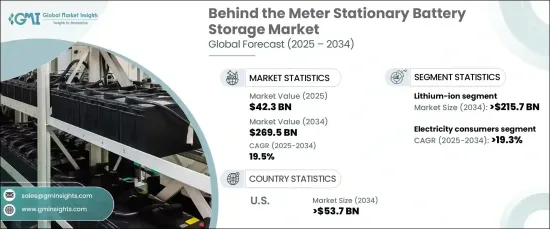
As electricity prices continue to rise and power outages become increasingly frequent, consumers are turning to energy storage technologies to ensure uninterrupted power supply and capitalize on surplus energy generated from renewable sources like solar power. Governments worldwide are bolstering this trend through incentives and subsidies that encourage the adoption of renewable energy and energy storage solutions. Advancements in battery technology, in line with decreasing manufacturing costs, are further transforming the market, making it more accessible to residential, commercial, and industrial consumers. The global shift toward sustainable energy practices underscores the essential role of behind-the-meter battery storage in meeting future energy needs.
| Market Scope | |
|---|---|
| Start Year | 2024 |
| Forecast Year | 2025-2034 |
| Start Value | $42.3 Billion |
| Forecast Value | $269.5 Billion |
| CAGR | 19.5% |
The market is categorized by battery type into lithium-ion and lead-acid batteries, with lithium-ion dominating due to its superior energy density, efficiency, and longevity. This segment is forecasted to achieve USD 215.7 billion in revenue by 2034, reflecting its growing adoption across residential and commercial sectors. Lithium-ion batteries are compact, durable, and increasingly affordable, making them the preferred choice for consumers seeking efficient energy storage solutions. Continuous technological innovation in this space is reducing production costs and enhancing performance, further driving demand for these batteries.
Applications of behind-the-meter stationary battery storage span electricity consumers, system operators, and mini-grids, with the electricity consumers segment expected to grow at a CAGR of 19.3% through 2034. The adoption of renewable energy sources such as solar is a primary driver, necessitating efficient storage systems to optimize energy utilization. Rising electricity costs and the emphasis on energy self-sufficiency are prompting households and businesses to integrate battery storage solutions, enabling them to store and manage power effectively. These systems empower users to achieve energy resilience, particularly in regions with unreliable grid infrastructures.
In the United States, the behind-the-meter stationary battery storage market is projected to reach USD 53.7 billion by 2034. Widespread adoption of renewable energy technologies like solar and wind has catalyzed demand for battery storage among residential and commercial users. By storing surplus energy for later use, particularly during peak hours or outages, these systems align with federal and state-level initiatives promoting clean energy and grid resilience. The increasing affordability of renewable energy systems, coupled with favorable policies, positions the U.S. as a key player in the global market expansion.
Table of Contents
Chapter 1 Methodology & Scope
- 1.1 Market definitions
- 1.2 Base estimates & calculations
- 1.3 Forecast calculation
- 1.4 Data sources
- 1.4.1 Primary
- 1.4.2 Secondary
- 1.4.2.1 Paid
- 1.4.2.2 Public
Chapter 2 Executive Summary
- 2.1 Industry synopsis, 2021 – 2034
Chapter 3 Industry Insights
- 3.1 Industry ecosystem analysis
- 3.2 Regulatory landscape
- 3.3 Industry impact forces
- 3.3.1 Growth drivers
- 3.3.2 Industry pitfalls & challenges
- 3.4 Growth potential analysis
- 3.5 Porter's Analysis
- 3.5.1 Bargaining power of suppliers
- 3.5.2 Bargaining power of buyers
- 3.5.3 Threat of new entrants
- 3.5.4 Threat of substitutes
- 3.6 PESTEL Analysis
Chapter 4 Competitive landscape, 2024
- 4.1 Strategic dashboard
- 4.2 Innovation & sustainability landscape
Chapter 5 Market Size and Forecast, By Battery, 2021 – 2034 (USD Million & MW)
- 5.1 Key trends
- 5.2 Lithium-ion
- 5.3 Lead acid
Chapter 6 Market Size and Forecast, By Application, 2021 – 2034 (USD Million & MW)
- 6.1 Key trends
- 6.2 Electricity consumers
- 6.3 System operations
- 6.4 Mini grids
Chapter 7 Market Size and Forecast, By Region, 2021 – 2034 (USD Million & MW)
- 7.1 Key trends
- 7.2 North America
- 7.2.1 U.S.
- 7.2.2 Canada
- 7.2.3 Mexico
- 7.3 Europe
- 7.3.1 UK
- 7.3.2 France
- 7.3.3 Germany
- 7.3.4 Italy
- 7.3.5 Russia
- 7.3.6 Spain
- 7.4 Asia Pacific
- 7.4.1 China
- 7.4.2 Australia
- 7.4.3 India
- 7.4.4 Japan
- 7.4.5 South Korea
- 7.5 Middle East & Africa
- 7.5.1 Saudi Arabia
- 7.5.2 UAE
- 7.5.3 Turkey
- 7.5.4 South Africa
- 7.5.5 Egypt
- 7.6 Latin America
- 7.6.1 Brazil
- 7.6.2 Argentina
Chapter 8 Company Profiles
- 8.1 C&D Technologies
- 8.2 Duracell
- 8.3 Enersys
- 8.4 Exide Industries
- 8.5 Furukawa Battery
- 8.6 GS Yuasa International
- 8.7 Johnson Controls
- 8.8 Lockheed Martin
- 8.9 Narada
- 8.10 Panasonic
- 8.11 Ritar International Group
- 8.12 Siemens


