|
시장보고서
상품코드
1684806
보일러 시장 기회, 성장 촉진요인, 산업 동향 분석, 예측(2025-2034년)Boiler Market Opportunity, Growth Drivers, Industry Trend Analysis, and Forecast 2025 - 2034 |
||||||

2024년에 1,003억 달러로 평가된 세계의 보일러 시장은 2025년부터 2034년까지 CAGR이 7%를 나타낼 것으로 예측되어 대폭적인 확대가 전망되고 있습니다.
이러한 상승세는 온실가스 배출을 대상으로 하는 엄격한 환경규제와 에너지효율이 높은 난방기술로의 변화가 주요 요인이 되고 있습니다. 세계 각국의 정부는 기존의 화석 연료 기반 시스템에서 벗어나도록 산업계에 장려하는 정책을 도입하고 있으며, 최신 환경 친화적인 보일러 솔루션의 채용이 증가하고 있습니다.

또한 건강 관리, 식품 가공, 화학 제조 등의 산업은 운영 비용을 줄이면서 지속가능성 목표를 달성하기 위해 고효율 보일러를 적극적으로 요구하고 있습니다. 기업과 소비자의 환경 의식이 높아짐에 따라 에너지 출력을 극대화하면서 연료 소비를 최적화하는 보일러에 대한 수요가 증가하고 있습니다. 에너지 효율적인 난방 솔루션에 대한 정부의 인센티브, 보조금 및 세제 우대 조치의 가용성이 높아짐에 따라 시장 성장이 더욱 강화되고 있습니다. 또한 AI 주도의 예지보전과 실시간 효율 모니터링 등 스마트 보일러 기술의 지속적인 진보가 시장 기업에게 새로운 기회를 창출하고 있습니다.
| 시장 범위 | |
|---|---|
| 시작 연도 | 2024년 |
| 예측 연도 | 2025-2034년 |
| 시작 금액 | 1,003억 달러 |
| 예측 금액 | 2,011억 달러 |
| CAGR | 7% |
50-100MMBTU/hr의 보일러가 주요 부문이 되어 2034년까지 120억 달러의 매출이 예상됩니다. 이 성장의 원동력이 되고 있는 것은 산업·상업 부문 전체의 에너지 효율 향상을 목표로 하는 정부의 대처입니다. 노후화된 인프라 개보수에 중점을 둔 관민 협력도 이 확대에 중요한 역할을 합니다. 구식 난방 시스템이 시대에 뒤떨어짐에 따라 현대화에 대한 노력이 기세를 늘리고 고급 보일러 기술의 채용을 더욱 강화하고 있습니다. 산업계는 점점 에너지 절약 전략을 우선시하고 있으며, 이산화탄소 배출량을 줄이면서 우수한 성능을 발휘하는 대용량 보일러에 대한 수요가 급증하고 있습니다. 이러한 개발은 제조업체와 서비스 제공 업체에게 유리한 비즈니스 환경을 창출하고이 분야의 지속적인 혁신을 촉진합니다.
전기연소 보일러 분야는 화석연료에 대한 의존도를 줄이고 이산화탄소 배출을 최소화하기 위한 규제 노력에 힘입어 2034년까지 연평균 복합 성장률(CAGR)은 10%를 나타내 눈부신 성장을 보일 것으로 예측됩니다. 전기 융기 보일러는 지속가능성 기준에 부합하며, 기존의 난방 시스템에 비해 우수한 에너지 효율을 제공하기 때문에 그린 빌딩 기술로의 전환이 이러한 동향을 더욱 가속화하고 있습니다. 친환경 비즈니스 운영에 투자하는 기업은 유지 보수가 필요하지 않으며 비용 효율적인 솔루션을 제공하는 전기 보일러를 선택하는 경향이 커지고 있습니다. 배출 감축 규제가 강화됨에 따라 산업계는 난방 인프라 업그레이드를 강요하고 전기 보일러 설치에 대한 투자를 뒷받침하고 있습니다. 시장 진출기업은 효율을 높이고 소비자 수요 증가에 대응하기 위해 발열체의 개량이나 자동 제어 시스템 등의 기술적 진보에 주력하고 있습니다.
북미의 보일러 시장은 에너지 효율과 이산화탄소 배출에 대한 우려가 높아짐에 따라 2034년까지 100억 달러를 창출할 것으로 예상됩니다. 이 지역의 기업과 소비자들은 진화하는 규제 요건을 준수하는 고성능 보일러 시스템을 적극적으로 요구하고 있습니다. 한편 유럽에서는 유럽연합(EU)이 실시하는 엄격한 탄소 감축 정책이 시장 성장에 강한 영향을 미치고 있습니다. 각국 정부는 구식 난방 시스템을 에너지 효율적인 대체품으로 대체하도록 장려하고 있으며 최신 보일러 시장 점유율 상승에 기여하고 있습니다. 탈탄소화에 대한 노력이 추세를 보이는 가운데 산업과 상업 모두 지속가능성 목표를 충족하는 차세대 난방 솔루션에 투자하고 있으며 세계 보일러 시장의 밝은 전망을 강화하고 있습니다.
목차
제1장 조사 방법과 조사 범위
- 시장 범위와 정의
- 시장 추계·예측 파라미터
- 예측 계산
- 데이터 소스
- 1차 데이터
- 2차 데이터
- 유료
- 공적
제2장 주요 요약
제3장 업계 인사이트
- 생태계 분석
- 규제 상황
- 업계에 미치는 영향요인
- 성장 촉진요인
- 업계의 잠재적 위험 및 과제
- 성장 가능성 분석
- Porter's Five Forces 분석
- PESTEL 분석
제4장 경쟁 구도
- 서론
- 전략적 전망
- 혁신과 지속가능성의 전망
제5장 시장 규모와 예측 : 연료별(2021-2034년)
- 주요 동향
- 천연가스
- 석유
- 석탄
- 전기
- 기타
제6장 시장 규모와 예측 : 용량별(2021-2034년)
- 주요 동향
- 10 MMBtu/hr 이하
- 10-50 MMBTU/hr
- 50-100 MMBTU/hr
- 100-250 MMBTU/hr
- 250 MMBTU/hr 이상
제7장 시장 규모와 예측 : 용도별(2021-2034년)
- 주요 동향
- 주택
- 상업
- 사무실
- 의료시설
- 교육기관
- 숙박
- 소매점
- 기타
- 산업
- 식품가공
- 펄프 및 종이
- 화학
- 정제소
- 1차 금속
- 기타
제8장 시장 규모와 예측 : 지역별(2021-2034년)
- 주요 동향
- 북미
- 미국
- 캐나다
- 멕시코
- 유럽
- 프랑스
- 영국
- 폴란드
- 이탈리아
- 스페인
- 오스트리아
- 독일
- 스웨덴
- 러시아
- 아시아태평양
- 중국
- 인도
- 필리핀
- 일본
- 한국
- 호주
- 인도네시아
- 중동 및 아프리카
- 사우디아라비아
- 이란
- 아랍에미리트(UAE)
- 나이지리아
- 남아프리카
- 라틴아메리카
- 아르헨티나
- 칠레
- 브라질
제9장 기업 프로파일
- AO Smith
- Ariston Holding
- Babcock &Wilcox
- Babcock Wanson
- BDR Thermea Group
- Bosch Industriekessel
- Bradford White Corporation
- BURNHAM COMMERCIAL BOILERS
- Carrier
- Clayton Industries
- Cleaver-Brooks
- DAIKIN INDUSTRIES
- FERROLI SpA
- Fulton
- Hurst Boiler &Welding Co
- IHI Corporation
- John Cockerill
- John Wood Group PLC
- Lennox International
- Miura America
- PM Lattner Manufacturing
- PARKER BOILER
- Thermax
- US Boiler Company
- Vaillant Group
- Vattenfall AB
- VIESSMANN
- Weil-McLain
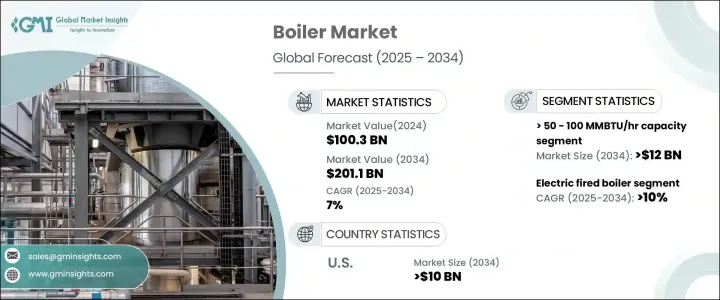
The Global Boiler Market, valued at USD 100.3 billion in 2024, is on track for significant expansion, with projections indicating a CAGR of 7% from 2025 to 2034. This upward trajectory is largely driven by stringent environmental regulations targeting greenhouse gas emissions and the shift toward energy-efficient heating technologies. Governments worldwide are introducing policies that encourage industries to move away from conventional fossil-fuel-based systems, leading to increased adoption of modern, eco-friendly boiler solutions.
Additionally, industries such as healthcare, food processing, and chemical manufacturing are actively seeking high-efficiency boilers to meet sustainability goals while reducing operational costs. As businesses and consumers become more environmentally conscious, the demand for boilers that optimize fuel consumption while maximizing energy output continues to rise. The growing availability of government-backed incentives, subsidies, and tax benefits for energy-efficient heating solutions further strengthens market growth. Moreover, ongoing advancements in smart boiler technologies, including AI-driven predictive maintenance and real-time efficiency monitoring, are creating new opportunities for market players.
| Market Scope | |
|---|---|
| Start Year | 2024 |
| Forecast Year | 2025-2034 |
| Start Value | $100.3 Billion |
| Forecast Value | $201.1 Billion |
| CAGR | 7% |
Boilers with capacities ranging from 50 to 100 MMBTU/hr are expected to be a key segment, generating USD 12 billion by 2034. This growth is fueled by government initiatives aimed at improving energy efficiency across industrial and commercial sectors. Public-private collaborations focused on retrofitting aging infrastructure are also playing a vital role in this expansion. As older heating systems become obsolete, modernization efforts are gaining momentum, further propelling the adoption of advanced boiler technologies. Industries are increasingly prioritizing energy conservation strategies, leading to a surge in demand for high-capacity boilers that offer superior performance while reducing carbon footprints. These developments create a favorable business environment for manufacturers and service providers, fostering continuous innovation in the sector.
The electric-fired boiler segment is forecast to experience an impressive CAGR of 10% through 2034, driven by regulatory efforts to reduce dependence on fossil fuels and minimize carbon emissions. The shift toward green building technologies is further accelerating this trend, as electric-fired boilers align with sustainability standards and offer superior energy efficiency compared to traditional heating systems. Businesses investing in environmentally responsible operations are increasingly opting for electric boilers, which provide cost-effective solutions with lower maintenance requirements. As emission reduction regulations tighten, industries are compelled to upgrade their heating infrastructure, boosting investments in electric boiler installations. Market participants are focusing on technological advancements, such as improved heating elements and automated control systems, to enhance efficiency and meet growing consumer demand.
North America boiler market is projected to generate USD 10 billion by 2034, driven by increasing concerns over energy efficiency and carbon emissions. Businesses and consumers in the region are actively seeking high-performance boiler systems that comply with evolving regulatory requirements. Meanwhile, in Europe, market growth is strongly influenced by stringent carbon reduction policies implemented by the European Union. Governments are encouraging the replacement of outdated heating systems with energy-efficient alternatives, contributing to rising market share for modern boilers. As decarbonization efforts gain momentum, both industrial and commercial sectors are investing in next-generation heating solutions that align with sustainability targets, reinforcing the positive outlook for the global boiler market.
Table of Contents
Chapter 1 Methodology & Scope
- 1.1 Market scope & definitions
- 1.2 Market estimates & forecast parameters
- 1.3 Forecast calculation
- 1.4 Data sources
- 1.4.1 Primary
- 1.4.2 Secondary
- 1.4.2.1 Paid
- 1.4.2.2 Public
Chapter 2 Executive Summary
- 2.1 Industry synopsis, 2021 - 2034
Chapter 3 Industry Insights
- 3.1 Industry ecosystem analysis
- 3.2 Regulatory landscape
- 3.3 Industry impact forces
- 3.3.1 Growth drivers
- 3.3.2 Industry pitfalls & challenges
- 3.4 Growth potential analysis
- 3.5 Porter's Analysis
- 3.5.1 Bargaining power of suppliers
- 3.5.2 Bargaining power of buyers
- 3.5.3 Threat of new entrants
- 3.5.4 Threat of substitutes
- 3.6 PESTEL Analysis
Chapter 4 Competitive Landscape, 2024
- 4.1 Introduction
- 4.2 Strategic outlook
- 4.3 Innovation & sustainability landscape
Chapter 5 Market Size and Forecast, By Fuel, 2021 – 2034 (Units & USD Million)
- 5.1 Key trends
- 5.2 Natural gas
- 5.3 Oil
- 5.4 Coal
- 5.5 Electric
- 5.6 Others
Chapter 6 Market Size and Forecast, By Capacity, 2021 – 2034 (Units & USD Million)
- 6.1 Key trends
- 6.2 ≤ 10 MMBtu/hr
- 6.3 > 10 - 50 MMBTU/hr
- 6.4 > 50 - 100 MMBTU/hr
- 6.5 > 100 - 250 MMBTU/hr
- 6.6 > 250 MMBTU/hr
Chapter 7 Market Size and Forecast, By Application, 2021 – 2034 (Units & USD Million)
- 7.1 Key trends
- 7.2 Residential
- 7.3 Commercial
- 7.3.1 Offices
- 7.3.2 Healthcare facilities
- 7.3.3 Educational institutions
- 7.3.4 Lodgings
- 7.3.5 Retail stores
- 7.3.6 Others
- 7.4 Industrial
- 7.4.1 Food processing
- 7.4.2 Pulp & paper
- 7.4.3 Chemical
- 7.4.4 Refinery
- 7.4.5 Primary metal
- 7.4.6 Others
Chapter 8 Market Size and Forecast, By Region, 2021 – 2034 (Units & USD Million)
- 8.1 Key trends
- 8.2 North America
- 8.2.1 U.S.
- 8.2.2 Canada
- 8.2.3 Mexico
- 8.3 Europe
- 8.3.1 France
- 8.3.2 UK
- 8.3.3 Poland
- 8.3.4 Italy
- 8.3.5 Spain
- 8.3.6 Austria
- 8.3.7 Germany
- 8.3.8 Sweden
- 8.3.9 Russia
- 8.4 Asia Pacific
- 8.4.1 China
- 8.4.2 India
- 8.4.3 Philippines
- 8.4.4 Japan
- 8.4.5 South Korea
- 8.4.6 Australia
- 8.4.7 Indonesia
- 8.5 Middle East & Africa
- 8.5.1 Saudi Arabia
- 8.5.2 Iran
- 8.5.3 UAE
- 8.5.4 Nigeria
- 8.5.5 South Africa
- 8.6 Latin America
- 8.6.1 Argentina
- 8.6.2 Chile
- 8.6.3 Brazil
Chapter 9 Company Profiles
- 9.1 A.O. Smith
- 9.2 Ariston Holding
- 9.3 Babcock & Wilcox
- 9.4 Babcock Wanson
- 9.5 BDR Thermea Group
- 9.6 Bosch Industriekessel
- 9.7 Bradford White Corporation
- 9.8 BURNHAM COMMERCIAL BOILERS
- 9.9 Carrier
- 9.10 Clayton Industries
- 9.11 Cleaver-Brooks
- 9.12 DAIKIN INDUSTRIES
- 9.13 FERROLI S.p.A
- 9.14 Fulton
- 9.15 Hurst Boiler & Welding Co
- 9.16 IHI Corporation
- 9.17 John Cockerill
- 9.18 John Wood Group PLC
- 9.19 Lennox International
- 9.20 Miura America
- 9.21 P.M. Lattner Manufacturing
- 9.22 PARKER BOILER
- 9.23 Thermax
- 9.24 U.S. Boiler Company
- 9.25 Vaillant Group
- 9.26 Vattenfall AB
- 9.27 VIESSMANN
- 9.28 Weil-McLain