


|
시장보고서
상품코드
1684848
이산화티타늄 나노재료 시장 기회, 성장 촉진요인, 산업 동향 분석, 예측(2025-2034년)Titanium Dioxide Nanomaterials Market Opportunity, Growth Drivers, Industry Trend Analysis, and Forecast 2025 - 2034 |
||||||

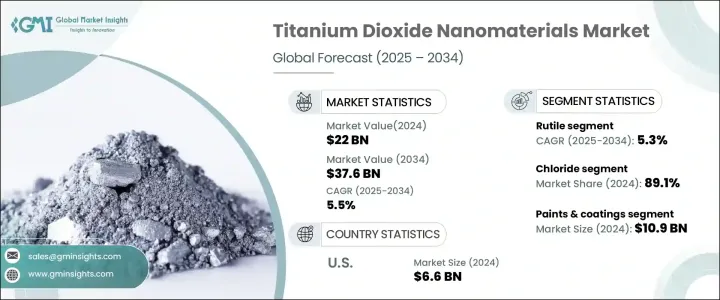
세계의 이산화티타늄 나노재료 시장은 2024년 220억 달러에 이르렀고, 2025년부터 2034년까지 CAGR 5.5%를 나타낼 것으로 예측됩니다.
다양한 산업에서 이러한 첨단 재료에 대한 수요가 증가하고 있는 것은 우수한 광학 품질, 높은 화학적 안정성, 강한 자외선 내성 등의 현저한 특성으로 인한 것입니다. 이러한 독특한 특성으로 인해 이산화티타늄 나노물질은 매우 다재다능하며 건설, 자동차, 헬스케어, 화장품, 일렉트로닉스 등의 분야에서 널리 사용되고 있습니다.
세계 인프라의 확장과 지속가능성에 대한 증가가 결합되어 고성능, 내구성 있는 재료에 대한 수요가 더욱 높아지고 있습니다. 산업이 혁신을 계속하고 있는 가운데 나노기술과 이산화티타늄과 같은 첨단재료의 채용은 제조와 기술 개발의 미래를 형성하는데 중요한 역할을 할 것으로 예상됩니다. 급속한 산업화가 진행되는 신흥국은 시장 성장에 기여하고 있으며 공급업체와 제조업체 모두에게 새로운 기회를 제공합니다.
| 시장 범위 | |
|---|---|
| 시작 연도 | 2024년 |
| 예측 연도 | 2025-2034년 |
| 시작 금액 | 220억 달러 |
| 예측 금액 | 376억 달러 |
| CAGR | 5.5% |
이산화티타늄 나노재료 시장의 루틸 부문은 2024년 201억 달러로 평가되었으며, 향후 10년간 CAGR 5.3%를 나타낼 것으로 예측됩니다. 우수한 광학 특성으로 알려진 루틸은 코팅, 플라스틱, 퍼스널케어 제품 등의 응용 분야에서 일반적으로 사용됩니다. 루틸 수요 증가는 건설 산업과 자동차 산업의 확대, 화장품 분야의 급성장에 의해 야기되고 있습니다. 보다 심미적이고 오래 지속되는 제품으로의 전환에 따라 루틸은 다양한 최종 용도 시장에서 계속 견인력을 갖고 있으며 시장 전체의 성장에 크게 기여하고 있습니다.
염화물법은 이산화티타늄 나노재료 시장을 독점하고 2024년에는 89.1% 시장 점유율을 차지했습니다. 이 제조 방법은 일관된 크기와 우수한 광학 특성을 나타내는 고순도 나노 입자를 만드는 능력으로 선호됩니다. 이러한 품질로 인해 염화물 기반 이산화티타늄 나노 재료는 고급 코팅, 전자 장비, 화장품 등의 응용에 필수적입니다. 보다 엄격한 환경 규제가 지속 가능한 생산 기술을 장려하는 동안 염화물 부문은 친환경 제조 공정 수요에 힘입어 진화하고 있습니다. 게다가 항공우주나 자동차 등의 산업에서는 경량의 내구성이 있는 재료에 대한 요구가 높아지고 있으며, 염화물계 나노 재료의 추가 도입에 박차를 가하고 있습니다. 신흥국 시장에서의 산업화와 인프라 정비의 가속도 이 부문의 범위와 영향의 확대에 중요한 역할을 하고 있습니다.
미국에서는 이산화티타늄 나노재료 시장이 2024년 66억 달러에 달했으며 2034년까지 연평균 복합 성장률(CAGR) 5.7%를 나타낼 것으로 보입니다. 전자, 헬스케어, 신재생에너지 등의 분야에서 나노기술의 급속한 진보가 이 성장의 주요 원동력이 되고 있습니다. 태양전지 생산에서 이산화티타늄 나노물질 수요가 증가하는 것은 환경 지속가능성에 대한 국가의 주목과 함께 이 분야의 지속적인 혁신에 박차를 가하고 있습니다. R&D 투자는 미국이 세계 시장에서 경쟁력을 유지하고 이산화티타늄 나노재료 산업에서 주요 기업로서의 지위를 강화하기 위한 주요 발전입니다.
목차
제1장 조사 방법과 조사 범위
- 시장 범위와 정의
- 기본 추정과 계산
- 예측 계산
- 데이터 소스
- 1차 데이터
- 2차 자료
- 유료 정보원
- 공적 정보원
제2장 주요 요약
제3장 업계 인사이트
- 생태계 분석
- 밸류체인에 영향을 주는 요인
- 이익률 분석
- 방해
- 장래의 전망
- 제조업체
- 유통업체
- 공급자의 상황
- 이익률 분석
- 주요 뉴스
- 규제 상황
- 영향요인
- 성장 촉진요인
- 일렉트로닉스와 옵토일렉트로닉스에 대한 수요 증가
- 헬스케어와 바이오테크놀러지 분야에서의 용도 확대
- 환경의 지속가능성과 엄격한 규제
- 업계의 잠재적 위험 및 과제
- 나노입자 노출에 대한 건강과 환경에 대한 우려
- 성장 촉진요인
- 성장 가능성 분석
- Porter's Five Forces 분석
- PESTEL 분석
제4장 경쟁 구도
- 서론
- 기업 점유율 분석
- 경쟁 포지셔닝 매트릭스
- 전략 전망 매트릭스
제5장 시장 추계·예측 : 그레이드별(2021-2034년)
- 주요 동향
- 루타일
- 아나타제
제6장 시장 추계·예측 : 프로세스별(2021-2034년)
- 주요 동향
- 염화물
- 황산염
제7장 시장 추계·예측 : 용도별(2021-2034년)
- 주요 동향
- 페인트 및 코팅
- 플라스틱
- 종이 및 펄프
- 인쇄용 잉크
- 기타
제8장 시장 추계·예측 : 지역별(2021-2034년)
- 주요 동향
- 북미
- 미국
- 캐나다
- 유럽
- 영국
- 독일
- 프랑스
- 이탈리아
- 스페인
- 러시아
- 아시아태평양
- 중국
- 인도
- 일본
- 한국
- 호주
- 라틴아메리카
- 브라질
- 멕시코
- 중동 및 아프리카
- 남아프리카
- 사우디아라비아
- 아랍에미리트(UAE)
제9장 기업 프로파일
- Altairnano
- American Elements
- Catalysis
- CINKARNA Celje
- Cristal
- DuPont
- Evonik Industries
- Huntsman International
- Ishihara Sangyo Kaisha
- Kronos Worldwide
- Nanoptek
- Reinste Nano Ventures
- Sakai Chemical Industry
- Showa Denko
- Tronox Holdings
The Global Titanium Dioxide Nanomaterials Market reached USD 22 billion in 2024 and is estimated to expand at a projected CAGR of 5.5% from 2025 to 2034. The growing demand for these advanced materials across multiple industries can be attributed to their remarkable properties, including excellent optical qualities, high chemical stability, and strong UV resistance. These unique characteristics make titanium dioxide nanomaterials highly versatile, fostering their widespread use in sectors like construction, automotive, healthcare, cosmetics, and electronics.
The expansion of the global infrastructure, coupled with an increasing push towards sustainability, has further fueled the demand for high-performance, durable materials. As industries continue to innovate, the adoption of nanotechnology and advanced materials like titanium dioxide is expected to play a crucial role in shaping the future of manufacturing and technological development. Emerging economies, with their rapid industrialization, are contributing to the market's growth, offering new opportunities for suppliers and manufacturers alike.
| Market Scope | |
|---|---|
| Start Year | 2024 |
| Forecast Year | 2025-2034 |
| Start Value | $22 Billion |
| Forecast Value | $37.6 Billion |
| CAGR | 5.5% |
The rutile segment of the titanium dioxide nanomaterials market was valued at USD 20.1 billion in 2024 and is forecast to grow at a CAGR of 5.3% during the upcoming decade. Rutile, known for its superior optical properties, is commonly used in applications such as coatings, plastics, and personal care products. Its increasing demand is driven by the expanding construction and automotive industries, as well as the rapidly growing cosmetics sector. With a shift toward more aesthetic, long-lasting products, rutile continues to gain traction across various end-use markets, contributing significantly to overall market growth.
The chloride method dominated the titanium dioxide nanomaterials market, holding a commanding 89.1% market share in 2024. This production method is preferred for its ability to create high-purity nanoparticles that exhibit consistent size and excellent optical characteristics. These qualities make chloride-based titanium dioxide nanomaterials indispensable in applications like advanced coatings, electronics, and cosmetics. With stricter environmental regulations encouraging more sustainable production techniques, the chloride segment is evolving, driven by the demand for environmentally friendly manufacturing processes. In addition, the growing need for lightweight and durable materials in industries like aerospace and automotive is fueling further adoption of chloride-based nanomaterials. The acceleration of industrialization and infrastructure development in emerging markets is also playing a significant role in expanding the reach and impact of this segment.
In the United States, the titanium dioxide nanomaterials market reached USD 6.6 billion in 2024 and is set to grow at a CAGR of 5.7% through 2034. The rapid advancement of nanotechnology in sectors like electronics, healthcare, and renewable energy is a major driver of this growth. The increasing demand for titanium dioxide nanomaterials in solar cell production, combined with the nation's focus on environmental sustainability, is sparking ongoing innovation in this field. Investments in research and development are key to ensuring that the U.S. maintains a competitive edge in the global market, strengthening its position as a leading player in the titanium dioxide nanomaterials industry.
Table of Contents
Chapter 1 Methodology & Scope
- 1.1 Market scope & definitions
- 1.2 Base estimates & calculations
- 1.3 Forecast calculations
- 1.4 Data sources
- 1.4.1 Primary
- 1.4.2 Secondary
- 1.4.2.1 Paid sources
- 1.4.2.2 Public sources
Chapter 2 Executive Summary
- 2.1 Industry synopsis, 2021-2034
Chapter 3 Industry Insights
- 3.1 Industry ecosystem analysis
- 3.1.1 Factor affecting the value chain
- 3.1.2 Profit margin analysis
- 3.1.3 Disruptions
- 3.1.4 Future outlook
- 3.1.5 Manufacturers
- 3.1.6 Distributors
- 3.2 Supplier landscape
- 3.3 Profit margin analysis
- 3.4 Key news & initiatives
- 3.5 Regulatory landscape
- 3.6 Impact forces
- 3.6.1 Growth drivers
- 3.6.1.1 Increasing demand in electronics and optoelectronics
- 3.6.1.2 Growing applications in healthcare and biotechnology
- 3.6.1.3 Environmental sustainability and stringent regulations
- 3.6.2 Industry pitfalls & challenges
- 3.6.2.1 Health and environmental concerns regarding nanoparticle exposure
- 3.6.1 Growth drivers
- 3.7 Growth potential analysis
- 3.8 Porter’s analysis
- 3.9 PESTEL analysis
Chapter 4 Competitive Landscape, 2024
- 4.1 Introduction
- 4.2 Company market share analysis
- 4.3 Competitive positioning matrix
- 4.4 Strategic outlook matrix
Chapter 5 Market Estimates & Forecast, By Grade, 2021-2034 (USD Billion) (Kilo Tons)
- 5.1 Key trends
- 5.2 Rutile
- 5.3 Anatase
Chapter 6 Market Estimates & Forecast, By Process, 2021-2034 (USD Billion) (Kilo Tons)
- 6.1 Key trends
- 6.2 Chloride
- 6.3 Sulfate
Chapter 7 Market Estimates & Forecast, By Application, 2021-2034 (USD Billion) (Kilo Tons)
- 7.1 Key trends
- 7.2 Paints & coatings
- 7.3 Plastic
- 7.4 Paper and pulp
- 7.5 Printing inks
- 7.6 Others
Chapter 8 Market Estimates & Forecast, By Region, 2021-2034 (USD Billion) (Kilo Tons)
- 8.1 Key trends
- 8.2 North America
- 8.2.1 U.S.
- 8.2.2 Canada
- 8.3 Europe
- 8.3.1 UK
- 8.3.2 Germany
- 8.3.3 France
- 8.3.4 Italy
- 8.3.5 Spain
- 8.3.6 Russia
- 8.4 Asia Pacific
- 8.4.1 China
- 8.4.2 India
- 8.4.3 Japan
- 8.4.4 South Korea
- 8.4.5 Australia
- 8.5 Latin America
- 8.5.1 Brazil
- 8.5.2 Mexico
- 8.6 MEA
- 8.6.1 South Africa
- 8.6.2 Saudi Arabia
- 8.6.3 UAE
Chapter 9 Company Profiles
- 9.1 Altairnano
- 9.2 American Elements
- 9.3 Catalysis
- 9.4 CINKARNA Celje
- 9.5 Cristal
- 9.6 DuPont
- 9.7 Evonik Industries
- 9.8 Huntsman International
- 9.9 Ishihara Sangyo Kaisha
- 9.10 Kronos Worldwide
- 9.11 Nanoptek
- 9.12 Reinste Nano Ventures
- 9.13 Sakai Chemical Industry
- 9.14 Showa Denko
- 9.15 Tronox Holdings

(주말 및 공휴일 제외)


