|
시장보고서
상품코드
1685069
유리 섬유 시장 기회, 성장 촉진 요인, 산업 동향 분석, 예측(2025-2034년)Fiberglass Market Opportunity, Growth Drivers, Industry Trend Analysis, and Forecast 2025 - 2034 |
||||||

세계의 유리 섬유 시장은 2024년에 287억 달러로 평가되었고 2025년부터 2034년까지 CAGR 6.4%로 성장할 것으로 예상됩니다.
유리 섬유는 뛰어난 강도, 내구성, 다용도로 유명하며 끊임없는 기술의 발전으로 인해 다양한 산업에서 점점 더 중요해지고 있습니다. 제조업체는 이 소재의 열안정성, 유연성, 강도를 크게 개선하여 건설, 자동차, 항공우주, 신재생에너지 분야에서의 용도를 확대하고 있습니다. 내화성 및 환경 친화적인 옵션 개발 등 유리 섬유의 지속적인 혁신은 안전 및 환경 규제의 엄격화가 주요 요인이 되고 있습니다. 이러한 기술 혁신은 보다 지속가능한 소재에 대한 수요에 대응할 뿐만 아니라 다양한 용도에 걸쳐 소재의 성능을 높이고 있습니다. 특히 오래 지속되고 내구성있는 재료가 필요한 산업에서 유리 섬유는 뛰어난 내식성으로 인해 콘크리트 및 기타 구조 부품의 보강재로 최선의 선택이되었습니다.
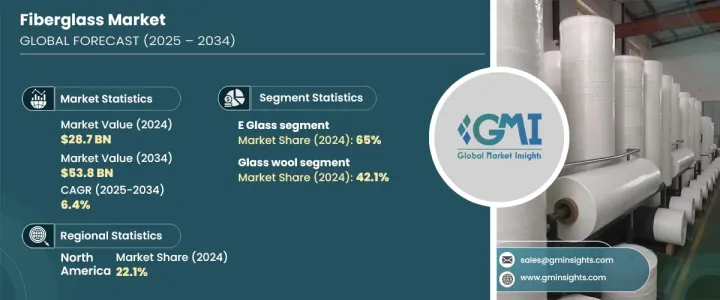
유리 섬유 시장의 E 유리 부문은 2024년에 전체 시장의 65% 점유율을 차지했습니다. 합리적인 가격과 범용성으로 널리 인정받는 E 유리는 건설, 자동차, 항공우주 등의 산업에서 폭넓은 용도로 선정된 소재입니다. 그 균형 잡힌 특성은 특히 구조 보강이나 단열재 등의 범용 용도에 이상적인 선택이 되고 있습니다. 한편, 우수한 내식성으로 알려진 ECR 유리는 해양 및 화학처리 분야 등 보다 높은 내구성이 요구되는 산업에서 큰 지지를 얻고 있습니다.
| 시장 범위 | |
|---|---|
| 시작 연도 | 2024년 |
| 예측 연도 | 2025-2034년 |
| 시작 금액 | 287억 달러 |
| 예측 금액 | 538억 달러 |
| CAGR | 6.4% |
제품 유형별로는 글라스울 분야가 2024년 점유율 42.1%로 시장을 선도하고 있습니다. 글라스울의 뛰어난 단열 및 차음 특성은 건축이나 HVAC 시스템에 빠뜨릴 수 없는 재료가 되고 있습니다. 또한 쵸드 스트랜드 제품 수요도 크고 자동차 및 선박 등 산업에서 복합재료의 보강재로서 범용성이 평가되고 있습니다. 또한 주로 직물과 특수 직물에 사용되는 얀 제품도 유리 섬유 시장에서 안정적인 존재감을 유지하고 있습니다.
2024년 세계 유리 섬유 시장 점유율의 22.1%를 차지하는 북미는 성장을 견인하는 주요 지역입니다. 35억 달러 시장 가치를 지닌 미국은 활발한 건설과 자동차 부문에 의해 지원되며 유리 섬유 시장의 개척에 큰 역할을 하고 있습니다. 유리 섬유는 이러한 산업, 특히 단열재, 복합재료, 경량 부품에 크게 의존합니다. 항공우주 산업도 시장에 크게 기여하고 있으며, 유리 섬유 복합재는 항공기 제조에 필수적입니다. 게다가 미국의 풍력에너지 분야에서는 특히 풍력 터빈 블레이드의 제조에 있어서 유리 섬유 수요가 증가하고 있으며, 이 재료 시장 확대를 더욱 추진하고 있습니다.
목차
제1장 조사 방법과 조사 범위
- 시장 범위와 정의
- 기본 추정과 계산
- 예측 계산
- 데이터 소스
제2장 주요 요약
제3장 업계 인사이트
- 생태계 분석
- 밸류체인에 영향을 주는 요인
- 이익률 분석
- 혁신
- 장래의 전망
- 제조업체
- 유통업체
- 공급자의 상황
- 이익률 분석
- 주요 뉴스
- 규제 상황
- 영향요인
- 성장 촉진요인
- 건설 및 인프라 개발
- 자동차의 경량화
- 풍력에너지 확대
- 업계의 잠재적 위험 및 과제
- 품질관리와 규격
- 세계경제의 불확실성
- 성장 촉진요인
- 성장 가능성 분석
- Porter's Five Forces 분석
- PESTEL 분석
제4장 경쟁 구도
- 소개
- 기업 점유율 분석
- 경쟁 포지셔닝 매트릭스
- 전략 전망 매트릭스
제5장 시장 규모와 예측 : 유리 유형별, 2021년-2034년
- 주요 동향
- E 유리
- ECR 유리
- H 유리
- AR 유리
- S 유리
- 기타
제6장 시장 규모와 예측 : 제품 유형별, 2021년-2034년
- 주요 동향
- 글라스울
- 쵸드 스트랜드
- 얀
- 로빙스
- 패브릭
- 기타
제7장 시장 규모와 예측 : 용도별, 2021년-2034년
- 주요 동향
- 복합재료
- 단열재
- 섬유
- 일렉트로닉스
- 기타
제8장 시장 규모와 예측 : 최종용도산업별, 2021년-2034년
- 주요 동향
- 건설
- 자동차
- 항공우주
- 풍력에너지
- 해양
- 전기 및 전자
- 공업
- 기타
제9장 시장 규모와 예측 : 지역별, 2021년-2034년
- 주요 동향
- 북미
- 미국
- 캐나다
- 유럽
- 영국
- 독일
- 프랑스
- 이탈리아
- 스페인
- 러시아
- 아시아태평양
- 중국
- 인도
- 일본
- 한국
- 호주
- 라틴아메리카
- 브라질
- 멕시코
- 중동 및 아프리카
- 남아프리카
- 사우디아라비아
- 아랍에미리트(UAE)
제10장 기업 프로파일
- Advanced Fiber Products
- Ashland Global Holdings
- BLG Fiberglass
- Johns Manville
- Nihon Glass Fiber Industrial
- Nippon Electric Glass(NEG)
- Owens Corning
- PPG Industries
- Saint-Gobain Vetrotex
- Seal Reinforced Fiberglass
The Global Fiberglass Market, valued at USD 28.7 billion in 2024, is set to experience robust growth with an expected CAGR of 6.4% from 2025 to 2034. Fiberglass, known for its impressive strength, durability, and versatility, is becoming increasingly essential in a variety of industries thanks to continuous technological advancements. Manufacturers have made significant improvements to the material's thermal stability, flexibility, and strength, expanding its application across construction, automotive, aerospace, and renewable energy sectors. The ongoing innovation in fiberglass, including the development of fire-resistant and eco-friendly options, is largely driven by stricter safety and environmental regulations. These innovations are not only addressing the demand for more sustainable materials but also enhancing the material's performance across diverse applications. Its remarkable corrosion resistance further solidifies fiberglass as a top choice for reinforcing concrete and other structural components, particularly in industries that require long-lasting, durable materials.
The E Glass segment of the fiberglass market dominated in 2024, accounting for 65% of the total market share. E Glass, widely recognized for its affordability and versatility, is the material of choice for a wide range of applications in industries such as construction, automotive, and aerospace. Its balanced properties make it an ideal option for general-purpose use, particularly in structural reinforcement and insulation. On the other hand, ECR Glass, known for its superior corrosion resistance, is gaining significant traction in industries that demand higher durability, such as marine and chemical processing sectors.
| Market Scope | |
|---|---|
| Start Year | 2024 |
| Forecast Year | 2025-2034 |
| Start Value | $28.7 Billion |
| Forecast Value | $53.8 Billion |
| CAGR | 6.4% |
In terms of product type, the glass wool segment led the market with a 42.1% share in 2024. Glass wool's exceptional thermal and acoustic insulation properties make it an indispensable material in construction and HVAC systems. The market also sees significant demand for chopped strand products, which are valued for their versatility in reinforcing composites across industries such as automotive and marine. Additionally, yarn products, mainly used in textiles and specialty fabrics, continue to maintain a steady presence in the fiberglass market.
North America, holding 22.1% of the global fiberglass market share in 2024, is a key region driving growth. The United States, with a market value of USD 3.5 billion, plays a major role in the development of the fiberglass market, bolstered by the thriving construction and automotive sectors. Fiberglass is heavily relied upon in these industries, particularly for insulation, composite materials, and lightweight components. The aerospace industry also contributes significantly to the market, with fiberglass composites being essential in aircraft manufacturing. Additionally, the wind energy sector in the U.S. has a growing demand for fiberglass, particularly in the production of wind turbine blades, further driving the material's market expansion.
Table of Contents
Chapter 1 Methodology & Scope
- 1.1 Market scope & definition
- 1.2 Base estimates & calculations
- 1.3 Forecast calculation
- 1.4 Data sources
- 1.4.1 Primary
- 1.4.2 Secondary
- 1.4.2.1 Paid sources
- 1.4.2.2 Public sources
Chapter 2 Executive Summary
- 2.1 Industry synopsis, 2021-2034
Chapter 3 Industry Insights
- 3.1 Industry ecosystem analysis
- 3.1.1 Factor affecting the value chain
- 3.1.2 Profit margin analysis
- 3.1.3 Disruptions
- 3.1.4 Future outlook
- 3.1.5 Manufacturers
- 3.1.6 Distributors
- 3.2 Supplier landscape
- 3.3 Profit margin analysis
- 3.4 Key news & initiatives
- 3.5 Regulatory landscape
- 3.6 Impact forces
- 3.6.1 Growth drivers
- 3.6.1.1 Construction and infrastructure development
- 3.6.1.2 Automotive lightweighting
- 3.6.1.3 Wind energy expansion
- 3.6.2 Industry pitfalls & challenges
- 3.6.2.1 Quality control and standards
- 3.6.2.2 Global economic uncertainty
- 3.6.1 Growth drivers
- 3.7 Growth potential analysis
- 3.8 Porter’s analysis
- 3.9 PESTEL analysis
Chapter 4 Competitive Landscape, 2024
- 4.1 Introduction
- 4.2 Company market share analysis
- 4.3 Competitive positioning matrix
- 4.4 Strategic outlook matrix
Chapter 5 Market Size and Forecast, By Glass Type, 2021-2034 (USD Billion) (Kilo Tons)
- 5.1 Key trends
- 5.2 E Glass
- 5.3 ECR Glass
- 5.4 H Glass
- 5.5 AR Glass
- 5.6 S Glass
- 5.7 Others
Chapter 6 Market Size and Forecast, By Product Type, 2021-2034 (USD Billion) (Kilo Tons)
- 6.1 Key trends
- 6.2 Glass wool
- 6.3 Chopped strand
- 6.4 Yarn
- 6.5 Rovings
- 6.6 Fabrics
- 6.7 Others
Chapter 7 Market Size and Forecast, By Application, 2021-2034 (USD Billion) (Kilo Tons)
- 7.1 Key trends
- 7.2 Composites
- 7.3 Insulation
- 7.4 Textiles
- 7.5 Electronics
- 7.6 Others
Chapter 8 Market Size and Forecast, By End Use Industries, 2021-2034 (USD Billion) (Kilo Tons)
- 8.1 Key trends
- 8.2 Construction
- 8.3 Automotive
- 8.4 Aerospace
- 8.5 Wind energy
- 8.6 Marine
- 8.7 Electrical & electronics
- 8.8 Industrial
- 8.9 Others
Chapter 9 Market Size and Forecast, By Region, 2021-2034 (USD Billion) (Kilo Tons)
- 9.1 Key trends
- 9.2 North America
- 9.2.1 U.S.
- 9.2.2 Canada
- 9.3 Europe
- 9.3.1 UK
- 9.3.2 Germany
- 9.3.3 France
- 9.3.4 Italy
- 9.3.5 Spain
- 9.3.6 Russia
- 9.4 Asia Pacific
- 9.4.1 China
- 9.4.2 India
- 9.4.3 Japan
- 9.4.4 South Korea
- 9.4.5 Australia
- 9.5 Latin America
- 9.5.1 Brazil
- 9.5.2 Mexico
- 9.6 MEA
- 9.6.1 South Africa
- 9.6.2 Saudi Arabia
- 9.6.3 UAE
Chapter 10 Company Profiles
- 10.1 Advanced Fiber Products
- 10.2 Ashland Global Holdings
- 10.3 BLG Fiberglass
- 10.4 Johns Manville
- 10.5 Nihon Glass Fiber Industrial
- 10.6 Nippon Electric Glass (NEG)
- 10.7 Owens Corning
- 10.8 PPG Industries
- 10.9 Saint-Gobain Vetrotex
- 10.10 Seal Reinforced Fiberglass