

|
시장보고서
상품코드
1698262
H2-ICE 시장 : 시장 기회, 성장 촉진요인, 산업 동향 분석, 예측(2025-2034년)H2-ICE Market Opportunity, Growth Drivers, Industry Trend Analysis, and Forecast 2025 - 2034 |
||||||

세계의 H2-ICE 시장은 2025년에 360만 달러로 추정되며, 2025-2034년 142.9%의 연평균 복합 성장률(CAGR)로 성장할 것으로 전망됩니다.
이러한 현저한 확대는 엄격한 정부 정책, 인프라 투자 증가, 산업 전체의 탄소 배출량 감축을 목표로 한 광범위한 탈탄소화 이니셔티브의 조합에 의해 초래되고 있습니다. 지속 가능한 에너지에 대한 세계의 주목이 높아지는 가운데 수소를 동력원으로 하는 내연기관은 기존의 화석연료를 기반으로 하는 엔진을 대체할 효율적이고 실행 가능한 선택지로 큰 지지를 받고 있습니다.
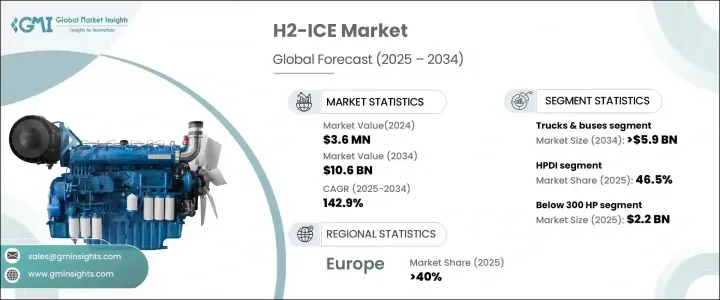
세계 각국 정부가 배출가스 규제를 강화하는 가운데 산업계는 보다 깨끗한 연료 솔루션을 적극적으로 모색하고 있습니다. 수소 연료 엔진은 특히 신뢰성과 고성능이 중요한 헤비듀티 용도에서 매력적인 선택지가 됩니다. 배터리 전기차와 달리 H2-ICE 테크놀로지는 신속한 연료 보급과 운전 거리 연장을 가능하게 해 장거리 운송 및 산업 용도에 이상적인 선택지가 됩니다. 연료 보급 스테이션과 제조 시설 등 수소 인프라에 대한 투자가 확대되고 있는 것이 시장 도입을 더욱 가속화하고 있습니다. 조업 효율과 비용 대비 효과를 유지하면서 지속가능성 목표에 부합하기 위해 수소 기반 기술을 도입하는 기업이 늘고 있습니다. 건설기계, 물류기계, 농기계의 수소엔진 채택이 증가하고 있는 것은 수소엔진의 다용도성과 다양한 분야에 혁명을 가져올 가능성을 뒷받침하고 있습니다.
| 시장 범위 | |
|---|---|
| 시작 연도 | 2024년 |
| 예측 연도 | 2025-2034년 |
| 시작 금액 | 360만 달러 |
| 예측 금액 | 106억 달러 |
| CAGR | 142.9% |
시장은 연소 기술을 기반으로 불꽃 점화 포트 연료 분사(PFI-SI), 고압 직접 분사(HPDI), 불꽃 점화 조기 사이클 직접 분사(ECDI-SI)로 구분됩니다. HPDI 부문은 2025년 시장 점유율의 46.5%를 차지할 것으로 추정되며, 이 분야에서의 우위성을 부각시키고 있습니다. 이 고압 수소 분사 방식은 다른 연소 방식에 비해 출력과 열효율을 크게 향상시킵니다. 그 뛰어난 성능 때문에, 상용차나 산업 기계에 즐겨 채용되고 있습니다. 트럭이나 버스를 포함한 대형 수송 차량은, 엄격한 배기가스 규제를 준수하면서 장거리에서도 최적의 성능을 유지할 수 있는 것으로부터, HPDI 기술을 급속히 채용하고 있습니다.
시장 세분화에서는 엔진을 출력별로 300마력 미만과 300마력 이상으로 분류하고 있습니다. 300마력 미만 부문은 소형 및 중형차에 폭넓은 적용을 반영해 2025년에는 22억 달러를 창출할 것으로 예측되고 있습니다. 소형 트럭, 버스, 건설 기계, 특히 배기가스 규제가 엄격한 도시 환경에서는, 이러한 수소 엔진의 수요가 높아지고 있습니다. 이러한 분야에서 H2-ICE 기술의 채용은, 세계의 지속 가능성에 대한 대처나, 인구 밀집지에서의 오염 삭감을 목적으로 한 규제 조치에 따른 것입니다. 정부 및 기업이 보다 청정한 에너지 솔루션으로의 전환을 가속화하는 가운데 저마력 카테고리의 수소연료 엔진 수요는 크게 증가할 것으로 예상됩니다.
유럽은 세계의 H2-ICE 시장에서 지배적인 지위를 유지하고 있고, 2025년 시장 점유율의 40%를 차지할 전망이며, 평가액은 1,300만 달러입니다. 이 지역은 수소 인프라에 대한 많은 투자 및 지속 가능한 에너지를 촉진하는 정책 틀에 의해 2025-2034년 CAGR 140%라는 경이적인 성장을 이룰 것으로 예측되고 있습니다. 수많은 수소 제조 프로젝트가 진행 중이며, H2-ICE 차량 공급망은 지속적으로 견고하고 안정적인 시장 기반을 확보하고 있습니다. 유럽 국가에서는 청정 에너지로의 이행이 급속히 진행되고 있으며 수소 내연기관에의 수요가 더욱 높아지고 있습니다. 각국이 탄소 중립 달성을 향한 대처를 강화하는 가운데, 수소를 기반으로 한 솔루션은, 수송이나 산업 용도의 미래를 형성하는데 중요한 역할을 하게 될 것입니다.
목차
제1장 조사 방법 및 조사 범위
- 조사 디자인
- 조사 접근
- 데이터 수집 방법
- 기본 추정 및 계산
- 기준 연도 산출
- 시장추계 주요 동향
- 예측 모델
- 1차 조사 및 검증
- 시장 범위 및 정의
제2장 주요 요약
제3장 업계 인사이트
- 생태계 분석
- 공급자의 상황
- 원재료 공급자
- 부품 공급자
- 제조업체
- 기술 제공업체
- 유통업체
- 최종 용도
- 이익률 분석
- 공급자의 상황
- 기술 및 혁신의 전망
- 특허 분석
- 규제 상황
- 가격 동향
- 영향요인
- 성장 촉진요인
- 온실가스(GHG) 배출 감축 요구 증가
- 그린모빌리티에 대한 정부의 규제 및 인센티브
- 수소 인프라 투자 증가
- 대형 용도에서의 EV를 대체하는 비용 대비 효과
- 업계의 잠재적 위험 및 과제
- 수소 제조 및 유통의 고비용
- 수소 저장 및 안전성의 과제
- 성장 촉진요인
- 성장 가능성 분석
- Porter's Five Forces 분석
- PESTEL 분석
제4장 경쟁 구도
- 서문
- 기업 점유율 분석
- 경쟁 포지셔닝 매트릭스
- 전략 전망 매트릭스
제5장 시장 추계 및 예측 : 차량별(2025-2034년)
- 주요 동향
- 트럭 및 버스
- 건설 기계
- 채광 기계
- 크롤러 굴삭기
- 트랙터
- 기타
제6장 시장 추계 및 예측 : 연소 방식별(2025-2034년)
- 주요 동향
- 불꽃 점화 포트 연료 분사(PFI-SI)
- 고압 직접 분사(HPDI)
- 불꽃 점화 조기 사이클 직분사(ECDI-SI)
제7장 시장 추계 및 예측 : 마력별(2025-2034년)
- 주요 동향
- 300마력 미만
- 300마력 이상
제8장 시장 추계 및 예측 : 지역별(2025-2034년)
- 주요 동향
- 북미
- 미국
- 캐나다
- 유럽
- 영국
- 독일
- 프랑스
- 이탈리아
- 스페인
- 러시아
- 북유럽
- 아시아태평양
- 중국
- 인도
- 일본
- 호주
- 한국
- 동남아시아
- 라틴아메리카
- 브라질
- 멕시코
- 아르헨티나
- 중동 및 아프리카
- UAE
- 남아프리카
- 사우디아라비아
제9장 기업 프로파일
- Ashok Leyland
- Cummins
- MAN Trucks
- Deutz AG
- PACCAR Inc
- Volvo
- JCB
- Liebherr
- Keyou
- Garett
The Global H2-ICE Market, with a valuation of USD 3.6 million in 2025 and an anticipated CAGR of 142.9% between 2025 and 2034. This remarkable expansion is driven by a combination of stringent government policies, increasing infrastructure investments, and widespread decarbonization initiatives aimed at reducing carbon emissions across industries. As the global focus on sustainable energy intensifies, hydrogen-powered internal combustion engines are gaining significant traction as an efficient and viable alternative to traditional fossil fuel-based engines.
With governments worldwide enforcing stricter emission regulations, industries are actively seeking cleaner fuel solutions. Hydrogen-fueled engines present a compelling option, particularly in heavy-duty applications where reliability and high performance are critical. Unlike battery-electric vehicles, H2-ICE technology enables rapid refueling and extended operational range, making it an ideal choice for long-haul transportation and industrial applications. The growing investment in hydrogen infrastructure, including fueling stations and production facilities, further accelerates market adoption. Companies are increasingly integrating hydrogen-based technologies to align with their sustainability goals while maintaining operational efficiency and cost-effectiveness. The rising adoption of hydrogen engines in construction, logistics, and agricultural machinery underscores their versatility and potential to revolutionize multiple sectors.
| Market Scope | |
|---|---|
| Start Year | 2024 |
| Forecast Year | 2025-2034 |
| Start Value | $3.6 Million |
| Forecast Value | $10.6 Billion |
| CAGR | 142.9% |
The market is segmented based on combustion technology into port fuel injection with spark ignition (PFI-SI), high-pressure direct injection (HPDI), and early cycle direct injection with spark ignition (ECDI-SI). The HPDI segment accounted for 46.5% of the market share in 2025, highlighting its dominance in the sector. This high-pressure hydrogen injection method significantly enhances power output and thermal efficiency compared to other combustion techniques. Its superior performance makes it the preferred choice for commercial vehicles and industrial machinery. Heavy-duty transportation, including trucks and buses, is rapidly adopting HPDI technology due to its ability to maintain optimal performance over long distances while adhering to stringent emission standards.
Market segmentation by power output categorizes engines into those below 300 HP and those above 300 HP. The below 300 HP segment is projected to generate USD 2.2 billion in 2025, reflecting its widespread application in light and medium-duty vehicles. Smaller trucks, buses, and construction equipment, particularly in urban environments with strict emission regulations, are driving demand for these hydrogen-powered engines. The adoption of H2-ICE technology in these segments aligns with global sustainability initiatives and regulatory measures aimed at reducing pollution in densely populated areas. As governments and corporations accelerate their shift toward cleaner energy solutions, the demand for hydrogen-fueled engines in lower horsepower categories is expected to rise significantly.
Europe remains a dominant player in the global H2-ICE market, accounting for 40% of the market share in 2025, with a valuation of USD 13 million. The region is projected to grow at a staggering CAGR of 140% from 2025 to 2034, driven by substantial investments in hydrogen infrastructure and policy frameworks promoting sustainable energy. With numerous hydrogen production projects underway, the supply chain for H2-ICE vehicles remains robust, ensuring a stable market foundation. European countries are rapidly transitioning to clean energy solutions, further fueling demand for hydrogen-powered internal combustion engines. As nations intensify efforts to achieve carbon neutrality, hydrogen-based solutions are set to play a crucial role in shaping the future of transportation and industrial applications.
Table of Contents
Chapter 1 Methodology & Scope
- 1.1 Research design
- 1.1.1 Research approach
- 1.1.2 Data collection methods
- 1.2 Base estimates & calculations
- 1.2.1 Base year calculation
- 1.2.2 Key trends for market estimation
- 1.3 Forecast model
- 1.4 Primary research and validation
- 1.4.1 Primary sources
- 1.4.2 Data mining sources
- 1.5 Market scope & definition
Chapter 2 Executive Summary
- 2.1 Industry 3600 synopsis, 2025 - 2034
Chapter 3 Industry Insights
- 3.1 Industry ecosystem analysis
- 3.1.1 Supplier landscape
- 3.1.1.1 Raw material suppliers
- 3.1.1.2 Component suppliers
- 3.1.1.3 Manufacturers
- 3.1.1.4 Technology providers
- 3.1.1.5 Distributors
- 3.1.1.6 End use
- 3.1.2 Profit margin analysis
- 3.1.1 Supplier landscape
- 3.2 Technology & innovation landscape
- 3.3 Patent analysis
- 3.4 Regulatory landscape
- 3.5 Price trend
- 3.6 Impact forces
- 3.6.1 Growth drivers
- 3.6.1.1 Rising need to reduce greenhouse gas (GHG) emissions
- 3.6.1.2 Government regulations and incentives for green mobility
- 3.6.1.3 Increasing investments in hydrogen infrastructure
- 3.6.1.4 Cost-effective alternative to EVs in heavy-duty applications
- 3.6.2 Industry pitfalls & challenges
- 3.6.2.1 High costs of hydrogen production and distribution
- 3.6.2.2 Challenges in hydrogen storage and safety
- 3.6.1 Growth drivers
- 3.7 Growth potential analysis
- 3.8 Porter’s analysis
- 3.9 PESTEL analysis
Chapter 4 Competitive Landscape, 2025
- 4.1 Introduction
- 4.2 Company market share analysis
- 4.3 Competitive positioning matrix
- 4.4 Strategic outlook matrix
Chapter 5 Market Estimates & Forecast, By Vehicle, 2025 - 2034 ($Bn, Units)
- 5.1 Key trends
- 5.2 Trucks & buses
- 5.3 Construction equipment
- 5.4 Mining equipment
- 5.5 Crawler excavator
- 5.6 Tractor
- 5.7 Others
Chapter 6 Market Estimates & Forecast, By Combustion, 2025 - 2034 ($Bn, Units)
- 6.1 Key trends
- 6.2 Port fuel injection with spark ignition (PFI-SI)
- 6.3 High pressure direct injection (HPDI)
- 6.4 Early cycle direct injection with spark ignition (ECDI-SI)
Chapter 7 Market Estimates & Forecast, By Power Output, 2025 - 2034 ($Bn, Units)
- 7.1 Key trends
- 7.2 Below 300 HP
- 7.3 Above 300 HP
Chapter 8 Market Estimates & Forecast, By Region, 2025 - 2034 ($Bn, Units)
- 8.1 Key trends
- 8.2 North America
- 8.2.1 U.S.
- 8.2.2 Canada
- 8.3 Europe
- 8.3.1 UK
- 8.3.2 Germany
- 8.3.3 France
- 8.3.4 Italy
- 8.3.5 Spain
- 8.3.6 Russia
- 8.3.7 Nordics
- 8.4 Asia Pacific
- 8.4.1 China
- 8.4.2 India
- 8.4.3 Japan
- 8.4.4 Australia
- 8.4.5 South Korea
- 8.4.6 Southeast Asia
- 8.5 Latin America
- 8.5.1 Brazil
- 8.5.2 Mexico
- 8.5.3 Argentina
- 8.6 MEA
- 8.6.1 UAE
- 8.6.2 South Africa
- 8.6.3 Saudi Arabia
Chapter 9 Company Profiles
- 9.1 Ashok Leyland
- 9.2 Cummins
- 9.3 MAN Trucks
- 9.4 Deutz AG
- 9.5 PACCAR Inc
- 9.6 Volvo
- 9.7 JCB
- 9.8 Liebherr
- 9.9 Keyou
- 9.10 Garett


