|
시장보고서
상품코드
1698287
화장품용 병 시장 : 시장 기회, 성장 촉진요인, 산업 동향 분석, 예측(2025-2034년)Cosmetic Jars Market Opportunity, Growth Drivers, Industry Trend Analysis, and Forecast 2025-2034 |
||||||

세계의 화장품용 병 시장은 2024년에 47억 달러로 평가되었으며, 2025-2034년 연평균 복합 성장률(CAGR) 4.7%로 확대될 것으로 예측됩니다.
이 성장의 주요 요인은 스킨 케어 제품에 대한 수요 증가 및 전자상거래의 급속한 확대입니다. 소비자들은 미용 제품 및 퍼스널 케어 제품을 구매하기 위해 온라인 플랫폼으로의 전환을 강화하고 있으며, 안전하고 심미적으로 매력적이며 내구성 있는 화장품 패키지에 대한 수요 급증으로 이어지고 있습니다. 소비자직판(DTC) 브랜드의 인기가 높아짐에 따라 커스터마이즈 가능하고 기능적인 화장품용 병의 요구는 계속 높아지고 있습니다. 많은 브랜드는 현재 제품 프레젠테이션을 강화하고 제품의 무결성을 보호하며 강력한 브랜드 아이덴티티를 유지하기 위해 프리미엄으로 맞춤형 패키지를 우선시하고 있습니다.
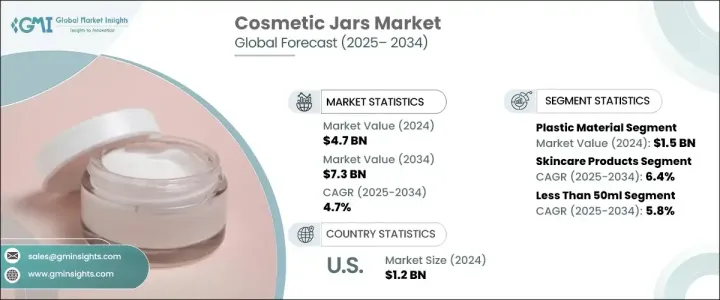
업계는 재료, 용도, 용량에 따라 구분됩니다. 재료별로는 플라스틱이 여전히 우세하고, 2024년에는 15억 달러를 차지했습니다. 플라스틱 병의 인기는 그 저렴한 가격, 내구성, 양판점이나 중가대의 스킨케어 브랜드에 적합한 것에 기인하고 있습니다. 전자상거래의 대두는 가볍고 잘 깨지지 않으며 운송에 비용 대비 효과가 높기 때문에 그 채택을 더욱 가속화시키고 있습니다. 게다가 여행하기 편리하고 커스터마이징 가능한 패키징 솔루션에 대한 수요의 고조가 시장에서 플라스틱 병의 지위를 강화하고 있습니다.
| 시장 범위 | |
|---|---|
| 시작 연도 | 2024년 |
| 예측 연도 | 2025-2034년 |
| 시작 금액 | 47억 달러 |
| 예측 금액 | 73억 달러 |
| CAGR | 4.7% |
용도별 세분화에는 스킨 케어 제품, 헤어 케어 제품, 메이크업과 화장품, 향수가 포함됩니다. 스킨케어 분야는 가장 급성장하고 있으며 예측 기간 동안 CAGR 6.4%로 확대될 것으로 예측됩니다. 셀프케어, 안티에이징 솔루션, 클린뷰티에 대한 소비자들의 관심 고조가 이 분야 확대에 크게 기여하고 있습니다. 브랜드는 고가의 제제의 산화와 오염을 막으려고 하기 때문에 프리미엄, 에어리스, 유리병의 수요가 높아지고 있습니다. DTC 스킨 케어 기업이나 온라인 쇼핑 플랫폼의 존재감의 고조도, 전자상거래 출하용으로 조정된, 여행하기 쉽고 안전하고 누출이 없는 병의 요구에 박차를 가하고 있습니다.
용량에 관해서는 시장은 50ml 미만, 50ml-200ml, 200ml 이상으로 분류됩니다. 50ml 미만의 카테고리가 가장 급성장하고 있어 5.8%로 증가할 것으로 예상되고 있습니다. 이 분야는, 샘플 사이즈 및 여행에 편리한 스킨 케어 제품의 수요의 고조에 의해 급성장하고 있습니다. 고급 브랜드는 에센스, 아이크림, 고급 처방용 작은 유리나 아크릴 병을 즐겨 사용하여 제품의 매력과 독점성을 높이고 있습니다. 정기 구입형 미용 서비스의 동향도 미니병의 인기에 기여하고 있으며, 소비자는 풀 사이즈의 제품을 구입하기 전에 시험 사이즈의 선택지를 얻을 수 있습니다. 게다가 리필 가능하고 지속 가능한 포장 솔루션을 요구하는 움직임이, 큰 리필 용기에 들어가도록 설계된 재사용 가능한 미니병의 채용으로 이어졌습니다.
북미는 2024년 세계 화장품용 병 시장 점유율의 30.1%를 차지했으며, 미국이 12억 달러로 압도적인 점유율을 차지했습니다. DTC 브랜드의 부상과 함께 고급 스킨케어 및 헤어케어 제품에 대한 수요 증대가 주요 추진력이 되고 있습니다. 폐기물 감소와 및지속 가능성에 초점을 맞춘 규제의 증가는 이 지역에서 재활용 가능하고 리필 가능한 화장품용 병의 수요를 더욱 부추기고 있습니다.
목차
제1장 조사 방법 및 조사 범위
제2장 주요 요약
제3장 업계 인사이트
- 생태계 분석
- 업계에 미치는 영향요인
- 성장 촉진요인
- 스킨케어 제품에 대한 수요 증가
- 지속 가능하고 친환경 패키지
- 전자상거래의 급성장
- 프리미엄화 및 고급 패키지
- 커스터마이징 및 개인화
- 업계의 잠재적 위험 및 과제
- 공급망의 혼란
- 지속 가능한 포장의 고비용
- 성장 촉진요인
- 성장 가능성 분석
- 규제 상황
- 기술 동향
- 향후 시장 동향
- 갭 분석
- Porter's Five Forces 분석
- PESTEL 분석
제4장 경쟁 구도
- 서문
- 기업 점유율 분석
- 주요 시장 기업의 경쟁 분석
- 경쟁 포지셔닝 매트릭스
- 전략 대시보드
제5장 시장 추계 및 예측 : 재료별(2021-2034년)
- 주요 동향
- 플라스틱
- 금속
- 유리
- 목재
- 기타
제6장 시장 추계 및 예측 : 용도별(2021-2034년)
- 주요 동향
- 스킨케어 제품
- 헤어 케어 제품
- 메이크업 및 화장품
- 향수
- 기타
제7장 시장 추계 및 예측 : 용량별(2021-2034년)
- 주요 동향
- 50ml 미만
- 50ml-200ml
- 200ml 이상
제8장 시장 추계 및 예측 : 지역별(2021-2034년)
- 주요 동향
- 북미
- 미국
- 캐나다
- 유럽
- 독일
- 영국
- 프랑스
- 스페인
- 이탈리아
- 네덜란드
- 아시아태평양
- 중국
- 인도
- 일본
- 호주
- 한국
- 라틴아메리카
- 브라질
- 멕시코
- 아르헨티나
- 중동 및 아프리카
- 사우디아라비아
- 남아프리카
- 아랍에미리트(UAE)
제9장 기업 프로파일
- Ampulla
- Berlin Packaging
- Berry Global
- Calaso
- CJK Packaging
- Cosmopack Industries
- Eurovetrocap
- Gerresheimer
- HCP Packaging
- Inoac
- Jarsking
- Kaufman Container
- Quadpack Industries
- Radcom
- Seacliff Beauty
- Stoelzle Glass Group
- Zenvista Packagings
The Global Cosmetic Jars Market was valued at USD 4.7 billion in 2024 and is projected to expand at a CAGR of 4.7% from 2025 to 2034. This growth is primarily driven by the rising demand for skincare products and the rapid expansion of e-commerce. Consumers are increasingly shifting towards online platforms to purchase beauty and personal care products, leading to a surge in demand for secure, aesthetically appealing, and durable cosmetic packaging. As direct-to-consumer (DTC) brands gain traction, the need for customizable and functional cosmetic jars continues to rise. Many brands now prioritize premium, tailor-made packaging to enhance product presentation, protect product integrity, and maintain a strong brand identity.
The industry is segmented based on material, application, and capacity. In terms of material, plastic remains the dominant segment, accounting for USD 1.5 billion in 2024. The popularity of plastic jars stems from their affordability, durability, and suitability for mass-market and mid-range skincare brands. The rise of e-commerce has further accelerated their adoption, as they are lightweight, non-fragile, and cost-effective for shipping. Additionally, the increasing demand for travel-friendly and customizable packaging solutions has strengthened the position of plastic jars in the market.
| Market Scope | |
|---|---|
| Start Year | 2024 |
| Forecast Year | 2025-2034 |
| Start Value | $4.7 Billion |
| Forecast Value | $7.3 Billion |
| CAGR | 4.7% |
The application-based segmentation includes skincare products, haircare products, makeup and cosmetics, and fragrances. The skincare segment is the fastest-growing, estimated to expand at a CAGR of 6.4% during the forecast period. The increasing consumer focus on self-care, anti-aging solutions, and clean beauty has significantly contributed to this segment's expansion. Demand for premium, airless, and glass jars has risen as brands seek to prevent oxidation and contamination in high-value formulations. The growing presence of DTC skincare companies and online shopping platforms has also fueled the need for travel-friendly, secure, and leak-proof jars tailored for e-commerce shipments.
Regarding capacity, the market is categorized into less than 50ml, 50ml-200ml, and above 200ml. The less than 50ml category is the fastest-growing, projected to increase at a CAGR of 5.8%. This segment has seen rapid growth due to the rising demand for sample-sized and travel-friendly skincare products. Luxury brands favor small glass and acrylic jars for serums, eye creams, and premium formulations, enhancing product appeal and exclusivity. The growing trend of subscription-based beauty services has also contributed to the popularity of mini jars, providing consumers with trial-sized options before purchasing full-sized products. Additionally, the push toward refillable and sustainable packaging solutions has led to the adoption of reusable mini jars designed to fit into larger refillable containers.
North America accounted for 30.1% of the global cosmetic jars market share in 2024, with the U.S. dominating at USD 1.2 billion. The growing demand for high-end skincare and haircare products, along with the rise of DTC brands, has been a key driver. Increasing regulatory focus on waste reduction and sustainability has further fueled the demand for recyclable and refillable cosmetic jars in the region.
Table of Contents
Chapter 1 Methodology and Scope
- 1.1 Market scope and definitions
- 1.2 Research design
- 1.2.1 Research approach
- 1.2.2 Data collection methods
- 1.3 Base estimates and calculations
- 1.3.1 Base year calculation
- 1.3.2 Key trends for market estimation
- 1.4 Forecast model
- 1.5 Primary research and validation
- 1.5.1 Primary sources
- 1.5.2 Data mining sources
Chapter 2 Executive Summary
- 2.1 Industry 360° synopsis
Chapter 3 Industry Insights
- 3.1 Industry ecosystem analysis
- 3.2 Industry impact forces
- 3.2.1 Growth drivers
- 3.2.1.1 Rising Demand for Skincare Products
- 3.2.1.2 Sustainable and Eco-friendly Packaging
- 3.2.1.3 Rapid Expansion of E-Commerce Industry
- 3.2.1.4 Premiumization and Luxury Packaging
- 3.2.1.5 Customization and Personalization
- 3.2.2 Industry pitfalls and challenges
- 3.2.2.1 Supply Chain Disruption
- 3.2.2.2 High Cost of Sustainable Packaging
- 3.2.1 Growth drivers
- 3.3 Growth potential analysis
- 3.4 Regulatory landscape
- 3.5 Technology landscape
- 3.6 Future market trends
- 3.7 Gap analysis
- 3.8 Porter's analysis
- 3.9 PESTEL analysis
Chapter 4 Competitive Landscape, 2024
- 4.1 Introduction
- 4.2 Company market share analysis
- 4.3 Competitive analysis of major market players
- 4.4 Competitive positioning matrix
- 4.5 Strategy dashboard
Chapter 5 Market Estimates and Forecast, By Material, 2021 – 2034 (USD Billion & Kilo Tons)
- 5.1 Key trends
- 5.2 Plastic
- 5.3 Metal
- 5.4 Glass
- 5.5 Wood
- 5.6 Others
Chapter 6 Market Estimates and Forecast, By Application, 2021 – 2034 (USD Billion & Kilo Tons)
- 6.1 Key trends
- 6.2 Skin care products
- 6.3 Hair care products
- 6.4 Makeup & Cosmetics
- 6.5 Fragrances
- 6.6 Others
Chapter 7 Market Estimates and Forecast, By Capacity, 2021 – 2034 (USD Billion & Kilo Tons)
- 7.1 Key trends
- 7.2 Less than 50 ml
- 7.3 50 ml – 200 ml
- 7.4 Above 200 ml
Chapter 8 Market Estimates and Forecast, By Region, 2021 – 2034 (USD Billion & Kilo Tons)
- 8.1 Key trends
- 8.2 North America
- 8.2.1 U.S.
- 8.2.2 Canada
- 8.3 Europe
- 8.3.1 Germany
- 8.3.2 UK
- 8.3.3 France
- 8.3.4 Spain
- 8.3.5 Italy
- 8.3.6 Netherlands
- 8.4 Asia Pacific
- 8.4.1 China
- 8.4.2 India
- 8.4.3 Japan
- 8.4.4 Australia
- 8.4.5 South Korea
- 8.5 Latin America
- 8.5.1 Brazil
- 8.5.2 Mexico
- 8.5.3 Argentina
- 8.6 Middle East and Africa
- 8.6.1 Saudi Arabia
- 8.6.2 South Africa
- 8.6.3 UAE
Chapter 9 Company Profiles
- 9.1 Ampulla
- 9.2 Berlin Packaging
- 9.3 Berry Global
- 9.4 Calaso
- 9.5 CJK Packaging
- 9.6 Cosmopack Industries
- 9.7 Eurovetrocap
- 9.8 Gerresheimer
- 9.9 HCP Packaging
- 9.10 Inoac
- 9.11 Jarsking
- 9.12 Kaufman Container
- 9.13 Quadpack Industries
- 9.14 Radcom
- 9.15 Seacliff Beauty
- 9.16 Stoelzle Glass Group
- 9.17 Zenvista Packagings