|
시장보고서
상품코드
1698295
자동차용 퓨즈 시장 기회, 성장 촉진요인, 산업 동향 분석, 예측(2025-2034년)Automotive Fuse Market Opportunity, Growth Drivers, Industry Trend Analysis, and Forecast 2025 - 2034 |
||||||

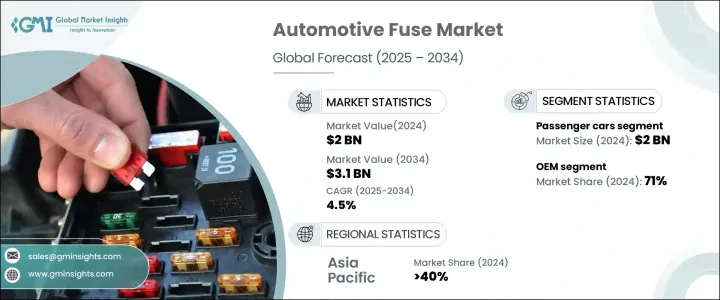
세계의 자동차용 퓨즈 시장은 2024년에 20억 달러로 평가되었고 2025년부터 2034년에 걸쳐 CAGR 4.5%를 나타낼 것으로 예측됩니다.
자동차 업계가 전기자동차 생산으로의 이동을 가속화하는 중 고성능 퓨즈 수요가 높아지고 있습니다.
퓨즈 기술의 급속한 진보로, 특히 고전압 전기자동차에서는 시스템 보호가 강화되고 있습니다. 효율성을 높이고 진화하는 안전 규정을 준수하는 것입니다. 자동차 제조업체는 차량의 전자 장비를 보호하고 전력 관리를 지원하며 전반적인 신뢰성을 향상시키는 혁신적인 퓨즈를 채택하여 시장이 크게 성장하고 있습니다.
| 시장 규모 | |
|---|---|
| 시작 연도 | 2024년 |
| 예측 연도 | 2025-2034년 |
| 시작 금액 | 20억 달러 |
| 예측 금액 | 31억 달러 |
| CAGR | 4.5% |
ADAS(첨단 운전자 보조 시스템), 디지털 대시보드, 전동 파워 스티어링의 도입이 진행됨에 따라, 보다 고속 응답의 퓨즈에 대한 요구가 높아지고 있습니다. 기존의 퓨즈에서 스마트 퓨즈로의 전환은 원격 진단 기능을 도입하여 전기 부하를 모니터링하여 고장을 방지함으로써 안전성을 향상시킵니다.
자동차 제조업체는 퓨즈 제조업체와 협력하여 스마트 퓨즈 기술을 최신 차량 아키텍처에 통합합니다. 디지털화는 새로운 기회를 키우고 자동차 회로 보호를 최적화합니다. 이를 강화하고 전기적 리스크를 방지하면서 고전압 및 전류 부하에 대응할 수 있는 퓨즈가 필요합니다.
제조업체는 차량의 신뢰성을 높이기 위해 스마트 퓨즈 기술에 투자하여 실시간 고장 감지 및 예지 보전을 수행하고 있습니다. 자동차 제조업체는 이러한 퓨즈를 최신 차량 전자 장비에 통합하여 유지 보수 작업을 간소화하고 지속적인 모니터링을 보장하여 안전성과 성능을 향상시킵니다.
자동차 제조업체는 공급업체와 협력하여 특정 차량 구조 및 운영 요구 사항에 맞게 맞춤형 퓨즈 시스템을 개발하고 있습니다.
시장은 연료 유형별로 가솔린차, 디젤차, 전기자동차, 하이브리드차, 연료전지차로 구분됩니다. 그럼에도 불구하고 가솔린 차량이 여전히 주류이기 때문에 기존의 고성능 퓨즈에 대한 수요가 유지됩니다. 이 퓨즈는 점화, 연료 분사 및 조명 시스템과 같은 주요 전기 부품을 보호합니다.
퓨즈 유형에 따라 시장은 블레이드 퓨즈, 유리 퓨즈, 슬로우 블로우 퓨즈, 기타 범주로 분류됩니다. 자동차와 전기자동차 모두에서 널리 채택되어 회로 보호의 신뢰성이 뒷받침되고 있습니다.
아시아태평양은 자동차 생산 대수 증가와 소비자 수요 증가에 따라 강력한 시장 성장을 이루고 있습니다. 이 지역의 자동차 제조업체는 차량 일렉트로닉스의 강화에 주력하고 있으며, 효율적인 배전과 시스템의 안전성을 확보하는 지능형 고속 응답 퓨즈 수요를 촉진하고 있습니다.
목차
제1장 조사 방법과 조사 범위
- 조사 디자인
- 조사 접근
- 데이터 수집 방법
- 기본 추정과 계산
- 기준연도의 산출
- 시장추계의 주요 동향
- 예측 모델
- 1차 조사와 검증
- 1차 정보
- 데이터 마이닝 소스
- 시장 정의
제2장 주요 요약
제3장 업계 인사이트
- 생태계 분석
- 공급업체의 상황
- 원재료 공급업체
- 부품 공급업체
- 제조업체
- 서비스 제공업체
- 판매자
- 최종 용도
- 이익률 분석
- 코스트 내역 분석
- 기술과 혁신의 전망
- 주요 뉴스와 대처
- 규제 상황
- 영향요인
- 성장 촉진요인
- 전기자동차와 하이브리드 자동차의 보급
- 고급 차량 안전 기능에 대한 수요 증가
- 자동차 일렉트로닉스와 커넥티비티 솔루션의 성장
- 자동차의 안전성과 배출가스에 관한 엄격한 규제
- 업계의 잠재적 위험 및 과제
- 최신 차량 아키텍처와의 통합 과제
- 성장 촉진요인
- 성장 가능성 분석
- Porter's Five Forces 분석
- PESTEL 분석
제4장 경쟁 구도
- 서론
- 기업 점유율 분석
- 경쟁 포지셔닝 매트릭스
- 전략 전망 매트릭스
제5장 시장 추계·예측 : 퓨즈별(2021-2034년)
- 주요 동향
- 블레이드
- 유리
- 슬로우 블로우
- EV퓨즈
- 기타
제6장 시장 추계·예측 : 차량별(2021-2034년)
- 주요 동향
- 승용차
- 상용차
제7장 시장 추계·예측 : 연료별(2021-2034년)
- 주요 동향
- 가솔린
- 디젤
- 순수 전기
- 하이브리드
- 수소전기차(FCEV)
제8장 시장 추계·예측 : 판매 채널별(2021-2034년)
- 주요 동향
- OEM
- 애프터마켓
제9장 시장 추계·예측 : 지역별(2021-2034년)
- 주요 동향
- 북미
- 미국
- 캐나다
- 유럽
- 영국
- 독일
- 프랑스
- 스페인
- 이탈리아
- 러시아
- 북유럽
- 아시아태평양
- 중국
- 인도
- 일본
- 한국
- 호주
- 동남아시아
- 라틴아메리카
- 브라질
- 아르헨티나
- 멕시코
- 중동 및 아프리카
- UAE
- 남아프리카
- 사우디아라비아
제10장 기업 프로파일
- AEM Components
- Blue Sea Systems
- Conquer
- Dongguan Better Electronics Technology
- Eaton
- ETA Elektrotechnische Apparate
- Fuzetec Technology
- GLOSO TECH
- Halfords
- Littelfuse
- Mersen
- MTA
- ON Semiconductor
- OptiFuse
- Pacific Engineering Corporation(PEC)
- Protectron Electromech
- Rainbow Power
- SCHURTER
- Siba
- Ultra Wiring Connectivity System
The Global Automotive Fuse Market, valued at USD 2 billion in 2024, is projected to grow at a CAGR of 4.5% from 2025 to 2034. As the automotive industry accelerates its shift toward electric vehicle production, demand for high-performance fuses rises. With vehicle production increasing by 10.3% year-over-year, automakers seek advanced circuit protection solutions to support the growing integration of electrical components. Regulatory bodies mandate robust electrical safety systems, making fuses essential for preventing short circuits, overheating, and electrical failures.
Rapid advancements in fuse technology enhance system protection, particularly in high-voltage electric vehicles. Manufacturers focus on developing durable fuses that withstand fast-charging environments and extreme conditions. Research and development efforts aim to enhance fuse efficiency, ensuring compliance with evolving safety regulations. The market experiences significant growth as automakers adopt innovative fuses that safeguard vehicle electronics, support power management, and improve overall reliability.
| Market Scope | |
|---|---|
| Start Year | 2024 |
| Forecast Year | 2025-2034 |
| Start Value | $2 Billion |
| Forecast Value | $3.1 Billion |
| CAGR | 4.5% |
The increasing incorporation of advanced driver assistance systems, digital dashboards, and electric power steering drives the need for faster-response fuses. Investment in high-performance fuse solutions ensures compliance with emerging safety standards while protecting vehicle electrical components. The shift from conventional to smart fuses introduces remote diagnostic capabilities, improving safety by monitoring electrical loads and preventing failures. These intelligent fuses benefit electric and connected vehicles, which rely on efficient power management for optimal performance.
Automakers collaborate with fuse manufacturers to integrate smart fuse technologies into modern vehicle architectures. Digitalization fosters new opportunities, optimizing automotive circuit protection. The transition to electric powertrains requires fuses capable of handling high voltage and current loads while enhancing thermal management and preventing electrical risks. These advancements drive rapid adoption of electric and hybrid vehicles, making high-performance fuses indispensable to their development.
Manufacturers invest in smart fuse technology to enhance vehicle reliability, providing real-time fault detection and predictive maintenance. Intelligent fuses instantly report electrical system issues, improving safety and minimizing downtime. Automakers integrate these fuses into modern vehicle electronics to streamline maintenance operations and ensure continuous monitoring, reinforcing safety and performance.
Automakers collaborate with suppliers to develop customized fuse systems that align with specific vehicle structures and operational requirements. Optimized electrical protection enhances vehicle performance, extends lifespan, and reduces maintenance costs. Tailored fuse designs support sophisticated power systems while ensuring adherence to strict safety regulations.
The market is segmented by fuel type into gasoline, diesel, all-electric, hybrid, and fuel-cell vehicles. The gasoline segment is expected to witness substantial growth throughout the forecast period. Despite the rise of electric vehicles, gasoline cars remain dominant, sustaining demand for conventional and high-performance fuses. These fuses protect key electrical components, including ignition, fuel injection, and lighting systems.
By fuse type, the market is categorized into blade, glass, slow-blow, EV fuses, and others. Blade fuses held the largest market share in 2024 due to their compatibility, cost-effectiveness, and ease of replacement. Their widespread adoption in both traditional and electric vehicles underscores their reliability in circuit protection. As EV adoption rises, blade fuses with enhanced voltage and current capacities are being developed to support battery management and power distribution systems.
The Asia Pacific region experiences strong market growth, driven by increasing vehicle production and rising consumer demand. Government incentives for electric mobility encourage high-voltage fuse adoption, promoting technological advancements in automotive circuit protection. Automakers in the region focus on enhancing vehicle electronics, fueling demand for intelligent, high-speed response fuses that ensure efficient power distribution and system safety.
Table of Contents
Chapter 1 Methodology & Scope
- 1.1 Research design
- 1.1.1 Research approach
- 1.1.2 Data collection methods
- 1.2 Base estimates and calculations
- 1.2.1 Base year calculation
- 1.2.2 Key trends for market estimates
- 1.3 Forecast model
- 1.4 Primary research & validation
- 1.4.1 Primary sources
- 1.4.2 Data mining sources
- 1.5 Market definitions
Chapter 2 Executive Summary
- 2.1 Industry 3600 synopsis, 2021 - 2034
Chapter 3 Industry Insights
- 3.1 Industry ecosystem analysis
- 3.2 Supplier landscape
- 3.2.1 Raw material supplier
- 3.2.2 Component supplier
- 3.2.3 Manufacturer
- 3.2.4 Service provider
- 3.2.5 Distributor
- 3.2.6 End use
- 3.3 Profit margin analysis
- 3.4 Cost breakdown analysis
- 3.5 Technology & innovation landscape
- 3.6 Key news & initiatives
- 3.7 Regulatory landscape
- 3.8 Impact forces
- 3.8.1 Growth drivers
- 3.8.1.1 Increasing adoption of electric and hybrid vehicles
- 3.8.1.2 Rising demand for advanced vehicle safety features
- 3.8.1.3 Growth in automotive electronics and connectivity solutions
- 3.8.1.4 Stringent regulations for vehicle safety and emissions
- 3.8.2 Industry pitfalls & challenges
- 3.8.2.1 Integration challenges with modern vehicle architectures
- 3.8.1 Growth drivers
- 3.9 Growth potential analysis
- 3.10 Porter’s analysis
- 3.11 PESTEL analysis
Chapter 4 Competitive Landscape, 2024
- 4.1 Introduction
- 4.2 Company market share analysis
- 4.3 Competitive positioning matrix
- 4.4 Strategic outlook matrix
Chapter 5 Market Estimates & Forecast, By Fuse, 2021 - 2034 ($Mn & Units)
- 5.1 Key trends
- 5.2 Blade
- 5.3 Glass
- 5.4 Slow blow
- 5.5 EV fuse
- 5.6 Others
Chapter 6 Market Estimates & Forecast, By Vehicle, 2021 - 2034 ($Mn & Units)
- 6.1 Key trends
- 6.2 Passenger cars
- 6.3 Commercial vehicle
Chapter 7 Market Estimates & Forecast, By Fuel, 2021 - 2034 ($Mn & Units)
- 7.1 Key trends
- 7.2 Gasoline
- 7.3 Diesel
- 7.4 All-electric
- 7.5 Hybrid
- 7.6 FCEV
Chapter 8 Market Estimates & Forecast, By Sales Channel, 2021 - 2034 ($Mn & Units)
- 8.1 Key trends
- 8.2 OEM
- 8.3 Aftermarket
Chapter 9 Market Estimates & Forecast, By Region, 2021 - 2034 ($Mn & Units)
- 9.1 Key trends
- 9.2 North America
- 9.2.1 U.S.
- 9.2.2 Canada
- 9.3 Europe
- 9.3.1 UK
- 9.3.2 Germany
- 9.3.3 France
- 9.3.4 Spain
- 9.3.5 Italy
- 9.3.6 Russia
- 9.3.7 Nordics
- 9.4 Asia Pacific
- 9.4.1 China
- 9.4.2 India
- 9.4.3 Japan
- 9.4.4 South Korea
- 9.4.5 Australia
- 9.4.6 Southeast Asia
- 9.5 Latin America
- 9.5.1 Brazil
- 9.5.2 Argentina
- 9.5.3 Mexico
- 9.6 MEA
- 9.6.1 UAE
- 9.6.2 South Africa
- 9.6.3 Saudi Arabia
Chapter 10 Company Profiles
- 10.1 AEM Components
- 10.2 Blue Sea Systems
- 10.3 Conquer
- 10.4 Dongguan Better Electronics Technology
- 10.5 Eaton
- 10.6 ETA Elektrotechnische Apparate
- 10.7 Fuzetec Technology
- 10.8 GLOSO TECH
- 10.9 Halfords
- 10.10 Littelfuse
- 10.11 Mersen
- 10.12 MTA
- 10.13 ON Semiconductor
- 10.14 OptiFuse
- 10.15 Pacific Engineering Corporation (PEC)
- 10.16 Protectron Electromech
- 10.17 Rainbow Power
- 10.18 SCHURTER
- 10.19 Siba
- 10.20 Ultra Wiring Connectivity System