|
시장보고서
상품코드
1698303
배터리 팩 시장 기회, 성장 촉진요인, 산업 동향 분석, 예측(2025-2034년)Battery Pack Market Opportunity, Growth Drivers, Industry Trend Analysis, and Forecast 2025 - 2034 |
||||||

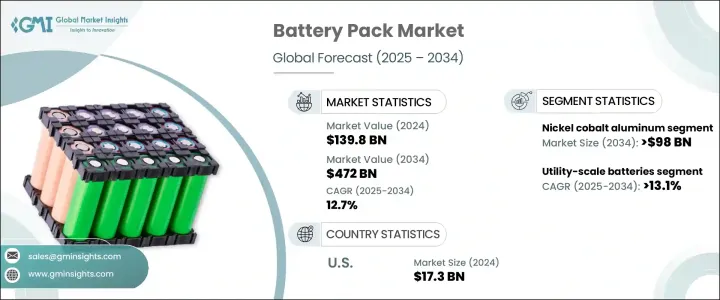
세계의 배터리 팩 시장 규모는 2024년에 1,398억 달러가 되었으며, 2025년부터 2034년에 걸쳐 CAGR 12.7%를 나타낼 것으로 예측됩니다.
이 시장의 확대는 주로 지속가능한 운송수단으로의 세계이행이 원동력이 되고 있어 세계 각국의 정부가 보조금, 세제우대조치, 엄격한 배출규제를 통해 탄소중립을 추진하고 있기 때문입니다. 전기자동차(EV) 수요가 급증하고 있기 때문에 첨단 배터리 팩 기술이 자동차 분야의 중요한 요소가 되고 있습니다. 제조업체 각사는 고성능 솔루션에 대한 요구의 고조에 대응하기 위해 에너지 저장 능력, 효율, 전지 수명 전체의 개선에 다액의 투자를 실시했습니다.

기술의 진보가 업계의 형태를 계속 변화시키는 동안, 배터리 화학의 혁신은 상당한 비용 절감과 성능 향상을 가져옵니다. 에너지 밀도 향상, 충전 시간 단축, 사이클 수명 연장은 시장 성장을 견인하는 획기적인 기술 중 하나입니다. 각 회사는 재질과 설계 구조를 개선하여 리튬 이온 배터리 팩을 최적화하고 저렴한 가격으로 지속 가능하게 만드는 데 주력하고 있습니다. 솔리드 스테이트 배터리 및 인산철 리튬(LFP) 배터리 기술로의 전환은 특히 안전 기능 강화 및 작동 수명 연장으로 시장 확대를 더욱 뒷받침하고 있습니다. 자동차 및 배터리 제조업체의 전략적 제휴와 대규모 제조 설비는 규모의 경제, 제조 비용 절감, 세계 보급 가속화에 기여하고 있습니다.
| 시장 범위 | |
|---|---|
| 시작 연도 | 2024년 |
| 예측 연도 | 2025-2034년 |
| 시작 금액 | 1,398억 달러 |
| 예측 금액 | 4,720억 달러 |
| CAGR | 12.7% |
시장은 배터리의 화학적 성질에 따라 니켈 코발트 알루미늄, 인산철 리튬, 니켈 망간 코발트, 산화망간 리튬, 기타 등 여러 카테고리로 구분됩니다. 이 중 니켈 코발트 알루미늄은 우수한 에너지 밀도, 경량성, 확장된 운영 효율성으로 인해 2034년까지 미화 980억 달러의 매출을 창출할 것으로 예상됩니다. 이러한 특성에 의해 특히 EV 분야에서는 장수명의 파워 솔루션을 필요로 하는 용도에 선호되는 선택지가 되고 있습니다.
전기자동차는 계속 배터리 팩 시장을 독점하고 있으며, 2024년 시장 점유율은 89%에 달했습니다. 전지 기술, 특히 고체 전지 및 LFP 화학에 대한 지속적인 투자는 탁월한 열 안정성과 수명 연장으로 인해 채택을 가속화할 것으로 예상됩니다.
2024년 미국의 배터리 팩 시장 규모는 173억 달러였으며 미국 전역에서 EV의 보급이 진행됨에 따라 대폭적인 성장이 예상되고 있습니다. 진화하는 소비자의 기대에 부응하기 위해 EV의 생산과 배터리 팩의 기술 혁신에 대한 투자를 강화하고 있습니다.
목차
제1장 조사 방법과 조사 범위
- 시장의 정의
- 기본 추정과 계산
- 예측 계산
- 1차 조사와 검증
- 시장 정의
제2장 주요 요약
제3장 업계 인사이트
- 업계 에코시스템
- 규제 상황
- 업계에 미치는 영향요인
- 성장 촉진요인
- 업계의 잠재적 위험 및 과제
- 성장 가능성 분석
- Porter's Five Forces 분석
- 공급기업의 협상력
- 구매자의 협상력
- 신규 진입업자의 위협
- 대체품의 위협
- PESTEL 분석
제4장 경쟁 구도
- 서론
- 전략 대시보드
- 혁신과 지속가능성의 전망
제5장 시장 규모와 예측 : 용도별(2021-2034년)
- 주요 동향
- 전기자동차
- 유틸리티 규모 배터리
- 비하인드 더 미터 배터리
제6장 시장 규모와 예측 : 배터리 화학별(2021-2034년)
- 주요 동향
- 인산철 리튬
- 니켈 코발트 알루미늄
- 니켈 망간 코발트
- 산화 리튬
- 기타
제7장 시장 규모와 예측 : 지역별(2021-2034년)
- 주요 동향
- 북미
- 미국
- 캐나다
- 유럽
- 독일
- 프랑스
- 스페인
- 영국
- 이탈리아
- 아시아태평양
- 중국
- 인도
- 일본
- 호주
- 중동 및 아프리카
- 사우디아라비아
- 남아프리카
- 라틴아메리카
- 브라질
- 아르헨티나
제8장 기업 프로파일
- AGreatE
- Blue Line Battery
- FRIWO
- Omnitron Bulgaria OOD
- Panasonic
- PMBL Limited
- Rivian
- Rapport
- Samsung
- SK Innovation
- VARTA
The Global Battery Pack Market was valued at USD 139.8 billion in 2024 and is projected to grow at a CAGR of 12.7% between 2025 and 2034. The market's expansion is primarily driven by the global transition toward sustainable transportation, as governments worldwide continue to push for carbon neutrality through subsidies, tax incentives, and strict emissions regulations. The demand for electric vehicles (EVs) is surging, making advanced battery pack technology a key factor in the automotive sector. Manufacturers are investing heavily in improving energy storage capabilities, efficiency, and overall battery lifespan to cater to the growing need for high-performance solutions.
As technological advancements continue to reshape the industry, battery chemistry innovations are leading to significant cost reductions and performance improvements. Enhanced energy densities, faster charging times, and longer cycle lives are among the breakthroughs driving market growth. Companies are focusing on optimizing lithium-ion battery packs by refining materials and design structures, making them more affordable and sustainable. The shift toward solid-state and lithium iron phosphate (LFP) battery technologies is further bolstering market expansion, particularly due to their enhanced safety features and extended operational lifespans. Strategic collaborations between automakers and battery manufacturers, along with large-scale manufacturing facilities, are contributing to economies of scale, reducing production costs, and accelerating global adoption.
| Market Scope | |
|---|---|
| Start Year | 2024 |
| Forecast Year | 2025-2034 |
| Start Value | $139.8 Billion |
| Forecast Value | $472 Billion |
| CAGR | 12.7% |
The market is segmented by battery chemistry into multiple categories, including nickel cobalt aluminum, lithium iron phosphate, nickel manganese cobalt, lithium manganese oxide, and others. Among these, nickel cobalt aluminum is expected to generate USD 98 billion by 2034, driven by its superior energy density, lightweight nature, and extended operational efficiency. These characteristics make it a preferred choice for applications that require long-lasting power solutions, particularly in the EV sector. The chemistry's longer cycle life and cost-effectiveness further contribute to its widespread demand, solidifying its position as a leading battery type in the market.
Electric vehicles continue to dominate the battery pack market, holding an 89% market share in 2024. Large-scale manufacturing of lithium-ion battery packs, coupled with advancements in energy density, charging speeds, and durability, has significantly enhanced EV performance, making them more attractive to consumers. Continuous investments in battery technology, particularly in solid-state batteries and LFP chemistry, are expected to accelerate adoption thanks to their superior thermal stability and extended lifespans. The push for sustainability and stringent environmental regulations are compelling automakers to integrate next-generation battery packs, further fueling industry expansion.
The U.S. Battery Pack Market was valued at USD 17.3 billion in 2024 and is set for substantial growth as EV adoption rises across the country. Government incentives, coupled with rapid technological advancements, are propelling demand for high-performance battery solutions. Major automakers are ramping up investments in EV production and battery pack innovations to meet evolving consumer expectations. With the market evolving at a rapid pace, the need for cutting-edge battery technologies is only expected to grow, strengthening the industry's foothold in the global energy transition.
Table of Contents
Chapter 1 Methodology & Scope
- 1.1 Market definitions
- 1.2 Base estimates & calculations
- 1.3 Forecast calculation
- 1.4 Primary research & validation
- 1.4.1 Primary sources
- 1.4.2 Data mining sources
- 1.5 Market definitions
Chapter 2 Executive Summary
- 2.1 Industry synopsis, 2021 – 2034
Chapter 3 Industry Insights
- 3.1 Industry ecosystem
- 3.2 Regulatory landscape
- 3.3 Industry impact forces
- 3.3.1 Growth drivers
- 3.3.2 Industry pitfalls & challenges
- 3.4 Growth potential analysis
- 3.5 Porter's analysis
- 3.5.1 Bargaining power of suppliers
- 3.5.2 Bargaining power of buyers
- 3.5.3 Threat of new entrants
- 3.5.4 Threat of substitutes
- 3.6 PESTEL analysis
Chapter 4 Competitive landscape, 2024
- 4.1 Introduction
- 4.2 Strategic dashboard
- 4.3 Innovation & sustainability landscape
Chapter 5 Market Size and Forecast, By Application, 2021 – 2034 (USD Billion)
- 5.1 Key trends
- 5.2 Electric vehicles
- 5.3 Utility-Scale batteries
- 5.4 Behind-the-Meter batteries
Chapter 6 Market Size and Forecast, By Battery Chemistry, 2021 – 2034 (USD Billion)
- 6.1 Key trends
- 6.2 Lithium iron phosphate
- 6.3 Nickel cobalt aluminum
- 6.4 Nickel manganese cobalt
- 6.5 Lithium manganese oxide
- 6.6 Others
Chapter 7 Market Size and Forecast, By Region, 2021 – 2034 (USD Billion)
- 7.1 Key trends
- 7.2 North America
- 7.2.1 U.S.
- 7.2.2 Canada
- 7.3 Europe
- 7.3.1 Germany
- 7.3.2 France
- 7.3.3 Spain
- 7.3.4 UK
- 7.3.5 Italy
- 7.4 Asia Pacific
- 7.4.1 China
- 7.4.2 India
- 7.4.3 Japan
- 7.4.4 Australia
- 7.5 Middle East & Africa
- 7.5.1 Saudi Arabia
- 7.5.2 South Africa
- 7.6 Latin America
- 7.6.1 Brazil
- 7.6.2 Argentina
Chapter 8 Company Profiles
- 8.1 AGreatE
- 8.2 Blue Line Battery
- 8.3 FRIWO
- 8.4 Omnitron Bulgaria OOD
- 8.5 Panasonic
- 8.6 PMBL Limited
- 8.7 Rivian
- 8.8 Rapport
- 8.9 Samsung
- 8.10 SK Innovation
- 8.11 VARTA