

|
시장보고서
상품코드
1699359
대리모 출산 시장 기회, 성장 촉진요인, 산업 동향 분석, 예측(2025-2034년)Surrogacy Market Opportunity, Growth Drivers, Industry Trend Analysis, and Forecast 2025-2034 |
||||||

세계의 대리모 출산 시장은 2024년 224억 달러로 평가되었으며 2025년부터 2034년까지 연평균 복합 성장률(CAGR) 24.6%를 나타낼 것으로 예상됩니다.
이 업계는 대리모 출산을 통해 어린이와 부부를 지원하는 다양한 기술과 서비스를 포함하고 있습니다. 걸음, 불임 치료에 대한 액세스 향상 등을 배경으로 늘어나고 있습니다. 또한, 대리모 출산을 지지하는 사회 규범이나 법적 틀의 변화가 시장 확대에 기여하고 있습니다.
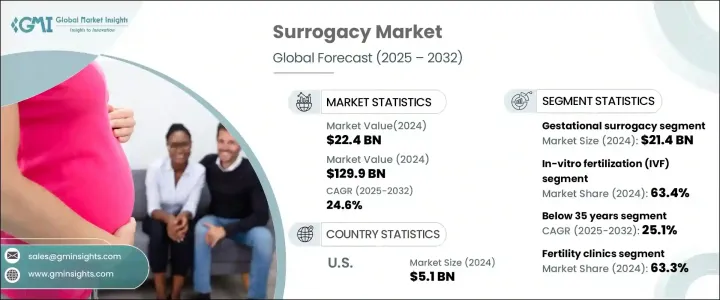
시장은 임신 대리 출산과 전통적인 대리 출산으로 구분되며, 2024년에는 임신 대리 출산이 214억 달러로 선두에 서 있었습니다. 이 부문은 여러 국가의 규제 승인과 구조화된 프레임워크로 인해 24.9%의 연평균 성장률로 성장할 것으로 예상됩니다. 기존의 방법보다 임신 대리모 출산이 법적으로 인정되고 있기 때문에 임신을 희망하는 부모에게 있어서 보다 현실적인 선택지가 되고 있습니다.
| 시장 범위 | |
|---|---|
| 시작 연도 | 2024년 |
| 예측 연도 | 2025-2034년 |
| 시작 금액 | 224억 달러 |
| 예측 금액 | 1,299억 달러 |
| CAGR | 24.6% |
기술별로 보면 시장은 자궁내 수정(IUI)과 체외수정(IVF)으로 분류되며, IVF는 더욱 고전적인 IVF와 현미수정(ICSI)으로 나뉩니다. 체외수정(IVF) 부문은 2024년 63.4% 시장 점유율을 차지했으며 24.7%의 연평균 복합 성장률(CAGR)을 나타낼 것으로 예측되고 있습니다.
시장은 연령층별로 구분되어 있으며, 35세 미만, 35-37세, 38-39세, 40-42세, 43-44세, 44세 이상의 카테고리가 있습니다. 급속도로 확대되고 있으며, CAGR은 25.1%을 나타낼 것으로 예측되고 있습니다.
최종 용도별로는 시장은 병원, 불임 치료 클리닉, 기타로 나뉘어져 2024년 시장 점유율은 불임 치료 클리닉이 63.3%로 압도적이었습니다. 이러한 클리닉은 대리모 출산의 종합 센터로서, 고급 불임 치료와 함께 의료, 법률, 심리적 서포트를 제공합니다.
지역별로는 미국이 2024년의 북미 대리모 출산 시장을 리드해, 51억 달러의 수익을 기록했습니다. 개인이나 커플의 불임율 증가가 시장 수요를 견인하고 있습니다.
목차
제1장 조사 방법과 조사 범위
제2장 주요 요약
제3장 업계 인사이트
- 생태계 분석
- 업계에 미치는 영향요인
- 성장 촉진요인
- 불임 환자 수 증가
- 시장에서 이용 가능한 불임 치료의 선택에 관한 의식 증가
- 호르몬의 변화로 이어지는 앉기 쉬운 라이프 스타일이나 건강에 해로운 식습관 증가
- 불임 치료 클리닉 증가
- 업계의 잠재적 위험 및 과제
- 상업적 대리모 출산에 관한 엄격한 규제
- 대리모 출산에 드는 높은 비용
- 성장 촉진요인
- 성장 가능성 분석
- 규제 상황
- 기술적 전망
- Porter's Five Forces 분석
- PESTEL 분석
제4장 경쟁 구도
- 서론
- 기업 매트릭스 분석
- 주요 시장 기업의 경쟁 분석
- 경쟁 포지셔닝 매트릭스
- 전략 대시보드
제5장 시장 추계·예측 : 유형별(2021-2032년)
- 주요 동향
- 임신 대리모
- 전통 대리모
제6장 시장 추계·예측 : 기술별(2021-2032년)
- 주요 동향
- 자궁 내 수정(IUI)
- 체외수정(IVF)
- 고전적/표준 IVF
- 세포질 내 정자 주입(ICSI)
- 기타 기술
제7장 시장 추계·예측 : 연령층별(2021-2032년)
- 주요 동향
- 35세 미만
- 35-37세
- 38-39세
- 40-42세
- 43-44세
- 44세 이상
제8장 시장 추계·예측 : 서비스 제공업체별(2021-2032년)
- 주요 동향
- 병원
- 불임 클리닉
- 기타 서비스 제공업체
제9장 시장 추계·예측 : 지역별(2021-2032년)
- 주요 동향
- 북미
- 미국
- 캐나다
- 유럽
- 체코 공화국
- 에스토니아
- 조지아
- 그리스
- 폴란드
- 스웨덴
- 영국
- 아시아태평양
- 인도
- 태국
- 한국
- 호주
- 아프리카
- 케냐
- 나이지리아
- 남아프리카
제10장 기업 프로파일
- IVIRMA
- Bangkok IVF Center
- Boston IVF
- Bourn Hall International(TVM Capital Healthcare)
- Circle Surrogacy
- Extraordinary Conceptions
- Growing Generations
- Houston Fertility Center
- Kindbody
- Max Healthcare
- MLSPL(Morpheus IVF Clinic)
- New Hope Fertility Clinic
- NOVA IVF
- Ovation Fertility
- Scanfert Clinic
The Global Surrogacy Market was valued at USD 22.4 billion in 2024 and is expected to expand at a CAGR of 24.6% from 2025 to 2034. This industry encompasses a range of technologies and services that assist individuals and couples in having children through surrogacy. Key players include fertility clinics, hospitals, and medical professionals specializing in assisted reproductive technology (ART). The demand for surrogacy continues to grow, driven by rising awareness, technological advancements in ART, and increased accessibility to fertility treatments. Additionally, changing societal norms and legal frameworks supporting surrogacy contribute to market expansion. With the growing prevalence of infertility and delayed parenthood, the need for reliable reproductive solutions is at an all-time high.
The market is segmented into gestational and traditional surrogacy, with gestational surrogacy leading at USD 21.4 billion in 2024. This segment is set to grow at a CAGR of 24.9% due to regulatory approvals and structured frameworks in various countries. The legal recognition of gestational surrogacy over traditional methods makes it a more viable choice for intended parents.
| Market Scope | |
|---|---|
| Start Year | 2024 |
| Forecast Year | 2025-2034 |
| Start Value | $22.4 Billion |
| Forecast Value | $129.9 Billion |
| CAGR | 24.6% |
By technology, the market is categorized into intrauterine insemination (IUI) and in-vitro fertilization (IVF), with IVF further divided into classical IVF and intracytoplasmic sperm injection (ICSI). The IVF segment held a 63.4% market share in 2024 and is projected to grow at a 24.7% CAGR. The rising infertility rate, coupled with evolving reproductive options, fuels demand for IVF-based surrogacy.
The market is also segmented by age group, with categories including below 35 years, 35-37 years, 38-39 years, 40-42 years, 43-44 years, and over 44 years. The below-35 segment is expanding rapidly, with a projected 25.1% CAGR. This growth is attributed to higher success rates in IVF procedures for younger women, making them the preferred choice for surrogacy programs.
By end use, the market is divided into hospitals, fertility clinics, and others, with fertility clinics dominating at 63.3% market share in 2024. These clinics serve as comprehensive centers for surrogacy, offering medical, legal, and psychological support, along with advanced fertility treatments. Their role in streamlining the surrogacy process further strengthens their position in the market.
Regionally, the U.S. led the North American surrogacy market in 2024, generating USD 5.1 billion in revenue. The increasing infertility rate among individuals and couples drives market demand. Rising acceptance of ART, coupled with strong regulatory support, is expected to fuel continued growth in the surrogacy industry.
Table of Contents
Chapter 1 Methodology and Scope
- 1.1 Market scope and definitions
- 1.2 Research design
- 1.2.1 Research approach
- 1.2.2 Data collection methods
- 1.3 Base estimates and calculations
- 1.3.1 Base year calculation
- 1.3.2 Key trends for market estimation
- 1.4 Forecast model
- 1.5 Primary research and validation
- 1.5.1 Primary sources
- 1.5.2 Data mining sources
Chapter 2 Executive Summary
- 2.1 Industry 3600 synopsis
Chapter 3 Industry Insights
- 3.1 Industry ecosystem analysis
- 3.2 Industry impact forces
- 3.2.1 Growth drivers
- 3.2.1.1 Increasing number of infertility cases
- 3.2.1.2 Rising awareness about the infertility treatment options available in the market
- 3.2.1.3 Increasing adoption of sedentary lifestyle and unhealthy eating habits leading to hormonal change
- 3.2.1.4 Increasing number of fertility clinics
- 3.2.2 Industry pitfalls and challenges
- 3.2.2.1 Stringent regulations pertaining commercial surrogacy
- 3.2.2.2 High cost involved in surrogacy procedure
- 3.2.1 Growth drivers
- 3.3 Growth potential analysis
- 3.4 Regulatory landscape
- 3.5 Technological landscape
- 3.6 Porter's analysis
- 3.7 PESTEL analysis
Chapter 4 Competitive Landscape, 2024
- 4.1 Introduction
- 4.2 Company matrix analysis
- 4.3 Competitive analysis of major market players
- 4.4 Competitive positioning matrix
- 4.5 Strategy dashboard
Chapter 5 Market Estimates and Forecast, By Type, 2021 – 2032 ($ Mn)
- 5.1 Key trends
- 5.2 Gestational surrogacy
- 5.3 Traditional surrogacy
Chapter 6 Market Estimates and Forecast, By Technology, 2021 – 2032 ($ Mn)
- 6.1 Key trends
- 6.2 Intrauterine insemination (IUI)
- 6.3 In-vitro fertilization (IVF)
- 6.3.1 Classical/standard IVF
- 6.3.2 Intracytoplasmic sperm injection (ICSI)
- 6.4 Other technologies
Chapter 7 Market Estimates and Forecast, By Age Group, 2021 – 2032 ($ Mn)
- 7.1 Key trends
- 7.2 Below 35 years
- 7.3 35-37 years
- 7.4 38 - 39 years
- 7.5 40-42 years
- 7.6 43-44 years
- 7.7 Over 44 years
Chapter 8 Market Estimates and Forecast, By Service Provider, 2021 – 2032 ($ Mn)
- 8.1 Key trends
- 8.2 Hospitals
- 8.3 Fertility clinics
- 8.4 Other service providers
Chapter 9 Market Estimates and Forecast, By Region, 2021 – 2032 ($ Mn)
- 9.1 Key trends
- 9.2 North America
- 9.2.1 U.S.
- 9.2.2 Canada
- 9.3 Europe
- 9.3.1 Czech Republic
- 9.3.2 Estonia
- 9.3.3 Georgia
- 9.3.4 Greece
- 9.3.5 Poland
- 9.3.6 Sweden
- 9.3.7 UK
- 9.4 Asia Pacific
- 9.4.1 India
- 9.4.2 Thailand
- 9.4.3 South Korea
- 9.4.4 Australia
- 9.5 Africa
- 9.5.1 Kenya
- 9.5.2 Nigeria
- 9.5.3 South Africa
Chapter 10 Company Profiles
- 10.1 IVIRMA
- 10.2 Bangkok IVF Center
- 10.3 Boston IVF
- 10.4 Bourn Hall International (TVM Capital Healthcare)
- 10.5 Circle Surrogacy
- 10.6 Extraordinary Conceptions
- 10.7 Growing Generations
- 10.8 Houston Fertility Center
- 10.9 Kindbody
- 10.10 Max Healthcare
- 10.11 MLSPL (Morpheus IVF Clinic)
- 10.12 New Hope Fertility Clinic
- 10.13 NOVA IVF
- 10.14 Ovation Fertility
- 10.15 Scanfert Clinic


