|
시장보고서
상품코드
1708212
단위 용량 포장 시장 기회, 성장 촉진요인, 산업 동향 분석, 예측(2025-2034년)Unit Dose Packaging Market Opportunity, Growth Drivers, Industry Trend Analysis, and Forecast 2025 - 2034 |
||||||

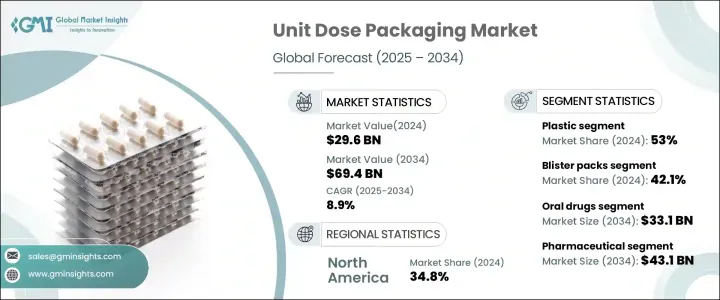
세계의 단위 용량 포장 시장은 2024년에 296억 달러로 평가되며, 2025-2034년에 CAGR 8.9%로 성장할 것으로 예측됩니다.
이러한 강력한 성장의 배경에는 의약품, 건강기능식품, 영양보충제 등 업계 전반에 걸쳐 정확하고 편리한 투약 솔루션에 대한 수요가 증가하고 있기 때문입니다. 단위 용량 포장은 환자의 복약 순응도를 높이고, 투약 오류를 줄이며, 안전성을 향상시킬 수 있는 능력으로 인해 많은 사랑을 받고 있습니다. 전 세계 의료 시스템이 정확한 투약의 중요성을 강조하는 가운데, 제약사들은 안전하고 효과적인 약물전달을 보장하기 위해 블리스터 팩, 프리필드 시린지, 앰플, 바이알과 같은 단위 용량 포맷을 점점 더 많이 채택하고 있습니다. 또한 맞춤형 영양 및 예방 헬스케어의 인기가 높아지면서 기능성 식품 및 프로바이오틱스 보충제에서 단위 용량 포장의 사용이 확대되고 있으며, 이는 시장에 새로운 성장 기회를 창출하고 있습니다.
시장의 성장 궤적은 특히 의약품 분야에서 보다 안전하고 변조 방지 포장의 사용을 촉진하는 규제 정책의 영향을 받고 있습니다. 투약 오류를 최소화하고 환자 안전을 강화하는 것이 중요해지면서 단위 용량 포장이 선호되고 있습니다. 또한 특히 COVID-19 이후 편의성을 중시하는 포장 솔루션에 대한 수요가 급증하면서 시장을 더욱 촉진하고 있습니다. 소비자들은 현재 이동이 잦은 라이프스타일에 맞추어 일회용, 위생적이고 휴대가 가능한 포장 형태를 선호하고 있습니다. 이러한 추세는 식품 및 음료 업계에도 적용되어 1회분씩 소분된 소포장과 파우치가 사용 편의성과 정확한 용량 관리로 인해 인기를 끌고 있습니다. 그 결과, 제조업체들은 엄격한 규제 요건을 충족하고 소비자의 기호 변화에 대응하기 위해 첨단 포장 기술과 지속가능한 소재에 많은 투자를 하고 있습니다.
| 시장 범위 | |
|---|---|
| 시작연도 | 2024년 |
| 예측연도 | 2025-2034년 |
| 시작 금액 | 296억 달러 |
| 예상 금액 | 694억 달러 |
| CAGR | 8.9% |
플라스틱, 알루미늄, 종이/판지, 유리가 주요 카테고리로 분류되며, 2024년에는 플라스틱 부문이 시장 점유율의 53%를 차지할 것으로 예상되며, 플라스틱 부문의 강점, 다목적성, 효과적인 장벽 보호 능력이 그 원동력이 될 것으로 보입니다. 플라스틱 포장은 안전성을 보장하고 제품의 유통기한을 연장하므로 의약품 및 식품 포장에 선호되고 있습니다. 그러나 환경 지속가능성에 대한 관심이 높아지면서 제조업체들은 재활용 가능한 플라스틱, 생분해성 플라스틱 등 친환경적인 대체품을 개발하기 위해 노력하고 있습니다. 이러한 기술 혁신은 포장의 기능성을 유지하면서 환경 친화적인 솔루션을 제공함으로써 플라스틱 부문의 지속적인 시장 우위를 점할 수 있도록 돕고 있습니다.
포장 유형별로 시장은 블리스터 팩, 향 주머니 및 파우치, 앰플 및 바이알, 프리필드 시린지, 기타로 나뉩니다. 블리스터 팩은 2024년 42.1%의 점유율을 차지했는데, 이는 의약품 및 건강 보조 식품 용도에서 널리 사용되고 있음을 반영합니다. 각 제조업체들은 블리스터 팩에 분리 가능한 뚜껑, 쉽게 열 수 있는 디자인, 개선된 차단성 등을 통해 제품의 안전성을 보장하고 사용자 친화적인 사용 편의성을 제공합니다. 이러한 기술 혁신은 기능성과 지속가능성의 균형을 갖춘 포장 솔루션에 대한 수요 증가와 맞물려 시장에서 블리스터 팩의 인기를 견인하고 있습니다.
북미 단위 용량 포장 시장은 2024년 세계 시장 점유율의 34.8%를 차지하며, 첨단 포장 솔루션에 대한 높은 수요에 힘입어 성장세를 이어갈 것으로 전망됩니다. 이 지역에서는 환자의 안전과 복약 순응도 강화에 대한 관심이 높아지면서 프리필드 주사기, 1회용 바이알, 스틱 팩과 같은 단위 용량 포맷의 채택이 급증하고 있습니다. 당뇨병, 심혈관 질환, 호흡기 질환과 같은 만성질환 증가로 인해 제약사들은 투약 오류를 최소화하고 치료 결과를 개선하기 위해 포장 기술에 대한 투자를 더욱 확대하고 있습니다. 그 결과, 북미는 단위 용량 포장 기술 혁신에 있으며, 중요한 시장으로 남아 있으며, 연구개발에 대한 지속적인 투자로 업계의 미래를 형성할 것으로 예측됩니다.
목차
제1장 조사 방법과 조사 범위
제2장 개요
제3장 업계 인사이트
- 에코시스템 분석
- 업계에 대한 영향요인
- 촉진요인
- 정밀 투여 솔루션에 대한 수요 증가
- 제약 업계의 성장
- OTC(over-the-counter)의 성장
- 뉴트라슈티컬과 보충제에서 단위 용량 포장의 사용 증가
- POC(Point of Care) 검사·진단 키트의 확대
- 업계의 잠재적 리스크 & 과제
- 첨단 포장 기계에 대한 고액의 초기 투자
- 일회용 플라스틱 폐기물에 관한 환경 문제
- 촉진요인
- 성장 가능성 분석
- 규제 상황
- 기술 상황
- 향후 시장 동향
- 갭 분석
- Porter의 산업 분석
- PESTEL 분석
제4장 경쟁 구도
- 서론
- 기업 점유율 분석
- 주요 시장 기업의 경쟁 분석
- 경쟁 포지셔닝 매트릭스
- 전략 대시보드
제5장 시장 추산·예측 : 재료 유형별, 2021-2034년
- 주요 동향
- 플라스틱
- 알루미늄
- 종이·판지
- 유리
제6장 시장 추산·예측 : 포장 유형별, 2021-2034년
- 주요 동향
- 블리스터 팩
- 사쉐·파우치
- 앰플 & 바이알
- 프리필드 시린지
- 기타
제7장 시장 추산·예측 : 용도별, 2021-2034년
- 주요 동향
- 경구약
- 주사제
- 국소·경피
- 기타
제8장 시장 추산·예측 : 최종 용도별, 2021-2034년
- 주요 동향
- 의약품
- 화장품·퍼스널케어
- 뉴트라슈티컬
- 기타
제9장 시장 추산·예측 : 지역별, 2021-2034년
- 주요 동향
- 북미
- 미국
- 캐나다
- 유럽
- 독일
- 영국
- 프랑스
- 스페인
- 이탈리아
- 네덜란드
- 아시아태평양
- 중국
- 인도
- 일본
- 호주
- 한국
- 라틴아메리카
- 브라질
- 멕시코
- 아르헨티나
- 중동 및 아프리카
- 사우디아라비아
- 남아프리카공화국
- 아랍에미리트
제10장 기업 개요
- Adelphi Healthcare Packaging
- Amcor
- AptarGroup
- Berry Global
- Borosil
- Catalent
- Constantia Flexibles
- Corning
- DWK Life Sciences
- Gerresheimer
- Glenroy
- Lameplast
- Nipro
- Schott
- SGD Pharma
- Shiotani Glass
- Stevanato Group
- Unit Pack Company
- Valmatic
- West Pharmaceutical Services
The Global Unit Dose Packaging Market was valued at USD 29.6 billion in 2024 and is projected to grow at a CAGR of 8.9% between 2025 and 2034. This robust growth is fueled by the rising demand for precise and convenient dosing solutions across industries, particularly pharmaceuticals, nutraceuticals, and dietary supplements. Unit dose packaging has gained traction due to its ability to enhance patient compliance, reduce medication errors, and improve safety. As healthcare systems worldwide emphasize the importance of accurate dosing, pharmaceutical companies are increasingly adopting unit dose formats such as blister packs, pre-filled syringes, ampoules, and vials to ensure safe and effective medication delivery. Furthermore, the growing popularity of personalized nutrition and preventive healthcare has expanded the use of unit dose packaging in functional foods and probiotic supplements, creating new growth opportunities in the market.
The market's growth trajectory is also influenced by regulatory policies that promote the use of safer and tamper-evident packaging, particularly in the pharmaceutical sector. With an increasing focus on minimizing medication errors and enhancing patient safety, unit dose packaging formats are becoming a preferred choice. Additionally, the surge in demand for convenience-driven packaging solutions, especially in the post-COVID-19 era, has further propelled the market. Consumers now seek single-use, hygienic, and portable packaging formats that align with their on-the-go lifestyles. The trend has also extended to the food and beverage industry, where single-dose sachets and pouches are gaining momentum due to their ease of use and precise portion control. As a result, manufacturers are investing heavily in advanced packaging technologies and sustainable materials to cater to evolving consumer preferences while complying with stringent regulatory requirements.
| Market Scope | |
|---|---|
| Start Year | 2024 |
| Forecast Year | 2025-2034 |
| Start Value | $29.6 Billion |
| Forecast Value | $69.4 Billion |
| CAGR | 8.9% |
The market is segmented by material type, with plastic, aluminum, paper & paperboard, and glass being the primary categories. In 2024, the plastic segment accounted for 53% of the market share, driven by its strength, versatility, and ability to provide effective barrier protection. Plastic packaging extends product shelf life while ensuring safety, making it a preferred choice in pharmaceuticals and food packaging. However, the increasing emphasis on environmental sustainability has prompted manufacturers to develop eco-friendly alternatives, such as recyclable and biodegradable plastics. These innovations provide environmentally conscious solutions without compromising packaging functionality, positioning the plastic segment for continued dominance in the market.
In terms of packaging types, the market is divided into blister packs, sachets & pouches, ampoules & vials, pre-filled syringes, and others. Blister packs held a 42.1% share in 2024, reflecting their widespread use in pharmaceutical and nutraceutical applications. Manufacturers are enhancing blister packs with peelable lids, easy-open designs, and improved barrier properties to ensure product safety while delivering a user-friendly experience. These innovations align with the growing demand for packaging solutions that balance functionality and sustainability, driving the popularity of blister packs in the market.
North America unit dose packaging market accounted for 34.8% of the global share in 2024, propelled by a high demand for advanced packaging solutions. The region's focus on improving patient safety and medication adherence has led to a surge in the adoption of unit dose formats such as pre-filled syringes, single-dose vials, and stick packs. The increasing prevalence of chronic conditions, including diabetes, cardiovascular diseases, and respiratory issues, has further driven pharmaceutical companies to invest in packaging technologies that minimize medication errors and improve treatment outcomes. As a result, North America remains a critical market for unit dose packaging innovations, with continued investments in research and development expected to shape the future of the industry.
Table of Contents
Chapter 1 Methodology and Scope
- 1.1 Market scope and definitions
- 1.2 Research design
- 1.2.1 Research approach
- 1.2.2 Data collection methods
- 1.3 Base estimates and calculations
- 1.3.1 Base year calculation
- 1.3.2 Key trends for market estimation
- 1.4 Forecast model
- 1.5 Primary research and validation
- 1.5.1 Primary sources
- 1.5.2 Data mining sources
Chapter 2 Executive Summary
- 2.1 Industry 3600 synopsis
Chapter 3 Industry Insights
- 3.1 Industry ecosystem analysis
- 3.2 Industry impact forces
- 3.2.1 Growth drivers
- 3.2.1.1 Rising demand for precision dosing solutions
- 3.2.1.2 Growth in the pharmaceutical industry
- 3.2.1.3 Growth in over-the-counter (OTC) medicines
- 3.2.1.4 Increasing use of unit dose packaging in nutraceuticals and supplements
- 3.2.1.5 Expansion of point-of-care testing and diagnostic kits
- 3.2.2 Industry pitfalls and challenges
- 3.2.2.1 High initial investment in advanced packaging machinery
- 3.2.2.2 Environmental concerns regarding single-use plastic waste
- 3.2.1 Growth drivers
- 3.3 Growth potential analysis
- 3.4 Regulatory landscape
- 3.5 Technology landscape
- 3.6 Future market trends
- 3.7 Gap analysis
- 3.8 Porter's analysis
- 3.9 PESTEL analysis
Chapter 4 Competitive Landscape, 2024
- 4.1 Introduction
- 4.2 Company market share analysis
- 4.3 Competitive analysis of major market players
- 4.4 Competitive positioning matrix
- 4.5 Strategy dashboard
Chapter 5 Market Estimates & Forecast, By Material Type, 2021-2034 (USD Billion & Kilo Tons)
- 5.1 Key trends
- 5.2 Plastic
- 5.3 Aluminum
- 5.4 Paper & paperboard
- 5.5 Glass
Chapter 6 Market Estimates & Forecast, By Packaging Type, 2021-2034 (USD Billion & Kilo Tons)
- 6.1 Key trends
- 6.2 Blister packs
- 6.3 Sachets & pouches
- 6.4 Ampoules & vials
- 6.5 Pre-filled syringes
- 6.6 Others
Chapter 7 Market Estimates & Forecast, By Application, 2021-2034 (USD Billion & Kilo Tons)
- 7.1 Key trends
- 7.2 Oral drugs
- 7.3 Injectables
- 7.4 Topical & transdermal
- 7.5 Others
Chapter 8 Market Estimates & Forecast, By End Use, 2021-2034 (USD Billion & Kilo Tons)
- 8.1 Key trends
- 8.2 Pharmaceutical
- 8.3 Cosmetics & personal care
- 8.4 Nutraceuticals
- 8.5 Others
Chapter 9 Market Estimates and Forecast, By Region, 2021-2034 (USD Billion & Kilo Tons)
- 9.1 Key trends
- 9.2 North America
- 9.2.1 U.S.
- 9.2.2 Canada
- 9.3 Europe
- 9.3.1 Germany
- 9.3.2 UK
- 9.3.3 France
- 9.3.4 Spain
- 9.3.5 Italy
- 9.3.6 Netherlands
- 9.4 Asia Pacific
- 9.4.1 China
- 9.4.2 India
- 9.4.3 Japan
- 9.4.4 Australia
- 9.4.5 South Korea
- 9.5 Latin America
- 9.5.1 Brazil
- 9.5.2 Mexico
- 9.5.3 Argentina
- 9.6 Middle East and Africa
- 9.6.1 Saudi Arabia
- 9.6.2 South Africa
- 9.6.3 UAE
Chapter 10 Company Profiles
- 10.1 Adelphi Healthcare Packaging
- 10.2 Amcor
- 10.3 AptarGroup
- 10.4 Berry Global
- 10.5 Borosil
- 10.6 Catalent
- 10.7 Constantia Flexibles
- 10.8 Corning
- 10.9 DWK Life Sciences
- 10.10 Gerresheimer
- 10.11 Glenroy
- 10.12 Lameplast
- 10.13 Nipro
- 10.14 Schott
- 10.15 SGD Pharma
- 10.16 Shiotani Glass
- 10.17 Stevanato Group
- 10.18 Unit Pack Company
- 10.19 Valmatic
- 10.20 West Pharmaceutical Services