|
시장보고서
상품코드
1716480
산업용 로봇 시장 기회, 성장 촉진 요인, 산업 동향 분석, 예측(2025-2034년)Industrial Robotics Market Opportunity, Growth Drivers, Industry Trend Analysis, and Forecast 2025 - 2034 |
||||||

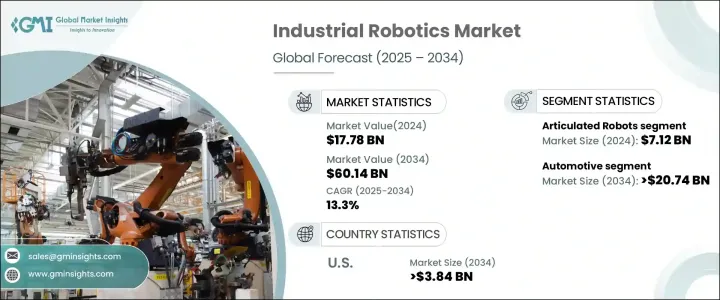
세계 산업용 로봇 시장은 2024년에 177억 8,000만 달러에 이르렀고, 2025년부터 2034년까지 연평균 복합 성장률(CAGR) 13.3%로 성장할 것으로 예상됩니다.
이 급성장의 배경에는 기업이 생산성 향상을 도모하고 노동력 부족과 인건비 상승 등의 과제에 대처하기 위해 다양한 분야에서 자동화에 대한 수요가 증가함에 따라 주도되고 있습니다. E-Commerce의 대두에 의해 물류에 있어서의 자동화의 이용이 증가하고 있는 것도, 로봇 수요의 급증에 기여하고 있습니다. 기업은 현재, 창고에서 재고의 구분이나 관리에 자동화 시스템을 보다 많이 이용해, 효율을 높이고 있습니다.
로봇에 의한 자동화로의 전환에 영향을 미치는 주요 요인 중 하나는 숙련 노동자의 부족과 운용 비용의 상승입니다. 중국과 인도와 같은 개발도상국들은 높은 임금 상승률을 경험하고 있으며, 기업은 로봇 공학과 같은 비용 효율적인 대체 수단을 모색해야 합니다.
| 시장 범위 | |
|---|---|
| 시작 연도 | 2024년 |
| 예측 연도 | 2025-2034년 |
| 시작 금액 | 177억 8,000만 달러 |
| 예측 금액 | 601억 4,000만 달러 |
| CAGR | 13.3% |
시장은 로봇 유형에 따라 구분되며, 다관절 로봇, 카테시안 로봇, 스카라 로봇, 원통 로봇, 협동 로봇(코봇), 병렬 로봇, 극좌표 로봇이 포함됩니다. 다관절 로봇은 뛰어난 민첩성과 능력으로 2024년에는 71억 2,000만 달러가 되어 최대 시장 점유율을 차지하고 있습니다. 이 로봇은 비용을 절감하고 효율을 향상시킬 수 있기 때문에 자동차, 금속 가공, 중공업 등의 산업에서 높은 지지를 얻고 있습니다.
용도별로는 산업용 로봇 시장은 자동차, 일렉트로닉스, 식음료, 의약품, 기타 산업으로 분류됩니다.
미국의 산업용 로봇 시장은 크게 성장하고 있으며, 2034년에는 38억 4,000만 달러 이상에 달할 것으로 예측됩니다. 로봇공학의 채택은 자동차, 일렉트로닉스, 물류 등의 분야에서 확대가 계속될 것으로 예측됩니다. 또한 AI와 로보틱스 소프트웨어의 통합이 기세를 늘리고 있으며, 중소기업에서는 코봇과 자율형 시스템에 대한 관심이 높아지고 있습니다.
목차
제1장 조사 방법과 조사 범위
제2장 주요 요약
제3장 업계 인사이트
- 생태계 분석
- 업계에 미치는 영향요인
- 성장 촉진요인
- 자동화 수요 증가
- AI와 머신러닝의 진보
- 노동력 부족과 비용 상승
- 스마트 팩토리와 인더스트리 4.0의 성장
- 신산업에서의 로보틱스 확대
- 업계의 잠재적 위험 및 과제
- 높은 초기 투자와 유지 보수 비용
- 노동력 재배치와 스킬 갭
- 성장 촉진요인
- 잠재성장력의 분석
- 규제 상황
- 기술 동향
- 향후 시장 동향
- 갭 분석
- Porter's Five Forces 분석
- PESTEL 분석
제4장 경쟁 구도
- 소개
- 기업 점유율 분석
- 주요 시장 기업의 경쟁 분석
- 경쟁 포지셔닝 매트릭스
- 전략 대시보드
제5장 시장 추정 및 예측 : 유형별, 2021년-2034년
- 다관절 로봇
- 카테시안 로봇
- 스칼라 로봇
- 원통형 로봇
- 협동 로봇/COBOTS
- 병렬 로봇/델타 로봇
- 극좌표 로봇/구체 로봇
제6장 시장 추정 및 예측 : 최종 용도별, 2021년-2034년
- 자동차
- 금속 및 기계
- 고무 플라스틱
- 음식
- 전기 및 전자
- 소비재
- 헬스케어
- 기타
제7장 시장 추정 및 예측 : 지역별, 2021년-2034년
- 주요 동향
- 북미
- 미국
- 캐나다
- 유럽
- 독일
- 영국
- 프랑스
- 스페인
- 이탈리아
- 네덜란드
- 아시아태평양
- 중국
- 인도
- 일본
- 호주
- 한국
- 라틴아메리카
- 브라질
- 멕시코
- 아르헨티나
- 중동 및 아프리카
- 사우디아라비아
- 남아프리카
- 아랍에미리트(UAE)
제8장 기업 프로파일
- ABB Group
- Comau SpA
- Denso Corporation
- Epson America, Inc.
- Fanuc Corporation
- HD HYUNDAI ROBOTICS
- Kawasaki Heavy Industries, Ltd.
- KUKA AG
- Mitsubishi Electric Corporation
- Nachi Fujikoshi Corp
- Daihen, Inc.
- Omron Corporation
- Panasonic Corporation
- Rethink Robotics Inc.
- Staubli Group
- Universal Robots A/S
- Yamaha Motor Co., Ltd.
The Global Industrial Robotics Market reached USD 17.78 billion in 2024 and is expected to grow at a CAGR of 13.3% from 2025 to 2034. This rapid expansion is being driven by the growing demand for automation across various sectors as businesses seek to improve productivity and address challenges such as labor shortages and rising labor costs. Automation is particularly gaining traction in industries like manufacturing, where robotic systems are used to streamline operations, reduce expenses, and enhance product quality. The increased use of automation in logistics, especially with the rise of e-commerce, has also contributed to the surge in demand for robotics. Companies are now relying more on automated systems for sorting and managing inventory in warehouses, enhancing efficiency. With businesses focusing on boosting their operations, the adoption of robotic technologies is set to increase faster than ever.
One of the main factors influencing the shift toward robotic automation is the lack of available skilled labor, coupled with rising operational expenses. Developed countries with aging populations, such as the U.S., Japan, and Germany, are particularly facing this challenge. In addition, developing nations like China and India are experiencing higher wage growth, making it necessary for businesses to seek cost-effective alternatives such as robotics. These factors are compelling industries to adopt robotic solutions at a much faster rate to remain competitive and maintain profitability.
| Market Scope | |
|---|---|
| Start Year | 2024 |
| Forecast Year | 2025-2034 |
| Start Value | $17.78 Billion |
| Forecast Value | $60.14 Billion |
| CAGR | 13.3% |
The market is segmented based on the types of robots, which include articulated robots, cartesian robots, SCARA robots, cylindrical robots, collaborative robots (cobots), parallel robots, and polar robots. Articulated robots hold the largest market share, valued at USD 7.12 billion in 2024, due to their exceptional agility and ability to perform complex tasks like welding and material handling. These robots are highly favored in industries such as automotive, metalworking, and heavy industries due to their ability to reduce costs and improve efficiency.
In terms of application, the industrial robotics market is categorized into automotive, electronics, food and beverage, pharmaceuticals, and other industries. The automotive industry, in particular, is expected to reach USD 20.74 billion by 2034, as robotics are widely used in manufacturing processes like welding, painting, and assembly. Robotics also play a significant role in electric vehicle production, where precision and efficiency are crucial.
The U.S. industrial robotics market is set to grow substantially, with projections indicating it will surpass USD 3.84 billion by 2034. Adoption of robotics is expected to continue expanding across sectors such as automotive, electronics, and logistics. Additionally, the integration of AI and robotics software is gaining momentum, with smaller businesses showing increasing interest in cobots and autonomous systems.
Table of Contents
Chapter 1 Methodology and Scope
- 1.1 Market scope and definitions
- 1.2 Research design
- 1.2.1 Research approach
- 1.2.2 Data collection methods
- 1.3 Base estimates and calculations
- 1.3.1 Base year calculation
- 1.3.2 Key trends for market estimation
- 1.4 Forecast model
- 1.5 Primary research and validation
- 1.5.1 Primary sources
- 1.5.2 Data mining sources
Chapter 2 Executive Summary
- 2.1 Industry 360° synopsis
Chapter 3 Industry Insights
- 3.1 Industry ecosystem analysis
- 3.2 Industry impact forces
- 3.2.1 Growth drivers
- 3.2.1.1 Increasing Demand for Automation
- 3.2.1.2 Advancements in AI and Machine Learning
- 3.2.1.3 Rising Labor Shortages and Costs
- 3.2.1.4 Growth of Smart Factories & Industry 4.0
- 3.2.1.5 Expansion of Robotics in New Industries
- 3.2.2 Industry pitfalls and challenges
- 3.2.2.1 High Initial Investment & Maintenance Costs
- 3.2.2.2 Workforce Displacement & Skill Gaps
- 3.2.1 Growth drivers
- 3.3 Growth potential analysis
- 3.4 Regulatory landscape
- 3.5 Technology landscape
- 3.6 Future market trends
- 3.7 Gap analysis
- 3.8 Porter's analysis
- 3.9 PESTEL analysis
Chapter 4 Competitive Landscape, 2024
- 4.1 Introduction
- 4.2 Company market share analysis
- 4.3 Competitive analysis of major market players
- 4.4 Competitive positioning matrix
- 4.5 Strategy dashboard
Chapter 5 Market Estimates & Forecast, By Type, 2021 – 2034 (USD Million and Units)
- 5.1 Articulated robots
- 5.2 Cartesian robots/ Gantry robots
- 5.3 SCARA robots
- 5.4 Cylindrical robots
- 5.5 Collaborative robots/ COBOTS
- 5.6 Parallel robots/ Delta robots
- 5.7 Polar robots/ spherical robots
Chapter 6 Market estimates & forecast, By End Use, 2021 – 2034 (USD Million and Units)
- 6.1 Automotive
- 6.2 Metal & Machinery
- 6.3 Rubber & Plastic
- 6.4 Food & beverage
- 6.5 Electrical & electronics
- 6.6 Consumer goods
- 6.7 Healthcare
- 6.8 Others
Chapter 7 Market Estimates and Forecast, By Region, 2021 – 2034 (USD Million and Units)
- 7.1 Key trends
- 7.2 North America
- 7.2.1 U.S.
- 7.2.2 Canada
- 7.3 Europe
- 7.3.1 Germany
- 7.3.2 UK
- 7.3.3 France
- 7.3.4 Spain
- 7.3.5 Italy
- 7.3.6 Netherlands
- 7.4 Asia Pacific
- 7.4.1 China
- 7.4.2 India
- 7.4.3 Japan
- 7.4.4 Australia
- 7.4.5 South Korea
- 7.5 Latin America
- 7.5.1 Brazil
- 7.5.2 Mexico
- 7.5.3 Argentina
- 7.6 Middle East and Africa
- 7.6.1 Saudi Arabia
- 7.6.2 South Africa
- 7.6.3 UAE
Chapter 8 Company Profiles
- 8.1 ABB Group
- 8.2 Comau SpA
- 8.3 Denso Corporation
- 8.4 Epson America, Inc.
- 8.5 Fanuc Corporation
- 8.6 HD HYUNDAI ROBOTICS
- 8.7 Kawasaki Heavy Industries, Ltd.
- 8.8 KUKA AG
- 8.9 Mitsubishi Electric Corporation
- 8.10 Nachi Fujikoshi Corp
- 8.11 Daihen, Inc.
- 8.12 Omron Corporation
- 8.13 Panasonic Corporation
- 8.14 Rethink Robotics Inc.
- 8.15 Staubli Group
- 8.16 Universal Robots A/S
- 8.17 Yamaha Motor Co., Ltd.