|
시장보고서
상품코드
1716545
에너지 저장 시스템 시장 : 기회, 성장 촉진요인, 산업 동향 분석 및 예측(2025-2034년)Energy Storage Systems Market Opportunity, Growth Drivers, Industry Trend Analysis, and Forecast 2025 - 2034 |
||||||

세계의 에너지 저장 시스템(ESS) 시장은 2024년에 6,687억 달러로 평가되었으며, 2025년부터 2034년까지 연평균 성장률(CAGR) 21.7%로 성장할 것으로 예측됩니다.
세계의 에너지 환경이 지속 가능성과 탈탄소화를 향해 계속 진화함에 따라 이 시장은 기하급수적으로 성장하고 있습니다. 각국이 탄소 배출 제로와 기후 목표를 달성하기 위해 노력하면서 에너지 저장 시스템(ESS)은 재생 에너지의 광범위한 채택을 가능하게 하는 핵심 인프라로 부상하고 있습니다. 정부와 민간 부문은 태양광과 풍력의 간헐적인 특성을 극복하고 그리드의 안정성과 신뢰성을 보장하기 위해 혁신적인 ESS 기술에 막대한 투자를 하고 있습니다.

화석 연료 기반 발전에서 청정 에너지원으로의 전환이 가속화되면서 에너지 공급과 수요의 변동을 효율적으로 관리할 수 있는 저장 솔루션에 대한 수요가 급증하고 있습니다. 전 세계적으로 급속한 도시화, 산업화, 전력 소비 증가로 인해 첨단 에너지 저장 솔루션의 필요성이 더욱 커지고 있으며, 노후화된 전력망 인프라를 현대화하고 중단 없는 에너지 액세스를 보장하는 데 없어서는 안 될 필수 요소로 자리 잡았습니다. 또한 옥상 태양광 및 마이크로그리드와 같은 분산형 에너지 시스템의 통합이 증가함에 따라 최적화된 에너지 사용과 비용 효율성을 보장하기 위한 로컬 에너지 저장에 대한 필요성이 커지고 있습니다.
| 시장 범위 | |
|---|---|
| 시작 연도 | 2024년 |
| 예측 연도 | 2025-2034년 |
| 시작 금액 | 6,687억 달러 |
| 예측 금액 | 5조 1,200억 달러 |
| CAGR | 21.7% |
에너지 저장 시스템은 에너지 공급과 수요의 균형을 유지하는 데 필수적이며, 특히 풍력 및 태양광과 같은 재생 에너지원이 전 세계적으로 새로운 용량 추가를 계속 주도하고 있습니다. ESS 기술은 에너지 효율을 개선하고 전력망 신뢰성 문제를 해결하여 피크 수요 또는 비상 시 저장된 에너지를 공급하는 데 중요한 역할을 합니다. 이 분야에서 가장 눈에 띄는 기술 중 하나는 양수식 수력 발전으로, 에너지가 초과되는 기간 동안 낮은 저수지에서 높은 저수지로 물을 옮겼다가 필요할 때 방출하여 전기를 생산하는 방식으로 작동합니다. 양수 발전은 상당한 장기 저장 능력을 제공하며 재생 에너지를 국가 전력망에 통합하는 데 핵심적인 역할을 하므로 현대 에너지 저장 포트폴리오의 초석이 되고 있습니다. 에너지 안보와 환경 지속 가능성에 대한 우려가 높아지면서 전 세계 각국 정부는 기존 화석 연료에 대한 의존도를 줄이고 에너지 복원력을 강화하기 위해 첨단 에너지 저장 시스템의 개발과 배치를 촉진하는 우호적인 정책과 인센티브를 도입하고 있습니다.
허리케인과 같은 자연재해의 빈도가 증가함에 따라 탄력적이고 안정적인 에너지 백업 시스템의 필요성이 강조되면서 전기 에너지 시간 이동 부문은 2024년에 50.2%의 시장 점유율을 차지할 것으로 예상됩니다. 또한 전 세계적으로 전기자동차(EV)가 빠르게 도입되면서 EV 충전 인프라와 스마트한 에너지 관리 솔루션을 지원하는 강력한 에너지 저장에 대한 수요가 크게 증가하고 있습니다. 친환경 운송 수단으로의 전환을 장려하는 정부의 인센티브는 탈탄소화 목표에 부합하는 효율적인 저장 기술에 대한 수요를 더욱 높이고 있습니다.
미국의 에너지 저장 시스템 시장은 청정 에너지 전환에 대한 정부의 강력한 지원과 광범위한 태양광 발전 설치에 힘입어 2024년에만 1,067억 달러에 달할 것으로 예상됩니다. 특히 아시아태평양 지역의 신흥 경제국들은 지속 가능한 에너지 프레임워크로 전환하려는 노력을 강화하면서 비용 효율적이고 진보된 ESS 솔루션에 대한 수요가 급증하고 있습니다. 중국과 인도와 같은 국가에서는 재생에너지와 ESS의 통합을 강화하기 위해 적극적인 조치를 취하고 있으며, 이는 대규모 에너지 저장장치 도입을 향한 전 세계적인 모멘텀을 강조하고 있습니다.
목차
제1장 조사 방법과 조사 범위
제2장 주요 요약
제3장 업계 인사이트
- 업계 생태계
- 규제 상황
- 업계에 미치는 영향요인
- 성장 촉진요인
- 업계의 잠재적 위험 및 과제
- 성장 가능성 분석
- Porter's Five Forces 분석
- PESTEL 분석
제4장 경쟁 구도
- 소개
- 전략 대시보드
- 혁신 및 지속가능성 전망
제5장 시장 규모와 예측 : 기술별(2021-2034년)
- 주요 동향
- 양수 발전
- 전기 화학
- 리튬 이온
- 황나트륨
- 납축
- 플로우 배터리
- 기타
- 전기 기계
- 플라이휠
- CAES
- 열
- 물
- 용융염
- PCM
- 기타
제6장 시장 규모와 예측 : 용도별(2021-2034년)
- 주요 동향
- 전기 에너지 시간 이동
- 전기 공급 용량
- 블랙 스타트
- 재생 가능 용량 강화
- 주파수 조정
- 기타
제7장 시장 규모와 예측 : 지역별(2021-2034년)
- 주요 동향
- 북미
- 미국
- 캐나다
- 멕시코
- 유럽
- 영국
- 프랑스
- 독일
- 이탈리아
- 러시아
- 스페인
- 아시아태평양
- 중국
- 호주
- 인도
- 일본
- 한국
- 중동 및 아프리카
- 사우디아라비아
- 아랍에미리트(UAE)
- 튀르키예
- 남아프리카
- 이집트
- 라틴아메리카
- 브라질
- 아르헨티나
제8장 기업 프로파일
- ABB
- Abengoa SA
- Burns & McDonnell
- BYD Company Ltd.
- CALMAC
- Durapower Group
- Exide Technologies
- General Electric
- Hitachi Energy Ltd.
- Johnson Controls
- LG Energy Solution
- McDermott
- Narada Power Source Co. Ltd
- Panasonic Corporation
- Samsung SDI Co., Ltd
- SCHMID Group
- Siemens
- Sinohydro Corporation
- Toshiba Corporation
- Voith GmbH &Co. KGaA
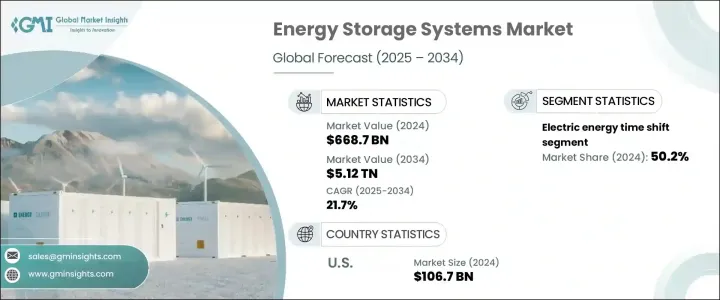
The Global Energy Storage Systems Market, valued at USD 668.7 billion in 2024, is projected to expand at a CAGR of 21.7% between 2025 and 2034. The market is witnessing exponential growth as the global energy landscape continues to evolve toward sustainability and decarbonization. With nations committing to net-zero emissions and climate goals, energy storage systems (ESS) are emerging as critical infrastructure for enabling the widespread adoption of renewable energy. Governments and private sectors are investing heavily in innovative ESS technologies to overcome the intermittent nature of solar and wind power while ensuring grid stability and reliability.
The accelerating shift from fossil fuel-based power generation to clean energy sources has created a strong demand for storage solutions that can efficiently manage fluctuations in energy supply and demand. Rapid urbanization, industrialization, and growing electricity consumption worldwide are further fueling the need for advanced energy storage solutions, making them indispensable for modernizing aging grid infrastructure and ensuring uninterrupted energy access. Additionally, the rising integration of decentralized energy systems, such as rooftop solar and microgrids, is driving the need for localized energy storage to ensure optimized energy usage and cost efficiency.
| Market Scope | |
|---|---|
| Start Year | 2024 |
| Forecast Year | 2025-2034 |
| Start Value | $668.7 Billion |
| Forecast Value | $5.12 Trillion |
| CAGR | 21.7% |
Energy storage systems are essential for maintaining the balance between energy supply and demand, particularly as renewable energy sources like wind and solar continue to dominate new capacity additions worldwide. ESS technologies are instrumental in improving energy efficiency and addressing grid reliability challenges, providing stored energy during peak demand or emergencies. One of the most prominent technologies in this space is pumped hydro storage, which works by transferring water from a lower reservoir to a higher one during periods of excess energy generation and releasing it to generate electricity when needed. Pumped hydro offers significant long-duration storage capabilities and is key to integrating renewable power into national grids, making it a cornerstone of modern energy storage portfolios. As concerns over energy security and environmental sustainability rise, governments across the globe are introducing favorable policies and incentives that promote the development and deployment of advanced energy storage systems to reduce dependency on conventional fossil fuels and strengthen energy resilience.
The electric energy time-shift segment accounted for a dominant 50.2% market share in 2024, as the growing frequency of natural disasters such as hurricanes underscores the need for resilient and reliable energy backup systems. Furthermore, the rapid adoption of electric vehicles (EVs) worldwide is significantly increasing the demand for robust energy storage to support EV charging infrastructure and smarter energy management solutions. Government incentives encouraging the shift to eco-friendly transportation options are further boosting demand for efficient storage technologies that align with decarbonization goals.
The U.S. Energy Storage Systems Market alone reached USD 106.7 billion in 2024, driven by strong federal support for clean energy transitions and widespread solar power installations. Emerging economies, especially in Asia-Pacific, are witnessing soaring demand for cost-effective and advanced ESS solutions as they intensify efforts to transition to sustainable energy frameworks. Countries like China and India are taking proactive steps to enhance renewable integration with ESS, highlighting a global momentum toward large-scale energy storage adoption.
Table of Contents
Chapter 1 Methodology & Scope
- 1.1 Market definitions
- 1.2 Base estimates & calculations
- 1.3 Forecast calculation
- 1.4 Primary research & validation
- 1.4.1 Primary sources
- 1.4.2 Data mining sources
- 1.5 Market definitions
Chapter 2 Executive Summary
- 2.1 Industry synopsis, 2021 – 2034
Chapter 3 Industry Insights
- 3.1 Industry ecosystem
- 3.2 Regulatory landscape
- 3.3 Industry impact forces
- 3.3.1 Growth drivers
- 3.3.2 Industry pitfalls & challenges
- 3.4 Growth potential analysis
- 3.5 Porter's analysis
- 3.5.1 Bargaining power of suppliers
- 3.5.2 Bargaining power of buyers
- 3.5.3 Threat of new entrants
- 3.5.4 Threat of substitutes
- 3.6 PESTEL analysis
Chapter 4 Competitive landscape, 2024
- 4.1 Introduction
- 4.2 Strategic dashboard
- 4.3 Innovation & sustainability landscape
Chapter 5 Market Size and Forecast, By Technology, 2021 - 2034 (USD Million & MW)
- 5.1 Key trends
- 5.2 Pumped hydro
- 5.3 Electro-chemical
- 5.3.1 Lithium-ion
- 5.3.2 Sodium sulphur
- 5.3.3 Lead acid
- 5.3.4 Flow battery
- 5.3.5 Others
- 5.4 Electro-mechanical
- 5.4.1 Flywheel
- 5.4.2 CAES
- 5.5 Thermal
- 5.5.1 Water
- 5.5.2 Molten salt
- 5.5.3 PCM
- 5.5.4 Others
Chapter 6 Market Size and Forecast, By Application, 2021 - 2034 (USD Million & MW)
- 6.1 Key trends
- 6.2 Electric energy time shift
- 6.3 Electric supply capacity
- 6.4 Black start
- 6.5 Renewable capacity firming
- 6.6 Frequency regulation
- 6.7 Others
Chapter 7 Market Size and Forecast, By Region, 2021 - 2034 (USD Million & MW)
- 7.1 Key trends
- 7.2 North America
- 7.2.1 U.S.
- 7.2.2 Canada
- 7.2.3 Mexico
- 7.3 Europe
- 7.3.1 UK
- 7.3.2 France
- 7.3.3 Germany
- 7.3.4 Italy
- 7.3.5 Russia
- 7.3.6 Spain
- 7.4 Asia Pacific
- 7.4.1 China
- 7.4.2 Australia
- 7.4.3 India
- 7.4.4 Japan
- 7.4.5 South Korea
- 7.5 Middle East & Africa
- 7.5.1 Saudi Arabia
- 7.5.2 UAE
- 7.5.3 Turkey
- 7.5.4 South Africa
- 7.5.5 Egypt
- 7.6 Latin America
- 7.6.1 Brazil
- 7.6.2 Argentina
Chapter 8 Company Profiles
- 8.1 ABB
- 8.2 Abengoa S.A.
- 8.3 Burns & McDonnell
- 8.4 BYD Company Ltd.
- 8.5 CALMAC
- 8.6 Durapower Group
- 8.7 Exide Technologies
- 8.8 General Electric
- 8.9 Hitachi Energy Ltd.
- 8.10 Johnson Controls
- 8.11 LG Energy Solution
- 8.12 McDermott
- 8.13 Narada Power Source Co. Ltd
- 8.14 Panasonic Corporation
- 8.15 Samsung SDI Co., Ltd
- 8.16 SCHMID Group
- 8.17 Siemens
- 8.18 Sinohydro Corporation
- 8.19 Toshiba Corporation
- 8.20 Voith GmbH & Co. KGaA