

|
시장보고서
상품코드
1721406
전면 유리 열선 시장 : 기회, 성장 촉진요인, 산업 동향 분석 및 예측(2025-2034년)Heated Windshield Market Opportunity, Growth Drivers, Industry Trend Analysis, and Forecast 2025 - 2034 |
||||||

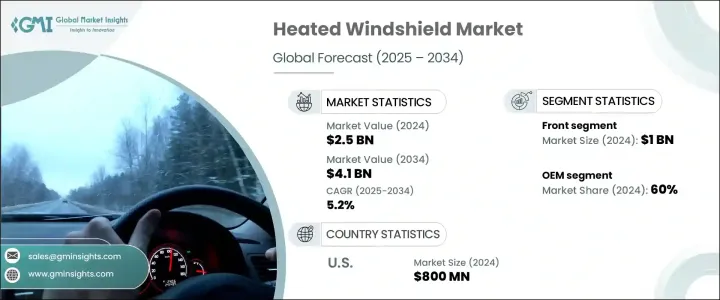
세계의 전면 유리 열선 시장 규모는 2024년 25억 달러로 평가되었고, 2034년에는 41억 달러에 이를 것으로 예측되며, CAGR 5.2%로 성장할 전망입니다. 이러한 성장은 주로 가시성 향상, 안전 기능 강화, 극한 기상 조건에서의 적응력 향상에 대한 소비자 수요 증가에 의해 주도되고 있습니다. 특히 추운 지역에서 날씨 예측이 어려워지면서 자동차 구매자들은 운전자의 안전과 편안함을 보장하는 기술을 더욱 중요하게 여기고 있습니다. 특히 열선 유리는 공조 시스템에 과부하를 주지 않으면서 얼음, 서리, 안개를 빠르게 제거할 수 있어 큰 주목을 받고 있습니다. 자동차 업계가 전기차와 고급 차량으로 빠르게 전환함에 따라 열선 유리 시스템은 에너지 효율과 첨단 운전자 보조 시스템(ADAS)을 지원하는 표준 기능이 되고 있습니다.
스마트 기능의 통합이 증가하고 차량 성능 향상에 대한 요구가 높아지면서 자동차 제조업체는 보다 안정적이고 내구성이 뛰어나며 에너지 효율적인 유리 기술에 투자하게 되었습니다. 또한 전도성 코팅과 내장형 발열체의 발전으로 경쟁 환경이 재편되고 OEM과 애프터마켓 채널 모두에서 구매 결정에 영향을 미치고 있습니다. 제조업체는 진화하는 규제 표준과 안전, 효율성, 지속 가능성에 대한 소비자의 기대에 부응하여 대응하고 있으며, 이는 예측 기간 동안 채택과 기술 혁신을 더욱 촉진할 것으로 예상됩니다.
| 시장 범위 | |
|---|---|
| 시작 연도 | 2024년 |
| 예측 연도 | 2025-2034년 |
| 시작 금액 | 25억 달러 |
| 예측 금액 | 41억 달러 |
| CAGR | 5.2% |
전면 유리 열선은 서리, 안개, 얼음이 쌓이는 것을 방지하여 악천후에도 선명한 시야를 확보할 수 있도록 설계되어 안전성을 높여줍니다. 이러한 솔루션은 빠른 성에 제거가 운전자의 편안함을 지원할 뿐만 아니라 ADAS의 원활한 작동을 보장하는 전기 및 프리미엄 차량에서 특히 중요합니다. 내장 와이어 및 투명 전도성 층과 같은 첨단 가열 기술을 통합하면 김서림 제거 속도가 빨라지고 마모에 대한 저항력이 높아지며 기존 공조 시스템에 대한 의존도가 줄어들어 열선 유리는 현대 차량에서 중요한 자산이 됩니다.
시장은 전면 유리와 후면 유리로 분류되며, 전면 유리는 2024년에 10억 달러로 평가되었습니다. 이는 주로 운전자의 시야를 유지하고 방해받지 않는 시야를 필요로 하는 ADAS 구성 요소를 지원하는 역할에 기인합니다. 후방 열선 유리는 특히 후진 시 후방 시야가 중요한 차량 및 상용차에서 수요가 증가하고 있습니다. 그러나 후방 열선 유리의 채택률은 여전히 전면 유리에 비해 뒤처져 있습니다.
판매 채널별로 시장은 주문자 상표 부착 생산(OEM)과 애프터마켓으로 나뉩니다.
미국의 열선 유리 시장은 전기 및 고급 차량의 채택 증가와 첨단 안전 기술에 대한 수요에 힘입어 2024년 8억 달러에 달할 것으로 예상됩니다. 미국 자동차 제조업체들은 에너지 절약과 뛰어난 가시성에 대한 소비자의 요구를 해결하기 위해 열선 유리 시스템을 적극적으로 도입하고 있습니다. 이러한 시스템은 HVAC 부하를 줄이고 최적의 성에 제거 성능을 보장함으로써 전기차의 배터리 효율을 보존하는 데 중추적인 역할을 합니다.
세계의 전면 유리 열선 분야를 선도하는 주요 기업으로는 일본판 유리, AGC, 후쿠요 유리, 가디언 유리, 폭스바겐, 필킨턴, 마그나, 산고반 세큐릿, 테슬라, 도요타 자동차 등이 이러한 기업들은 차세대 히팅 기술을 개발하기 위해 연구 개발에 많은 투자를 하고 있으며, 고급 자동차와 고성능 자동차 부문 수요 증가에 대응하기 위해 OEM과 전략적 파트너십을 맺고 있습니다.
목차
제1장 조사 방법과 범위
제2장 주요 요약
제3장 업계 인사이트
- 생태계 분석
- 공급업체의 상황
- 원자재 공급업체
- 부품 공급업체
- 제조업체
- 기술 공급업체
- 유통 채널 분석
- 최종 용도
- 이익률 분석
- 공급업체의 상황
- 기술 및 혁신 환경
- 특허 분석
- 규제 상황
- 비용 분석
- 주요 뉴스와 대처
- 영향 요인
- 성장 촉진요인
- 전기자동차의 보급 확대
- 스마트 유리 및 전도성 코팅의 발전
- 더 엄격한 안전 및 가시성 규정
- 상용차 부문의 확대
- 업계의 잠재적 위험 및 과제
- 높은 제조 및 교체 비용
- ADAS와 스마트 기능의 복잡한 통합
- 성장 촉진요인
- 성장 가능성 분석
- Porter's Five Forces 분석
- PESTEL 분석
제4장 경쟁 구도
- 소개
- 기업의 시장 점유율 분석
- 경쟁 포지셔닝 매트릭스
- 전략적 전망 매트릭스
제5장 시장 추계 및 예측 : 포지션별(2021-2034년)
- 주요 동향
- 전면
- 후면
제6장 시장 추계 및 예측 : 유리제(2021-2034년)
- 주요 동향
- 라미네이트
- 전도성 코팅 유리
- 강화
- 기타
제7장 시장 추계 및 예측 : 차량별(2021-2034년)
- 주요 동향
- 승용차
- 해치백
- 세단
- SUV
- 상용차
- 소형 상용차
- MCV
- HCV
제8장 시장추계 및 예측 : 판매 채널별(2021-2034년)
- 주요 동향
- 애프터마켓
- OEM
제9장 시장추계 및 예측 : 지역별(2021-2034년)
- 주요 동향
- 북미
- 미국
- 캐나다
- 유럽
- 독일
- 프랑스
- 영국
- 스페인
- 이탈리아
- 러시아
- 북유럽 국가
- 아시아태평양
- 중국
- 인도
- 일본
- 한국
- 호주 및 뉴질랜드
- 동남아시아
- 라틴아메리카
- 브라질
- 멕시코
- 아르헨티나
- 중동 및 아프리카
- 아랍에미리트(UAE)
- 남아프리카
- 사우디아라비아
제10장 기업 프로파일
- AGC
- BMW
- Corning
- Ford Motor
- Fuyao Glass
- General Motors
- Guardian Glass
- Hyundai Motors
- Magna
- Mercedes-Benz
- Nippon Sheet Glass
- Pilkington
- Saint-Gobain Sekurit
- Stellantis
- Tesla
- Toyota
- Volkswagen
- Volvo
- Webasto
- Xinyi Glass
The Global Heated Windshield Market was valued at USD 2.5 billion in 2024 and is estimated to grow at a CAGR of 5.2% to reach USD 4.1 billion by 2034. This growth is primarily driven by rising consumer demand for improved visibility, enhanced safety features, and increased adaptability in extreme weather conditions. As weather unpredictability intensifies, especially in colder regions, automotive buyers are placing greater importance on technologies that ensure driver safety and comfort. Heated windshields, in particular, are gaining significant attention due to their ability to rapidly clear ice, frost, and fog without overburdening the HVAC system. With the automotive industry witnessing a strong shift toward electric and luxury vehicles, heated windshield systems are becoming standard features that support energy efficiency and advanced driver assistance systems (ADAS).
The growing integration of smart features and the push for higher vehicle performance have prompted automakers to invest in more reliable, durable, and energy-efficient windshield technologies. Additionally, advancements in conductive coatings and embedded heating elements are reshaping the competitive landscape and influencing purchase decisions across both OEM and aftermarket channels. Manufacturers are responding by aligning with evolving regulatory standards and consumer expectations for safety, efficiency, and sustainability, which is expected to further drive adoption and technological innovation throughout the forecast period.
| Market Scope | |
|---|---|
| Start Year | 2024 |
| Forecast Year | 2025-2034 |
| Start Value | $2.5 Billion |
| Forecast Value | $4.1 Billion |
| CAGR | 5.2% |
Heated windshields are specifically designed to boost safety by eliminating the accumulation of frost, fog, and ice, thereby offering clear visibility in adverse weather. These solutions are especially important in electric and premium vehicles where fast defrosting supports not only driver comfort but also ensures the seamless functioning of ADAS. The incorporation of advanced heating technologies, such as embedded wires and transparent conductive layers, allows for faster defogging, greater resistance to wear, and reduced reliance on traditional climate control systems-making heated windshields a valuable asset in modern vehicles.
The market is categorized into front and rear windshields, with the front segment generating USD 1 billion in 2024. The prominence of this segment is largely attributed to its role in maintaining driver visibility and supporting ADAS components that require an unobstructed view. Rear heated windshields are also experiencing increased traction, especially in fleet and commercial vehicles, where rear visibility is critical during reversing. However, the adoption rate of rear windshields still trails that of the front segment.
In terms of sales channels, the market is divided between original equipment manufacturers (OEMs) and the aftermarket. OEMs accounted for 60% of the market share in 2024, largely due to the rising demand for factory-installed solutions in electric and high-end vehicles. These windshields are seamlessly integrated with ADAS and self-driving systems, ensuring top-tier performance even in harsh conditions.
The U.S. Heated Windshield Market reached USD 800 million in 2024, propelled by the growing adoption of electric and luxury vehicles, along with the demand for advanced safety technologies. U.S. automakers are actively implementing heated windshield systems to address consumer needs for energy savings and superior visibility. These systems play a pivotal role in preserving battery efficiency in EVs by reducing the HVAC load and ensuring optimal defrosting performance.
Key companies leading the global heated windshield space include Nippon Sheet Glass, AGC, Fuyao Glass, Guardian Glass, Volkswagen, Pilkington, Magna, Saint-Gobain Sekurit, Tesla, and Toyota Motor. These players are heavily investing in R&D to develop next-generation heating technologies and are forging strategic partnerships with OEMs to cater to the rising demand in luxury and high-performance vehicle segments.
Table of Contents
Chapter 1 Methodology & Scope
- 1.1 Research design
- 1.1.1 Research approach
- 1.1.2 Data collection methods
- 1.2 Base estimates & calculations
- 1.2.1 Base year calculation
- 1.2.2 Key trends for market estimation
- 1.3 Forecast model
- 1.4 Primary research and validation
- 1.4.1 Primary sources
- 1.4.2 Data mining sources
- 1.5 Market scope & definition
Chapter 2 Executive Summary
- 2.1 Industry 3600 synopsis, 2021 - 2034
Chapter 3 Industry Insights
- 3.1 Industry ecosystem analysis
- 3.1.1 Supplier landscape
- 3.1.1.1 Raw material providers
- 3.1.1.2 Component providers
- 3.1.1.3 Manufacturers
- 3.1.1.4 Technology providers
- 3.1.1.5 Distribution channel analysis
- 3.1.1.6 End use
- 3.1.2 Profit margin analysis
- 3.1.1 Supplier landscape
- 3.2 Technology & innovation landscape
- 3.3 Patent analysis
- 3.4 Regulatory landscape
- 3.5 Cost breakdown analysis
- 3.6 Key news & initiatives
- 3.7 Impact forces
- 3.7.1 Growth drivers
- 3.7.1.1 Increasing adoption in electric vehicles
- 3.7.1.2 Advancements in smart glass & conductive coatings
- 3.7.1.3 Stricter safety & visibility regulations
- 3.7.1.4 Expansion in the commercial vehicle segment
- 3.7.2 Industry pitfalls & challenges
- 3.7.2.1 High manufacturing & replacement costs
- 3.7.2.2 Complex integration with ADAS & smart features
- 3.7.1 Growth drivers
- 3.8 Growth potential analysis
- 3.9 Porter’s analysis
- 3.10 PESTEL analysis
Chapter 4 Competitive Landscape, 2024
- 4.1 Introduction
- 4.2 Company market share analysis
- 4.3 Competitive positioning matrix
- 4.4 Strategic outlook matrix
Chapter 5 Market Estimates & Forecast, By Position, 2021 - 2034 ($Mn, Units)
- 5.1 Key trends
- 5.2 Front
- 5.3 Rear
Chapter 6 Market Estimates & Forecast, By Glass, 2021 - 2034 ($Mn, Units)
- 6.1 Key trends
- 6.2 Laminated
- 6.3 Conductive coated glass
- 6.4 Tempered
- 6.5 Others
Chapter 7 Market Estimates & Forecast, By Vehicle, 2021 - 2034 ($Mn, Units)
- 7.1 Key trends
- 7.2 Passenger cars
- 7.2.1 Hatchback
- 7.2.2 Sedan
- 7.2.3 SUV
- 7.3 Commercial vehicle
- 7.3.1 LCV
- 7.3.2 MCV
- 7.3.3 HCV
Chapter 8 Market Estimates & Forecast, By Sales Channel, 2021 - 2034 ($Mn, Units)
- 8.1 Key trends
- 8.2 Aftermarket
- 8.3 OEM
Chapter 9 Market Estimates & Forecast, By Region, 2021 - 2034 ($Mn, Units)
- 9.1 Key trends
- 9.2 North America
- 9.2.1 U.S.
- 9.2.2 Canada
- 9.3 Europe
- 9.3.1 Germany
- 9.3.2 France
- 9.3.3 UK
- 9.3.4 Spain
- 9.3.5 Italy
- 9.3.6 Russia
- 9.3.7 Nordics
- 9.4 Asia Pacific
- 9.4.1 China
- 9.4.2 India
- 9.4.3 Japan
- 9.4.4 South Korea
- 9.4.5 ANZ
- 9.4.6 Southeast Asia
- 9.5 Latin America
- 9.5.1 Brazil
- 9.5.2 Mexico
- 9.5.3 Argentina
- 9.6 MEA
- 9.6.1 UAE
- 9.6.2 South Africa
- 9.6.3 Saudi Arabia
Chapter 10 Company Profiles
- 10.1 AGC
- 10.2 BMW
- 10.3 Corning
- 10.4 Ford Motor
- 10.5 Fuyao Glass
- 10.6 General Motors
- 10.7 Guardian Glass
- 10.8 Hyundai Motor
- 10.9 Magna
- 10.10 Mercedes-Benz
- 10.11 Nippon Sheet Glass
- 10.12 Pilkington
- 10.13 Saint-Gobain Sekurit
- 10.14 Stellantis
- 10.15 Tesla
- 10.16 Toyota
- 10.17 Volkswagen
- 10.18 Volvo
- 10.19 Webasto
- 10.20 Xinyi Glass


