|
시장보고서
상품코드
1721469
협동 로봇 시장 기회, 성장 촉진요인, 산업 동향 분석 및 예측(2025-2034년)Collaborative Robots Market Opportunity, Growth Drivers, Industry Trend Analysis, and Forecast 2025 - 2034 |
||||||

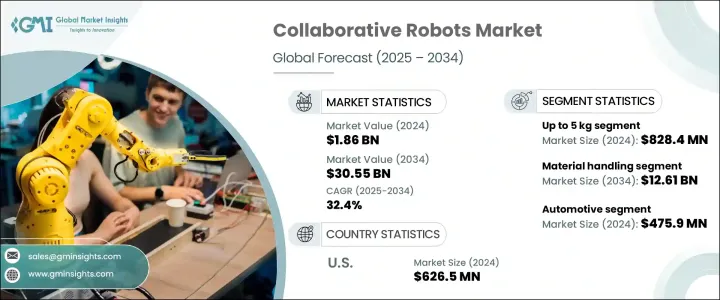
세계의 협동 로봇 시장 규모는 2024년 18억 6,000만 달러로 평가되었고, CAGR 32.4%를 나타내 2034년에는 305억 5,000만 달러에 이를 것으로 예측되고 있습니다. 근로자의 안전성 향상을 우선하는 동안 협동 로봇(통칭 코봇)은 업무 최적화를 목표로 하는 기업에게 선호되는 솔루션이 되고 있습니다.

Industry 4.0의 원칙이 받아들여지고 있는 가운데, 기업은 코봇을 AI, IoT, 머신러닝 기술과 통합하여 시장 수요 변화에 민첩하게 대응하는 스마트 공장을 구축하는 움직임이 가속화되고 있습니다. 디지털 변환 동향은 기존 워크플로우를 재구성할 뿐만 아니라 코봇을 노동력 부족에 대처하고 반복적이고 위험한 작업을 간소화하는 중요한 도구로 자리매김하고 있습니다. 게다가 중소기업(SME)이 세계 시장에서 경쟁력을 유지하려고 하고 있는 가운데, 다운타임을 삭감하고 시장 투입까지의 시간을 단축하기 위해 적당한 가격으로 사용하기 쉬운 로봇 솔루션을 채용하게 되었습니다. 스마트 매뉴팩처링 이니셔티브에 대한 정부의 지원은 휴먼 머신 인터페이스(HMI) 시스템의 혁신과 함께 각 업계에서 cobot 도입의 기세에 계속 박차를 가하고 있습니다.
| 시장 범위 | |
|---|---|
| 시작 연도 | 2024년 |
| 예측 연도 | 2025-2034년 |
| 시작 금액 | 18억 6,000만 달러 |
| 예측 금액 | 305억 5,000만 달러 |
| CAGR | 32.4% |
페이로드 용량의 관점에서 시장은 5kg까지, 5-10kg, 10-25kg, 25kg 이상의 카테고리로 구분됩니다. 이러한 코봇은 조립, 품질 검사, 포장 등의 경작에 널리 채용되고 있어 자동화를 목표로 하는 중소기업에 매우 적합합니다.
협동 작업 로봇은 자재관리, 용접, 납땜, 디스펜싱, 조립, 분해, 가공 등 다양한 용도로 도입되고 있습니다. 코봇은 피킹, 포장, 팔레타이징 등의 기능을 자동화하여 물류와 창고 관리의 효율성을 높입니다.
미국의 협동 로봇 시장은 2024년에 6억 2,650만 달러에 이르렀으며, 자동화 기술 혁신의 주도권을 반영하고 있습니다.
주요 기업으로는 Universal Robots A/S, ABB, FANUC America Corporation, KUKA AG, Yaskawa America, Inc. 등이 있으며, 모두 AI 통합, 경쟁력 있는 가격 전략, 신흥 시장에서의 사업 확대에 투자를 계속해 세계의 발자취를 강화하고 있습니다.
목차
제1장 조사 방법과 범위
제2장 주요 요약
제3장 업계 인사이트
- 생태계 분석
- 업계에 미치는 영향요인
- 성장 촉진요인
- 생산성과 업무 효율 향상의 필요성
- 직장의 안전과 규정 준수에 대한 관심 증가
- 다양한 업계에서 노동력 부족이 증가
- Industry 4.0의 급속한 성장
- 업계의 잠재적 위험 및 과제
- 고액의 자본 투자
- 신흥 국가의 낮은 도입률
- 성장 촉진요인
- 성장 가능성 분석
- 규제 상황
- 기술 환경
- 향후 시장 동향
- 갭 분석
- Porter's Five Forces 분석
- PESTEL 분석
제4장 경쟁 구도
- 서론
- 기업 시장 점유율 분석
- 주요 시장 기업의 경쟁 분석
- 경쟁 포지셔닝 매트릭스
- 전략 대시보드
제5장 시장 추계·예측 : 페이로드별(2021-2034년)
- 주요 동향
- 최대 5kg
- 5-10kg
- 10-25kg
- 25kg 이상
제6장 시장 추계·예측 : 용도별(2021-2034년)
- 주요 동향
- 자재 취급
- 조립 및 분해
- 용접 및 납땜
- 디스펜싱
- 가공
- 기타
제7장 시장 추계·예측 : 최종 이용 산업별(2021-2034년)
- 주요 동향
- 자동차
- 일렉트로닉스
- 금속 및 가공
- 플라스틱 및 폴리머
- 식품 및 음료
- 가구 및 장비
- 헬스케어
- 물류
- 기타
제8장 시장 추계·예측 : 지역별(2021-2034년)
- 주요 동향
- 북미
- 미국
- 캐나다
- 유럽
- 독일
- 영국
- 프랑스
- 스페인
- 이탈리아
- 네덜란드
- 아시아태평양
- 중국
- 인도
- 일본
- 호주
- 한국
- 라틴아메리카
- 브라질
- 멕시코
- 아르헨티나
- 중동 및 아프리카
- 사우디아라비아
- 남아프리카
- 아랍에미리트(UAE)
제9장 기업 프로파일
- Universal Robots A/S
- ABB
- FANUC America Corporation
- KUKA AG
- Yaskawa America, Inc.
- Techman Robot Inc.
- Doosan Robotics Co.,Ltd.
- Rethink Robotics
- DENSO WAVE INCORPORATED
- OMRON Corporation
- Hanwha Group
- Staubli International AG
- ROBOTICS TECHNOLOGY CO., LTD
The Global Collaborative Robots Market was valued at USD 1.86 billion in 2024 and is estimated to grow at a CAGR of 32.4% to reach USD 30.55 billion by 2034. This remarkable growth trajectory reflects the rising emphasis on intelligent automation and the evolving role of human-robot collaboration in modern manufacturing environments. As industrial sectors prioritize enhanced productivity, cost efficiency, and workforce safety, collaborative robots-commonly known as cobots-are becoming a preferred solution for businesses seeking to optimize their operations. These robots are engineered to operate safely alongside human workers, offering flexibility, adaptability, and precision in dynamic production lines.
With the growing acceptance of Industry 4.0 principles, companies are increasingly integrating cobots with AI, IoT, and machine learning technologies to build smart factories that are agile and responsive to shifting market demands. The trend toward digital transformation is not only reshaping traditional workflows but also positioning cobots as a vital tool for addressing labor shortages and streamlining repetitive or hazardous tasks. Moreover, as small and medium-sized enterprises (SMEs) look to stay competitive in the global marketplace, they are embracing affordable and user-friendly robotic solutions to reduce downtime and accelerate time-to-market. Government support for smart manufacturing initiatives, alongside innovations in human-machine interface (HMI) systems, continues to fuel the momentum behind cobot deployment across industries.
| Market Scope | |
|---|---|
| Start Year | 2024 |
| Forecast Year | 2025-2034 |
| Start Value | $1.86 Billion |
| Forecast Value | $30.55 Billion |
| CAGR | 32.4% |
In terms of payload capacity, the market is segmented into up to 5 kg, 5-10 kg, 10-25 kg, and above 25 kg categories. The segment for robots with up to 5 kg payload capacity led the market, reaching a valuation of USD 828.4 million in 2024. These cobots are widely adopted for light-duty tasks such as assembly, quality inspection, and packaging, making them highly suitable for SMEs venturing into automation. Their compact footprint, low cost, and intuitive operation make them an attractive entry point for industries transitioning to automated processes.
Collaborative robots are deployed in various applications, including material handling, welding, soldering, dispensing, assembly, disassembly, and processing. Among these, the material handling segment is projected to generate USD 12.61 billion by 2034. Cobots enhance logistics and warehousing efficiency by automating functions like picking, packing, and palletizing. They integrate machine vision systems and advanced sensors that allow them to perform repetitive tasks with accuracy while ensuring worker safety.
The U.S. Collaborative Robots Market reached USD 626.5 million in 2024, reflecting its leadership in automation innovation. Companies in the U.S. are simplifying adoption by offering plug-and-play robotic systems that require minimal technical expertise, making automation accessible even to smaller businesses.
Key players include Universal Robots A/S, ABB, FANUC America Corporation, KUKA AG, and Yaskawa America, Inc., all of whom continue to invest in AI integration, competitive pricing strategies, and expansion across emerging markets to strengthen their global footprint.
Table of Contents
Chapter 1 Methodology and Scope
- 1.1 Market scope and definitions
- 1.2 Research design
- 1.2.1 Research approach
- 1.2.2 Data collection methods
- 1.3 Base estimates and calculations
- 1.3.1 Base year calculation
- 1.3.2 Key trends for market estimation
- 1.4 Forecast model
- 1.5 Primary research and validation
- 1.5.1 Primary sources
- 1.5.2 Data mining sources
Chapter 2 Executive Summary
- 2.1 Industry 3600 synopsis
Chapter 3 Industry Insights
- 3.1 Industry ecosystem analysis
- 3.2 Industry impact forces
- 3.2.1 Growth drivers
- 3.2.1.1 Need to enhance productivity and operational efficiency
- 3.2.1.2 Growing focus on workplace safety and compliance
- 3.2.1.3 Rising labor shortages across various industries
- 3.2.1.4 Rapid growth of Industry 4.0
- 3.2.2 Industry pitfalls and challenges
- 3.2.2.1 High capital investment
- 3.2.2.2 Low adoption rate in developing countries
- 3.2.1 Growth drivers
- 3.3 Growth potential analysis
- 3.4 Regulatory landscape
- 3.5 Technology landscape
- 3.6 Future market trends
- 3.7 Gap analysis
- 3.8 Porter’s analysis
- 3.9 PESTEL analysis
Chapter 4 Competitive Landscape, 2024
- 4.1 Introduction
- 4.2 Company market share analysis
- 4.3 Competitive analysis of major market players
- 4.4 Competitive positioning matrix
- 4.5 Strategy dashboard
Chapter 5 Market Estimates & Forecast, By Payload, 2021-2034 (USD Million & Units)
- 5.1 Key trends
- 5.2 Up to 5 kg
- 5.3 5-10 kg
- 5.4 10-25 kg
- 5.5 More than 25 kg
Chapter 6 Market Estimates & Forecast, By Application, 2021-2034 (USD Million & Units)
- 6.1 Key trends
- 6.2 Material handling
- 6.3 Assembling & dissembling
- 6.4 Welding & soldering
- 6.5 Dispensing
- 6.6 Processing
- 6.7 Others
Chapter 7 Market Estimates & Forecast, By End Use Industry, 2021-2034 (USD Million & Units)
- 7.1 Key trends
- 7.2 Automotive
- 7.3 Electronics
- 7.4 Metals & machining
- 7.5 Plastics & polymers
- 7.6 Food & beverages
- 7.7 Furniture & equipment
- 7.8 Healthcare
- 7.9 Logistics
- 7.10 Others
Chapter 8 Market Estimates and Forecast, By Region, 2021 – 2034 (USD Million & Units)
- 8.1 Key trends
- 8.2 North America
- 8.2.1 U.S.
- 8.2.2 Canada
- 8.3 Europe
- 8.3.1 Germany
- 8.3.2 UK
- 8.3.3 France
- 8.3.4 Spain
- 8.3.5 Italy
- 8.3.6 Netherlands
- 8.4 Asia Pacific
- 8.4.1 China
- 8.4.2 India
- 8.4.3 Japan
- 8.4.4 Australia
- 8.4.5 South Korea
- 8.5 Latin America
- 8.5.1 Brazil
- 8.5.2 Mexico
- 8.5.3 Argentina
- 8.6 Middle East and Africa
- 8.6.1 Saudi Arabia
- 8.6.2 South Africa
- 8.6.3 UAE
Chapter 9 Company Profiles
- 9.1 Universal Robots A/S
- 9.2 ABB
- 9.3 FANUC America Corporation
- 9.4 KUKA AG
- 9.5 Yaskawa America, Inc.
- 9.6 Techman Robot Inc.
- 9.7 Doosan Robotics Co., Ltd.
- 9.8 Rethink Robotics
- 9.9 DENSO WAVE INCORPORATED
- 9.10 OMRON Corporation
- 9.11 Hanwha Group
- 9.12 Staubli International AG
- 9.13 ROBOTICS TECHNOLOGY CO., LTD